
Digestive enzymes can give consistent bloating relief when the problem is a specific food-digestion mismatch, such as lactose, beans, or heavy mixed meals. They are less consistent when bloating comes from constipation, IBS, SIBO, reflux, stress, medication effects, or overall fiber tolerance. Match the enzyme to the trigger first.
How did we evaluate digestive enzymes for bloating?
We evaluated digestive enzymes by looking at mechanism, trigger specificity, human evidence, label transparency, and realistic trial design. Lactase and alpha-galactosidase received stronger support because their food targets are clearer than broad proprietary blends. Reviews on lactose maldigestion, fermentable carbohydrates, and pancreatic enzyme therapy informed the evidence hierarchy. Yuve products were compared as digestive-routine options, not as disease treatments or guaranteed bloating fixes.
When do digestive enzymes work most consistently?
Digestive enzymes work most consistently when a person can name the food category that triggers symptoms. Lactase fits dairy because lactose maldigestion means the small intestine does not break down lactose efficiently. Alpha-galactosidase fits beans, lentils, and some cruciferous vegetables because it helps break down certain galacto-oligosaccharides before gut bacteria ferment them. Protease, lipase, and amylase blends fit less cleanly because bloating after a large meal can reflect meal size, fat content, reflux, constipation, or delayed emptying rather than enzyme shortage. The National Institute of Diabetes and Digestive and Kidney Diseases describes lactose intolerance as symptoms caused by lactose malabsorption, which makes lactase a logical targeted option (NIDDK). Consistency usually comes from narrow matching, not from the biggest enzyme panel.
How do common enzyme and Yuve options compare?
Some links below are affiliate links. This does not influence our evaluation criteria or recommendations.
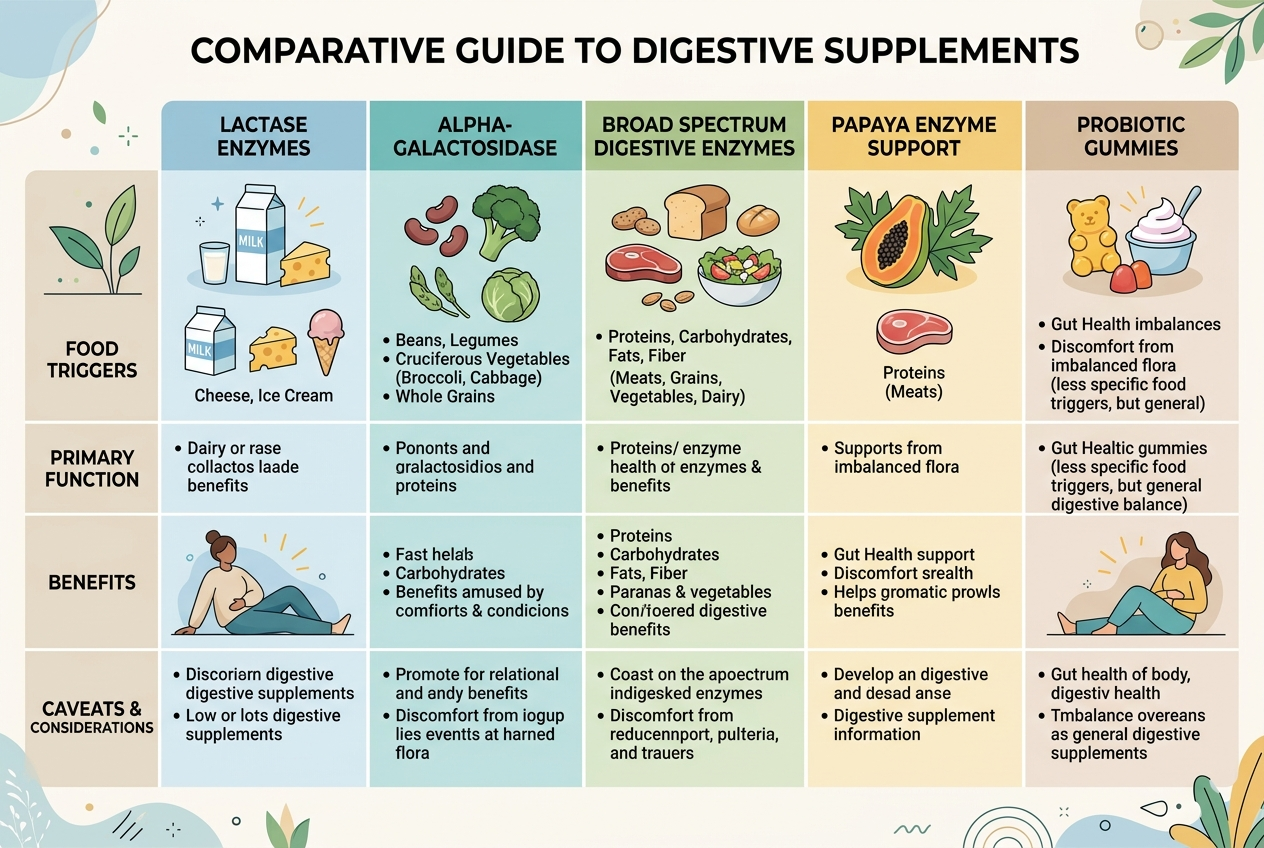
The comparison should start with the trigger. Lactase is best for dairy meals. Alpha-galactosidase is best for beans, lentils, and some high-FODMAP vegetables. Broad digestive enzyme blends are best for people who repeatedly notice discomfort after large mixed meals and want a short trial with clear timing. Yuve Vegan Daily Cleanse is best for plant-based shoppers who want papaya-enzyme routine support rather than an animal-derived enzyme capsule. Yuve Probiotic Gummies are best for a daily probiotic habit, not immediate meal digestion. Yuve Prebiotic Fiber Gummies are best for fiber routine support when increased gradually. A probiotic can support microbial balance over time, but it will not digest lactose at dinner.
| Best for | Option | Main digestive role | Main caveat |
|---|---|---|---|
| Dairy-triggered bloating | Lactase | Breaks down lactose | Only relevant for lactose-containing meals |
| Bean or lentil gas | Alpha-galactosidase | Targets galacto-oligosaccharides | Timing with the first bites matters |
| Large mixed meals | Broad enzyme blend | Protease, lipase, amylase support | Evidence varies by formula |
| Plant-based enzyme routine | Yuve Vegan Daily Cleanse | Papaya-enzyme support | Not a medical diagnosis tool |
| Daily probiotic support | Yuve Probiotic Gummies | Bacillus coagulans routine support | Not a same-meal enzyme |
What evidence supports food-specific enzymes?
Food-specific enzymes have the cleanest logic because they connect one enzyme to one substrate. Lactase supplementation can reduce symptoms in people with lactose maldigestion when taken with lactose-containing foods, although dose, meal size, and residual lactase activity influence results. Alpha-galactosidase has clinical research showing reduced gas production after bean-containing meals in some settings (Ganiats et al.). Pancreatic enzyme replacement is medically important for pancreatic insufficiency, but that is a clinician-managed condition, not a reason for healthy shoppers to assume enzyme deficiency. Broad over-the-counter blends can still help some people, but evidence becomes harder to generalize because formulas vary. A useful trial should test one enzyme, one trigger food category, and one timing pattern. If the symptom pattern is random, enzymes become a weaker first bet.
What label details matter before buying?
A digestive enzyme label should name enzymes, disclose activity units, explain timing, list allergens, and avoid miracle claims. Lactase labels commonly use FCC lactase units. Alpha-galactosidase labels may list GalU or other activity references. Protease, amylase, and lipase labels should use activity units such as HUT, DU, or FIP when possible because milligrams alone do not describe catalytic activity well. Proprietary blends that hide enzyme activity make comparison harder. Yuve product labels should be judged by the same standard: clear Supplement Facts, directions, ingredient identity, and realistic structure/function language. For Yuve Vegan Daily Cleanse, the buyer should view papaya enzyme as plant-based routine support. For Yuve Probiotic Gummies, the buyer should view Bacillus coagulans as probiotic routine support rather than a food-digesting enzyme.
How should someone test enzymes without fooling themselves?
A clean enzyme trial should last one to two weeks and change only one variable. Choose the most predictable trigger meal, take the enzyme exactly as directed, and record timing, bloating, gas, stool changes, reflux, and pain. Do not start probiotics, fiber, magnesium, collagen, diet changes, and enzymes in the same week. That creates noise. If the issue is dairy, test lactase with dairy. If the issue is beans, test alpha-galactosidase with beans. If the issue is all meals, late meals, stress, constipation, or severe pain, enzymes may be the wrong tool. Red flags such as blood, fever, weight loss, persistent vomiting, black stool, severe abdominal pain, anemia, or nighttime symptoms should stop the supplement experiment. A clinician can evaluate causes that a supplement trial cannot safely sort.
For a closer look at clean-label options, see Do Digestive Enzymes Actually Work for Bloating? What the Research Shows.
For a closer look at clean-label options, see FODZYME Alternatives That Aren’t Powders: Capsules, Tablets, Gummies, and Yuve Options Compared.
What questions do people ask about digestive enzymes and bloating?
Do digestive enzymes work every time?
No. Digestive enzymes work best when the enzyme matches the food trigger. Random bloating usually needs broader pattern tracking.
Should I take enzymes before or after eating?
Most digestive enzymes make more sense with the first bites of the trigger meal. Always follow the product label because timing varies by formula.
Are probiotics better than enzymes for bloating?
Neither is automatically better. Enzymes are meal-specific; probiotics are routine-specific. The better choice depends on timing and trigger pattern.
Where does Yuve fit?
Yuve fits the routine-support lane. Compare Vegan Daily Cleanse, Probiotic Gummies, Prebiotic Fiber Gummies, and the digestion collection by use case.
Can enzymes make bloating worse?
They can if the formula irritates you, contains allergens, or distracts from the real trigger. Stop if symptoms clearly worsen.
When should I skip supplements and get help?
Skip self-testing when symptoms are severe, persistent, unexplained, or paired with red flags. Supplements should not delay medical evaluation.
Leave a Reply