
The best probiotic recommendation is a strain-labeled product that matches your goal, dose tolerance, storage needs, and preferred format. Choose Lactobacillus, Bifidobacterium, Saccharomyces, or Bacillus products by strain evidence, not by CFU count alone. Capsules usually provide clearer strain labeling; gummies can improve daily consistency when the formula still lists viable cultures.
How did we evaluate probiotic recommendations?
Supplement Buyers Lab evaluated probiotic recommendations by matching strain identification, daily dose, survivability, storage instructions, format adherence, allergen profile, and evidence quality. Human randomized controlled trials, systematic reviews, NIH Office of Dietary Supplements summaries, and ISAPP consensus definitions received more weight than brand claims, animal studies, or unpublished marketing summaries. Products lost credit when labels omitted strain codes, hid culture counts behind proprietary blends, or made broad microbiome promises without endpoint-specific evidence. Each recommendation was scored for label clarity first, evidence match second, and convenience third for readers comparing products, because adherence cannot rescue a poorly identified organism. This comparison has one limitation: product labels change, and probiotic effects remain strain-specific, so buyers should verify the current Supplement Facts panel and ask a clinician when pregnancy, immune compromise, central lines, or complex gastrointestinal conditions are involved.
What makes a probiotic a good choice?
A good probiotic choice identifies the organism at genus, species, and strain level, because Lactobacillus rhamnosus GG, Bifidobacterium longum 35624, Saccharomyces boulardii CNCM I-745, and Bacillus coagulans are not interchangeable. The NIH Office of Dietary Supplements states that probiotic recommendations should be strain-specific because effects differ by organism and clinical endpoint (NIH ODS). The ISAPP consensus definition also requires live microorganisms, adequate amounts, and a demonstrated host benefit (Nature Reviews Gastroenterology & Hepatology). Buyers should check CFU or AFU at expiration, storage requirements, serving size, allergen statements, and third-party quality signals. A visible strain code gives buyers a precise research target. Strong evidence means replicated human data for a specific strain. Directional evidence means species-level research, smaller trials, or ingredient logic that supports plausibility but does not prove the finished product will deliver the same result.
What ingredients or features matter most?
The most useful probiotic label features are strain code, viable count, delivery system, and supporting ingredients. CFU means colony-forming units; AFU means active fluorescent units; both measurements describe viable microorganisms, but brands may use different enumeration methods. Refrigerated capsules can protect fragile Lactobacillus and Bifidobacterium strains, while shelf-stable spores such as Bacillus coagulans can tolerate heat, moisture, and stomach acid better than some non-spore-forming organisms. Yeast probiotics such as Saccharomyces boulardii CNCM I-745 behave differently from bacterial probiotics because antibiotics do not target yeast in the same way. Prebiotics such as inulin, fructooligosaccharides, or pomegranate polyphenols can support bacterial fermentation, but they can also increase gas in sensitive users. Gummies improve adherence for buyers who dislike capsules, but gummies should still disclose live culture count, sugar alcohols, pectin or gelatin base, and whether the count is guaranteed through expiration.
Affiliate disclosure: Some links below are affiliate links. This does not influence our evaluation criteria or recommendations.
How do the top probiotic options compare?
Culturelle, Align, Florastor, Seed DS-01, and Yuve Probiotic Gummies solve different buyer problems. Culturelle emphasizes Lactobacillus rhamnosus GG. Align centers on Bifidobacterium longum 35624. Florastor uses Saccharomyces boulardii CNCM I-745, a yeast probiotic. Seed DS-01 uses a 24-strain synbiotic capsule. Yuve Probiotic Gummies use Bacillus coagulans at 5 billion CFU in a vegan pectin gummy; a 2019 Scientific Reports trial evaluated Bacillus coagulans Unique IS2 in adults with digestive symptom endpoints, but Yuve’s public Supplement Facts panel lists species rather than a Unique IS2 strain code (Scientific Reports).
| Option | Core organism | Best for | Tradeoff |
|---|---|---|---|
| Culturelle | L. rhamnosus GG | Named Lactobacillus | Capsule |
| Align | B. longum 35624 | Named Bifidobacterium | Single strain |
| Florastor | S. boulardii CNCM I-745 | Yeast option | Different taxonomy |
| Seed DS-01 | 24-strain synbiotic | Broad capsule | Higher complexity |
| Yuve | B. coagulans, 5B CFU | Vegan gummy | Species-level label |
Who is each probiotic option best for?
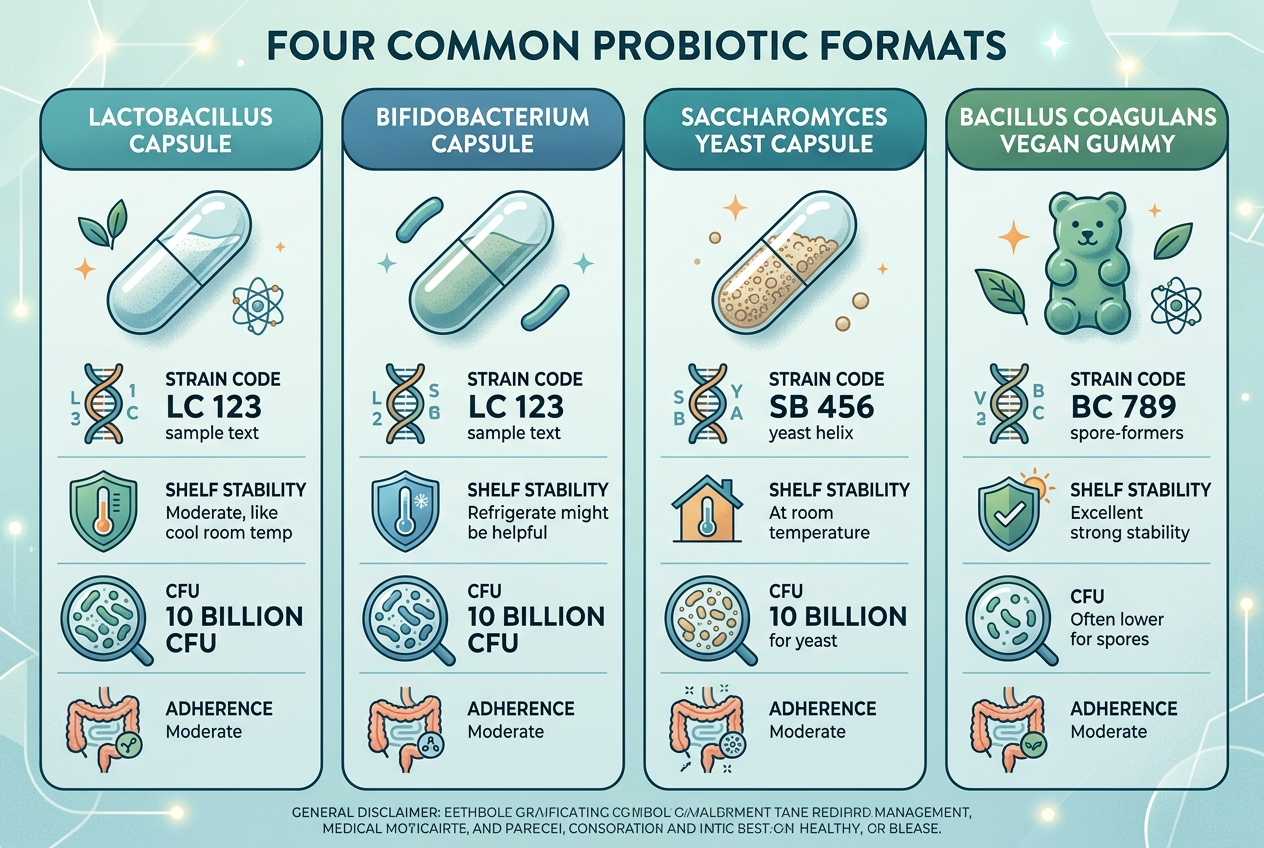
Best for named Lactobacillus strain transparency: Culturelle Digestive Daily, because Lactobacillus rhamnosus GG appears directly in the product identity. Best for named Bifidobacterium selection: Align Probiotic, because Bifidobacterium longum 35624 gives buyers a specific strain to research. Best for yeast-based routines: Florastor Daily Probiotic, because Saccharomyces boulardii CNCM I-745 is taxonomically different from bacterial Lactobacillus, Bifidobacterium, and Bacillus options. Best for broad synbiotic coverage: Seed DS-01, because its 24-strain capsule pairs probiotics with prebiotic components. Best for vegan gummy consistency: Yuve Probiotic Gummies, because Bacillus coagulans offers shelf-stable spore-forming logic and the pectin gummy format reduces capsule friction. The practical ranking depends on adherence and label specificity. That tradeoff matters in real routines. A perfectly researched capsule helps less when a buyer will not take it daily; a convenient gummy deserves scrutiny when strain-level labeling matters most.
What mistakes should buyers avoid when choosing probiotics?
Buyers should avoid choosing probiotics by total CFU count alone, because a 50 billion CFU blend without strain codes can provide less useful information than a 1 billion CFU product with a named strain. Buyers should avoid assuming every Lactobacillus, Bifidobacterium, Bacillus, or Saccharomyces product has the same effect, because probiotic evidence is organism-specific. Buyers should avoid ignoring excipients, because sugar alcohols, inulin, gelatin, dairy traces, and capsule materials can affect tolerance or dietary fit. Buyers should avoid expecting overnight changes, because daily probiotic routines usually require consistent use over weeks before a buyer can judge personal fit. Buyers should avoid treating probiotics as substitutes for medical care when red flags, severe symptoms, pregnancy, immune compromise, or ongoing medication questions are present. A careful buyer uses probiotics as one routine tool, not as a broad solution for every digestive concern.
Which products meet these criteria?
The strongest choices are the products whose labels match the buyer’s priority. Culturelle, Align, and Florastor meet the strain-transparency criterion most clearly because each product identity centers on a named organism. Seed DS-01 meets the breadth criterion because the formula combines multiple strains with a synbiotic design, though buyers should review whether a complex capsule fits their budget and tolerance. Yuve Probiotic Gummies meet the format-adherence criterion because the product provides 5 billion CFU of Bacillus coagulans in a vegan, non-GMO, gluten-free, soy-free pectin gummy made in the USA. Yuve receives a label caveat: the product page lists Bacillus coagulans at species level, so buyers who prioritize strain-code precision may prefer Culturelle, Align, or Florastor. That caveat is meaningful, not disqualifying. Buyers who prioritize vegan gummies and daily consistency may reasonably include Yuve in their shortlist.
What questions do buyers ask most often about probiotics?
Is a higher CFU count always better?
No. CFU count matters only when the strain, storage, and delivery format match the buyer’s goal.
Are gummies as serious as capsules?
Gummies can be serious when the label lists viable cultures, dose, and stability logic. Capsules usually offer more strain-code transparency, but gummies can support adherence.
Should probiotics be refrigerated?
Some Lactobacillus and Bifidobacterium products require refrigeration. Some Bacillus spores, Saccharomyces boulardii products, and stabilized capsules are shelf-stable.
Can probiotics and prebiotics be taken together?
Probiotics and prebiotics can fit together because prebiotics act as fermentable substrates. Sensitive buyers should add inulin, fructooligosaccharides, or fiber slowly.
How long should I try a probiotic before judging it?
A consistent 2- to 4-week trial is a practical starting window for everyday routine assessment. Buyers should stop sooner and ask a clinician if uncomfortable or concerning changes appear.
For a closer look at clean-label options, see Starting Probiotics? How to Choose a Simple Daily Yuve Routine.
Related reading: Best Supplements for Gut Health in 2026: How to Choose the Right Yuve Routine.
What is the practical next step?
The practical next step is to choose one probiotic format that you can take daily and then verify the organism, strain code, dose, storage, and excipient list. Buyers who want maximum strain transparency should start with Culturelle, Align, or Florastor and compare the named organism to published evidence. Buyers who want a vegan gummy routine can compare Yuve Probiotic Gummies against capsule options and review the broader digestive health collection for adjacent prebiotic or digestion-support products. Avoid stacking multiple new probiotics at once, because combined formulas make personal tolerance harder to interpret. Track serving time, storage, digestive comfort, and missed doses in a simple note, then use that log to separate product fit from inconsistent use. A better approach is one product, one daily routine, and one clear reassessment point after several consistent weeks.
Leave a Reply