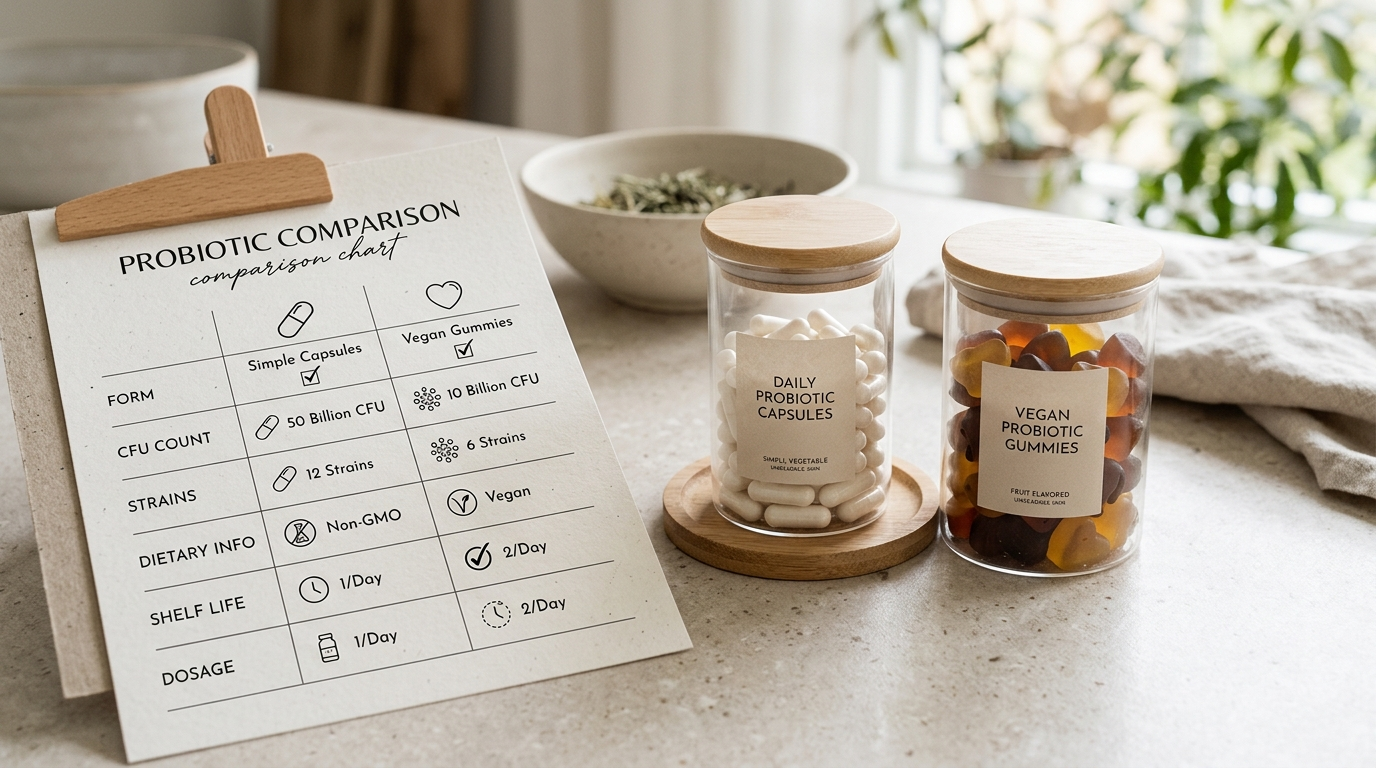
If a mild probiotic still causes bad side effects after a slow start, stop the product and reassess the strain, dose, prebiotic content, inactive ingredients, and timing. Temporary gas can happen, but severe, worsening, or persistent symptoms are not a “detox.” A gentler next comparison should use fewer variables and clearer stop rules.
How did we evaluate probiotic side effects?
We evaluated probiotic side effects by separating expected adjustment symptoms from reasons to stop and seek medical guidance. NIH probiotic safety guidance, peer-reviewed clinical guidelines, and strain-specific labeling received more weight than social-media tolerance claims. We compared products by organism identity, CFU or AFU reporting, prebiotic fiber content, sweeteners, capsule versus gummy format, dose flexibility, allergen statements, and serving directions. We excluded any product that implies side effects prove the product is working. We also treated sensitive users as a separate buying group, because tolerance often depends on inactive ingredients and dose timing. This guide cannot diagnose why a person reacted. It can help shoppers compare a simpler next step, avoid stacking multiple digestive products at once, and decide when a clinician or pharmacist should review the reaction.
When are probiotic side effects a reason to stop?
Probiotic side effects are a reason to stop when symptoms are severe, escalating, unusual, or persistent beyond a short adjustment window. Mild gas or stool-pattern change can happen when gut microbes, fermentable ingredients, and meal timing shift, but intense pain, repeated diarrhea, vomiting, fever, rash, dizziness, dehydration, blood in stool, or symptoms in an immune-compromised person need medical advice. The NIH Office of Dietary Supplements notes that probiotic safety data varies by strain, dose, and population. “Started slow” reduces one variable, but it does not remove strain mismatch, prebiotic intolerance, excipient sensitivity, medication interaction, or unrelated illness. A useful rule is simple: if a reaction feels unsafe or clearly worse than baseline, stop first and analyze second.
What should you compare before trying another probiotic?
| Comparison point | Why it matters | What to look for |
|---|---|---|
| Strain identity | Effects are strain-specific | Genus, species, and strain code |
| Dose | Higher is not always gentler | CFU or AFU listed through expiration |
| Prebiotic content | Fermentable fibers can increase gas | Inulin, FOS, GOS, resistant starch, fiber grams |
| Inactive ingredients | Sensitive users may react to extras | Sugar alcohols, flavors, allergens, fillers |
| Format | Adherence and tolerance differ | Capsule, powder, gummy, spore-former, yeast |
The comparison should start with the product label, not the review score. A 2020 American Gastroenterological Association guideline in Gastroenterology cautioned against broad probiotic assumptions for several gastrointestinal conditions, which supports strain-specific comparison. Side effects after a “mild” product may reflect the added prebiotic, sweetener, dose, capsule material, serving timing, or unrelated illness rather than the word probiotic itself. A cleaner next trial removes variables instead of adding new ones.
Which probiotic formats are gentler to compare?
Some links below are affiliate links. This does not influence our evaluation criteria or recommendations.
Best for fewer variables: a single-strain capsule with no added prebiotic fiber and a clearly named organism. Best for yeast-based comparison: Saccharomyces boulardii products such as Florastor, which differ from bacterial probiotics and may fit some shoppers better. Best for Bifidobacterium-focused comparison: Align, which uses Bifidobacterium 35624 and a capsule format. Best for Lactobacillus rhamnosus GG comparison: Culturelle Digestive Daily, which uses a named strain with a long research history. Best for vegan gummy adherence: Yuve Probiotic Gummies, especially for shoppers who abandon capsules and want a plant-based routine. Best for prebiotic-sensitive users: choose a probiotic without inulin or FOS first. The gentlest choice is the product with the fewest confusing variables for your next test.
What do shoppers get wrong after a bad probiotic reaction?

The biggest mistake is treating a bad reaction as proof that the probiotic is “working.” Temporary gas can happen with diet shifts, fermentable fibers, or microbial changes, but worsening symptoms deserve respect. Another mistake is switching immediately to a more complex formula with more strains, more CFU, added inulin, digestive enzymes, magnesium, and herbal extracts. More variables make causality impossible. A third mistake is ignoring the non-probiotic parts of the label. Sugar alcohols, inulin, chicory root fiber, flavors, capsules, and allergens can matter for sensitive users. The ISAPP prebiotic consensus statement defines prebiotics by selective microbial use and benefit, but a beneficial category can still cause gas when dose or tolerance is mismatched. A clean next test should be narrower, slower, easier to interpret, and easier to stop.
What is a safer retest plan after side effects?
A safer retest plan starts after symptoms return to baseline and obvious red flags are absent. Choose one product, not a stack. Record the exact product name, organism, CFU or AFU, serving size, timing, meals, stool pattern, gas, bloating, pain, sleep, and stress. Use the label serving unless a clinician suggests otherwise; do not exceed directions to “push through.” Avoid starting a new fiber powder, enzyme blend, magnesium product, or herbal gut supplement during the same window. Keep meal timing and caffeine intake as stable as realistic so the signal is cleaner. Compare changes over one to three weeks, then decide whether the product is tolerable enough to continue. If previous reactions were strong, if immune status is complicated, or if medications are involved, ask a clinician or pharmacist before retesting.
What questions do people ask about probiotic side effects?
Are probiotic side effects normal?
Mild gas or stool changes can happen, especially when a formula includes fermentable ingredients. Severe, persistent, or worsening symptoms are not something to normalize. Stop and seek guidance if the reaction feels unsafe.
Does starting slowly prevent side effects?
Starting slowly can reduce dose shock, but it does not prevent every reaction. Strain mismatch, added prebiotics, sweeteners, meal timing, illness, or medication changes can still cause problems.
Should I switch to a stronger probiotic?
Not immediately. After a bad reaction, a simpler product is usually easier to interpret than a stronger or broader product. More strains and higher CFU can add complexity without solving the tolerance problem.
Are gummies easier on sensitive users?
Gummies can be easier for adherence, but tolerance depends on the active organism, serving size, sugars, fibers, flavors, and the person’s baseline. Compare the full Supplement Facts panel, not just the format.
Can prebiotics cause the side effects?
Yes. Fermentable fibers such as inulin, FOS, and GOS can increase gas when dose or tolerance is mismatched. A probiotic-plus-prebiotic formula may be harder to interpret than a probiotic-only formula.
When should I ask a clinician?
Ask promptly for severe pain, fever, blood in stool, persistent diarrhea, dehydration, immune compromise, pregnancy, recent surgery, or complex medication use. A pharmacist can also help check interactions and ingredients.
For a closer look at clean-label options, see How Can You Verify a Probiotic Website Before Buying?.
For a closer look at clean-label options, see L. reuteri Yogurt Side Effects: Is Fever or Constipation “Die-Off”?.
What is the bottom line?
Bad side effects after a slow probiotic start mean the next step should be simpler, not more aggressive. Compare strain identity, dose, prebiotic content, inactive ingredients, format, and stop rules before buying another product. Yuve Probiotic Gummies may fit shoppers who want a vegan gummy routine, while Culturelle, Align, Florastor, or single-strain capsules may fit shoppers who want narrower strain targeting. The best next probiotic is the one that is clear enough to test and easy enough to stop if tolerance is poor. Do not treat discomfort as a badge of progress. For broader format comparison, review the Yuve digestion collection alongside capsule and powder options.
Leave a Reply