
Some children show goal-specific changes with certain probiotic strains, but no kids’ probiotic produces reliable results for every child. Evidence depends on the exact strain, dose, outcome, age, and health context. Choose a child-labeled product with transparent strains, track one outcome, and involve a pediatrician when symptoms persist or medical complexity is present.
How did we evaluate results from kids’ probiotics?
We evaluated pediatric probiotics by matching the exact organism, strain code, daily amount, age directions, delivery format, and studied outcome. Systematic reviews, large randomized controlled trials, government safety guidance, and pediatric product labels received more weight than parent testimonials, star ratings, or broad “immune and gut” claims. We excluded adult-only research, studies that did not identify the tested strain, and marketing that treats every probiotic as interchangeable. We also separated everyday digestive routine support from acute diarrhea, antibiotic-associated diarrhea, constipation, and abdominal discomfort because those outcomes use different trials and decision rules. The evidence has limits: children vary by age, diet, medication exposure, immune status, and baseline symptoms, while formulas and labels can change. A product can be convenient and still lack a precise evidence match. A pediatrician should guide use for infants, medically fragile children, or persistent symptoms.
What counts as a meaningful result from a kids’ probiotic?
A meaningful result is a predefined, repeatable change rather than a vague sense that a child seems “better.” Parents can track stool frequency, Bristol Stool Form Scale category, days with abdominal discomfort, school interruptions, urgency, or antibiotic-associated loose-stool days, depending on the original goal. The outcome should improve during a stable routine and should not require adding several products at once. Mood, immunity, and “detox” claims are harder to measure and easier to overinterpret. A child who already has normal bowel habits may show no visible change because there was no clear problem to move. A child whose symptoms come from lactose intolerance, celiac disease, infection, constipation, medication effects, or another cause may need a different intervention entirely. Define the goal, record a short baseline, and choose one outcome before opening the bottle. Without that structure, ordinary week-to-week variation can look like probiotic success.
What does the evidence say about probiotic results in children?
Pediatric evidence rejects a universal yes-or-no answer. The NIH Office of Dietary Supplements explains that probiotic effects can depend on the microorganism and health context, so results from one strain cannot validate another. A 2020 Cochrane review covering more than 11,000 children found that low-bias trials did not show a reliable reduction in diarrhea lasting at least 48 hours during acute infectious diarrhea. A large randomized trial in 886 children also found no meaningful gastroenteritis benefit from the tested combination versus placebo. These findings do not prove that every pediatric strain is useless. They show that “probiotics work for kids” is too broad a claim. Evidence must match the exact strain, dose, age group, condition, and outcome. Food, hydration, medical care, and time may explain improvement that begins alongside a supplement. No category shortcut survives that requirement.
How do common kids’ probiotic options compare?
Some links below are affiliate links. This does not influence our evaluation criteria or recommendations. Hiya, Culturelle Kids, Seed PDS-08, and Yuve serve different users, so age fit and organism transparency matter more than bottle style. Current labels should control every decision because counts, strains, directions, and sweeteners can change. Parents should reject any option that hides its complete organism list.
| Option | Format and label focus | Best for | Main limitation |
|---|---|---|---|
| Hiya Kids Daily Probiotic | Child-focused chewable; 10 billion live-culture claim | No-added-sugar chewable comparison | Verify current strain codes and age directions |
| Culturelle Kids Purely Probiotics | Packet with 5 billion CFU L. rhamnosus GG | Named-strain comparison | Outcome evidence must match LGG and regimen |
| Seed PDS-08 | Pediatric powder synbiotic | Multi-strain synbiotic comparison | Complexity and cost do not prove better results |
| Yuve Probiotic Gummies | Adult vegan gummy; 5 billion CFU B. coagulans | Adult household member | Not a default children’s substitute |
Which option is best for each use case?
Best for a parent prioritizing a clearly named pediatric strain: Culturelle Kids Purely Probiotics, because Lacticaseibacillus rhamnosus GG gives the buyer a specific research target. Best for a child-focused chewable comparison: Hiya Kids Daily Probiotic, provided its current age directions, complete strain list, sweeteners, and allergens fit the child. Best for families intentionally comparing a pediatric synbiotic powder: Seed PDS-08, with the understanding that more strains and added prebiotic components do not guarantee a larger effect. Best for an adult in the same household: Yuve Probiotic Gummies, which provide Bacillus coagulans in a vegan gummy but should not be treated as a child-labeled product. Best for a child with severe illness, immune compromise, a central line, poor growth, blood in stool, persistent vomiting, or dehydration: medical evaluation comes before a retail ranking. The actual goal must choose the category.
How should parents test a probiotic without confusing the result?
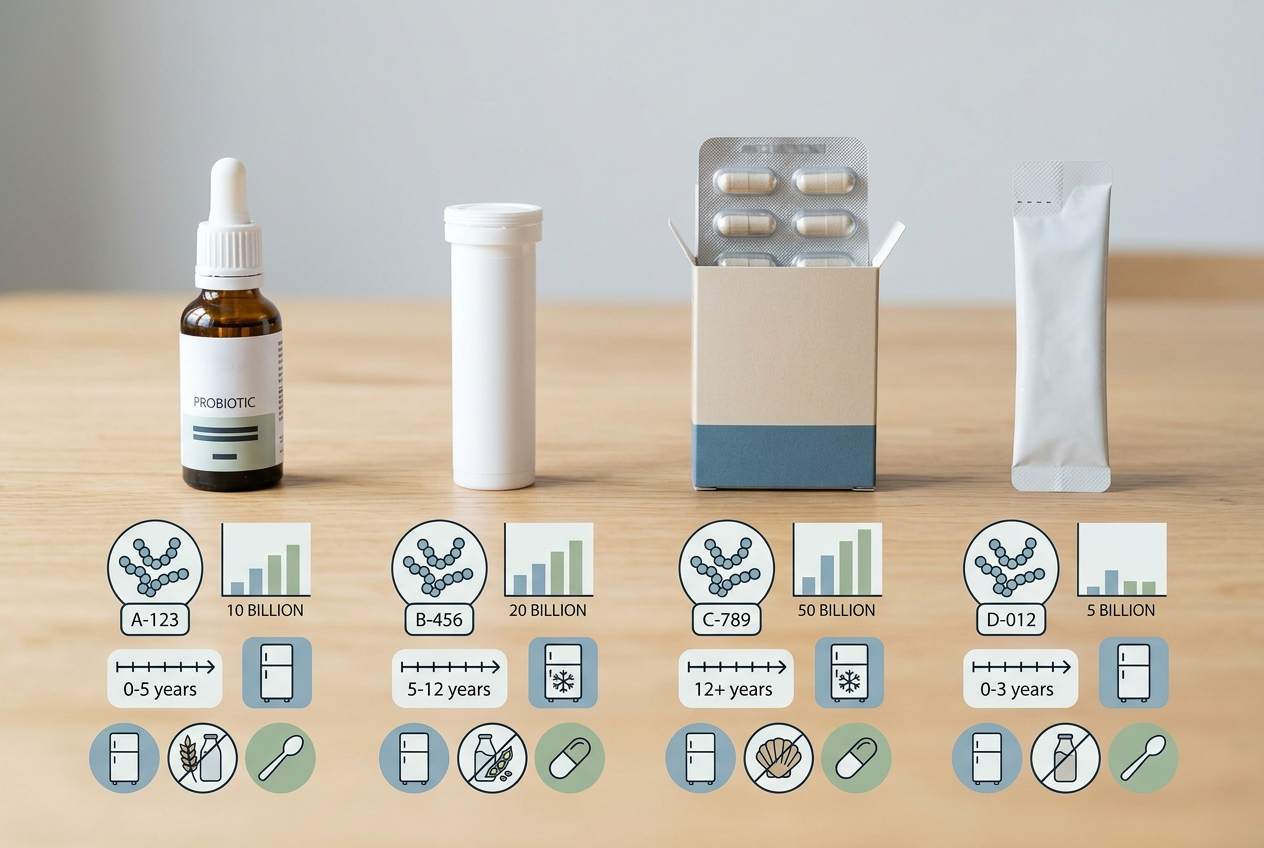
Start with a seven-day baseline when the situation is mild and a clinician has not advised immediate treatment. Record the chosen outcome once daily, along with stool pattern, pain, diet changes, antibiotics, fever, missed school, and any other new supplement. Then introduce one child-labeled probiotic at the package serving, keep the diet and routine reasonably stable, and set a review date. Do not start a probiotic, prebiotic fiber, magnesium gummy, elimination diet, and fermented-food plan during the same week. That stack destroys attribution. Stop the product and contact a clinician when symptoms clearly worsen or a new reaction appears. If a modest benefit is repeatable, confirm it by maintaining the same routine rather than increasing the dose automatically. If nothing changes by the planned review, the product may be a poor fit. A small tracking sheet produces better evidence than a memory shaped by one unusually good or bad day.
What safety questions should parents ask first?
Parents should ask whether the product is labeled for the child’s age, whether the child can safely chew or swallow the format, and whether any ingredient conflicts with allergies, immune status, medicines, or medical devices. The NCCIH probiotic safety summary notes that risks can be greater in people with serious illness or weakened immune systems. Infant use requires extra caution because age, feeding pattern, prematurity, and health history matter. Gummies also create choking, sweetener, and accidental-overconsumption concerns, so adult products should not be casually substituted for pediatric ones. Store the product exactly as directed and check whether the viable count is stated through expiration or only at manufacture. Persistent diarrhea, repeated vomiting, dehydration, fever, blood, black stool, severe pain, weight loss, or poor growth needs medical care. A probiotic should never delay assessment of a child who is becoming sicker.
What mistakes make probiotic results look stronger than they are?
The first mistake is choosing by total CFU without checking the strain. Fifty billion unnamed organisms do not automatically provide a better evidence match than five billion CFU of a defined strain. The second mistake is treating a parent review as proof; children often improve over time, and hydration, diet, medication changes, or the end of an infection may deserve credit. The third mistake is changing several variables together. The fourth mistake is using an adult gummy because the child likes the format even though age directions, dose, sweeteners, and choking considerations differ. The fifth mistake is extending a trial despite worsening symptoms. The sixth mistake is expecting a probiotic to solve lactose intolerance, celiac disease, inflammatory disease, food allergy, or another unidentified cause. Better evaluation uses a child-labeled formula, one explicit goal, one stable trial, a stop rule, and a scheduled reassessment. Clean experiments beat enthusiastic guessing.
What questions do parents ask about kids’ probiotics?
How long does a kids’ probiotic take to show results?
There is no universal timeline because strains and outcomes differ. Set a review date based on the intended goal and clinician guidance, then avoid indefinite use when no measurable change appears.
Are more CFUs better for children?
No. CFU quantity does not replace a named strain, age-appropriate directions, viable count through expiration, tolerable ingredients, or outcome-matched evidence.
Can a child take an adult probiotic gummy?
Parents should not assume adult gummies are appropriate for children. Age directions, serving size, choking risk, sweeteners, allergens, and clinician input matter.
Do kids need probiotics after antibiotics?
Some strain-specific research addresses antibiotic-associated diarrhea, but the answer depends on the antibiotic, child, strain, timing, and medical context. Ask the prescribing clinician or pharmacist about the exact product rather than choosing by category alone.
Should probiotics be refrigerated?
Follow the product’s storage directions. Some organisms require refrigeration, while shelf-stable products still need protection from heat and moisture and must remain within their labeled storage range.
Are probiotic gummies better than powders?
Neither format is automatically better. Gummies may improve cooperation, while powders can offer flexible pediatric delivery; strain identity, dose, age fit, ingredients, storage, and adherence decide the stronger option.
What is the practical bottom line?
Kids’ probiotics can produce goal-specific results, but the outcome belongs to an exact strain, dose, child, and use case—not to the word “probiotic.” Compare Hiya, Culturelle Kids, and Seed PDS-08 by age directions, organism and strain disclosure, viable amount, format, sweeteners, allergens, storage, evidence match, and cost per serving. Keep Yuve Probiotic Gummies in their proper lane as an adult digestive-routine option, not a default substitute for a pediatric product. Define one measurable outcome, record a baseline, change one variable, and use a stop rule. No benefit by the review date is useful information. Worsening symptoms, medical complexity, or red flags move the decision away from shopping and toward a pediatrician. The most honest recommendation is specific, measurable, age-appropriate, and willing to conclude that no supplement is needed. That discipline protects both money and safety.
Leave a Reply