
A good supplement stack is short, evidence-matched, and easy to repeat. Rate it by asking whether each product has a clear job, a sensible dose, a third-party quality signal, and no overlap with another product. Probiotics, fiber, enzymes, minerals, and vitamins should solve different bottlenecks, not create a crowded routine.
How should you evaluate a supplement stack?
We evaluated supplement stacks by separating nutrition gaps, digestive-support goals, ingredient evidence, safety overlap, and adherence friction across probiotics, prebiotic fibers, enzymes, minerals, and daily multivitamins. Human clinical evidence, NIH Office of Dietary Supplements fact sheets, ISAPP probiotic guidance, and label-level details carried more weight than social-media stack screenshots or influencer routines. We excluded disease-treatment claims, megadose protocols, and products that need clinician supervision, because a public stack rating should stay inside general wellness, structure/function, and label-literacy boundaries for ordinary shoppers. We also weighted repeatability, medication-interaction caution, and dose transparency, because a perfect label does little when the routine is too annoying, risky, expensive, redundant, or confusing to use; the limitation is that no online stack review can replace labs, medication review, pregnancy guidance, or clinician care for persistent symptoms.
What makes a supplement stack worth keeping?
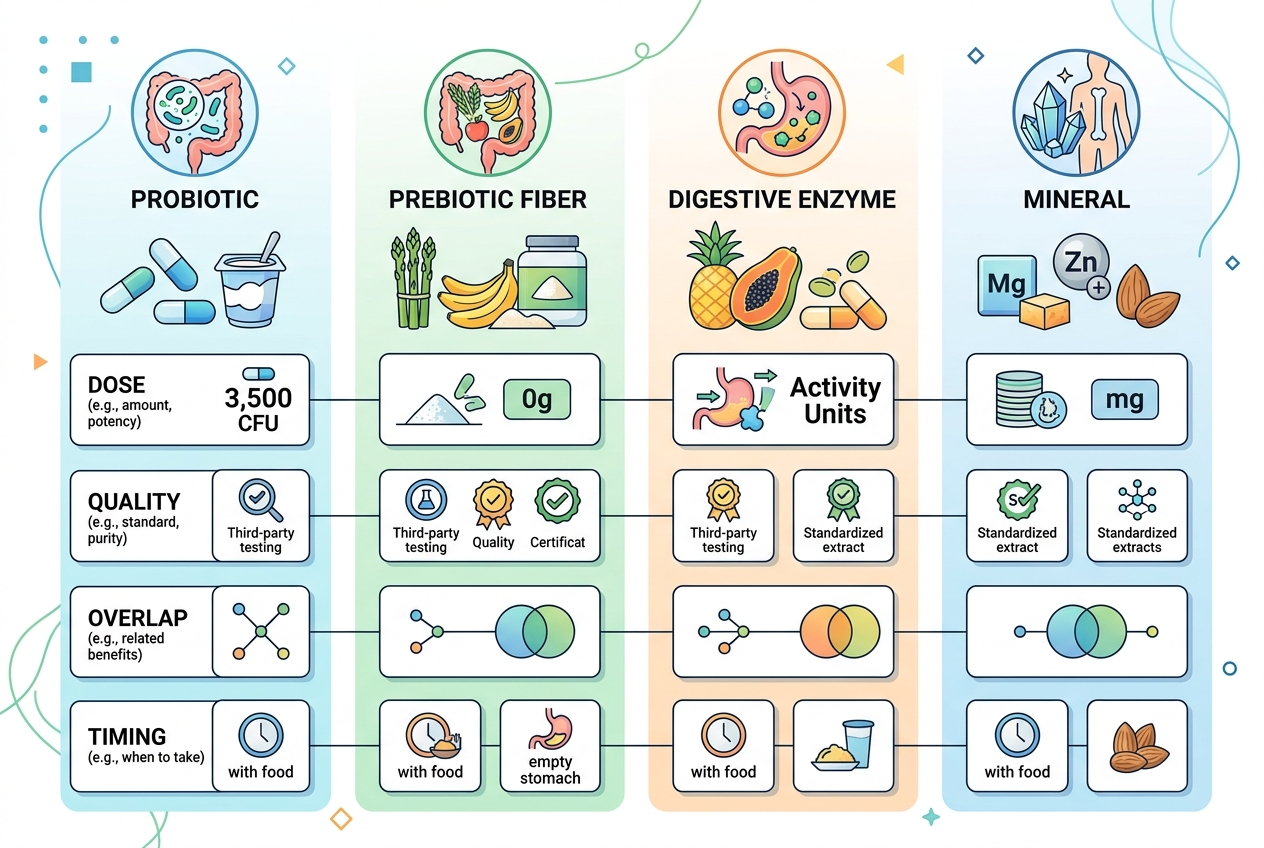
A supplement stack is worth keeping when every item answers one specific question. A probiotic should name the organism or strain, a fiber product should disclose grams of fiber per serving, a digestive enzyme should match the meal type, and a mineral should list the elemental dose. The NIH Office of Dietary Supplements explains that supplement labels can differ from drug labels because supplements are not preapproved for effectiveness by FDA before sale. That makes the stack audit practical: identify the job, check the dose, check quality signals, and remove duplicates. Two magnesium products, three gut powders, and a probiotic with no CFU-at-expiration statement usually add confusion before they add value. A cleaner stack often has one digestive-support product, one nutrient-gap product, and one habit anchor such as fiber, protein, or hydration that the person actually repeats.
How do common gut-support options compare?
Some links below are affiliate links. This does not influence our evaluation criteria or recommendations.
| Option | Best for | Key label check | Main caution |
|---|---|---|---|
| Yuve Probiotic Gummies | Routine-friendly probiotic use | Organism identity, serving size, vegan format | Gummies fit adherence, but probiotics need time and consistency |
| Culturelle Digestive Daily | Strain-recognized Lactobacillus rhamnosus GG comparison | LGG strain naming and CFU count | Capsules may not suit people avoiding pills |
| NOW Psyllium Husk | Soluble-fiber stool and fullness support | Fiber grams per serving and fluid instructions | Psyllium can worsen bloating if increased too fast |
| Digestive enzyme blends | Meal-specific protein, fat, or carbohydrate digestion support | Enzyme units such as FCC, HUT, FIP, or ALU | Generic blends may not match the trigger meal |
The best stack uses categories that do not duplicate each other. Yuve Probiotic Gummies fit someone who wants a low-friction probiotic habit, while psyllium fits someone whose stack lacks soluble fiber. Culturelle fits shoppers who prioritize Lactobacillus rhamnosus GG strain recognition. Enzyme blends fit meal-specific digestion questions, not a broad microbiome goal.
Which supplement should usually be rated first?
Best for routine adherence: the product you can take for 30 days without friction should be rated first, because inconsistent use makes label quality irrelevant. Best for gut microbiome support: a probiotic with named organisms, storage directions, and a realistic serving schedule deserves more confidence than a vague “gut blend.” The International Scientific Association for Probiotics and Prebiotics defines probiotics as live microorganisms that provide a health benefit when administered in adequate amounts, so “adequate amount” and organism identity matter. Best for stool-pattern support: psyllium, partially hydrolyzed guar gum, or food-based fiber often deserves review before another capsule. Best for meal heaviness: digestive enzymes deserve review only when the enzyme units match the foods being eaten. A stack with probiotic, fiber, enzyme, magnesium, multivitamin, and greens powder may look complete, but overlap often hides the actual lever.
What are the biggest stack mistakes?
The biggest stack mistake is changing too many variables at once. A person who starts probiotics, magnesium citrate, digestive enzymes, berberine, greens powder, and a new diet in the same week cannot identify which item caused better digestion, looser stool, reflux, nausea, or bloating. A 2018 review in Nutrients notes that probiotic effects are strain-specific and condition-specific, which means a broad “probiotic helped” conclusion is weaker than a matched organism, dose, and outcome. The second mistake is ignoring total daily dose across products. Magnesium from a sleep supplement plus magnesium from a multivitamin can quietly stack. The third mistake is trusting proprietary blends that hide ingredient amounts. The fourth mistake is adding gut products before checking meals, fiber intake, water, alcohol, caffeine, and medication timing. Boring variables often beat expensive clutter because they expose the signal.
How should you simplify a crowded supplement stack?
Simplify a crowded stack by assigning every product a keep, pause, or verify label. Keep products with a clear gap, measurable label, tolerable dose, and no duplication. Pause products that overlap another item, hide amounts in proprietary blends, or create side effects that mask the stack’s signal. Verify products that affect medication timing, pregnancy, bleeding risk, blood pressure, glucose, or chronic digestive symptoms with a clinician or pharmacist. For digestive support, a practical core might include one probiotic format, one fiber strategy, and one meal-specific enzyme only if meals justify it. Yuve’s digestive health collection illustrates category separation: probiotic gummies, prebiotic fiber gummies, lactase enzymes, and digestive enzyme products answer different questions. A clean stack should feel boring on paper. If the routine needs a spreadsheet to explain, the routine probably needs pruning before another product.
What questions come up when rating a supplement stack?
How many supplements are too many?
There is no universal number, but more than three to five daily products deserves a duplication check. The stronger question is whether each product has a separate job, a known dose, and a reason to stay after 30 days.
Should probiotics and prebiotic fiber be taken together?
They can be paired, but they do different jobs. Probiotics supply live microorganisms, while prebiotic fibers such as inulin, FOS, psyllium, and resistant starch feed or influence existing microbes.
Is a gummy supplement less serious than a capsule?
Format does not decide usefulness by itself. A gummy can be useful when the dose, organism identity, and routine adherence fit the goal, while a capsule can still be weak if the label is vague.
Should digestive enzymes be in every gut stack?
Digestive enzymes make the most sense when the label’s enzyme units match the meal pattern. A broad enzyme blend is less compelling when the real issue is low fiber, irregular meals, reflux triggers, or medication timing.
What is the safest way to test a new stack?
Change one variable at a time for at least one to two weeks unless a clinician gives different instructions. Track dose, timing, meals, stool pattern, bloating, sleep, and any new symptoms.
When should someone stop rating a stack online and ask a clinician?
Clinician guidance matters when symptoms include bleeding, unexplained weight loss, persistent vomiting, severe pain, trouble swallowing, pregnancy, medication interactions, or major bowel-habit changes. A supplement stack should support wellness, not delay evaluation.
Related reading: Can You Take Probiotics With Vitamins?.
Related reading: Can You Take Probiotics and Fiber at the Same Time?.
What is the bottom-line stack rating method?
Rate a supplement stack by clarity, evidence, dose transparency, quality signals, overlap, and adherence. A good stack has fewer moving parts than a flashy stack: one clear probiotic or fiber strategy, one targeted nutrient gap if needed, and one meal-specific support only when it matches the diet. Use named organisms, grams, CFU-at-expiration, enzyme units, and third-party testing language as evidence markers. Then test changes slowly, one product or dose change at a time, so the body’s response stays readable. A stack earns confidence when it improves consistency without adding confusion, side effects, or duplicate ingredients. If a product cannot explain its job in one sentence, it has not earned a permanent spot. If two products explain the same job, one of them probably belongs on pause until the routine is easier to read.
Image prompts:
- Hero image: Editorial flat lay of supplement bottles, probiotic gummies, fiber scoop, capsule organizer, checklist, water glass, and nutrition label on a clean neutral desk, bright natural light, no visible logos. Alt text: Supplement stack audit with gummies, capsules, fiber, checklist, and water.
- In-article image: Comparison-style layout showing four labeled supplement categories: probiotic, prebiotic fiber, digestive enzyme, and mineral, with simple label-callout cards for dose, quality, overlap, and timing. Alt text: Visual guide to comparing probiotic, fiber, enzyme, and mineral supplements.
Leave a Reply