
The best gut supplement depends on the pattern you are trying to support: probiotic strains for microbiome support, prebiotic fiber for stool regularity and fermentation, digestive enzymes for specific food breakdown, and peppermint oil for occasional abdominal discomfort. Start with one category, verify the exact ingredient and dose, and judge results over several weeks.
How did we evaluate gut supplements?
We evaluated gut supplements by matching each category to a specific use case, evidence type, and label requirement. Human randomized trials, peer-reviewed reviews, National Institutes of Health pages, and the International Scientific Association for Probiotics and Prebiotics received more weight than brand claims. We excluded products that rely on proprietary blends without strain names, fiber grams, enzyme activity units, or clear serving directions. We also separated everyday digestive-support claims from medical claims, because supplements cannot diagnose, treat, cure, or prevent disease. This comparison cannot decide whether a symptom needs medical care; it can help shoppers separate probiotic, prebiotic, enzyme, and comfort-support products before buying. The practical standard is simple: the product label should identify what the ingredient is, why the ingredient fits the use case, how the serving should be taken, and whether tolerance can be tracked.
What should you do first when choosing a gut supplement?
Choose the supplement category before choosing the brand. A probiotic product supplies live microorganisms, and the NIH Office of Dietary Supplements notes that effects are strain-specific rather than universal. A prebiotic fiber product supplies fermentable substrate, and the ISAPP consensus statement defines a prebiotic as a substrate selectively used by host microorganisms that confers a health benefit. Digestive enzymes support breakdown of targeted nutrients such as lactose, protein, or specific carbohydrates. Enteric-coated peppermint oil has clinical evidence for occasional IBS-type abdominal discomfort, but it can bother reflux-prone users. The practical first step is a pattern match: stool regularity points toward fiber, lactose timing points toward lactase, fermented-food gaps point toward probiotics, and meal-specific heaviness may point toward enzymes. One product should not be expected to cover every pattern, and one new supplement at a time gives the cleanest read on tolerance.
How do the main gut supplement options compare?
| Option | Best fit | Label checks | Main caveat |
|---|---|---|---|
| Probiotic strains | Microbiome routine support | Genus, species, strain, CFU at expiry | Benefits are strain-specific |
| Prebiotic fiber | Regularity and short-chain fatty-acid support | Fiber grams, fiber type, serving size | Too much too fast can increase gas |
| Digestive enzymes | Food-specific breakdown support | FCC lactase units, enzyme activity, timing | Works only when matched to the food |
| Peppermint oil | Occasional abdominal comfort | Enteric coating, dose, reflux warning | May aggravate heartburn |
The table matters because gut supplements are not interchangeable. A 2020 American Gastroenterological Association guideline in Gastroenterology found insufficient evidence to recommend probiotics broadly for several gastrointestinal conditions, which means strain and use case matter. A fiber gummy, capsule probiotic, lactase tablet, and peppermint softgel answer different questions. Shoppers comparing products should ask whether the active component is named, whether the serving amount is measurable, whether the timing makes biological sense, and whether the product matches the routine pattern being tracked. That filter removes vague “gut health” claims before price or flavor enters the decision.
Which products meet these criteria?
Some links below are affiliate links. This does not influence our evaluation criteria or recommendations.
Best for vegan gummy routine support: Yuve Vegan Probiotic Gummies fit shoppers who want a plant-based, gelatin-free daily format and prefer a low-friction routine. Verify the Supplement Facts panel for the exact microorganism name, serving size, and CFU before comparing it with capsules. Best for strain-specific capsule shoppers: Culturelle Digestive Daily uses Lactobacillus rhamnosus GG, a named strain with human research history. Best for Bifidobacterium-focused shoppers: Align uses Bifidobacterium 35624, a strain often discussed in digestive-comfort research. Best for yeast-based probiotic shoppers: Florastor uses Saccharomyces boulardii CNCM I-745. Best for fiber-first shoppers: Yuve Prebiotic Fiber Gummies, Benefiber, and psyllium products should be compared by fiber type, grams per serving, sweeteners, and tolerance. The strongest choice is the one whose label matches the pattern you are tracking.
What gets people in trouble with gut supplements?
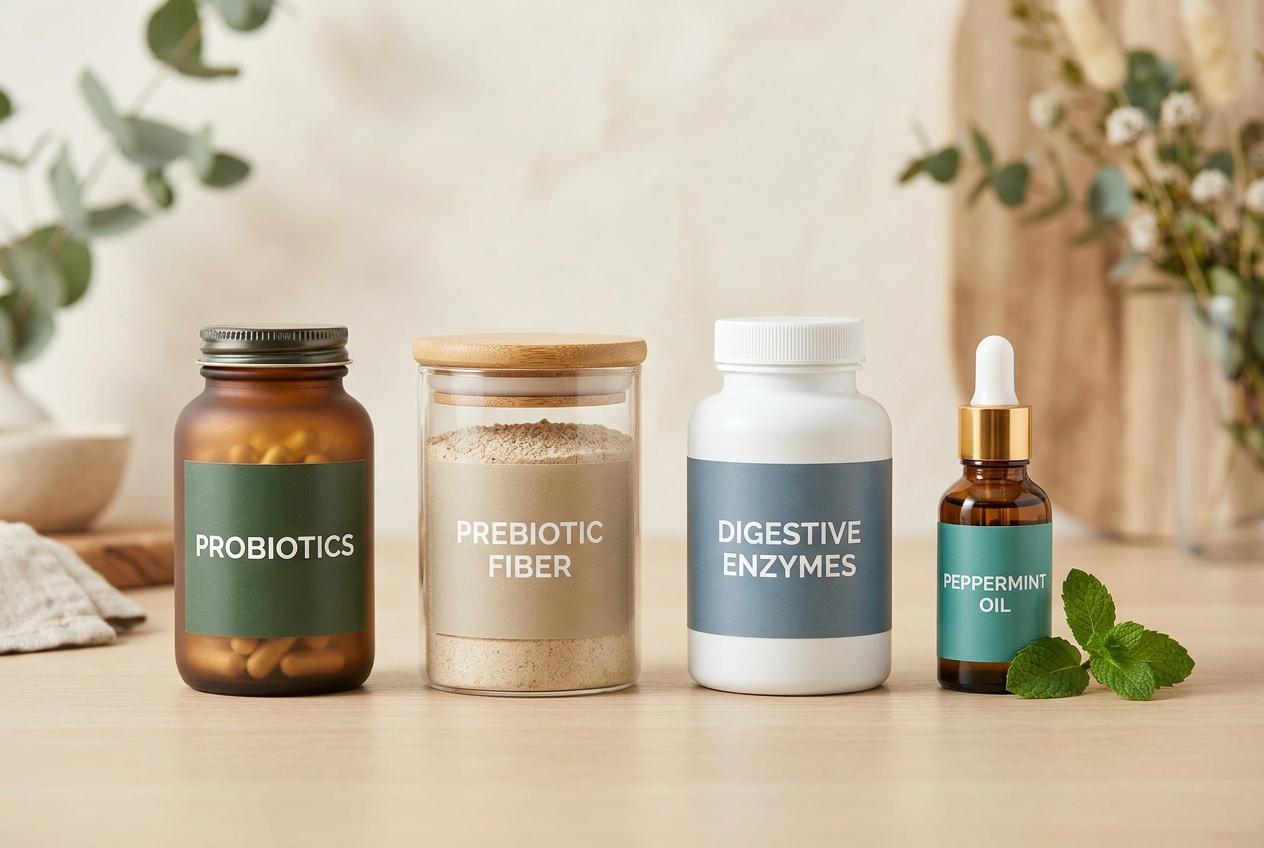
The biggest mistake is stacking categories before identifying a baseline. A person may start a probiotic, inulin fiber, magnesium, digestive enzymes, and peppermint oil in the same week, then have no clean way to connect a change to a product. Prebiotic fibers such as inulin can increase gas when the dose rises quickly, even though prebiotic fermentation can support beneficial microbial activity. Probiotics can also cause temporary changes in stool pattern or bloating for some users, and the NIH notes that safety data varies by strain and population. Enzymes are narrower: lactase supports lactose digestion only when taken with lactose-containing food, while protease or bromelain products do not replace a balanced meal pattern. Start one product, use the label serving, record timing and symptoms, and reassess after a defined window instead of chasing daily noise.
What is the best supplement by use case?
Best for low-friction daily microbiome support: a clearly labeled probiotic with named organisms and CFU listed through expiration. Best for regularity support: a prebiotic fiber or psyllium product with fiber grams stated per serving. Best for dairy timing: a lactase enzyme with FCC lactase units and directions tied to the first bite or sip of lactose-containing food. Best for protein-heavy meals: a digestive enzyme formula that lists activity units rather than only milligrams. Best for occasional abdominal comfort: enteric-coated peppermint oil, with reflux caution. Best for sensitive stomachs: a single-ingredient or low-ingredient product started at the label serving rather than a multi-ingredient stack. Best for vegan gummy shoppers: Yuve’s digestion collection gives probiotic, prebiotic, and enzyme formats to compare against capsule and powder options. Best for label-driven shoppers: products that avoid proprietary blends make dose comparisons easier.
What questions should shoppers ask before buying?
Should I take probiotics or prebiotics first?
Choose based on the pattern. Probiotics add live microorganisms, while prebiotics feed existing microorganisms. If stool regularity and fiber intake are low, prebiotic fiber may be the cleaner first test; if fermented foods are rare, a probiotic may be easier to evaluate.
Are more probiotic strains always better?
More strains are not automatically better. The NIH probiotics fact sheet emphasizes that probiotic effects are strain-specific, so a two-strain product with named organisms can be more transparent than a 20-strain blend without useful evidence.
How long should I test one supplement?
Use a defined test window, usually several weeks, unless the label or a clinician gives different guidance. Track serving size, timing, stool pattern, bloating, and meal context. Stop and seek medical guidance for severe, persistent, or alarming symptoms.
Can I combine fiber and probiotics?
Fiber and probiotics can be used in the same routine, but starting both at once makes tolerance harder to read. A slower sequence is easier: test the probiotic or fiber first, then add the second category after the baseline is clear.
Are gummies weaker than capsules?
Format does not decide quality by itself. Gummies, capsules, powders, and tablets should be compared by active ingredient, dose, stability, serving size, and third-party quality signals. Gummies can win on adherence when the label is transparent.
When are digestive enzymes the better choice?
Digestive enzymes make the most sense when the problem follows a specific food pattern. Lactase matches lactose, alpha-galactosidase matches certain fermentable carbohydrates, and papaya or bromelain enzyme products are broader meal-support tools rather than universal gut fixes.
For a closer look at clean-label options, see FODZYME Alternatives That Are Not Powders: Capsules, Gummies, and Yuve Enzymes Compared.
For a closer look at clean-label options, see Gut Health Supplements That Actually Do Something Real: What to Try First.
What is the bottom line?
Gut supplements work best as matched tools, not as a single category. Compare probiotics by strain transparency, prebiotic fiber by grams and fiber type, enzymes by activity units, and peppermint oil by coating and reflux suitability. The most reliable buying process is boring in a good way: identify the pattern, choose one category, read the Supplement Facts panel, use the label serving, and track the same signals for several weeks. If a product cannot explain its active ingredient, dose, timing, and use case, skip it. Shoppers with red-flag symptoms, pregnancy, immune compromise, or prescription medications should ask a clinician before experimenting. For plant-based shoppers, Yuve’s digestive health collection is a useful place to compare vegan probiotic, prebiotic, and enzyme formats against capsule and powder alternatives. The win is a cleaner decision, not a bigger stack.
Leave a Reply