
Probiotic supplements do not fully replace fermented foods, and fermented foods do not automatically replace a strain-specific probiotic. Foods provide nutrients, flavors, and sometimes diverse live microbes; supplements provide defined organisms and doses when labels are complete. Neither is required for everyone. Choose food for dietary variety and a supplement only for a clearly defined, evidence-matched goal.
How did we evaluate probiotics and fermented foods?
We prioritized the International Scientific Association for Probiotics and Prebiotics, NIH Office of Dietary Supplements, human randomized trials, and systematic reviews that identify the tested food or probiotic strain. We compared live-microbe identity, dose consistency, food-matrix nutrients, serving pattern, storage, dietary restrictions, clinical evidence, and label transparency. We excluded testimonials, microbiome “reset” claims, CFU rankings without strain context, and assumptions that every fermented food contains living organisms. Pasteurized products, baked sourdough, most beer, and some shelf-stable pickles remain fermented foods even when processing removes or kills the microbes. Probiotic effects can also be strain-specific, so a study of Lacticaseibacillus rhamnosus GG cannot validate every capsule or gummy. The evidence supports complementary roles rather than one-for-one replacement. Individual tolerance, cost, culture, allergies, medicines, and health status still determine whether either option belongs in a routine.
Why are probiotic supplements and fermented foods not interchangeable?
Fermented foods are made through controlled microbial growth and enzymatic conversion, while probiotics are live microorganisms that confer a demonstrated benefit when consumed in an adequate amount. The ISAPP fermented-food consensus explains that a fermented food does not need to contain live microbes at the time of eating and should not be called probiotic unless defined organisms have supporting evidence. Yogurt with live cultures, kefir, kimchi, tempeh, miso, and refrigerated fermented vegetables also differ in organisms, nutrients, salt, sugar, serving size, and heat treatment. A probiotic supplement can name a strain and CFU count, but it does not reproduce the protein, calcium, fiber, polyphenols, flavors, or meal context of food. Conversely, a serving of kimchi cannot be assumed to deliver Bifidobacterium longum 35624 or Saccharomyces boulardii CNCM I-745. The practical distinction is functional: food broadens the diet; a transparent supplement can target a specific evidence lane.
What can fermented foods add that a supplement cannot?
Fermented foods can contribute ordinary food nutrients and microbial metabolites alongside any living cultures that remain. Yogurt may supply protein and calcium, tempeh supplies protein and fiber, and fermented vegetables contribute plant compounds as well as substantial sodium in some recipes. A small randomized feeding study assigned healthy adults to high-fermented-food or high-fiber diets and followed the interventions for 17 weeks. The Cell study found increased microbiota diversity and lower levels of several inflammatory markers in the fermented-food group, but its sample size, intensive diet design, and biomarker outcomes do not prove that one jar or beverage produces a clinical benefit. Fermented-food intake can also be limited by dairy allergy, lactose tolerance, histamine sensitivity, sodium restrictions, alcohol, added sugar, availability, or personal preference. Best for dietary variety: several tolerated foods across meals. Best for predictable nutrients: compare Nutrition Facts panels. Best for live cultures: verify “live and active cultures” and avoid assuming that every fermented label guarantees viable organisms.
How do common probiotic options compare with food-first choices?
Some links below are affiliate links. This does not influence our evaluation criteria or recommendations. A food-first routine, Culturelle Digestive Daily, Align Probiotic, Florastor, and Yuve Probiotic Gummies solve different problems. Culturelle identifies LGG, Align identifies B. longum 35624, and Florastor identifies the yeast S. boulardii CNCM I-745, enabling strain-level research matching. Yuve lists 5 billion CFU of Bacillus coagulans per two-gummy serving and offers a vegan, capsule-free format; buyers should check the current label for a strain code before connecting it to strain-specific evidence. A systematic review and meta-analysis found evidence that probiotic efficacy is strain- and disease-specific, reinforcing why these organisms cannot be ranked as universal replacements for food. Storage and expiration also matter. Current retail formulas can change. Foods deliver a matrix rather than a standardized probiotic dose. The table compares selection logic, not guaranteed outcomes.
| Option | What it supplies | Best-fit use case | Main limitation |
|---|---|---|---|
| Live-culture fermented foods | Food nutrients plus variable cultures | Dietary variety and meal-based intake | Organisms and viable counts often vary |
| Culturelle Digestive Daily | L. rhamnosus GG | LGG-specific evidence matching | One strain does not replace food variety |
| Align Probiotic | B. longum 35624 | 35624-specific evidence matching | Goal fit depends on the studied outcome |
| Florastor | S. boulardii CNCM I-745 | Named probiotic yeast | Yeast differs from bacterial cultures |
| Yuve Probiotic Gummies | B. coagulans, 5 billion CFU | Vegan, capsule-free routine | Verify current label for strain identity |
Which option is best for each practical goal?
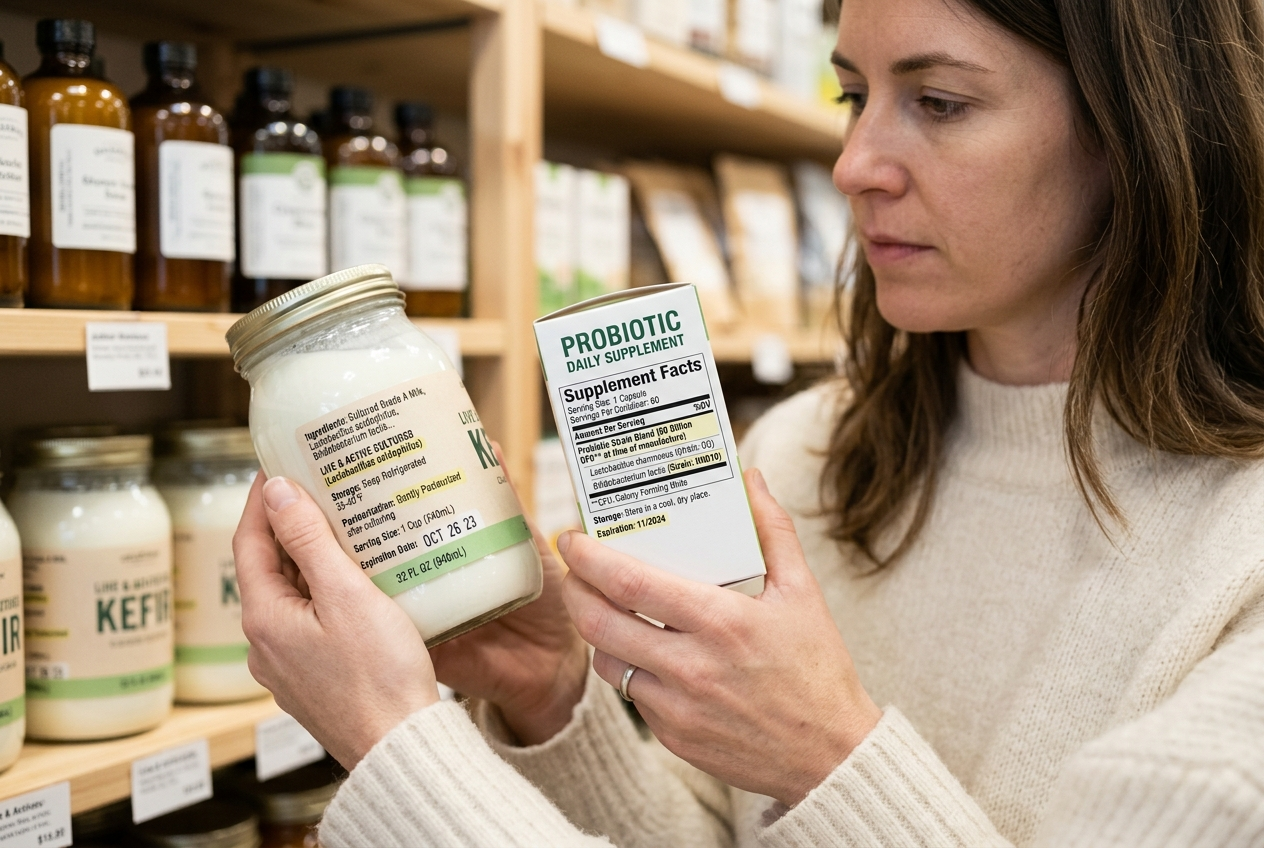
Best for building a varied diet: tolerated yogurt, kefir, tempeh, miso, or non-heated fermented vegetables incorporated as foods rather than medicines. Best for matching LGG research: Culturelle, provided the current label identifies L. rhamnosus GG and the intended outcome matches the evidence. Best for matching 35624 research: Align, with the same goal-and-dose verification. Best for a named probiotic yeast: Florastor with S. boulardii CNCM I-745. Best for a vegan gummy routine: Yuve Probiotic Gummies, while recognizing that convenience and 5 billion CFU do not establish a strain-specific outcome. Best for people who simply dislike fermented foods: no automatic deficiency needs correction; fiber-rich plants and a varied overall diet still matter. Best for persistent pain, blood in stool, fever, dehydration, unexplained weight loss, or prolonged bowel changes: clinical assessment rather than a retail substitution. “Best” describes fit for a defined use case, not universal superiority.
What should you look for on food and supplement labels?
For fermented foods, check whether the package states “live and active cultures,” whether the product was pasteurized after fermentation, and how much sodium, added sugar, protein, fiber, or alcohol a normal serving provides. “Fermented,” “pickled,” and “probiotic” are not interchangeable claims. For supplements, look for genus, species, strain designation, CFU per serving, viability through expiration, serving size, storage conditions, allergens, and other ingredients. The NIH Office of Dietary Supplements notes that higher CFU counts alone do not establish greater benefit and that recommendations should match a specific strain, dose, and use. Check whether a gummy adds sugar or sugar alcohols, whether a capsule contains dairy or gelatin, and whether a refrigerated product remained within its required temperature range. Transparent labels enable comparison; front-panel superlatives do not. Photograph the lot number and complete label before starting a time-bounded trial because formulas can change.
Can you use fermented foods and a probiotic together?
Many healthy adults can eat fermented foods while using a common probiotic, but combining them does not automatically create an additive benefit. The organisms, doses, and food matrices differ, and the finished combination may never have been studied. Introduce one change at a time when tolerance matters, especially if yogurt, kefir, kimchi, inulin, sugar alcohols, or large servings tend to increase gas or stool frequency. People with serious illness, compromised immune function, central venous catheters, recent major surgery, or complex medication regimens should ask a clinician before using live-microbial supplements. Fermented foods also require ordinary food-safety judgment; unpasteurized products and home ferments can carry risks when preparation, refrigeration, salt concentration, or acidity is inadequate. A structured approach creates cleaner information: keep the rest of the routine stable, use a normal food serving or labeled supplement serving, record the change, and reassess. More microbial products do not necessarily produce a better outcome.
What questions do people ask about replacing fermented foods?
Replacement questions often assume that fermented foods and probiotic supplements fill the same nutritional requirement. They do not. Fermented foods can contribute nutrients and food-matrix compounds, sometimes with variable live cultures, while supplements can provide specified organisms in a measured format. Neither category guarantees a broad microbiome change, permanent colonization, or relief from a symptom. Product selection also depends on dietary pattern, allergies, sodium, added sugar, format, strain identity, storage, and the outcome being tested. A person who does not eat kimchi or yogurt does not automatically need a probiotic, and a person who eats fermented foods does not automatically receive a clinically studied strain. The following answers use the narrowest evidence-supported interpretation. Choose normal foods for nutritional value and enjoyment; use a supplement only when its complete label and evidence fit a defined goal.
Do you need fermented foods for a healthy gut?
No single fermented food is required for digestive health. A varied diet with adequate fiber, protein, and micronutrients can support health even when yogurt, kefir, kimchi, miso, or tempeh are absent.
Does yogurt count as a probiotic?
Yogurt can contain live cultures, but “probiotic” properly requires defined organisms with evidence for a health benefit at an adequate amount. Check the culture statement and avoid assuming that every yogurt supplies a clinically studied probiotic strain.
Are refrigerated pickles always fermented?
No. Some pickles are acidified with vinegar rather than produced through microbial fermentation, while some fermented pickles are later pasteurized. The process and label determine whether live cultures remain.
Is a higher CFU supplement a better replacement?
No. CFU measures viable organisms, not food nutrients, strain relevance, or clinical effectiveness. A lower count of an evidence-matched strain can provide a clearer rationale than a high-count proprietary blend.
Can fermented foods permanently colonize the gut?
Most food-associated microbes appear transient rather than permanent residents. Temporary passage can still interact with the food matrix and existing microbiota, but permanent colonization should not be promised.
How long should you test one probiotic?
Use one product at its labeled serving for a goal-specific, time-bounded period informed by relevant research or a clinician. Stop and seek advice for concerning reactions, and do not extend an ineffective trial indefinitely.
For a closer look at clean-label options, see How to Tell Whether Store-Bought Fermented Foods Still Have Live Cultures.
For a closer look at clean-label options, see Do Store-Bought Fermented Foods Actually Have Probiotic Benefit?.
What is the bottom line on probiotics versus fermented foods?
Probiotic supplements do not recreate fermented foods, and fermented foods do not reliably deliver every evidence-backed probiotic strain. Choose yogurt, kefir, tempeh, miso, or fermented vegetables for their complete food value, provided the format fits allergies, sodium, sugar, alcohol, and personal tolerance. Choose a supplement only after defining the goal and verifying strain, CFU, serving size, expiration guarantee, storage, and other ingredients. Culturelle, Align, Florastor, and Yuve occupy different strain and format lanes; none universally replaces a varied diet or guarantees an outcome. People prioritizing a vegan, capsule-free format can review Yuve Probiotic Gummies and the broader digestive health collection, while buyers seeking strain-specific evidence should select the exact studied organism. If fermented foods are absent, build dietary variety first. If a supplement is added, test one transparent product rather than stacking several microbial sources at once.
Image notes:
- Hero image: fermented foods and several unbranded probiotic formats arranged as complementary choices, not substitutes.
- Inline image: label-comparison scene showing live-culture wording, strain codes, CFU, serving size, and storage.
Leave a Reply