
Digestive enzymes are best chosen by matching the enzyme to the food component that causes trouble: lactase for lactose, alpha-galactosidase for bean and vegetable oligosaccharides, and a broad-spectrum blend for meals containing several macronutrients. Persistent symptoms, weight loss, greasy stools, bleeding, or severe pain need medical evaluation rather than repeated supplement experiments.
How did we evaluate digestive-enzyme options?
We evaluated digestive-enzyme products by matching each named enzyme to its biochemical substrate, prioritizing guidance from the National Institute of Diabetes and Digestive and Kidney Diseases, Johns Hopkins Medicine, and human clinical research over testimonials or proprietary-blend claims. We favored labels that state individual enzymes and activity units, because milligrams alone do not describe catalytic strength and because lactase, lipase, protease, and alpha-galactosidase perform different jobs. We excluded prescription pancreatic enzyme replacement therapy from the consumer ranking; that treatment addresses diagnosed pancreatic insufficiency and requires clinician-directed dosing. Product labels and formulas can change, so shoppers should verify the current Supplement Facts panel, allergen statement, serving directions, and third-party quality documentation before purchase. The available evidence supports targeted enzymes most clearly when a known food component is involved, while evidence for routine broad-spectrum use in otherwise healthy adults remains more limited.
Which enzyme matches each type of food?
Lactase breaks lactose into absorbable sugars, so it is the most direct match for dairy-related symptoms in people with lactose malabsorption. The NIDDK lactose-intolerance guidance identifies lactase products as one option alongside portion control and lactose-free foods. Alpha-galactosidase targets raffinose-family carbohydrates found in beans and some cruciferous vegetables; a small randomized trial indexed by PubMed found that oral alpha-galactosidase reduced gas production after a bean-containing meal, but that result does not establish benefit for every cause of bloating. Protease acts on protein, lipase acts on fat, and amylase acts on starch. A broad-spectrum blend combines several activities, yet a longer ingredient list does not guarantee a better match. The useful question is not “Which product has the most enzymes?” The useful question is “Which substrate is present in the meal that reliably triggers symptoms?”
How do common over-the-counter options compare?
Some links below are affiliate links. This does not influence our evaluation criteria or recommendations. Lactaid Fast Act supplies targeted lactase for lactose-containing meals, while Beano supplies alpha-galactosidase for specific fermentable carbohydrates. Enzymedica Digest Basic uses a multi-enzyme formula for mixed meals. Yuve Vegan Daily Cleanse uses a plant-based papaya-enzyme format positioned for everyday digestive support; shoppers should compare its current activity-unit disclosures with the same rigor applied to every other option. No product can identify the cause of recurring symptoms.
| Option | Best for | Label detail to verify | Main limitation |
|---|---|---|---|
| Lactaid Fast Act | Lactose-containing meals | Lactase activity units and timing | Does not target non-dairy triggers |
| Beano | Beans and selected vegetables | Alpha-galactosidase units | Does not address lactose or fat digestion |
| Enzymedica Digest Basic | Mixed meals | Named enzymes and activity units | Broader formula may obscure the useful component |
| Yuve Vegan Daily Cleanse | Plant-based routine support | Current papaya-enzyme formula and serving directions | Not a substitute for targeted lactase or clinical evaluation |
What label details matter more than milligrams?
Enzyme activity units matter more than ingredient weight because enzymes catalyze reactions rather than serving as ordinary nutrient doses. A lactase label may use Food Chemicals Codex lactase units, often abbreviated FCC ALU; alpha-galactosidase commonly uses GalU; protease, lipase, and amylase use their own assay systems. Those units are not interchangeable, so a shopper cannot compare “500 mg of enzymes” with “9,000 FCC lactase units” as if both measurements describe the same effect. Johns Hopkins Medicine also distinguishes digestive enzymes from probiotics, which are microorganisms rather than catalysts. A useful label names each enzyme, provides activity at the end of shelf life when possible, lists allergens, and explains whether the capsule should be taken before or with food. Proprietary blends that disclose only a total weight make evaluation harder. Vegan certification, GMP manufacturing, and independent testing address sourcing or quality control; they do not prove that an enzyme matches a person’s symptom trigger.
Which enzyme is best for each use case?
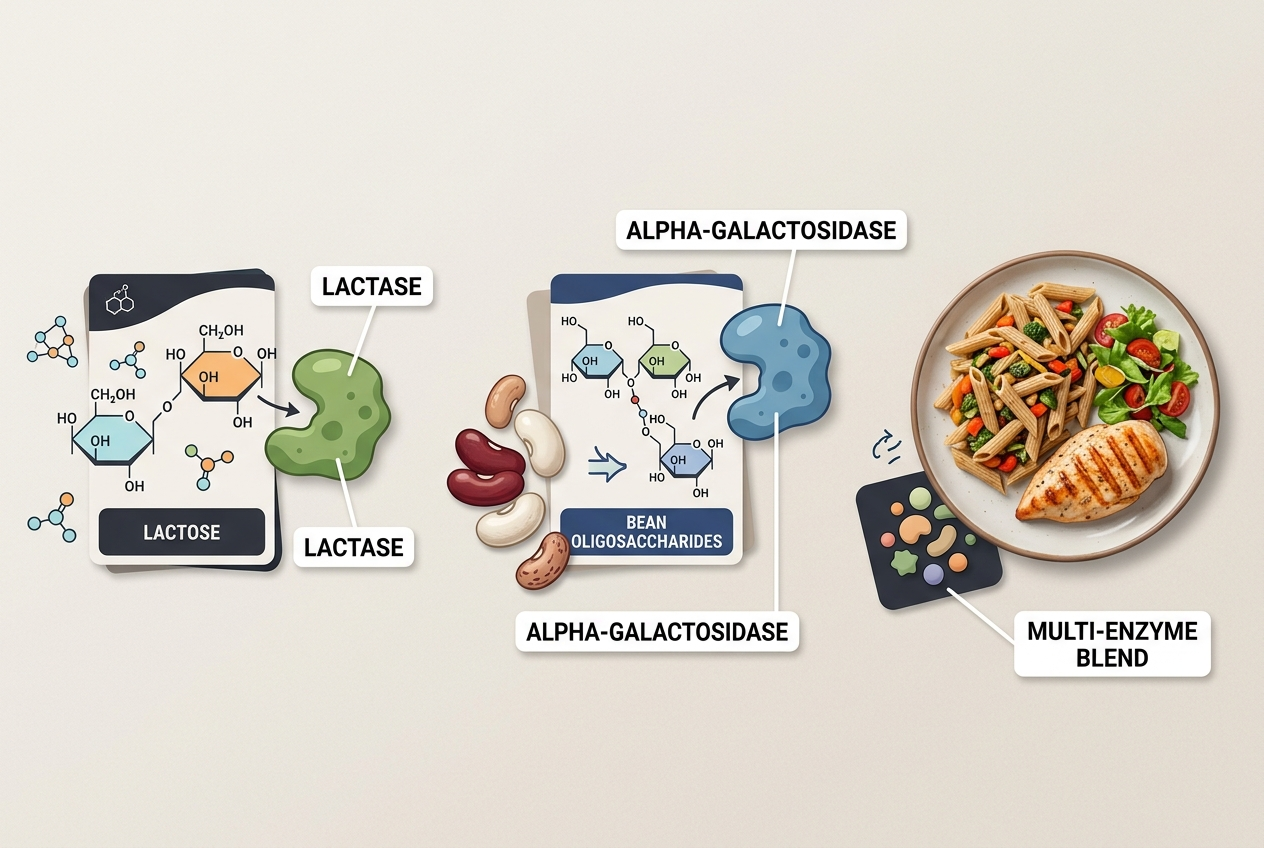
Best for lactose-containing meals: a lactase-only product provides the clearest substrate match and makes response easier to interpret. Best for beans or selected vegetables: alpha-galactosidase targets raffinose-family carbohydrates before colonic bacteria ferment them. Best for mixed restaurant meals: a transparent broad-spectrum formula can be practical when the meal contains starch, protein, and fat, although evidence for nonspecific bloating is less certain. Best for a plant-based routine: a clearly labeled papaya-enzyme product can offer a convenient format, but papain-related evidence does not justify promises about every digestive complaint. Best for suspected pancreatic insufficiency: no retail supplement belongs in the first-line slot. The NIDDK overview of exocrine pancreatic insufficiency describes prescription pancreatic enzyme replacement therapy as a clinician-managed treatment. A seven- to fourteen-day food-and-symptom log can reveal whether one substrate repeatedly precedes discomfort and can prevent buying a broad formula for a narrow, identifiable problem.
When should you avoid self-treating with enzymes?
Digestive-enzyme supplements should not delay evaluation when symptoms include unintentional weight loss, blood in stool, black stool, persistent vomiting, fever, dehydration, nighttime symptoms, or severe or escalating abdominal pain. Greasy, pale, floating stools and unexplained nutrient deficiencies can accompany fat malabsorption, but those signs do not identify a cause on their own. People who are pregnant, use anticoagulants, have a bleeding disorder, have diabetes, or have allergies to pineapple, papaya, latex, or fungal ingredients should review the exact formula with a clinician or pharmacist. Prescription pancreatic enzymes require individualized dosing and should never be replaced with a general wellness blend. Mild meal-linked discomfort may justify one targeted trial, taken exactly as labeled, while the rest of the routine stays stable. Stop the trial if symptoms worsen. A supplement response can suggest that a food substrate matters, but it cannot diagnose lactose intolerance, pancreatic insufficiency, celiac disease, inflammatory bowel disease, or another gastrointestinal condition.
What are common questions about digestive enzymes?
Should digestive enzymes be taken before or after eating?
Most targeted enzymes work best before or with the first bites because they need contact with the substrate. Follow the product label.
Can digestive enzymes stop all bloating?
No. Enzymes may help with one substrate, but bloating can also involve meal size, constipation, swallowed air, sensitivity, or another condition.
Are probiotics the same as digestive enzymes?
No. Digestive enzymes break chemical bonds in food, while probiotics are live microorganisms defined by strain and dose. The categories have different mechanisms and evaluation criteria.
Can healthy adults take enzymes every day?
Some adults use enzymes daily, but evidence is stronger for specific needs than for indefinite general use. Review recurrent use without a clear trigger with a clinician.
What is the simplest buying decision?
Identify the triggering food, select the matching enzyme, and check activity units. Compare a digestive health collection, then test one change.
Related reading: How to Choose a Clean-Label Digestive Support Supplement.
Related reading: Can I Take Papaya Enzyme Every Day? Timing, Safety, and Label Checks.
What is the practical next step?
Start with the narrowest plausible match: lactase for dairy lactose, alpha-galactosidase for beans and selected vegetables, or a transparent multi-enzyme product only when mixed meals create a consistent pattern. Record the meal, timing, dose, and response for seven to fourteen days without changing several other supplements at once. A repeatable food-specific response provides more useful information than a single unusually good or bad day. Stop if the product worsens symptoms, and bring the log to a clinician when discomfort persists or red-flag symptoms appear. Retail enzymes support digestion of defined substrates; they do not establish why symptoms occur. Shoppers comparing vegan formats can review the Yuve Vegan Daily Cleanse label alongside targeted competitors, checking named enzymes, activity units, allergens, and directions rather than relying on ingredient count or marketing terms. The best purchase is the product whose mechanism matches the meal—not the bottle with the busiest label.
Leave a Reply