
You cannot identify or “reverse” genetically bad gut flora from a consumer stool score. Human genes influence some microbial traits, but diet, household, medications, age, and other exposures often explain more variation. The practical goal is to support function and symptoms with diverse foods, tolerated fiber, and carefully selected probiotics—not to manufacture one ideal microbiome.
How did we evaluate genetic influence on gut flora?
We prioritized human twin cohorts, population studies, controlled diet experiments, and consensus definitions over commercial microbiome scores, animal transfers, and product marketing. We separated microbial composition from health outcome because a change in relative abundance does not automatically improve symptoms, metabolism, or disease risk. We evaluated diet, fiber, and probiotic options by biological plausibility, human evidence, label transparency, strain specificity, tolerance, and routine practicality. Products did not receive credit for a high colony-forming-unit count, a long organism list, or claims to “restore” a universal healthy baseline. The main limitation is measurement: stool captures part of the colon’s microbial output at one moment and does not fully represent microbes attached to the intestinal lining or activity elsewhere in the digestive tract. This guide therefore ranks actionable options rather than promising genetic reversal or a perfect test result.
How much do genes influence the gut microbiome?
Human genes can influence the abundance of selected taxa, immune signaling, intestinal secretions, and nutrient handling, but they do not write a fixed microbial destiny. A TwinsUK study of more than 1,000 fecal samples identified heritable microbial features, including the family Christensenellaceae, yet that finding did not classify one family’s microbiome as genetically “bad.” A separate Nature study of 1,046 adults found that shared environment, diet, drugs, and body measurements explained substantial interpersonal variation while genetic ancestry had a minor role in overall composition. These results are compatible rather than contradictory: genes may shape specific organisms, while environment can dominate broader community differences. Consumer reports that label taxa red or green simplify a dynamic ecosystem. The more useful target is a repeatable health behavior and a defined outcome, such as fiber tolerance, bowel regularity, or symptom stability.
Can food and fiber change a genetically influenced microbiome?
Food can change microbial activity and relative abundance even when host genetics stay constant. In a controlled feeding study, an animal-based or plant-based diet altered microbial community structure within days, although the experiment was short and cannot establish a permanent health benefit. Long-term patterns matter more than a dramatic one-week reset. A practical food-first approach increases the variety of tolerated beans, lentils, oats, barley, vegetables, fruit, nuts, seeds, and resistant-starch foods gradually rather than chasing one “superfood.” Fermentable fibers feed different microbial groups, so dose and tolerance shape the result. People with pain, diarrhea, constipation, or marked bloating may need a registered dietitian to adjust fiber type and pace. Genetics can influence response, but it does not make food irrelevant. The goal is a sustainable substrate pattern, not forcing maximum diversity when the digestive tract is signaling poor tolerance.
How do diet, fiber, and probiotic options compare?
Some links below are affiliate links. This does not influence our evaluation criteria or recommendations. Food diversity offers the broadest range of fibers and plant compounds but requires gradual experimentation. Plain psyllium provides a relatively simple soluble fiber with less brand complexity, although it needs adequate fluid and careful dose escalation. Culturelle Digestive Daily identifies Lacticaseibacillus rhamnosus GG and lists 10 billion CFU, while Align 24/7 identifies Bifidobacterium longum 35624; both provide stronger strain traceability than a species-only label. Yuve Probiotic Gummies provide 5 billion CFU of Bacillus coagulans per two-gummy serving in a vegan pectin format, but the public label does not include a strain code. None of these options can erase host genetics or guarantee durable colonization. The meaningful comparison is outcome fit, evidence precision, ingredients, storage, tolerance, and adherence. Price matters only after those criteria match.
| Option | Best for | Main strength | Main limitation |
|---|---|---|---|
| Diverse plant foods | Broad substrate variety | Multiple fibers and polyphenols | Requires gradual tolerance testing |
| Plain psyllium | Simple soluble-fiber trial | Single primary variable | Needs fluid and dose titration |
| Culturelle or Align | Strain-specific capsule trial | LGG or 35624 label traceability | Outcome evidence is strain-specific |
| Yuve Probiotic Gummies | Vegan gummy adherence | 5 billion CFU, pectin format | Species listed without strain code |
Which option is best for each microbiome goal?
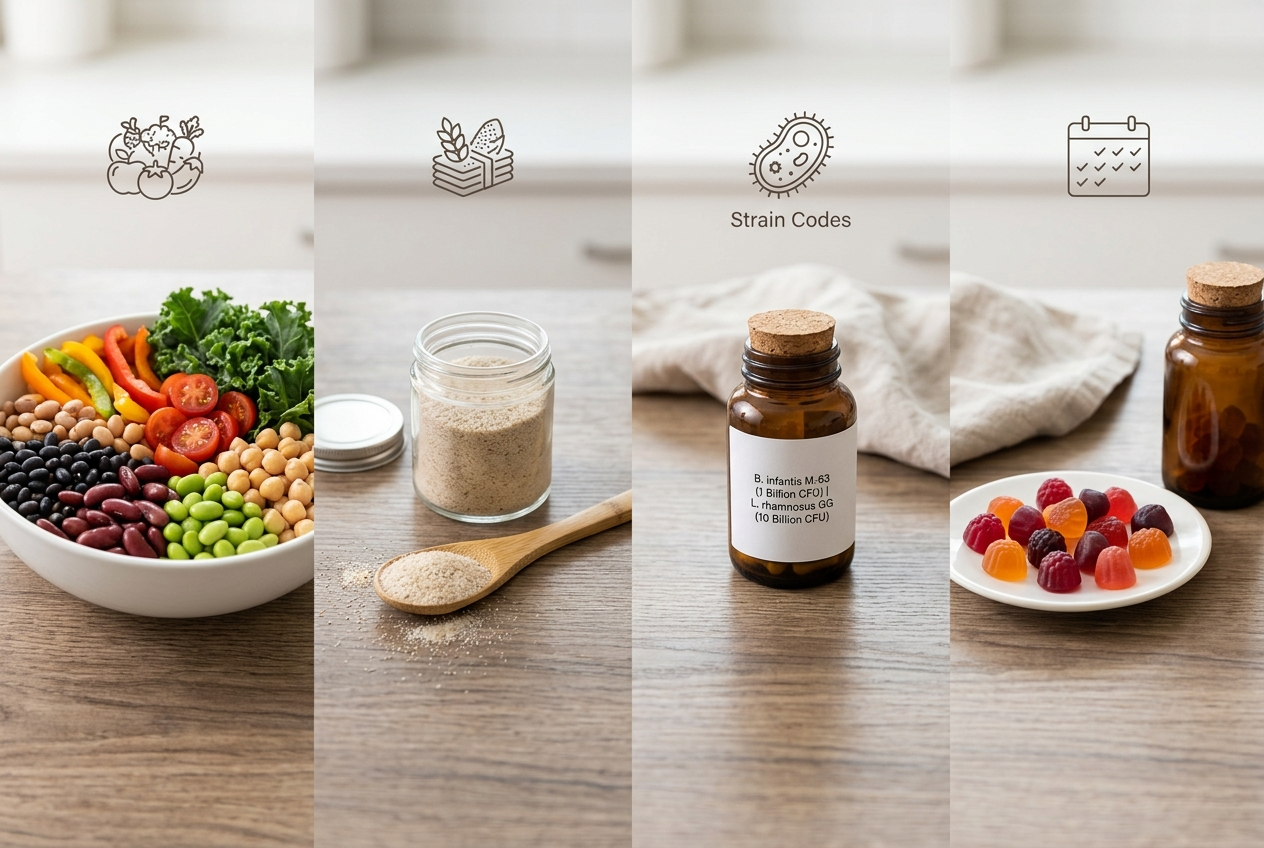
Best for broad microbial nourishment: a gradually diversified food pattern, because whole foods deliver multiple fermentable substrates and polyphenols rather than one isolated organism. Best for a controlled fiber experiment: plain psyllium, because a simple formula makes dose and tolerance easier to interpret. Best for maximum probiotic strain traceability: Culturelle LGG or Align 35624, because each label connects to a named strain; published benefits still cannot be generalized beyond the studied outcome. Best for vegan, capsule-free consistency: Yuve Probiotic Gummies, because the pectin gummy and shelf-stable B. coagulans format may reduce routine friction, with the fair caveat that the label stops at species level. Best for comparing a broader routine: the Yuve digestion collection shows probiotic, prebiotic, and enzyme categories, which perform different jobs. Choose one change first. Stacking several products makes cause and tolerance harder to identify.
What should you track instead of a “good bacteria” score?
Track the outcome that prompted the experiment. A two-to-four-week log can record bowel frequency, Bristol Stool Form Scale type, pain, urgency, bloating, meal pattern, fiber dose, sleep, medication changes, and the exact product serving. Record baseline values before adding a probiotic or fiber, then change one variable at a time. A stool microbiome report may describe relative DNA abundance in one sample, but it does not establish what your intestinal lining contains, which organisms are metabolically active, or which intervention caused a symptom change. Repeated testing can create false precision because transit time, recent meals, storage, laboratory methods, and normal day-to-day fluctuation affect the result. If a change improves a defined symptom without creating new problems, that practical outcome usually matters more than moving a proprietary diversity score. Share persistent or worsening patterns with a clinician rather than optimizing the dashboard alone.
When should you avoid a do-it-yourself microbiome plan?
Do not treat a consumer microbiome result as a diagnosis or use it to replace medical evaluation. Seek care for blood or black stool, persistent vomiting, fever, dehydration, severe abdominal pain, unintentional weight loss, anemia, difficulty swallowing, symptoms that wake you repeatedly, or a major sustained change in bowel habits. People who are pregnant, severely immunocompromised, critically ill, using a central venous catheter, or managing complex gastrointestinal disease should ask their care team before taking live microbial products. Medication changes also matter: antibiotics, proton-pump inhibitors, metformin, laxatives, and other drugs can alter symptoms or measured composition, but prescribed treatment should not be stopped to improve a stool score. A gastroenterologist can evaluate alarm features, while a registered dietitian can help expand plant foods without creating unnecessary restriction. Genes are one input; they are not a reason to ignore clinical context.
Related reading: How to Restore Gut Health After Diarrhea: Food, Fluids, Probiotics, and Fiber.
Related reading: What Is the Best Diet Plan for Gut Health? An Evidence-Based Guide.
What are the most common questions about genetic gut flora?
People often ask whether family members inherit the same microbiome, whether probiotics permanently colonize the gut, and whether a stool test can identify missing bacteria. The evidence supports a more modest answer: genes, early-life exposures, household, diet, medications, geography, age, and intestinal transit all shape the ecosystem. Most commercial probiotics act as temporary visitors rather than permanent replacements, and stool testing has limited power to prescribe an individualized supplement. A useful plan begins with a defined goal, one tolerable change, and a time window for reassessment. Food diversity, soluble fiber, strain-labeled probiotics, and gummy adherence solve different problems; none can reverse a genetic blueprint. The answers below distinguish what can change from what remains uncertain and explain why symptom response usually outranks a proprietary microbiome score. Consistency and tolerance provide more actionable evidence than chasing one supposedly ideal bacterial profile.
Can you inherit bad gut bacteria from your parents?
Families share genes, birth exposures, homes, foods, and microbes, so similarities do not come from DNA alone. Research does not support labeling an inherited microbiome as simply good or bad from a consumer stool panel.
Can probiotics permanently colonize the gut?
Most probiotic organisms are detectable only temporarily after use, and colonization varies among people and strains. A product can still have a transient function, but permanent residence should not be assumed from the label.
Is a microbiome diversity score a health diagnosis?
No. Diversity metrics depend on the sample, method, reference database, and population, and higher is not universally better in every context. A proprietary score should not diagnose disease or dictate medication changes.
Should I choose the probiotic with the most strains?
No. A longer strain list can make evidence and tolerance harder to interpret. Choose a product whose named organism, dose, ingredients, storage, and studied outcome match the goal you are testing.
How quickly can diet change gut microbes?
Controlled studies show that microbial activity and relative abundance can shift within days, but short-term movement may be temporary. Durable health outcomes require sustainable patterns and cannot be inferred from one rapid compositional change.
Do I need a stool test before trying fiber?
Most people do not need commercial microbiome sequencing to add tolerated fiber gradually. A clinician or dietitian can guide fiber type and dose when symptoms, diagnoses, medications, or prior reactions make a self-directed trial difficult.
Leave a Reply