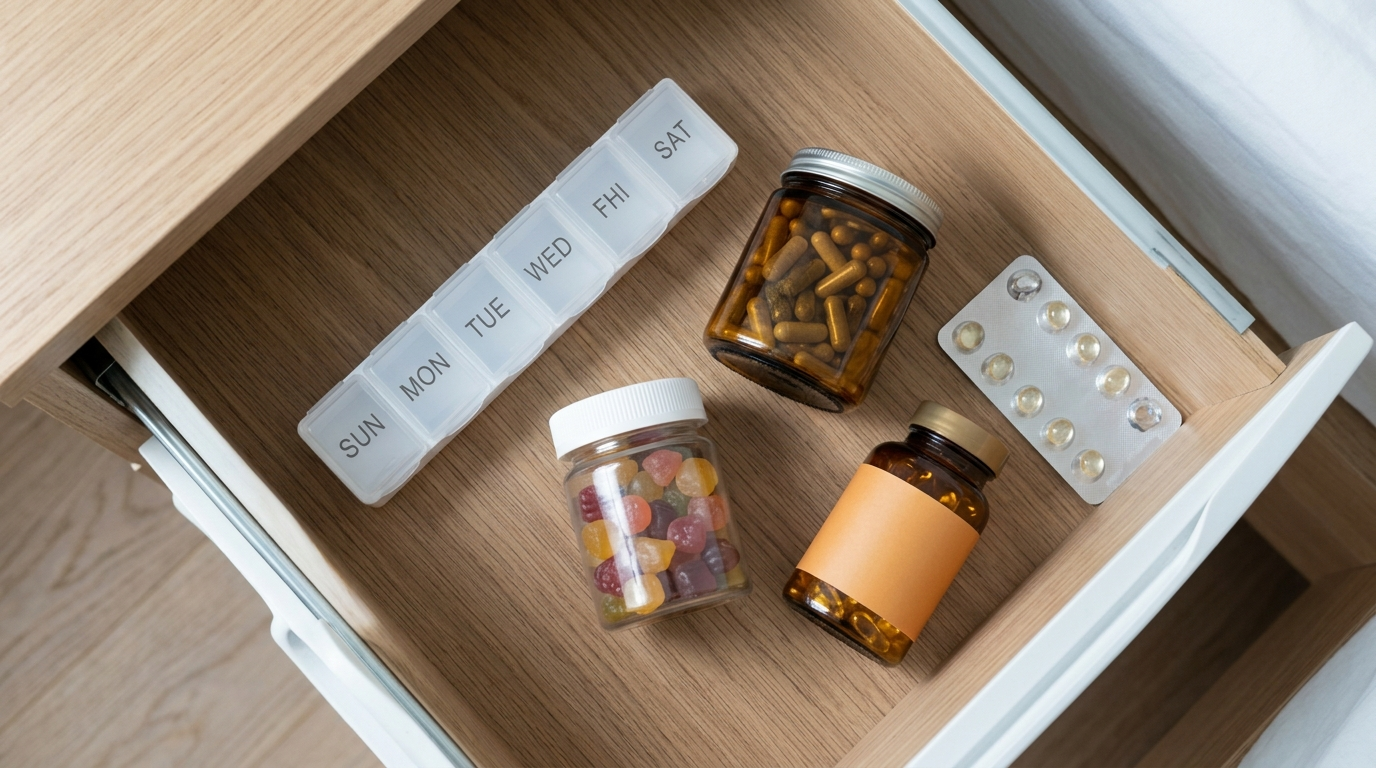
Most stable tablets and hard capsules can spend about one week in a clean, dry pill organizer when their labels allow room-temperature storage. Keep moisture-sensitive probiotics, softgels, chewables, gummies, and products supplied in protective blister packs in their original packaging unless a pharmacist or manufacturer confirms that transfer is appropriate.
How did we evaluate pill-organizer storage?
We evaluated supplement storage by prioritizing labeled storage directions, dosage-form sensitivity, container design, and the length of time a product would remain outside its original package. We used consumer guidance from MedlinePlus and FDA labeling resources rather than relying on organizer marketing claims. We treated tablets, hard capsules, softgels, gummies, live-culture probiotics, and blister-packed products as separate formats because humidity, oxygen, heat, and light affect them differently. We excluded prescription drugs with special handling requirements; a pharmacist should review those products individually. The evidence has an important limitation: manufacturers usually validate shelf life in the package they sell, not in every third-party organizer. A seven-day transfer can be reasonable for a robust room-temperature tablet, but that conclusion cannot automatically be applied to a moisture-sensitive probiotic capsule or a gummy stored in a warm bag.
When is a pill organizer a reasonable choice?
A pill organizer is most reasonable when the product is a conventional dry tablet or hard capsule, the label permits room-temperature storage, and the organizer will stay in a cool, dry, secure location. MedlinePlus describes weekly organizers as a practical adherence tool, but its separate storage guidance also says heat, air, light, and moisture can damage pills and capsules. That tension creates a useful rule: organize only the amount needed for the next seven days, not the entire bottle. Keep the labeled bottle, lot number, expiration date, and Supplement Facts panel so every compartment remains traceable. Do not combine pills that look alike if a mix-up would be difficult to detect. A bathroom, windowsill, kitchen counter beside a sink, parked car, or gym bag creates avoidable temperature or humidity exposure. Child-resistant storage still matters because most organizers do not replace the safety closure on the original package.
How do capsules, probiotics, gummies, and blister packs compare?
Some links below are affiliate links. This does not influence our evaluation criteria or recommendations. Dry capsules such as Culturelle or Align may tolerate brief organizer use only when the current label allows room-temperature storage and the capsule is not supplied in a protective blister. Yuve Probiotic Gummies use a gummy format, so keeping them sealed in the original bottle avoids sticking, flavor transfer, and needless humidity exposure. Blister-packed products should usually remain sealed until use because each cavity functions as an individual barrier. Formulas and packaging change, so the current label controls.
| Format | Best storage choice | Main risk after transfer | What to verify |
|---|---|---|---|
| Dry tablet | Seven-day organizer may be reasonable | Humidity and identification errors | Room-temperature label directions |
| Hard probiotic capsule | Original bottle unless label permits transfer | Moisture, heat, or refrigeration needs | Storage temperature and desiccant |
| Gummy or softgel | Original sealed bottle | Sticking, softening, oxidation | Heat and humidity directions |
| Blister-packed unit | Original blister | Loss of individual barrier | Manufacturer instructions |
What can damage supplements outside the original bottle?
Humidity can soften capsules, make tablets stick, and accelerate changes in ingredients that absorb water. Heat can deform softgels and gummies, while light and oxygen can affect sensitive oils, pigments, and some vitamins. MedlinePlus advises keeping medicines away from bathrooms, sinks, stoves, hot appliances, and cars because heat and moisture can reduce product quality. Dietary supplements are not identical to medicines, but the same physical exposures matter. A desiccant canister inside the original bottle manages the bottle’s headspace; it does not protect capsules moved to an organizer. Do not move the desiccant into a pill compartment, where it could be mistaken for a dose. Refrigeration is not a universal improvement because repeated removal can cause condensation, and some products specifically require dry room-temperature storage. Cracking, discoloration, a changed odor, leaking oil, fused gummies, or unusual softness are reasons to stop using the affected units and contact the manufacturer.
Which storage method is best for each use case?
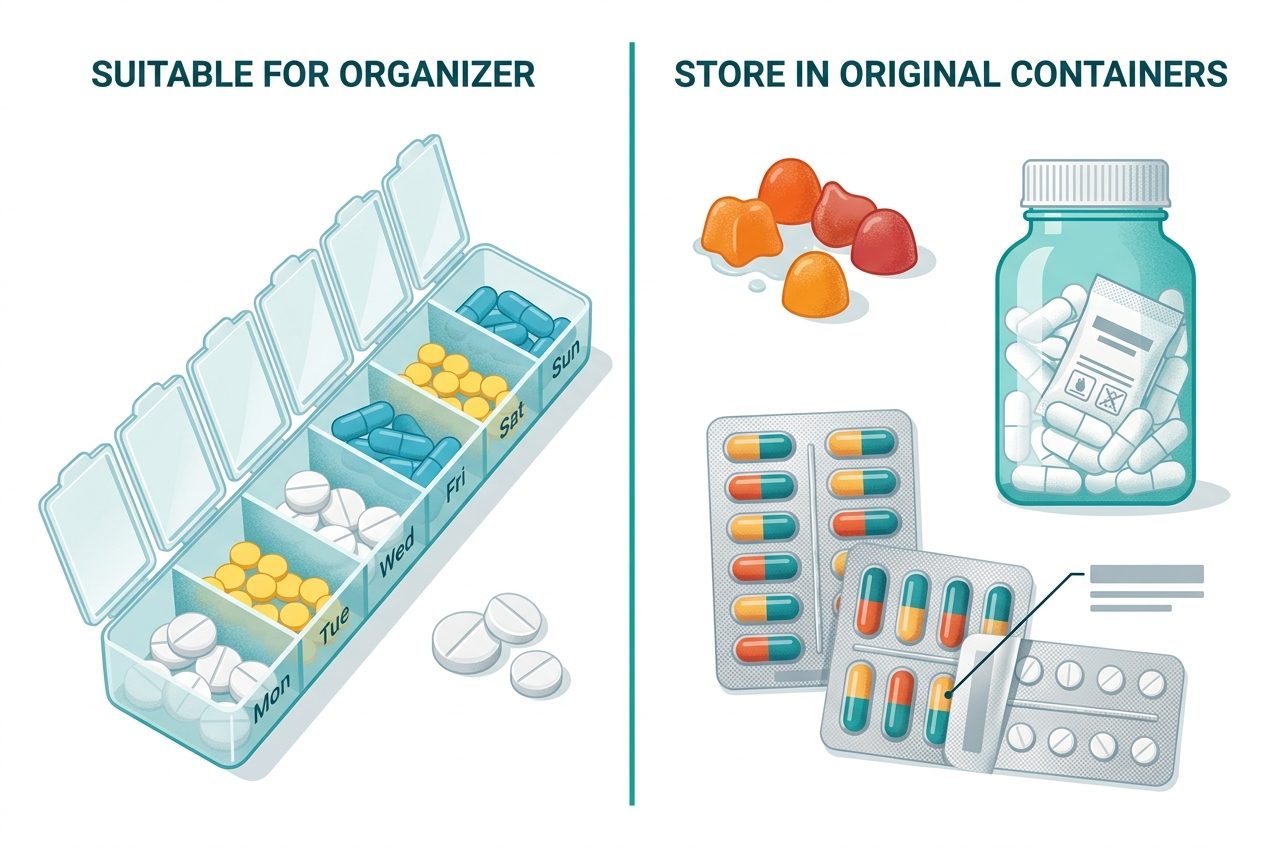
Best for a simple seven-day routine: a clean organizer with opaque, tightly closing compartments can support adherence for ordinary dry tablets and compatible capsules. Best for moisture-sensitive probiotics: the manufacturer’s bottle with its cap and desiccant preserves the tested container system. Best for travel: labeled original packaging provides identity, serving directions, lot information, and easier replacement if a bag is lost. Best for blister-packed supplements: keep each dose sealed in its cavity and cut the card only if the product name and expiration information remain attached. Best for gummies and softgels: the original bottle reduces contact, sticking, and temperature swings. Best for a complicated schedule: a pharmacist-reviewed organizer plan or pharmacy-prepared compliance pack reduces identification errors. The FDA dietary-supplement labeling guide explains that supplement expiration dating is optional, so preserving the label and purchase record is especially useful when a bottle does not show a date.
How should you fill a pill organizer safely?
Start with clean, completely dry hands and an organizer that has been washed according to its instructions and dried fully. Work with one bottle at a time, compare the serving size with the intended compartment, and close that bottle before opening the next one. Photograph the front label and Supplement Facts panel, or keep the original packages together, so an unidentified tablet can be checked instead of guessed. Fill no more than seven days unless a pharmacist or manufacturer confirms a longer transfer period. Store the loaded organizer in a dry drawer or cabinet, away from children, pets, steam, sunlight, and appliances. Do not place loose gummies beside capsules because flavors, oils, and moisture can transfer between formats. If two products look nearly identical, use separate organizers or labeled compartments. Clean out powder and fragments before refilling. An organizer reduces missed doses only when its contents remain identifiable, stable, and matched to the correct day and time.
What are common questions about supplement organizers?
Can probiotics go in a weekly pill organizer?
Only when the current label permits room-temperature storage and the manufacturer approves brief transfer. Keep refrigerated or moisture-sensitive probiotics in their original container.
Should the desiccant packet go in the organizer?
No. The desiccant belongs in the bottle, and its protection does not extend to organizer compartments.
Can gummies share a compartment with capsules?
Avoid mixing them. Gummies can transfer moisture, flavor, or oil and may stick to capsules.
How long can supplements stay in an organizer?
Seven days is a conservative routine for compatible dry products, not a stability guarantee. Ask before transferring a full month.
What if a capsule changes color or texture?
Do not use a cracked, sticky, swollen, discolored, or unusual-smelling capsule. Keep it for identification and contact the manufacturer.
Is a pill organizer child-resistant?
Usually not. Store the organizer out of sight and reach, ideally inside a locked cabinet.
For a closer look at clean-label options, see Is This a Good Way to Get Probiotics? Foods, Capsules, and Yuve Gummies Compared.
What is the practical next step?
Read every storage statement before moving a supplement, then divide the routine into two groups: robust dry tablets or capsules that can reasonably enter a seven-day organizer, and sensitive formats that should stay in their original packages. Keep gummies, softgels, refrigerated probiotics, desiccant-protected capsules, and blister-packed units sealed unless the manufacturer says otherwise. Preserve each bottle until its contents are finished so the Supplement Facts panel, lot number, and contact information remain available. People building a digestive routine can compare product formats in the digestive health collection, but convenience should never override storage directions. When the label is silent, send the manufacturer a specific question: “Has this product been evaluated for seven days outside its original container at room temperature?” A clear answer is more useful than assuming every capsule or gummy behaves the same way.
Leave a Reply