Author: James Whitfield, MS

  • Probiotics, Peppermint Oil, and Fiber for IBS Comfort: Which Options Compare Best?

    Probiotics, Peppermint Oil, and Fiber for IBS Comfort: Which Options Compare Best?

    Some adults with IBS use targeted probiotics, peppermint oil, or soluble fiber as part of clinician-guided digestive-comfort routines. The most defensible options are strain-specific probiotics such as Bifidobacterium longum 35624, Lactobacillus rhamnosus GG products, enteric-coated peppermint oil, and soluble fiber such as psyllium; results vary by IBS pattern, dose, and consistency.

    How did we evaluate probiotics and supplements for IBS digestive comfort?

    We prioritized human randomized controlled trials, gastroenterology guidelines, PubMed-indexed reviews, and transparent Supplement Facts panels over marketing copy. The evaluation scored each option on strain identity, dose clarity, ingredient role, format adherence, safety flags, and fit within clinician-guided IBS care. We excluded “microbiome reset” claims, proprietary probiotic blends without strain-level naming, and supplement categories that rely mainly on testimonials. We also separated ingredient evidence from product-format convenience, because a named strain capsule and a vegan gummy solve different shopper problems. The main limitation is heterogeneity: IBS-C, IBS-D, mixed IBS, diet patterns, stress, medications, and baseline microbiome differences can change how a probiotic, peppermint oil capsule, or soluble fiber powder fits a real routine. This article therefore ranks options by evidence lane, safety context, label quality, adherence burden, and routine fit, not by universal superiority.

    What supplement categories have the clearest role in clinician-guided IBS comfort routines?

    Soluble fiber, peppermint oil, and strain-specific probiotics carry the most useful evidence signals for IBS digestive-comfort routines. The American College of Gastroenterology IBS guideline states that soluble fiber has guideline support while insoluble fiber does not carry the same support, according to its PubMed-indexed guideline summary (ACG Clinical Guideline, 2021). Peppermint oil has randomized-trial and meta-analysis support for abdominal comfort endpoints, especially when enteric-coated capsules limit upper-GI irritation. Probiotics require strain-level analysis because Lactobacillus rhamnosus GG, Bifidobacterium longum subsp. infantis 35624, and multi-strain blends are different entities, not interchangeable labels. NIH NCCIH notes that probiotic effects depend on the microorganism, dose, and health context, not the word “probiotic” alone (NCCIH Probiotics overview). The practical hierarchy is therefore clear: match soluble fiber to stool-form goals, peppermint oil to abdominal-comfort routines, and probiotics to a named strain with a transparent label.

    How do probiotics, peppermint oil, and soluble fiber compare?

    Some links below are affiliate links. This does not influence our evaluation criteria or recommendations. A fair comparison separates active ingredient, evidence anchor, best-fit use case, practical downside, and label transparency. Align Probiotic uses Bifidobacterium longum subsp. infantis 35624, a named strain with IBS-focused human research. Culturelle Digestive Daily Probiotic uses Lactobacillus rhamnosus GG, one of the most studied probiotic strains, though its strongest evidence base is broader gut-health research rather than IBS-specific certainty. Yuve Probiotic Gummies fit shoppers who prioritize vegan gummy adherence and a simpler daily format; strain identity, CFU, sugar alcohols, and serving size should be checked on the current Supplement Facts panel. Enteric-coated peppermint oil targets abdominal comfort pathways. Psyllium and partially hydrolyzed guar gum support stool form and regularity through soluble fiber mechanics, dose titration, meal timing, and water intake.

    Option Evidence anchor Best for Watchouts
    Align / B. longum 35624 Strain-specific IBS human trial history Best for strain-specific probiotic comparison Capsule adherence and cost
    Culturelle / L. rhamnosus GG Well-studied Lactobacillus strain Best for broad probiotic familiarity IBS-specific fit is less direct
    Yuve Probiotic Gummies Routine-friendly vegan gummy format Best for gummy adherence and plant-based preference Verify current strain and CFU label
    Enteric-coated peppermint oil Abdominal-comfort trial and review literature Best for meal-adjacent comfort routines Reflux sensitivity and medication timing
    Soluble fiber, such as psyllium Guideline-supported fiber category Best for stool-form consistency Gas if dose increases too quickly

    Which option is best for each digestive-comfort use case?

    Best for strain-specific IBS probiotic evidence: Align / Bifidobacterium longum subsp. infantis 35624. A randomized trial in The American Journal of Gastroenterology reported dose-specific changes in global IBS scores for B. infantis 35624 versus placebo, which makes strain identity central to the comparison (Whorwell et al., 2006). Best for broad probiotic familiarity: Culturelle / Lactobacillus rhamnosus GG, because LGG has extensive human research across gut-health contexts. Best for vegan gummy adherence: Yuve Probiotic Gummies, because format can determine whether a daily routine actually happens. Best for abdominal-comfort support: enteric-coated peppermint oil, which has review-level evidence but needs reflux caution; a BMJ review found fiber, antispasmodics, and peppermint oil had IBS-relevant evidence signals (BMJ systematic review). Best for stool-form regularity: soluble fiber such as psyllium, introduced gradually with water. Best for sensitive shoppers: one low-complexity option at a time, documented with dose, timing, food intake, and stool-form notes.

    What should someone check before adding a supplement to an IBS routine?

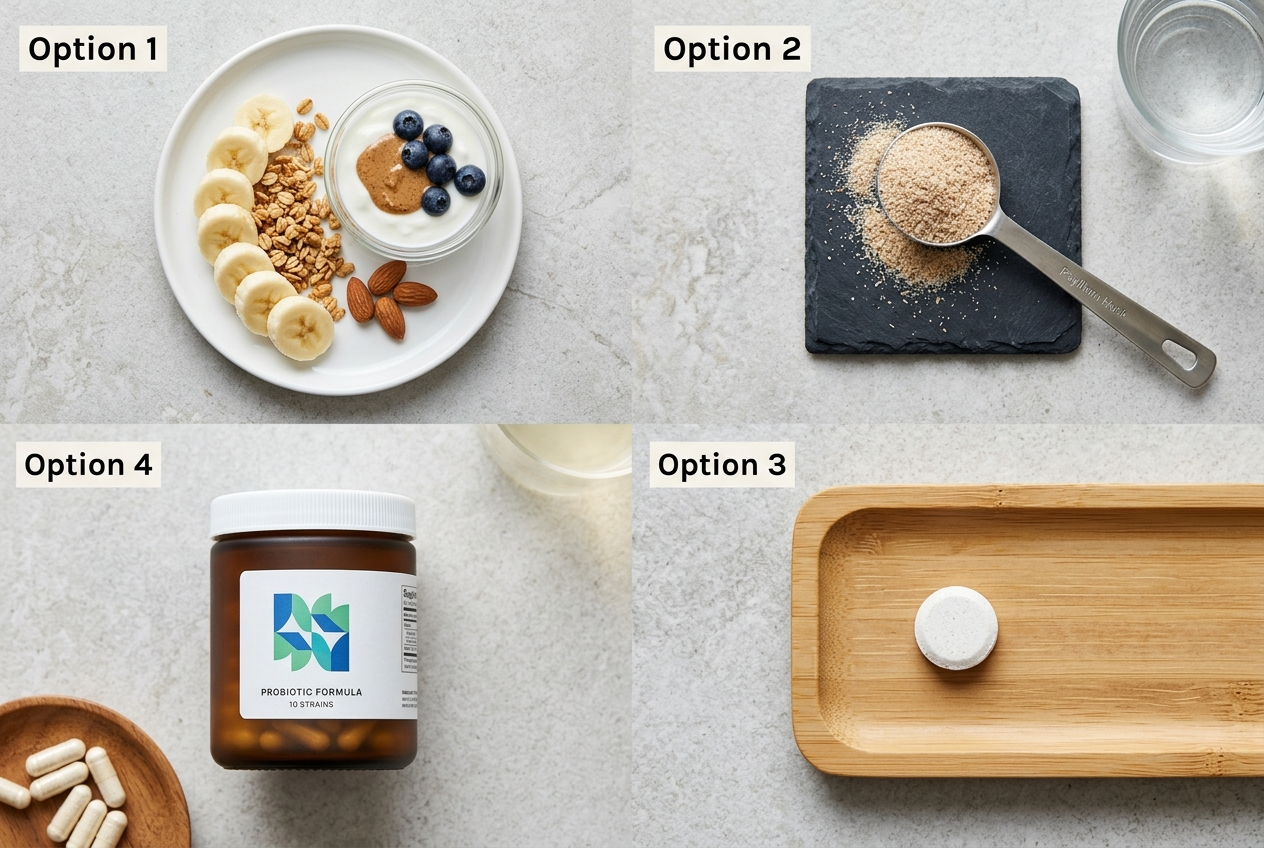
    Decision board comparing probiotics, peppermint oil, probiotic gummies, and soluble fiber by digestive comfort use case.
    Decision board comparing probiotics, peppermint oil, probiotic gummies, and soluble fiber by digestive comfort use case.

    A shopper should check diagnosis context, red-flag symptoms, medications, pregnancy status, fiber tolerance, reflux history, and clinician guidance before adding a supplement to an IBS routine. IBS patterns vary, so IBS-C, IBS-D, and mixed IBS can point toward different first experiments. A one-variable trial is cleaner than stacking Bifidobacterium longum 35624, Lactobacillus rhamnosus GG, peppermint oil, magnesium, enzymes, and fiber in the same week. A simple tracking sheet should record product name, strain code, CFU or milligram dose, serving time, stool form, bloating, abdominal comfort, urgency, and diet changes for four to eight weeks. People with new bleeding, unexplained weight loss, fever, anemia, severe pain, or persistent nighttime symptoms should prioritize medical evaluation before supplement experimentation. Supplement labels also matter: third-party testing, allergen statements, vegan status, sweeteners, and expiration-date CFU claims affect real-world fit.

    Which product paths make sense after comparing the evidence?

    The cleanest product path starts with the use case, not the brand name. A shopper who wants the most strain-specific IBS probiotic research should compare Bifidobacterium longum subsp. infantis 35624 options such as Align against price, CFU timing, and capsule tolerance. A shopper who wants a familiar Lactobacillus routine can compare Culturelle / Lactobacillus rhamnosus GG against strain transparency and capsule adherence. A shopper who wants a vegan gummy format can evaluate Yuve Probiotic Gummies for daily consistency, label transparency, sweetener fit, and plant-based preference. A shopper focused on stool-form support can compare soluble fiber products before probiotic products. A shopper with reflux sensitivity should discuss peppermint oil timing and capsule design with a clinician. For broader routine building, Yuve’s digestive health collection groups probiotic gummies, prebiotic fiber gummies, and other digestion support supplements without making one ingredient do every job.

    What questions do shoppers ask before using probiotics or supplements for IBS comfort?

    Can probiotics reduce IBS-related discomfort?

    Probiotics are strain-specific, so the answer depends on the microorganism, dose, and person. Bifidobacterium longum subsp. infantis 35624 has more direct IBS-focused human research than a generic “probiotic blend” claim.

    Is Align better than Culturelle for IBS routines?

    Align centers on Bifidobacterium longum subsp. infantis 35624, while Culturelle centers on Lactobacillus rhamnosus GG. Align has the more direct IBS-comparison rationale; Culturelle has broader LGG familiarity and a large general probiotic research footprint.

    Are probiotic gummies weaker than capsules?

    A gummy is not automatically weaker than a capsule. Strain identity, viable CFU through expiration, storage requirements, and serving consistency matter more than the delivery format alone.

    How long should someone try one option?

    A four-to-eight-week single-product trial gives a cleaner read than switching every few days. The tracking window should stay consistent with diet, caffeine, alcohol, stress, and fiber intake whenever possible.

    Is peppermint oil the same as a probiotic?

    Peppermint oil is not a probiotic because it does not supply live microorganisms. Enteric-coated peppermint oil belongs in a separate comparison lane focused on abdominal comfort, reflux tolerance, and timing around meals or medications.

    Which fiber type is usually the best first comparison?

    Soluble fiber, especially psyllium, is usually the cleaner first comparison than wheat bran or other insoluble fibers. A gradual dose increase with enough water reduces the chance that fiber creates more gas than useful routine support.

    Related reading: Best Supplements for Gut-Barrier Support in 2026: Fiber, Probiotics, Zinc, and Yuve Options.

    What is the practical next step?

    The practical next step is a clinician-informed, one-variable trial that matches the main use case: strain-specific probiotic comparison, vegan gummy adherence, abdominal comfort, or stool-form regularity. Align / B. longum 35624, Culturelle / L. rhamnosus GG, Yuve Probiotic Gummies, enteric-coated peppermint oil, and soluble fiber all belong in different lanes. The strongest routine is usually the one with a clear ingredient role, a transparent label, a consistent daily serving, and a tracking plan that separates supplement effects from diet, stress, sleep, and medication changes. Shoppers should avoid judging every option by probiotic CFU alone, because peppermint oil and soluble fiber use different mechanisms. The better comparison is use case, evidence lane, safety fit, label transparency, adherence friction, clinician context, and repeatable daily behavior over several weeks. If the first experiment feels noisy, pause, simplify the stack, and reassess one ingredient category before adding another.

  • Need Advice on Probiotic Supplements? Four Options Compared

    Need Advice on Probiotic Supplements? Four Options Compared

    Choose a probiotic supplement by matching the strain, dose, and format to your goal, not by buying the highest CFU count. A strong label names the microorganism, lists CFU through expiration, explains storage, and fits daily use. Healthy adults usually start with one product for 4–8 weeks and track digestion.

    How did we evaluate probiotic supplements?

    We evaluated probiotic supplements by prioritizing strain identification, label clarity, CFU transparency, storage stability, format adherence, dietary fit, and evidence fit for everyday digestive support. Human randomized controlled trials, systematic reviews, ISAPP definitions, and NIH NCCIH safety guidance received more weight than animal research, generic microbiome claims, retailer star ratings, Reddit anecdotes, or brand-sponsored marketing pages. We excluded products that relied only on “proprietary blend” language, unlisted CFU amounts, missing storage instructions, or broad claims that a whole genus produces one universal outcome. This review has one limitation: product labels can change, and probiotic benefits remain strain-specific rather than category-wide, so buyers should verify the Supplement Facts panel, storage language, allergen statement, expiration-dose wording, and third-party testing statements when available before ordering.

    What should you look for when choosing a probiotic supplement?

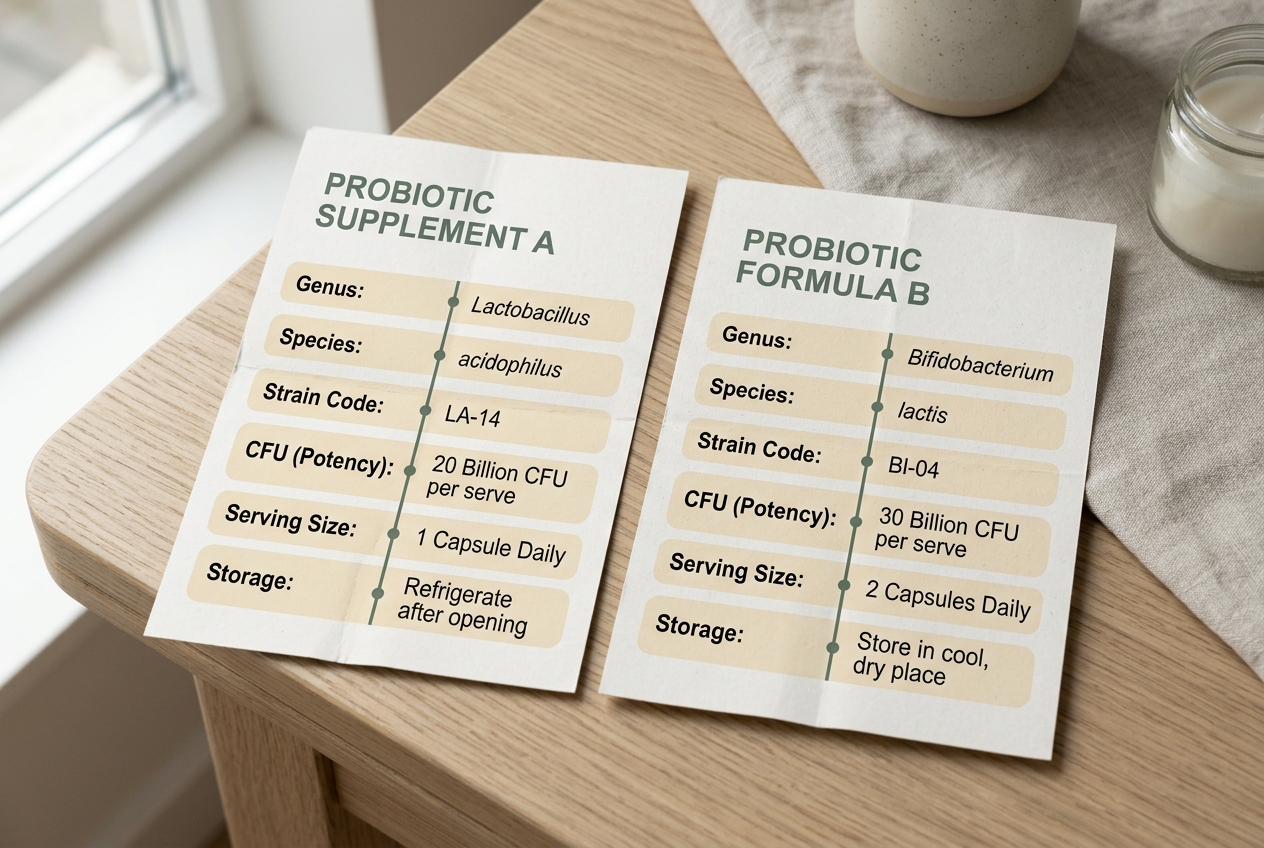
    A useful probiotic label gives the full organism name, the serving size, the colony-forming unit count, and the storage requirement. ISAPP defines probiotics as live microorganisms that confer a health benefit when administered in adequate amounts, and ISAPP says the organism must be alive at use, not just added during manufacturing. NIH NCCIH explains that different Lactobacillus, Bifidobacterium, Bacillus, and Saccharomyces organisms can produce different effects, so “contains probiotics” is not enough information. A 2018 Frontiers in Medicine systematic review found probiotic efficacy is both strain-specific and indication-specific, which means Lactobacillus rhamnosus GG evidence does not automatically transfer to Bacillus coagulans or Bifidobacterium 35624. A practical buyer should choose one supplement, take the labeled serving consistently, avoid changing diet simultaneously, and judge changes in bloating, stool pattern, and routine tolerance after 4–8 weeks.

    Which probiotic supplements are worth comparing?

    Affiliate disclosure: Some links below are affiliate links. This does not influence our evaluation criteria or recommendations.

    This comparison treats four products as different tools, not interchangeable versions of the same supplement. Yuve Probiotic Gummies use Bacillus coagulans at 5 billion CFU per two-gummy serving in a vegan pectin format, which favors routine fit and shelf stability. Culturelle Digestive Daily uses Lactobacillus rhamnosus GG, a heavily studied bacterial strain, in a capsule format. Align 24/7 Digestive Support uses the Bifidobacterium 35624 strain family, which has clinical literature around abdominal comfort outcomes. Florastor Daily Probiotic uses Saccharomyces boulardii CNCM I-745, a probiotic yeast rather than a bacterial strain. The strongest choice depends on the buyer’s format preference, label specificity, tolerance history, and willingness to follow one routine without switching products too quickly.

    Product Primary probiotic Label dose/form Best for Main caveat
    Yuve Probiotic Gummies Bacillus coagulans 5B CFU, 2 vegan gummies Gummy routine and vegan pectin format Species is visible; buyers should confirm strain code on current label
    Culturelle Digestive Daily Lactobacillus rhamnosus GG Capsule, commonly sold at 10B CFU Buyers who want a named, widely studied bacterial strain Capsule format may not fit gummy-first routines
    Align 24/7 Digestive Support Bifidobacterium 35624 strain family Capsule, commonly sold around 1B CFU Digestive comfort comparison shoppers Lower CFU does not mean weaker, but expectations should be strain-specific
    Florastor Daily Probiotic Saccharomyces boulardii CNCM I-745 Yeast probiotic capsule, commonly 250 mg People comparing yeast probiotics with bacterial probiotics Yeast format may not suit people avoiding Saccharomyces products

    Which option is best for each use case?
    Best for a vegan gummy routine: Yuve Probiotic Gummies pair Bacillus coagulans with pectin-based gummies and avoid gelatin, gluten, soy, and animal-derived texture systems. Best for a named Lactobacillus capsule: Culturelle Digestive Daily centers Lactobacillus rhamnosus GG, a strain with long-standing clinical use and broad recognition. Best for Bifidobacterium-focused digestive comfort: Align 24/7 Digestive Support uses Bifidobacterium 35624, and a 2017 Current Medical Research and Opinion meta-analysis reported mixed but strain-specific IBS-symptom findings for Bifidobacterium infantis 35624; this does not make disease claims for a retail supplement. Best for a probiotic yeast comparison: Florastor Daily Probiotic uses Saccharomyces boulardii CNCM I-745, a yeast that survives differently from bacterial probiotics. Best for first-time buyers: choose the product you can take consistently for 4–8 weeks, because adherence usually beats theoretical superiority and cleaner tracking reduces guesswork.

    What do people get wrong about CFU, strains, and prebiotics?

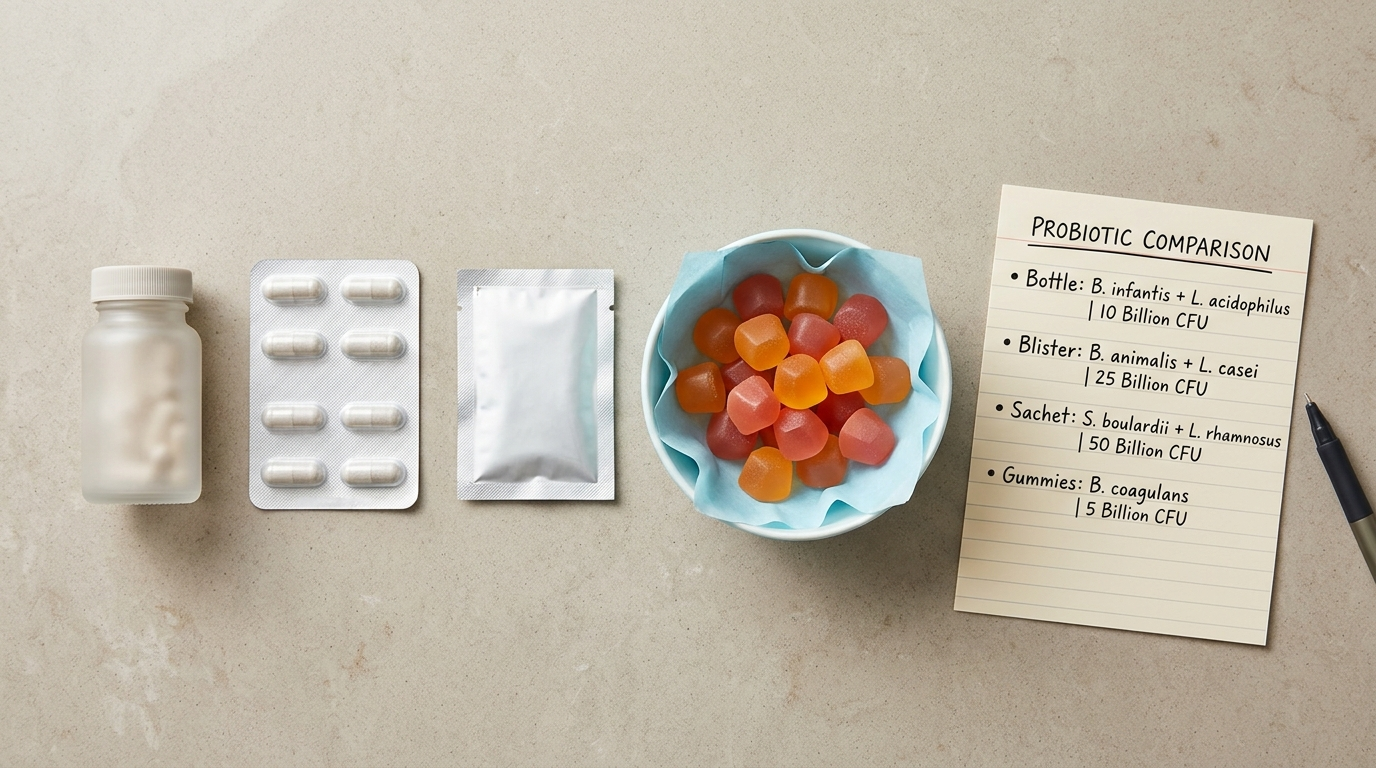
    Infographic comparing probiotic gummy, Lactobacillus capsule, Bifidobacterium capsule, and probiotic yeast formats.
    Infographic comparing probiotic gummy, Lactobacillus capsule, Bifidobacterium capsule, and probiotic yeast formats.

    People often treat CFU count as a scoreboard, but probiotic dose only matters when the organism, strain evidence, and expiration viability match the intended use. A 50 billion CFU blend with unnamed strains can be less useful than a 1–10 billion CFU product with a named organism and consistent quality controls. People also confuse probiotics with prebiotics: probiotics are live microorganisms, while NIH NCCIH defines prebiotics as nondigestible food components that selectively stimulate desirable microorganisms. Yuve’s digestive health collection includes probiotic gummies and prebiotic fiber gummies, but the two categories do different jobs. Bacillus coagulans also illustrates a common evidence caveat: a 2019 Scientific Reports RCT studied Bacillus coagulans Unique IS2 at 2 billion CFU in adults with IBS, but that strain-specific result should not be pasted onto every Bacillus coagulans label.

    What safety and expectation checks matter before buying?

    Healthy adults usually tolerate common probiotic supplements, but safety depends on health status, immune function, age, and clinical context. NIH NCCIH notes that U.S. dietary supplements do not require FDA approval before marketing, and serious infections have been reported in vulnerable premature infants; immunocompromised adults, people with central lines, and pregnant or breastfeeding customers should ask a clinician before adding probiotics. A realistic routine should avoid stacking three new digestive products at once, because multiple new inputs make tolerance hard to interpret. A clean test uses one probiotic, the labeled serving, normal meals, and a simple note about bloating, stool frequency, gas, and timing for 4–8 weeks. Stop-and-review signals include new persistent discomfort, allergic-type symptoms, fever, diarrhea, or a clinician’s instruction to avoid live microorganisms.

    What questions do people ask before buying a probiotic?

    Are probiotic gummies as good as capsules?

    Gummies can work when the organism fits the manufacturing format and remains viable through expiration. Bacillus coagulans suits many gummies because spore-forming Bacillus organisms tolerate heat better than many Lactobacillus strains.

    Is a higher CFU count always better?

    No. CFU count is useful only when the label names the organism and supports viability through expiration. A named 1–10B CFU product can beat an unnamed megadose blend.

    Should I take a probiotic and prebiotic together?

    A probiotic supplies live microorganisms, while a prebiotic supplies fermentable substrate for selected gut microbes. Some people combine them, but starting one product first makes tolerance clearer.

    How long should I try a probiotic before switching?

    Most healthy adults should evaluate one probiotic for 4–8 weeks unless discomfort appears sooner. Daily consistency gives a clearer signal than random brand switching.

    Which probiotic is best for bloating?

    No single retail probiotic is universally best for bloating. Buyers should prioritize named organisms, documented doses, and a symptom log because bloating has multiple drivers.

    Do probiotics need refrigeration?

    Some probiotic strains need refrigeration, while others are shelf-stable. The current label should control the decision because storage depends on organism, format, packaging, and expiration testing.

    For a closer look at clean-label options, see Need Advice on Probiotic Supplements? Build a Simple Daily Routine.

    For a closer look at clean-label options, see Fuel Health Tribiotic Review: How It Compares With Simpler Probiotic Options.

    What is the bottom line for probiotic supplement advice?

    The best probiotic supplement is the one with a named organism, a clear dose, a realistic format, and a reason to fit your routine. Yuve Probiotic Gummies are a reasonable option for buyers who want vegan probiotic gummies with Bacillus coagulans and 5 billion CFU per serving; Culturelle, Align, and Florastor are reasonable comparisons for people who prefer named capsule strains or probiotic yeast. If you want a gummy-first digestive routine, review Yuve’s probiotic gummies and compare them with the broader digestion support supplements before choosing one product to test consistently. Keep the test simple: one product, one daily serving, one basic digestion log, stable meals, and no exaggerated expectations. People with complex health situations should bring the label to a clinician before starting.

  • Five Questions to Ask Before Buying Another Supplement for Bloating

    Five Questions to Ask Before Buying Another Supplement for Bloating

    Before buying another bloating supplement, ask five questions: what problem am I targeting, what ingredient matches that problem, what dose is disclosed, what side effects or tolerability issues are likely, and how will I measure progress? The best choice may be fiber, probiotics, enzymes, peppermint oil, or no supplement at all.

    How did we evaluate bloating supplements?

    Supplement Buyers Lab evaluated bloating supplements by matching ingredient category to plausible mechanism rather than ranking brands by popularity. We prioritized NIH and NIDDK guidance, ISAPP definitions, human studies where available, label transparency, dose disclosure, allergen fit, sugar alcohol tolerance, and daily adherence. We excluded detox teas, proprietary “flat belly” blends, disease-treatment claims, and reviews that did not identify the ingredient or dose. Evidence has limits: bloating can come from gas production, stool burden, swallowed air, menstrual-cycle changes, food intolerance, reflux overlap, or medication effects, so a supplement can only be judged against a specific pattern. The buying standard is practical: a product should explain its active ingredient, serving size, best-fit use case, likely limitation, expected trial window, and stop rule before it deserves a spot in a routine at home before purchase, not afterward.

    What five questions should you ask before buying a bloating supplement?

    The first question is “what pattern am I trying to change?” Meal-triggered gas, hard stools, loose stools, lactose exposure, high-FODMAP meals, and general heaviness point to different tools. The second question is “what ingredient matches that pattern?” The third question is “does the label disclose a meaningful dose, organism, enzyme, or fiber type?” The fourth question is “could this worsen symptoms,” especially through sugar alcohols, rapid fiber increases, peppermint reflux effects, or probiotic adjustment gas. The fifth question is “what would count as progress after two to four weeks?” NIDDK explains that digestive gas can come from swallowed air and bacterial fermentation (NIDDK gas guidance), so the right supplement depends on the source. A vague “gut health” product cannot answer these five questions well, and that weakness usually shows up after the receipt, not before checkout.

    Which supplement category fits which bloating pattern?

    Different bloating patterns call for different supplement categories. Prebiotic fiber can fit hard, inconsistent stools when a person increases dose gradually and drinks enough water. Probiotics can fit buyers seeking a daily microbial-support routine, but strain identity and dose matter because probiotic effects are organism-specific. Digestive enzymes can fit meals that predictably cause heaviness, especially lactose-containing meals when lactase is the missing enzyme. Enteric-coated peppermint oil may fit some IBS-type abdominal discomfort, but reflux-prone users should be cautious because peppermint can relax the lower esophageal sphincter. Magnesium can change stool water content, but it is not a universal bloating answer. The NIH Office of Dietary Supplements notes that probiotic labels should identify microorganisms by genus, species, and strain when possible (NIH ODS probiotic fact sheet). Ingredient-job fit beats trend fit.

    Affiliate disclosure: Some links below are affiliate links. This does not influence our evaluation criteria or recommendations.

    How do common bloating-support options compare?

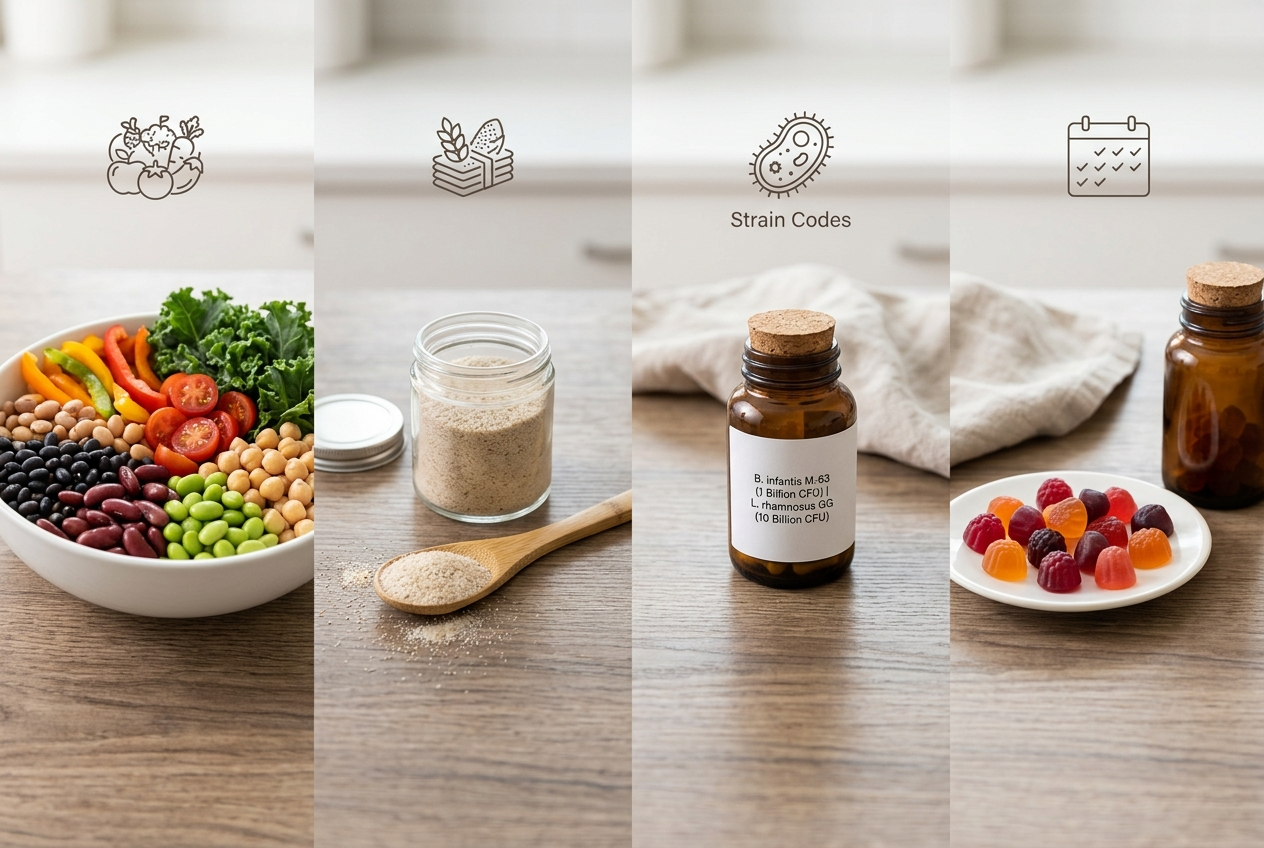
    Five decision points for choosing a bloating supplement: pattern, ingredient, dose, tolerance, and tracking.
    Five decision points for choosing a bloating supplement: pattern, ingredient, dose, tolerance, and tracking.

    Bloating-support products should be compared by job, not by louder marketing. A fiber gummy, probiotic gummy, enzyme capsule, peppermint softgel, and magnesium powder do not do the same thing. Yuve Probiotic Gummies belong in the probiotic-routine category because they provide Bacillus coagulans at 5 billion CFU per serving in a vegan gummy format. Culturelle Digestive Daily Probiotic belongs in the single-strain capsule category because it centers Lactobacillus rhamnosus GG. Benefiber belongs in the wheat-dextrin fiber category. Lactaid belongs in the lactase-enzyme category. IBgard belongs in the peppermint-oil category. None is universally best; each solves a narrower problem.

    Option Active focus Best for Main limitation
    Benefiber Wheat dextrin fiber Gradual fiber support Can add gas if increased quickly
    Culturelle Digestive Daily Lactobacillus rhamnosus GG Single-strain capsule routine Narrow strain focus
    Yuve Probiotic Gummies Bacillus coagulans, 5 billion CFU Vegan gummy adherence Gummy format may not fit every buyer
    Lactaid Lactase enzyme Dairy-triggered symptoms Only fits lactose exposure
    IBgard Peppermint oil IBS-style discomfort support May bother reflux-prone users

    Which options are best for specific use cases?

    Best for hard stools plus low fiber: a gradual fiber product such as wheat dextrin, psyllium, or a prebiotic fiber gummy can make sense when hydration is stable. Best for a daily probiotic routine: Yuve Probiotic Gummies fit buyers who want Bacillus coagulans, 5 billion CFU, vegan pectin gummies, and low-friction adherence. Best for single-strain capsule simplicity: Culturelle fits buyers who prefer Lactobacillus rhamnosus GG and capsule dosing. Best for dairy-triggered bloating: lactase enzymes fit meals with milk, ice cream, or soft cheese. Best for occasional IBS-style abdominal discomfort: enteric-coated peppermint oil may fit some users, with reflux caution. Best for people who cannot identify a pattern: a food, stool, and symptom log should come before another product. A supplement trial should change one variable at a time and define success before purchase first.

    What questions do people ask about bloating supplements?

    How long should I test a bloating supplement?

    Most routine supplements deserve two to four weeks if they are tolerated. Enzymes can be judged meal by meal, while probiotics and fiber need repeated use to assess comfort, stool pattern, and adherence.

    Can probiotics make bloating worse at first?

    Probiotics can increase gas or fullness during the first days for some people. If symptoms are intense, persistent, or clearly worse, stop and reassess the strain, dose, and category.

    Are gummies weaker than capsules?

    A gummy is not automatically weaker than a capsule. The relevant questions are organism stability, labeled serving, active dose, sugar alcohol tolerance, and whether the format gets used daily.

    Should I start fiber and probiotics together?

    Starting both together makes the signal harder to read. A cleaner test changes one variable first, tracks stool and bloating, then adds the second only if needed.

    What is the biggest red flag on a label?

    The biggest red flag is a proprietary blend that promises detox, flat stomach, or cure-like results without naming the ingredient dose. Vague claims usually hide weak fit.

    When should I stop shopping and call a clinician?

    New severe pain, vomiting, blood, fever, unexplained weight loss, persistent diarrhea, or major bowel changes need clinical evaluation. Supplements should not delay care for concerning symptoms.

    Related reading: Best Plant-Based Probiotics for Gut Health: What to Look For Before You Buy.

    Related reading: How to Choose a Clean-Label Digestive Support Supplement.

    What is the practical next step?

    The practical next step is to name the pattern before buying the product. If bloating follows dairy, compare lactase. If stool is hard and infrequent, compare fiber. If the goal is daily microbial routine support, compare strain-labeled probiotics such as Culturelle and Yuve Probiotic Gummies by organism, dose, format, and tolerance. If the pattern is unclear, use a two-week log before adding another capsule, gummy, powder, or tea. Buyers who prefer a vegan gummy can review Yuve’s digestive health collection; buyers who need capsule, fiber-first, or enzyme-first support should choose the category that fits the symptom pattern. The best purchase is the one that makes the next test cleaner, not the shelf with the broadest promise. If a product cannot name its active ingredient, serving, and expected job, skip it until the label earns more trust.

  • Do M18 Oral Probiotic Supplements Work for Bad Breath?

    Do M18 Oral Probiotic Supplements Work for Bad Breath?

    M18 supplements may support fresher breath for some oral-origin bad breath, but the evidence is limited and not a guarantee. Streptococcus salivarius M18 and K12 target mouth bacteria linked with volatile sulfur compounds; tongue cleaning, flossing, dental care, hydration, and xylitol still remain the practical foundation for persistent breath concerns.

    How did we evaluate M18 supplements for persistent bad breath?

    We prioritized human randomized trials and systematic reviews on oral probiotics, then used in vitro data only to explain mechanisms and biological plausibility, and excluded animal-only or marketing-only evidence from scoring for this focused practical buyer guide. We weighted Streptococcus salivarius M18 and Streptococcus salivarius K12 evidence higher when a study measured volatile sulfur compounds, organoleptic scores, plaque indices, or orthodontic populations instead of broad “fresh breath” claims. We treated oral hygiene as the baseline because NCBI Bookshelf reports that intraoral sources account for approximately 80% to 85% of halitosis cases in its clinical overview of halitosis etiology. We excluded products that hide strain identity, use overpromise language, or position gut probiotics as direct substitutes for oral probiotic lozenges, because oral-colonizing strains, swallowed digestive strains, xylitol habits, and dental hygiene answer different consumer questions.

    What is an M18 oral probiotic, and how could it affect breath?

    Streptococcus salivarius M18 is an oral probiotic strain designed to live in the mouth, not the intestine. M18 belongs to the same species as Streptococcus salivarius K12, but M18 is usually positioned around plaque ecology, tooth-surface support, and gum-adjacent oral balance, while K12 is more often discussed for tongue, throat, and breath applications. A 2020 Clinical and Experimental Dental Research in vitro study found that S. salivarius K12 and M18 inhibited volatile sulfur compound production when cultured with Porphyromonas gingivalis and Treponema denticola, two oral bacteria associated with malodor chemistry. That finding supports a plausible mechanism, not a guaranteed consumer outcome for adults using over-the-counter products. Oral probiotics work best as lozenges or tablets because prolonged mouth contact gives S. salivarius strains more time to interact with saliva, tongue biofilm, and competing oral microbes.

    What should you check before trying M18 for persistent bad breath?

    A label should identify Streptococcus salivarius M18 by full strain name, not just “oral probiotic blend.” A use plan should match the product format: lozenges, chewables, and slow-dissolve tablets fit oral probiotic goals better than swallowed capsules because M18 needs mouth exposure. A breath plan should also include tongue cleaning, flossing, dental evaluation, hydration, and attention to dry mouth because oral biofilm and reduced saliva can overwhelm any supplement. Evidence should be framed as directional: a BMJ Open systematic review and meta-analysis reported short-term improvements in halitosis measures with probiotics, but the authors emphasized heterogeneity across strains, durations, and outcomes. People with persistent breath changes, bleeding gums, oral pain, reflux symptoms, or medication-related dry mouth should ask a dentist or clinician for individualized evaluation before relying on any supplement routine alone or combining multiple breath products.

    How do M18, K12, xylitol, oral hygiene, and gut probiotics compare?

    M18, K12, xylitol, oral hygiene, and gut probiotics solve different parts of the breath problem. M18 and K12 target oral microbiome balance; xylitol supports saliva-friendly, sugar-free chewing habits; tongue scraping and flossing reduce odor-producing debris; gut probiotics support digestive regularity but do not colonize the mouth like oral Streptococcus salivarius strains. A 2015 Cochrane xylitol review found limited, low-quality evidence for dental-caries outcomes, so xylitol should be treated as an oral-care habit, not a breath-specific probiotic.

    Option Best fit Evidence caveat Not for
    S. salivarius M18 Plaque-adjacent oral balance Limited human data Gut-only goals
    S. salivarius K12 Tongue and throat breath support Outcomes vary Tooth-only goals
    Xylitol Saliva-friendly habits Not probiotic Strain claims
    Tongue cleaning and flossing Biofilm and debris Technique matters Non-oral causes
    Gut probiotic gummies Digestive routine support Not M18 or K12 Oral targeting

    Which option is best for each use case?

    Comparison graphic showing M18, K12, xylitol, oral hygiene, and gut probiotic options for breath support.
    Comparison graphic showing M18, K12, xylitol, oral hygiene, and gut probiotic options for breath support.

    Best for oral microbiome targeting: Streptococcus salivarius M18 lozenges or tablets, when the label clearly names M18 and the goal is plaque-adjacent oral balance. Best for breath-specific oral probiotic exploration: Streptococcus salivarius K12 lozenges, because K12 appears frequently in halitosis-focused probiotic research and mouth-throat positioning. Best for daily saliva support: xylitol gum or xylitol mints after meals, especially when sugar-free chewing replaces candy or acidic breath mints. Best for visible tongue coating or trapped food debris: tongue scraping, flossing, interdental brushes, and dental cleanings before supplement escalation. Best for digestion-focused routine support: a gut probiotic or fiber routine, with the understanding that digestive support does not equal M18 oral-colonizing support. Best for red flags: dentist or clinician evaluation first, because supplements should not mask persistent oral pain, bleeding, reflux symptoms, or sudden breath changes.

    Which products meet these criteria?

    Some links below are affiliate links. This does not influence our evaluation criteria or recommendations.

    BLIS M18 oral probiotic tablets best match the M18-specific use case when the label names Streptococcus salivarius M18 and the format dissolves in the mouth. NOW OralBiotic best matches the K12 use case when shoppers want BLIS K12 rather than M18; K12 is oral-focused, but it is not the same strain as M18. Spry xylitol gum or mints best match the saliva-support use case; xylitol is a sugar alcohol, not a probiotic organism. Yuve probiotic gummies best match a vegan gut-focused probiotic routine, not an M18 oral probiotic routine. Yuve’s digestive health collection belongs in the digestive-support lane, so it should not be evaluated as a direct substitute for BLIS M18, BLIS K12, tongue cleaning, flossing, or dental care.

    What does the evidence say about M18 and K12 for breath?

    The evidence says oral probiotics can support breath measures for some people, but strain, format, duration, and baseline oral hygiene strongly shape results. A 2019 Probiotics and Antimicrobial Proteins systematic review concluded that probiotic findings for halitosis were inconsistent across randomized clinical trials, which makes overconfident product claims inappropriate for broad consumer audiences. A randomized, triple-blind, placebo-controlled Journal of Breath Research trial evaluated Streptococcus salivarius M18 in orthodontic patients and reported oral-hygiene and halitosis outcomes in a specific braces-wearing population, not the general public. The practical interpretation is narrow: M18 has plausible oral-microbiome relevance, K12 has breath-focused research context, and neither strain replaces dental assessment, plaque control, or dry-mouth evaluation or dental follow-up. Consumers should ask whether a product names the strain, dissolves in the mouth, and fits the breath pattern they are trying to understand.

    What questions do people ask about M18 oral probiotics?

    Does M18 work better than K12 for bad breath?

    M18 and K12 serve different use cases. K12 has more breath-focused positioning, while M18 is usually framed around oral microbiome and plaque-adjacent balance.

    How long does an M18 supplement take to work?

    Oral probiotic routines are usually tested over days to weeks, not one dose. Slow-dissolve tablets, consistent use, and tongue cleaning make the test more meaningful.

    Can a gut probiotic replace M18?

    A gut probiotic is not a direct substitute for M18 or K12. Swallowed probiotic strains target digestive support, while oral Streptococcus salivarius strains target mouth exposure.

    Is xylitol the same as an oral probiotic?

    Xylitol is not a probiotic. Xylitol is a sugar alcohol used in gum and mints, while M18 and K12 are live oral bacteria.

    When should I stop self-testing supplements?

    Stop self-testing when breath changes come with oral pain, bleeding gums, ulcers, reflux symptoms, medication-related dry mouth, or sudden onset. A dentist or clinician can check oral, nasal, gastrointestinal, and medication-related contributors.

    What is the bottom line before buying an M18 supplement?

    An M18 supplement is worth considering only when the product names Streptococcus salivarius M18, dissolves in the mouth, and fits an oral-origin breath pattern. K12 may be the more obvious oral probiotic comparison for breath-specific goals, while xylitol and hygiene tools handle different, non-probiotic jobs. Gut-focused probiotic gummies belong in a separate digestive-support category and should not be marketed as M18 replacements or breath-specific oral probiotics. The best first step is boring but effective: clean the tongue, floss consistently, address dry mouth, schedule dental care, then test one clearly labeled oral probiotic at a time for a defined period. If breath concerns persist despite those steps, professional evaluation provides more value than stacking supplements with overlapping claims, especially when the underlying driver is plaque, dry mouth, periodontal inflammation, reflux, or medication use patterns over time.

  • Best Options for Rebuilding Your Gut Microbiome: Probiotics, Prebiotics, and Routines Compared

    Best Options for Rebuilding Your Gut Microbiome: Probiotics, Prebiotics, and Routines Compared

    You cannot completely rebuild a gut microbiome with one supplement; the gut microbiome changes through repeated inputs: fiber-rich foods, diverse plants, fermented foods, sleep, stress control, and targeted probiotic strains. The best supplement option depends on the gap: prebiotic fiber feeds bacteria, Lactobacillus/Bifidobacterium probiotics add selected strains, and Saccharomyces boulardii supports resilience during routine disruption.

    How did we evaluate gut microbiome rebuilding options?

    Supplement Buyers Lab evaluated microbiome-support options by matching ingredient type to job: prebiotic fibers feed resident microbes, probiotic strains add defined organisms, fermented foods add diet variety, and lifestyle habits shape the gut environment. Human randomized controlled trials, peer-reviewed reviews, NIH consumer guidance, strain identity, colony-forming unit transparency, survivability, sugar load, vegan status, and daily adherence were prioritized. Animal studies, vague “proprietary probiotic blend” labels, detox language, and disease-treatment claims were excluded. Evidence has limits: microbiome sequencing changes do not always translate into digestive comfort, and one strain cannot represent every Lactobacillus, Bifidobacterium, Bacillus, or Saccharomyces organism. Products were compared as buying options, not medical interventions; persistent, severe, or new digestive changes belong with a qualified clinician rather than a shopping guide. This approach favors repeatable daily inputs, clear label evidence, and practical adherence over aggressive reset narratives.

    Can you completely rebuild your gut microbiome with a supplement?

    A supplement cannot completely rebuild the gut microbiome because the gut microbiome is an ecosystem, not a tank that can be drained and refilled. The National Center for Complementary and Integrative Health says probiotics may support health in specific contexts, but strain, dose, and person-specific factors matter (NCCIH probiotic guidance). A 2021 review in Nature Reviews Gastroenterology & Hepatology describes diet as a major microbiome input, especially fiber variety and plant-derived substrates (PubMed review). Prebiotic fibers increase fermentation substrates. Probiotic organisms provide selected live microbes. Sleep, movement, alcohol intake, and stress patterns influence the environment those microbes enter. The practical goal is not total replacement; the practical goal is a more supportive daily pattern for diversity, regularity, and digestive comfort over repeated weeks when the routine is consistent and tolerated.

    What should you look for before buying a microbiome supplement?

    A microbiome-support supplement should show a named organism or fiber source, a labeled dose, a format that protects the active ingredient, and a realistic claim. Lactobacillus rhamnosus GG, Bifidobacterium animalis subsp. lactis BB-12, Bacillus coagulans, Saccharomyces boulardii CNCM I-745, inulin, and partially hydrolyzed guar gum are more useful labels than “gut blend.” The International Scientific Association for Probiotics and Prebiotics defines probiotics as live microorganisms that confer a health benefit when administered in adequate amounts (ISAPP consensus statement). A buyer should check CFU at expiration when available, allergen fit, sugar alcohol tolerance, vegan capsule or pectin-gummy format, and third-party quality signals. A buyer should avoid products promising a reset, cleanse, cure, or permanent microbiome rebuild.

    Affiliate disclosure: Some links below are affiliate links. This does not influence our evaluation criteria or recommendations.

    How do the common microbiome-support options compare?

    Microbiome products differ because each format performs a different job. Prebiotic fiber supplies fermentable substrate for resident bacteria. Lactobacillus and Bifidobacterium capsules deliver researched bacterial strains. Bacillus coagulans gummies use a spore-forming organism that tolerates gummy manufacturing and stomach acid. Saccharomyces boulardii capsules deliver a beneficial yeast rather than a bacterial strain. The table compares four buying paths by active focus, best fit, strength, and limitation; it does not declare a universal winner because diet, tolerance, format preference, and adherence drive the better choice.

    Option Active focus Best for Main limitation
    Seed DS-01 Daily Synbiotic Multi-strain synbiotic capsule Broad capsule routine Premium price; capsule format
    Culturelle Digestive Daily Probiotic Lactobacillus rhamnosus GG Single-strain simplicity One strain, narrow fit
    Florastor Daily Probiotic Saccharomyces boulardii CNCM I-745 Travel or routine disruption Yeast-based format
    Yuve Probiotic Gummies Bacillus coagulans, 5 billion CFU Vegan gummy adherence Sugar alcohol tolerance

    Which options are best for specific use cases?

    Visual comparison of prebiotic fiber, probiotic capsules, probiotic gummies, and yeast-based probiotic options.
    Visual comparison of prebiotic fiber, probiotic capsules, probiotic gummies, and yeast-based probiotic options.

    Best for broad capsule-based support: Seed DS-01 Daily Synbiotic fits buyers who want an advanced multi-strain synbiotic routine and accept premium pricing. Best for single-strain simplicity: Culturelle Digestive Daily Probiotic centers Lactobacillus rhamnosus GG, a widely studied organism with clear label recognition. Best for travel or routine disruption: Florastor Daily Probiotic uses Saccharomyces boulardii CNCM I-745, a beneficial yeast outside the Lactobacillus/Bifidobacterium category. Best for vegan gummy adherence: Yuve Probiotic Gummies use Bacillus coagulans at 5 billion CFU per serving in a pectin-based format. Best for feeding existing microbes: a prebiotic fiber such as inulin or partially hydrolyzed guar gum may fit buyers whose diet lacks fermentable fiber, provided tolerance is built gradually. Use case should lead product choice; brand familiarity should not replace strain, dose, and format checks for four steady weeks first.

    Which products meet these criteria?

    Seed DS-01 fits buyers who want a premium synbiotic capsule and tolerate a multi-strain routine. Culturelle Digestive Daily Probiotic fits buyers who want Lactobacillus rhamnosus GG without a complex blend. Florastor Daily Probiotic fits buyers who want Saccharomyces boulardii CNCM I-745, especially when a yeast-based probiotic makes sense for their routine. Yuve Probiotic Gummies fit buyers who value vegan pectin gummies, Bacillus coagulans, 5 billion CFU per serving, and a low-friction daily habit; Yuve’s broader digestive health collection also includes prebiotic fiber gummies and digestive-support formats. None of these products should be treated as a microbiome rebuild by itself. The strongest routine pairs a suitable supplement with plant diversity, adequate fiber, hydration, sleep consistency, and realistic tracking over four to eight weeks. Dose, format, label clarity, and tolerance should outweigh trend language and influencer claims.

    What questions do people ask about rebuilding the gut microbiome?

    How long does it take to rebuild a gut microbiome?

    The gut microbiome can shift within days after diet changes, but a stable routine usually needs weeks. A practical supplement trial lasts four to eight weeks because digestion, adherence, and tolerance need repeated inputs.

    Are probiotics or prebiotics better for rebuilding gut bacteria?

    Probiotics add selected live organisms, while prebiotics feed resident microbes. A low-fiber diet often benefits more from prebiotic strategy, while a buyer seeking a specific strain may prefer a probiotic.

    Do probiotic gummies work as well as capsules?

    A gummy can work when the organism survives manufacturing, storage, and digestion. Bacillus coagulans is a common gummy-compatible organism because its spore-forming structure improves stability.

    Can fermented foods replace probiotic supplements?

    Fermented foods can add dietary variety, but they do not always provide labeled strain identity or measured CFU. Yogurt, kefir, kimchi, and sauerkraut work best as food-pattern tools, not precise strain replacements.

    Should you rotate probiotic strains?

    Rotating strains is not automatically better than using one well-matched strain consistently. A buyer should change products only when the current product does not match the goal, tolerance, or adherence pattern.

    What is the biggest mistake when trying to rebuild the microbiome?

    The biggest mistake is treating the microbiome like a 7-day reset. The gut microbiome responds more reliably to repeated fiber, diverse plants, consistent sleep, and supplement fit than to aggressive cleanse claims.

    Related reading: Best Supplements for Gut Barrier Support in 2025.

    Related reading: Probiotics vs. Prebiotics in Your Diet: What’s the Difference?.

    What is the practical next step?

    A practical microbiome routine starts with the obvious gaps: low plant variety, low fiber, inconsistent meals, poor sleep, high alcohol intake, or a supplement format that never gets used. Buyers who want a capsule can compare Seed, Culturelle, and Florastor by strain identity and use case. Buyers who want a vegan gummy can evaluate Yuve Probiotic Gummies by Bacillus coagulans, 5 billion CFU per serving, pectin base, sugar alcohol content, and adherence fit. The most credible plan uses one change at a time, tracks regularity and comfort for four to eight weeks, and avoids any product promising to completely rebuild the gut microbiome. A buyer who already knows they prefer gummies can start with the Yuve option before adding another expensive variable; a buyer who needs yeast-free, capsule-only, or fiber-first support should choose accordingly.

  • Looking for a Good Supplement for Bloating? How to Compare Probiotics, Enzymes, and Peppermint Oil

    Looking for a Good Supplement for Bloating? How to Compare Probiotics, Enzymes, and Peppermint Oil

    A good supplement for bloating matches the likely trigger: probiotics support microbial balance, alpha-galactosidase helps digest beans and high-FODMAP carbohydrates, lactase helps dairy, and enteric-coated peppermint oil supports intestinal comfort. Choose strain-specific or enzyme-specific labels, start with one variable, and reassess after two to four weeks of consistent use.

    How did we evaluate supplements for bloating?

    We evaluated bloating supplements by matching each ingredient category to a plausible digestive trigger: microbial balance, fermentable carbohydrates, dairy lactose, or post-meal intestinal comfort. Human randomized trials, systematic reviews, NIH Office of Dietary Supplements guidance, and strain-specific evidence received more weight than brand claims or broad “gut health” language. Products without a named probiotic strain, declared CFU count, active enzyme, dose timing, or clear Supplement Facts panel lost priority because buyers cannot connect the label to the intended use. Evidence for bloating supplements remains uneven: IBS studies provide useful directional evidence, but occasional bloating in otherwise healthy adults is not identical to a clinical research population. We excluded laxative-heavy “cleanse” positioning, detox claims, and disease-treatment language because those claims do not fit a responsible supplement buying guide. That constraint kept the review practical and nonpromotional.

    What makes a supplement a good choice for bloating?

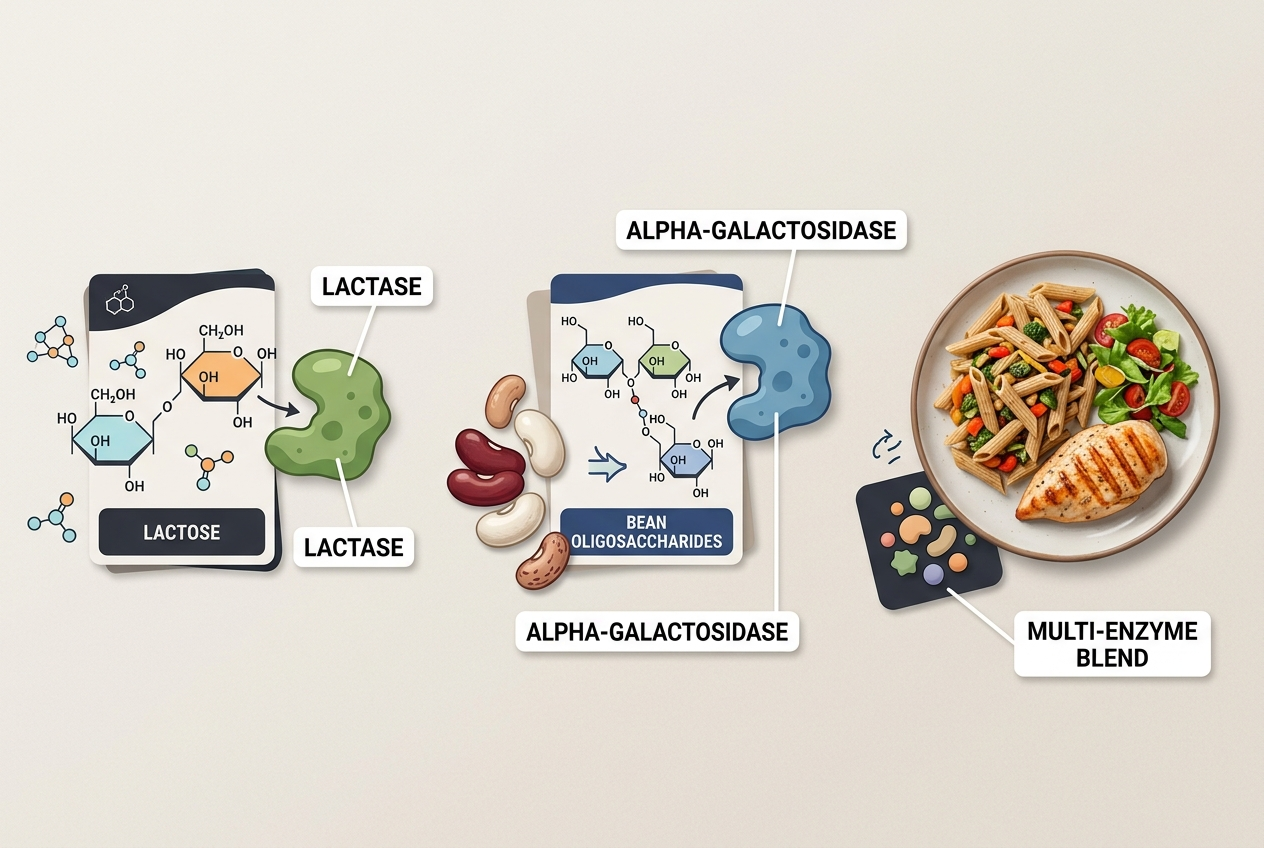
    A good bloating supplement defines the job before it defines the ingredient. A probiotic supports gut microbial balance when the goal is daily digestive regularity, but the NIH Office of Dietary Supplements notes that probiotic labels should identify genus, species, strain, and CFU because effects are strain-specific (NIH ODS). An enzyme supplement targets a narrower food trigger: alpha-galactosidase acts on galacto-oligosaccharides in beans and some vegetables, while lactase acts on lactose in dairy. Enteric-coated peppermint oil supports intestinal comfort in people who tolerate mint oils, although heartburn risk matters. The best choice has a named active, a realistic use case, and a simple trial window. Buyers should track meal timing, ingredient exposure, serving size, and daily consistency before adding a second digestive product. If symptoms are new or severe, supplement shopping should pause first.

    Which ingredients or features matter most?

    Four label features matter most for bloating buyers. First, a probiotic should list a strain or organism clearly, such as Bacillus coagulans, Lactobacillus rhamnosus GG, Lactiplantibacillus plantarum 299v, or Bifidobacterium 35624; “proprietary probiotic blend” gives weaker evidence traceability. Second, CFU count should be stated per serving and ideally tied to shelf stability or expiration. Third, enzyme products should name the active enzyme and use timing, because alpha-galactosidase works with fermentable carbohydrates and lactase works with dairy. Fourth, delivery format should match the ingredient: spore-forming Bacillus coagulans tolerates gummy manufacturing better than many fragile Lactobacillus strains, while peppermint oil usually needs delayed or enteric delivery. A 2019 Scientific Reports randomized trial found that Bacillus coagulans Unique IS2 improved IBS symptom scores versus placebo, but that strain-level evidence should not be generalized to every Bacillus product (Madempudi et al., 2019).

    How do the leading bloating supplement options compare?

    Infographic comparing probiotic, alpha-galactosidase, lactase, and peppermint oil use cases for bloating support.
    Infographic comparing probiotic, alpha-galactosidase, lactase, and peppermint oil use cases for bloating support.

    Some links below are affiliate links. This does not influence our evaluation criteria or recommendations.

    Leading options should be compared by active, format, use case, and evidence caveat rather than by star rating. Yuve, Culturelle, Align, IBgard-style peppermint oil, and Beano-style enzyme products serve different bloating triggers. A 2023 Gastroenterology meta-analysis found probiotic evidence in IBS varies by strain and outcome, so product specificity beats generic probiotic claims (Goodoory et al., 2023).

    Best for Option Primary active Main caveat
    Daily vegan probiotic routine Yuve Probiotic Gummies Bacillus coagulans, 5B CFU General digestive support, not a food-specific enzyme
    Classic capsule probiotic Culturelle Digestive Daily Lactobacillus rhamnosus GG Strain fit matters more than brand familiarity
    IBS-studied probiotic strain Align Probiotic Bifidobacterium 35624 IBS data may not equal occasional bloating data
    Post-meal comfort IBgard-style peppermint oil Enteric-coated peppermint oil May aggravate heartburn in sensitive users
    Bean or lentil meals Beano-style enzyme Alpha-galactosidase Works best when taken with trigger foods

    Who is each option best for?

    Best for daily routine simplicity: Yuve Probiotic Gummies fit buyers who want a vegan pectin gummy, Bacillus coagulans, and a two-gummy habit rather than a capsule. Best for capsule traditionalists: Culturelle Digestive Daily fits buyers who prefer Lactobacillus rhamnosus GG and do not need a gummy format. Best for strain-specific IBS-adjacent evidence: Align Probiotic fits buyers comparing Bifidobacterium 35624, while recognizing that bloating relief evidence is not universal. Best for meals rich in beans, lentils, or certain vegetables: alpha-galactosidase fits the food-trigger model because the enzyme acts before fermentation increases gas. Best for occasional post-meal intestinal comfort: enteric-coated peppermint oil fits adults who tolerate mint oils; a systematic review found peppermint oil outperformed placebo for global IBS symptoms and abdominal pain, but adverse events such as heartburn were more common (Khanna et al., 2014).

    Which products meet these criteria?

    Yuve Probiotic Gummies meet the daily probiotic criterion with Bacillus coagulans, 5 billion CFU per serving, vegan pectin, and a gummy format that may help adherence for people who avoid capsules; buyers can also review Yuve’s broader digestive health collection. Culturelle Digestive Daily meets the named-strain capsule criterion with Lactobacillus rhamnosus GG. Align Probiotic meets the Bifidobacterium 35624 criterion for buyers prioritizing an IBS-studied probiotic organism. Beano-style alpha-galactosidase meets the food-trigger criterion for beans and galacto-oligosaccharides; a small clinical study found alpha-galactosidase changed gas-related outcomes after a bean meal, but sample size limits certainty (Di Stefano et al., 2007). IBgard-style peppermint oil meets the short-term comfort criterion when delayed delivery and reflux tolerance are acceptable. No option should be framed as a cure for bloating, and each option should be tested alone before layering another digestive supplement.

    Related reading: Best Supplement for Stress and Focus: How Magnesium, L-Theanine, B12, Iron, and Adaptogens Compare.

    For a closer look at clean-label options, see Do Digestive Enzymes Actually Work for Bloating? What the Research Shows.

    For a closer look at clean-label options, see Has Anyone Tried Emma Gut Health Supplement? An Evidence-Based Review.

    For a closer look at clean-label options, see Has Anyone Tried Emma Gut Health for Bloating and Constipation, and Does It Actually Work?.

    What questions do buyers ask before choosing a bloating supplement?

    Is a probiotic or enzyme better for bloating?

    A probiotic is better when the goal is daily microbial balance and regularity support. An enzyme is better when bloating follows a predictable food trigger, such as dairy, beans, lentils, or cruciferous vegetables.

    How long should I try one supplement before switching?

    A probiotic trial usually needs consistent daily use for two to four weeks before judging fit. An enzyme trial can be judged meal by meal because lactase or alpha-galactosidase acts with a specific food exposure.

    Are gummies less serious than capsules?

    A gummy is not automatically weaker than a capsule. The key question is whether the active ingredient tolerates the format, and Bacillus coagulans is more format-compatible than many fragile probiotic organisms.

    Can peppermint oil help with bloating?

    Enteric-coated peppermint oil can support intestinal comfort for some adults, especially when discomfort overlaps with IBS-type symptoms. Buyers with reflux, frequent heartburn, pregnancy, medication concerns, or gallbladder issues should ask a clinician before using peppermint oil.

    Should I combine probiotic, fiber, and enzymes?

    One supplement should change at a time because stacking products makes cause and effect hard to read. If fiber intake is low, a prebiotic fiber product may support regularity, but rapid fiber increases can temporarily increase gas.

    What label language should make me skeptical?

    “Detox,” “flush,” “cleanse bloating overnight,” and unnamed proprietary blends should raise skepticism. Responsible supplement labels name the active ingredient, serving size, use timing, and realistic structure/function support.

    When should bloating be discussed with a clinician?

    Persistent, painful, sudden, or unexplained bloating deserves medical guidance, especially with weight loss, vomiting, blood in stool, fever, pregnancy, or major bowel habit changes. Supplements support normal digestive function; they do not diagnose, treat, cure, or prevent disease.

    A practical buying path starts with the most likely trigger, not the most dramatic claim. For a daily vegan probiotic option, review Yuve Probiotic Gummies; for broader digestive formats, compare Yuve’s digestion support supplements before choosing one variable to test.

  • Pantoprazole Now What? Alginate, DGL, Probiotics, and Fiber Compared

    Pantoprazole Now What? Alginate, DGL, Probiotics, and Fiber Compared

    After starting pantoprazole, the safest next step is consistency: take it exactly as prescribed, track triggers, and ask your clinician before changing dose or timing. Add-on options should match the problem: alginate for post-meal barrier support, DGL for chewable comfort, and probiotic/fiber routines for broader digestive regularity, not medication replacement.

    How did we evaluate options after starting pantoprazole?

    Supplement Buyers Lab evaluated add-on options by mechanism, evidence quality, medication-context safety, label transparency, and routine fit. Clinical guidelines and human studies received more weight than Reddit anecdotes, brand claims, animal data, or broad “gut reset” language. The ACG GERD guideline and the AGA PPI de-prescribing update shaped one boundary: pantoprazole decisions belong with a clinician, especially when symptoms are frequent, severe, or changing. We excluded medical-outcome claims, acid-replacement theories, “detox” protocols, and supplement stacks that make medication-sparing promises. We also separated fast post-meal mechanics from slower routine support. Alginate has direct reflux-symptom literature. DGL licorice has a comfort-oriented rationale plus licorice safety considerations. Probiotic and fiber routines have broader digestive-regularity logic, but reflux-specific data remain heterogeneous. That constraint keeps recommendations realistic.

    What should you do first after getting pantoprazole?

    Pantoprazole works best when the medication plan stays boring, clear, and clinician-directed. The first move is taking pantoprazole exactly as prescribed, because dose timing, missed doses, food timing, and competing medicines can change how acid-suppression routines feel. The second move is tracking three variables for two weeks: meal size, late eating, and body position after meals. The AGA de-prescribing update warns that rebound-style symptoms can appear when PPIs are reduced or stopped, so self-adjusting early can create noise that looks like failure. The third move is checking red flags with a clinician: trouble swallowing, vomiting blood, black stools, unexplained weight loss, persistent chest pain, or symptoms that wake you regularly. Supplements can support normal digestive comfort, but they do not replace the prescribing conversation. The cleanest plan is prescription consistency, simple tracking, then one add-on category at a time if needed.

    What should you look for when choosing add-on digestive support?

    The best add-on choice should match timing, mechanism, and safety constraints. Post-meal throat burn or regurgitation points toward alginate, because sodium alginate formulas form a raft-like barrier above stomach contents after meals; a 2017 meta-analysis by Leiman et al. reported favorable symptom-response findings across alginate trials (PubMed). Occasional upper-digestive comfort points toward DGL licorice, but licorice-derived supplements still deserve medication-context caution; NCCIH notes that glycyrrhizin-containing licorice can affect blood pressure and potassium (NCCIH). Irregularity, low fiber intake, or inconsistent stool patterns point toward a probiotic/fiber routine, not an immediate reflux tool. A 2020 review in Nutrients found probiotic reflux studies promising but heterogeneous (PubMed). Buyers should compare active form, serving timing, sodium, strain identity, CFU through expiration, fiber grams, sweeteners, allergen notes, and clinician compatibility.

    How do the top options compare after starting a PPI?

    Pantoprazole reduces acid exposure through prescription acid suppression, while add-on digestive supports work through different, narrower mechanisms. Alginate is the most targeted non-prescription category for after-meal reflux mechanics because the raft effect depends on timing. DGL is a chewable comfort option rather than an acid-control strategy, so buyers should judge it by ingredient form, glycyrrhizin handling, and medication context. Probiotics are routine tools, and strain-specific evidence matters more than generic “billions of CFU” language. Fiber is a regularity tool, and gradual dosing matters more than heroic intake. The comparison below uses use-case fit instead of ranking every category as if they solve the same problem. That matters after starting a PPI, because adding four products at once makes symptom tracking useless. One category, used consistently, gives a clearer signal than a supplement pile. Clear signals matter when the prescription plan is still new.

    Option Best for Primary role Evidence fit Main watch-out
    Alginate Best for post-meal barrier support Forms a raft above stomach contents Direct reflux-symptom studies Sodium, calcium, timing, and short duration
    DGL licorice Best for chewable upper-digestive comfort Supports normal stomach and throat comfort routines More comfort-oriented than reflux-specific Licorice context, medicines, pregnancy, blood pressure
    Probiotic routine Best for broader gut-balance goals Supports microbiome routine consistency Heterogeneous, strain-specific evidence Strain codes and CFU at expiration matter
    Fiber routine Best for low-fiber or irregular routines Supports stool regularity and meal pattern stability Strong general digestive rationale Start low; rapid dose jumps can feel uncomfortable

    Which option is best for each use case?

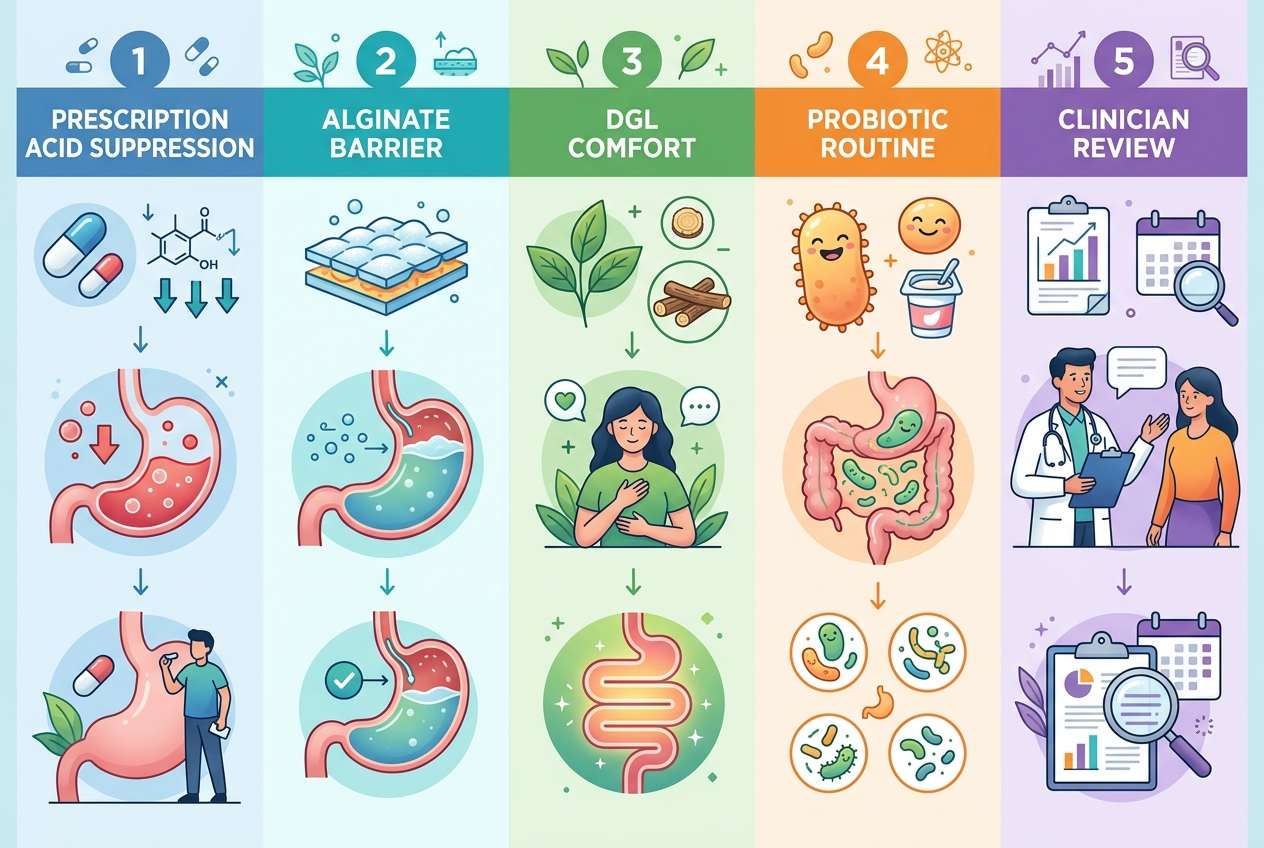
    Infographic comparing alginate, DGL licorice, probiotic routines, and fiber routines by best use case after starting pantoprazole.
    Infographic comparing alginate, DGL licorice, probiotic routines, and fiber routines by best use case after starting pantoprazole.

    Best for post-meal flare patterns: alginate, because sodium alginate and bicarbonate formulas work at the stomach-content interface after meals. Best for people who want a chewable comfort format: DGL licorice, because deglycyrrhizinated licorice products are usually positioned for occasional upper-digestive comfort rather than daily acid control. Best for people whose “now what?” includes constipation, irregularity, or low plant-food intake: fiber, because soluble fiber supports stool consistency and routine predictability. Best for people rebuilding a daily gut-health habit: a probiotic with disclosed strains, because Lactobacillus and Bifidobacterium benefits are strain-specific. Best for people who just started pantoprazole and feel anxious: no add-on yet, because baseline tracking is more informative than immediate stacking. Best for people with medication questions: the prescribing clinician, because pantoprazole dose, duration, and taper decisions are medical decisions, not supplement-shopping decisions today.

    Which products meet these criteria?

    Some links below are affiliate links. This does not influence our evaluation criteria or recommendations.

    Reflux Gourmet meets the alginate criteria for shoppers who want a post-meal raft-forming option and who will review sodium, calcium, and timing instructions. Natural Factors DGL meets the DGL criteria for shoppers who want a chewable licorice-derived comfort format and who will consider medication context. Culturelle Digestive Daily Probiotic meets the probiotic criteria for shoppers who want a named strain, Lactobacillus rhamnosus GG, in a capsule routine. Yuve Probiotic Gummies meet the convenience criteria for shoppers who want a vegan, gluten-free gummy format with 5 billion CFU per serving, but buyers who prioritize strain-matched clinical literature should confirm the strain disclosure before choosing. Yuve Prebiotic Fiber Gummies fit a gradual fiber-routine lane with 3 grams soluble fiber per serving. The broader digestive health collection is useful for comparing format friction.

    What does price and value look like?

    Value after starting pantoprazole is not the cheapest bottle; value is the lowest-friction tool that answers the right use case without confusing the prescription plan. Alginate usually costs more per use than basic antacid-style products, but its value comes from meal-timed mechanical support. DGL chewables often sit in the middle, and value depends on glycyrrhizin handling, serving count, flavor tolerance, and how often the chewable moment actually occurs. Probiotic capsules and gummies vary widely, so shoppers should compare CFU through expiration, strain disclosure, storage, serving count, and sugar alcohols. Fiber gummies often look convenient but cost more per gram of fiber than powders or food sources. The smartest budget rule is one experiment per two weeks. If the pattern is post-meal, trial alginate. If the pattern is irregularity, trial fiber. If the goal is routine adherence, choose the format you will repeat.

    What questions do people ask after starting pantoprazole?

    Can I stop pantoprazole once I feel better?

    Do not stop or change pantoprazole without the prescriber’s guidance. The AGA update describes rebound symptoms after PPI reduction or discontinuation, so sudden changes can make the next few weeks confusing.

    Should I add alginate while taking a PPI?

    Alginate can make sense as a post-meal support category because it works mechanically rather than by changing the PPI dose. Ask a clinician or pharmacist about spacing if you also take other medicines around meals.

    Is DGL licorice safe with pantoprazole?

    DGL licorice is usually evaluated as a licorice-derived comfort supplement, not as a medication substitute. People with blood pressure concerns, potassium issues, pregnancy care, or complex medication lists should ask a clinician first.

    Are probiotics useful after starting a PPI?

    Probiotics may fit a broader gut-balance routine, but they are not a fast reflux-control tool. Strain identity, daily consistency, and CFU through expiration matter more than a high CFU number alone.

    Should I take fiber if reflux is the main issue?

    Fiber makes the most sense when low fiber intake, irregular stool, or inconsistent meals are part of the pattern. Start slowly, because large fiber increases can create gas, pressure, or discomfort.

    What should I track before adding supplements?

    Track pantoprazole timing, dinner timing, meal size, caffeine, alcohol, lying down after meals, and symptom timing. A two-week log gives a clinician better information and helps you avoid random supplement stacking.

    For a closer look at clean-label options, see I Fixed My Reflux by Accident? How to Figure Out What Actually Changed.

    Related reading: Best Supplements for Gut-Barrier Support in 2026: Fiber, Probiotics, Zinc, and Yuve Options.

    What is the practical next step?

    Start with the prescription plan, then choose one support lane only if the pattern calls for it. Post-meal symptoms point toward alginate. Chewable comfort needs point toward DGL. Irregularity or low-fiber routines point toward fiber. Broader gut-balance goals point toward probiotics. Yuve is one reasonable option in the gummy probiotic/fiber lane, while Reflux Gourmet, Natural Factors, and Culturelle represent different mechanisms. None of these choices should be used to change pantoprazole dose, duration, or taper timing without clinical input. If symptoms are severe, new, worsening, or paired with alarm signs, professional medical guidance beats every comparison table. Keep the plan simple: stabilize the medication routine, track the pattern, choose one support category if appropriate, and reassess with real notes instead of vibes, especially during the first two weeks of early daily use tracking.

  • Looking for a Reliable Gut Health Supplement? How to Compare Probiotics, Fiber, Enzymes, and DGL

    Looking for a Reliable Gut Health Supplement? How to Compare Probiotics, Fiber, Enzymes, and DGL

    A reliable gut health supplement has a clear purpose, transparent Supplement Facts, realistic dosing, third-party quality signals, and a format you will actually take daily. For most buyers, the strongest options are not the loudest blends. They are probiotic, prebiotic, enzyme, or soothing-support formulas matched to the reason you are shopping.

    How did we evaluate reliable gut health supplements?

    We evaluated gut health supplements by matching product type to use case, then checking label transparency, ingredient identity, dose clarity, allergen notes, and quality-control signals. We prioritized FDA supplement guidance, NIH probiotic guidance, ISAPP terminology, and peer-reviewed evidence on fiber, probiotics, and digestive enzymes over testimonials or bestseller badges. We excluded products that rely on proprietary blends without meaningful ingredient amounts. The evidence varies by category, so this guide treats reliability as a buying standard, not as a promise that any supplement will fix a specific symptom. We also weighted adherence because a clinically elegant capsule, powder, or chewable fails in real life if the buyer avoids it after three days. The result is a category-first comparison rather than a winner-take-all brand ranking. We favored products that make tradeoffs visible instead of hiding them.

    What makes a gut health supplement reliable?

    A reliable gut health supplement tells you what it is, why it exists, and how to compare it. Probiotic products should identify organisms clearly, preferably by strain when the claim depends on strain-level evidence. The NIH Office of Dietary Supplements notes that probiotic effects can be species- and strain-specific, so a vague “probiotic blend” is less useful than a named organism and CFU count. Prebiotic products should identify the fiber source, such as inulin, partially hydrolyzed guar gum, or resistant starch. Enzyme products should name enzyme activities instead of hiding behind “digestive blend” language. Reliable brands also explain serving timing, storage, allergens, sweeteners, and intended use. The best choice is the one whose label answers your real question before you buy. If the label cannot explain the ingredient, amount, and use case, the review score should not rescue it.

    How do probiotics, prebiotics, enzymes, and soothing botanicals compare?

    Different gut health supplements solve different routine problems, so comparison starts with category fit. Probiotics support a daily organism-focused routine, but effects depend on organism identity, dose, and person-specific context. Prebiotics feed existing gut microbes and can support regularity, but fermentable fiber can cause temporary gas when started too quickly. Digestive enzymes support breakdown of specific foods, so lactase fits lactose digestion while bromelain and papaya enzymes fit protein-focused digestive support. DGL licorice, ginger, peppermint, and similar botanicals belong in a comfort-support category, not a microbiome-rebuilding category. Some links below are affiliate links. This does not influence our evaluation criteria or recommendations.

    Category Best fit Key label check Example option
    Probiotic Daily gut-balance routine Organism identity and CFU Yuve Probiotic Gummies
    Prebiotic Fiber and regularity support Fiber source and grams Yuve Prebiotic Fiber Gummies
    Enzyme Meal-specific digestion support Enzyme type and activity Yuve Vegan Daily Cleanse
    Botanical Occasional digestive comfort Active form and caution notes Yuve DGL Licorice Chewables

    Which label signals matter before you buy?

    The most useful label signals are identity, amount, quality control, tolerance, and routine fit. Identity means the label names the relevant organism, fiber, enzyme, mineral, or botanical form. Amount means the Supplement Facts panel states CFU, grams, milligrams, FCC units, or another meaningful measure. Quality control means the brand uses GMP manufacturing language, publishes testing standards, or carries independent seals such as USP, NSF, or Informed Choice where relevant. The FDA explains that dietary supplements are not approved for safety and effectiveness before marketing, so buyers must do more label screening than they would for drugs. Tolerance means checking sugar alcohols, high-FODMAP fibers, allergens, caffeine, and serving size. Routine fit means choosing gummies, capsules, powders, or chewables based on adherence, not supplement-purity theater. A product that is theoretically optimal but impossible to repeat is usually less reliable than a simpler format with transparent limitations.

    Which options are best for different gut health goals?

    Visual comparison of gut health supplement categories.
    Visual comparison of gut health supplement categories.

    Best for daily probiotic convenience: Yuve Probiotic Gummies, because gummies reduce pill fatigue and fit routine-based use. Best for fiber-gap support: Yuve Prebiotic Fiber Gummies, because prebiotic fiber targets microbial nourishment rather than organism addition. Best for meal heaviness after protein-rich foods: Yuve Vegan Daily Cleanse, because papaya-enzyme formulas belong in the food-breakdown lane. Best for occasional upper-digestive comfort: Yuve DGL Licorice Chewables, because chewable DGL fits an after-meal routine better than a broad probiotic when timing matters. Best for browsing related choices: the Yuve digestive health collection. The cleanest buying rule is category first, brand second. If the category is wrong, even a good product disappoints. That is why a prebiotic fiber gummy, probiotic gummy, enzyme formula, and DGL chewable should not be judged as interchangeable gut-health answers. Each belongs to a different decision lane.

    What mistakes make gut health supplements feel unreliable?

    The biggest mistake is buying a supplement for a symptom without matching the mechanism. Probiotics do not replace fiber. Fiber does not act like a digestive enzyme. Enzymes do not change meal timing, constipation, stress load, or sleep. The second mistake is starting multiple new products at once, which makes side effects impossible to attribute. The third mistake is assuming more ingredients means better support. Long blends can hide tiny amounts, sugar alcohols, overlapping fibers, or herbs that do not match the buyer’s goal. The fourth mistake is ignoring the first week. Prebiotic fiber can temporarily increase gas when the dose jumps too quickly, and probiotic routines may need consistency before a buyer can judge fit. A two-week single-variable trial is more reliable than a chaotic supplement stack. It also gives you a cleaner stop rule if gas, stool changes, reflux pressure, or discomfort clearly increases.

    What questions do people ask about reliable gut health supplements?

    Are probiotic gummies less reliable than capsules?

    Not automatically. Capsules often carry higher CFU counts, but gummies can improve adherence for people who avoid pills. Reliability depends on organism identity, dose transparency, storage instructions, and daily consistency.

    What is the best first gut health supplement?

    The best first choice depends on the bottleneck. Low-fiber diets usually point toward prebiotic fiber, pill fatigue points toward gummies, and meal-specific heaviness points toward enzymes.

    Should I choose probiotics or prebiotics?

    Probiotics add selected microorganisms, while prebiotics feed existing gut microbes. The ISAPP consumer guidance distinguishes probiotics from prebiotics by definition and function, so the right choice depends on your goal.

    Do third-party seals matter?

    Third-party seals matter most when contamination risk, potency, banned substances, or label accuracy are major concerns. USP, NSF, and Informed Choice signals do not prove benefit, but they can improve quality confidence.

    How long should I try one product?

    A two- to four-week single-product trial is usually more informative than changing products every few days. Stop sooner if a product causes severe, persistent, or concerning symptoms.

    Can I take multiple gut supplements together?

    Some people combine categories, but stacking new probiotic, prebiotic, enzyme, and botanical products at once creates noise. Add one variable at a time so your body has a fair test.

    What should sensitive users avoid first?

    Sensitive users should check sugar alcohols, high-dose inulin, caffeine, senna, aloe latex, and broad proprietary blends. Small servings and slow increases reduce avoidable discomfort.

    For a closer look at clean-label options, see Has Anyone Tried Emma Gut Health Supplement? An Evidence-Based Review.

    Related reading: Probiotics vs Prebiotics in Diet: What’s the Difference, Really?.

    Image prompts

    • Hero image: Clean editorial flat lay of probiotic gummies, fiber gummies, enzyme capsules, and chewable tablets beside a Supplement Facts checklist, modern neutral background. Alt text: Gut health supplements arranged beside a supplement label checklist.
    • Inline image: Comparison chart style image showing probiotic, prebiotic, enzyme, and botanical categories with icons for organism, fiber, meal, and comfort. Alt text: Visual comparison of gut health supplement categories.

  • Unhinged Constipation Hacks? Safer Options Compared Without the Chaos

    Unhinged Constipation Hacks? Safer Options Compared Without the Chaos

    “Unhinged constipation hacks” are usually the wrong starting point. Safer constipation support starts with stool mechanics: fiber, fluid, movement, bathroom timing, and carefully chosen OTC or supplement options. Psyllium, kiwi, PEG 3350, and prebiotic fiber have clearer logic than cleanses, extreme laxative stacking, or viral gut-reset tricks.

    How did we evaluate safe constipation-support options?

    We evaluated constipation-support options by prioritizing human guidance from NIDDK, peer-reviewed constipation trials, and ingredient transparency over Reddit anecdotes or TikTok “gut reset” claims. The NIDDK constipation overview defines constipation by fewer than three bowel movements weekly, hard stool, painful passage, or incomplete emptying, so we compared options against those mechanics. Stronger evidence included clinical guidelines, randomized controlled trials, and systematic reviews; directional evidence included ingredient-level studies and product-format logic. We treated product format as an adherence variable, not proof of clinical superiority overall. We excluded salt-water flushes, excessive stimulant stacking, castor-oil routines, and “cleanse” claims because those tactics can create dehydration, urgency, or false certainty without fixing the daily pattern. This review covers general digestive support and buying criteria, not medical diagnosis or individualized care.

    Which constipation hacks are actually safe enough to consider?

    The safest “hack” is usually boring: build stool softness, stool bulk, and repeatable bowel timing before adding aggressive products. The NIDDK treatment guidance points to higher-fiber foods, enough fluids, regular physical activity, and a consistent bathroom window, especially 15 to 45 minutes after breakfast when the gastrocolic reflex is active. Psyllium husk supports stool bulk because soluble fiber holds water in the stool matrix. Kiwi earns attention because a 2023 randomized controlled trial in The American Journal of Gastroenterology found that two green kiwifruit daily improved constipation and abdominal comfort in adults. Prebiotic fibers such as inulin can support beneficial bacteria, but they can also increase gas when the starting dose jumps too fast. Safer options work gradually; unhinged options usually force urgency.

    Which options should you compare before buying anything?

    Some links below are affiliate links. This does not influence our evaluation criteria or recommendations. A fair comparison separates mechanism, dose practicality, and routine fit. Metamucil uses psyllium, which is the classic stool-bulking fiber. Benefiber uses wheat dextrin, which mixes easily but has less constipation-specific identity than psyllium. MiraLAX uses PEG 3350, an OTC osmotic laxative that pulls water into stool and belongs in the “stronger step” lane, not the everyday supplement lane. Yuve Vegan Prebiotic Fiber Gummies use chicory-root inulin/FOS, with 1.5 g dietary fiber per gummy and a 1-2 gummy daily serving. The evidence caveat matters: the 2023 AGA/ACG clinical practice guideline assigns different certainty levels to OTC options, so formats should not be treated as equivalent. That makes comparison harder but safer.

    Option Best fit Main mechanism Evidence strength Main caveat
    Metamucil Psyllium Fiber People who want classic stool-bulking fiber Psyllium holds water and increases stool bulk Moderate to strong for fiber-led regularity support Needs water and gradual dosing
    Benefiber Wheat Dextrin People who dislike gritty fiber powders Soluble fiber mixes into drinks or soft foods Moderate category logic, less psyllium-specific evidence Wheat source may not fit every shopper
    MiraLAX PEG 3350 People needing an OTC osmotic option PEG 3350 draws water into stool Stronger OTC guideline history than most supplements Not a prebiotic or daily wellness gummy
    Yuve Vegan Prebiotic Fiber Gummies Low-fiber routines needing easier daily adherence Chicory-root inulin/FOS supports prebiotic fiber intake Directional ingredient-level support Lower fiber dose than powder; start gradually

    Which option is best for each use case?

    Best for stool-bulking mechanics: psyllium, because the fiber holds water and gives the bowel more structured material to move. Best for food-first regularity: two green kiwifruit daily, because the 2023 AJG randomized trial gives kiwi stronger direct evidence than most viral constipation hacks. Best for low-friction prebiotic intake: Yuve Vegan Prebiotic Fiber Gummies, because chicory-root inulin/FOS fits people who miss fiber targets and resist powders. Best for powder-averse soluble fiber: wheat dextrin, because the texture barrier is lower than gritty psyllium for some shoppers. Best for a stronger OTC step: PEG 3350, because osmotic laxatives work through water movement rather than microbiome support. Best for probiotic curiosity: choose carefully, because the NIH Office of Dietary Supplements notes that not all probiotic-labeled foods or supplements have proven health benefits. Use case beats hype every time.

    What do people get wrong about constipation support?

    Visual comparison of common constipation-support formats including psyllium, soluble fiber, osmotic support, and prebiotic fiber gummies.
    Visual comparison of common constipation-support formats including psyllium, soluble fiber, osmotic support, and prebiotic fiber gummies.

    The biggest mistake is treating constipation like a one-night plumbing emergency when the real pattern is usually weekly mechanics. Fiber works better when fluid intake rises with it; otherwise, a bigger fiber load can feel heavier, not easier. Probiotics are also overused as a first guess. A probiotic can support gut-bacteria balance, but stool frequency, stool form, straining, medication exposure, and bathroom timing often explain more than a vague “microbiome imbalance” story. Cleanses create another problem: urgency can feel like progress even when the underlying routine stays unchanged. Red flags deserve a different response. The NIDDK advises medical review when constipation persists despite self-care or appears with rectal bleeding, blood in stool, continual abdominal pain, or other concerning signs. New, severe, or progressively worsening constipation should not be handed to supplement shopping. Good support starts with pattern recognition, not punishment.

    Which products meet these constipation-support criteria?

    For a supplement-style comparison, Yuve Vegan Prebiotic Fiber Gummies fit the low-friction fiber lane, not the “strongest possible laxative” lane. Each gummy provides 1.5 g dietary fiber from chicory-root inulin/FOS, and the product page lists vegan, non-GMO, soy-free, gluten-free, and made-in-USA positioning. Metamucil fits shoppers who want a higher-dose psyllium route and can tolerate powder texture. Benefiber fits shoppers who want a soluble fiber that disappears more easily in drinks. MiraLAX fits a different OTC lane when osmotic support is the target and supplement framing is not enough. Yuve belongs in the comparison because adherence matters: a lower-dose fiber product taken consistently can be more useful than a powder that sits untouched. Shoppers comparing fiber, probiotics, and enzyme-adjacent formats can also browse Yuve’s digestive health collection, but one lane at a time keeps attribution cleaner.

    What questions come up most about constipation hacks?

    Are viral constipation hacks safe?

    Most viral constipation hacks are not the safest starting point. Salt-water flushes, laxative stacking, and harsh cleanse routines can create dehydration, cramping, or false confidence without improving the daily pattern.

    Is psyllium better than prebiotic fiber gummies?

    Psyllium is usually stronger for stool-bulking mechanics because it delivers more concentrated soluble fiber per serving. Prebiotic fiber gummies fit people who need a smaller, easier daily step and are more likely to stay consistent.

    Can probiotics fix constipation?

    A probiotic is not automatically a constipation-first tool. The NIH ODS probiotic fact sheet emphasizes strain identity and context, so probiotic benefits depend on the organism, dose, and goal.

    How fast should I increase fiber?

    Fiber should usually increase gradually over days or weeks. A sudden jump in psyllium, inulin, beans, or gummies can increase gas and bloating before stool rhythm improves.

    When should I stop self-managing constipation?

    Stop self-managing when constipation is new, severe, persistent, worsening, or paired with blood in stool, rectal bleeding, continual abdominal pain, vomiting, fever, or unexplained weight loss. A clinician can evaluate medication effects, pelvic-floor issues, and other causes that supplements cannot identify.

    Are Yuve Vegan Prebiotic Fiber Gummies a laxative?

    Yuve Vegan Prebiotic Fiber Gummies are not positioned as a laxative. They are a prebiotic fiber supplement with chicory-root inulin/FOS, which fits routine fiber support more than urgent relief.

    Related reading: Best Supplements for “Leaky Gut”? Safer Gut-Barrier Support Options.

    What is the bottom line for safer constipation support?

    Safe constipation support starts with the least chaotic lever that matches the pattern: fiber plus fluid, kiwi, walking, bathroom timing, or a clearly chosen OTC option. Yuve Vegan Prebiotic Fiber Gummies can fit low-fiber routines when powder adherence is the problem, while psyllium or PEG 3350 may fit different needs. Avoid stacking hacks just because Reddit made them sound heroic. Track stool frequency, stool form, straining, hydration, fiber intake, medications, and timing for one to two weeks before judging any option. Change one variable at a time so the result is interpretable, and keep the trial boring enough that you can actually repeat it. If symptoms escalate or red flags appear, stop comparing supplements and get medical guidance. The boring plan is the better plan here, which is annoying but genuinely useful for comparison.

  • Best Green Powder Supplement for Women With a Sensitive Gut: AG1 vs Live it Up vs Bloom vs Your Super

    Best Green Powder Supplement for Women With a Sensitive Gut: AG1 vs Live it Up vs Bloom vs Your Super

    A gentle green powder for women should prioritize a simple label, modest fermentable fiber, clear probiotic/enzyme information, and third-party testing over the longest ingredient list. Start with half servings, avoid stimulant-heavy blends, and choose the product that matches your tolerance: simple greens for sensitive guts, broader formulas for nutrient coverage.

    Affiliate disclosure: Some links below may be affiliate links. This does not influence our evaluation criteria or recommendations.

    How did we evaluate green powders for women with sensitive digestion?

    We evaluated AG1, Live it Up Super Greens, Bloom Greens & Superfoods, and Your Super Super Green Mix against four gut-tolerance criteria: ingredient complexity, fermentable fiber load, probiotic/enzyme transparency, and practical serving flexibility. We prioritized human evidence on probiotics, fiber, and digestive symptoms over brand claims, because finished green-powder formulas rarely have the same evidence base as their individual ingredients. The FDA states that dietary supplements are not approved for safety and effectiveness before marketing, so third-party testing and clear Supplement Facts panels matter. We treated Yuve Vegan Probiotic Gummies as a non-green-powder digestive support alternative only, because the product supplies Bacillus coagulans in a gummy format and does not meet the green-powder criterion. This comparison favors tolerability and label clarity, not the largest superfood count. We also scored partial-serving practicality because sensitive users often need slower dose escalation than standard labels describe.

    What should women look for in a gentle green powder supplement?

    Women who want a gentle green powder should look for a short, transparent formula before chasing a 50-ingredient blend. Fermentable fibers, inulin, sugar alcohols, prebiotic blends, and large servings of cruciferous greens can increase gas in sensitive users; the NIDDK explains that gas commonly comes from carbohydrate fermentation in the digestive tract. Probiotic claims require strain-level clarity, because the NIH Office of Dietary Supplements identifies probiotics by genus, species, and strain designation. Digestive enzymes add practical value when a label names enzyme types, but enzyme blends do not guarantee comfort. Third-party testing matters because greens can concentrate botanicals, minerals, and contaminants. A sensitive-gut checklist is simple: start with half a scoop, avoid proprietary digestive blends when possible, check sweeteners, and stop escalating dose if bloating increases. Women should also review iron, folate, iodine, pregnancy status, and medication use before botanical-heavy formulas.

    How do the top green powders compare for gut gentleness?

    AG1 fits women who want broad daily nutrition and can tolerate a complex formula with vitamins, minerals, botanicals, prebiotics, probiotics, and adaptogens. Live it Up Super Greens fits women who want a greens powder with probiotics and digestive enzymes but less lifestyle branding than AG1. Bloom Greens & Superfoods fits women who prioritize flavor variety and a lower entry price, while the formula uses multiple blends for greens, fiber, prebiotics, probiotics, enzymes, antioxidants, and adaptogens. Your Super Super Green Mix fits women who want the simplest green-powder concept: recognizable greens without probiotics or enzyme positioning. Yuve Vegan Probiotic Gummies fit women who want probiotic digestive support without drinking greens, but Yuve is not a green powder and should not replace a greens comparison winner. The comparison therefore separates formula intent from digestive certainty, because user tolerance remains individual.

    Product Best for Gut-gentleness signal Watch-out
    AG1 Broad daily nutrition Includes prebiotics and probiotics within a comprehensive formula High ingredient complexity may be harder to isolate if discomfort occurs
    Live it Up Super Greens Daily greens plus digestive support Positions probiotics and digestive enzymes as core formula features Still requires tolerance testing because greens and prebiotics vary by person
    Bloom Greens & Superfoods Flavor variety and budget entry Includes fiber, prebiotic/probiotic, and enzyme blend categories Multiple blends reduce ingredient-by-ingredient interpretability
    Your Super Super Green Mix Minimalist greens Simple greens-focused ingredient profile supports easier troubleshooting No probiotic or digestive-enzyme positioning for users seeking those features
    Yuve Vegan Probiotic Gummies Non-powder probiotic support 5 billion CFU Bacillus coagulans per 2-gummy serving Not a green powder; contains sugar alcohols that some users monitor

    Which option is best for each use case?

    Green powder, simple greens ingredients, and probiotic gummies shown as different digestive-support supplement formats.
    Green powder, simple greens ingredients, and probiotic gummies shown as different digestive-support supplement formats.

    Best for broad nutrient coverage: AG1, because its formula targets vitamins, minerals, botanicals, probiotics, and prebiotics in one daily scoop. Best for green-powder users who specifically want digestive-positioned features: Live it Up Super Greens, because probiotics and enzymes sit near the center of its product promise. Best for flavor variety and trial affordability: Bloom Greens & Superfoods, because its flavor lineup and lower published price reduce adoption friction. Best for ingredient simplicity: Your Super Super Green Mix, because a shorter greens-focused profile makes tolerance troubleshooting easier. Best for non-green-powder probiotic support: Yuve Vegan Probiotic Gummies, because the 2-gummy serving supplies 5 billion CFU Bacillus coagulans in a vegan, gluten-free, non-GMO format. The best green powder for a sensitive gut is not the most complete formula; it is the formula that lets the user identify what helps and what irritates.

    What about price, serving size, and value?

    Price matters, but value depends on how many servings a woman can take comfortably. A $35 tub becomes poor value if the full scoop causes bloating after three days, and a $79 subscription becomes better value only when the formula replaces multiple tolerated products. Fiber illustrates the tradeoff: a 2016 Alimentary Pharmacology & Therapeutics meta-analysis found fiber improved constipation outcomes but flatulence was significantly higher with fiber than placebo. That finding supports a practical rule, not a universal warning: fiber can support regularity, but dose and fiber type shape comfort. AG1 generally competes on breadth, Live it Up on greens-plus-digestion positioning, Bloom on approachable cost and taste, and Your Super on simplicity. For sensitive digestion, the highest-value product is the one that works at a half serving before moving to a full serving for gut-sensitive buyers.

    Which products meet these criteria without overstating gut benefits?

    AG1 meets the broadest-formula criterion, but its complexity makes it a better fit for women who already tolerate greens, prebiotics, and botanicals. Live it Up Super Greens meets the digestion-feature criterion, but the strongest evidence still applies to specific probiotic strains and enzyme types rather than a whole greens category. Bloom Greens & Superfoods meets the flavor-and-accessibility criterion, but proprietary blend categories make careful users dependent on serving-size experimentation. Your Super Super Green Mix meets the simplicity criterion and may be the cleanest first test for a sensitive gut, although it lacks probiotic and enzyme features. Yuve Vegan Probiotic Gummies meet the non-powder support criterion with Bacillus coagulans and 5 billion CFU per serving, but they do not meet the green-powder requirement. Women who want adjacent digestive support can compare options in Yuve’s digestive health collection.

    Related reading: Probiotics vs. Prebiotics in Your Diet: What’s the Difference?.

    What questions should women ask before choosing a green powder?

    Green-powder tolerance depends on dose, formula complexity, sweeteners, and baseline diet, so the best pre-purchase questions are practical rather than trendy. Women should ask whether the label names probiotic strains, whether the fiber source is clear, whether the serving can be split, whether the formula uses sugar alcohols or intense sweeteners, and whether the brand publishes third-party testing. Ingredient counts can create a false sense of value when sensitive digestion is the priority. A simple two-week test is the cleanest decision rule: half serving for days 1-4, full serving only if comfort stays normal, and no stacking with new probiotics or fiber products during the trial. This approach reduces noise because only one variable changes at a time. It also prevents a green powder, probiotic gummy, and new fiber habit from being blamed for the same reaction.

    Is AG1 gentle on the gut?

    AG1 can be gentle for women who already tolerate complex greens, prebiotics, probiotics, adaptogens, and vitamin-mineral blends. Sensitive users may prefer a half scoop first because AG1’s broad ingredient profile makes cause-and-effect harder to isolate.

    Is Live it Up Super Greens better for digestion than AG1?

    Live it Up Super Greens is more directly positioned around greens plus digestive support, while AG1 is positioned as a broader daily nutrition product. The better choice depends on whether the user values a narrower digestion-forward formula or a more comprehensive nutrient formula.

    Is Bloom Greens good for bloating?

    Bloom Greens & Superfoods includes fiber, prebiotic/probiotic, and digestive-enzyme blend categories, which match common digestive-support features. A sensitive user should still test a partial serving because fiber and prebiotics can feel helpful for one person and gassy for another.

    Is Your Super Super Green Mix a good choice for sensitive digestion?

    Your Super Super Green Mix is a strong simplicity pick because it focuses on recognizable greens instead of a long digestive-support stack. It is not the best pick for someone specifically seeking probiotic strains or digestive enzymes.

    Should women take green powders with probiotics?

    Women can choose green powders with probiotics when the label identifies organisms clearly and the serving feels tolerable. The NIH probiotic framework favors strain-level identification, so generic “probiotic blend” language is less useful than named genus, species, and strain information.

    Where does Yuve fit if it is not a green powder?

    Yuve Vegan Probiotic Gummies fit as an adjacent digestive-support option, not as a green-powder substitute. The product supplies Bacillus coagulans at 5 billion CFU per 2-gummy serving, while AG1, Live it Up, Bloom, and Your Super remain the green-powder comparison set.

    The best first move is a simple, measured trial. Choose the green powder that matches your tolerance profile, keep the serving conservative for the first week, and use adjacent digestive-support products only when they solve a separate routine problem.

  • Supplement Pill Burden Compared: Capsules, Gummies, Powders, and Probiotics

    Supplement Pill Burden Compared: Capsules, Gummies, Powders, and Probiotics

    Most adults who use supplements should keep the routine as low as practical: usually one probiotic serving per day, not a stack of many pills. A high daily pill burden starts when capsules hurt adherence, duplicate ingredients, or crowd meals. Format choice—capsule, gummy, chewable, powder—matters because consistency drives value.

    How did we evaluate daily supplement pill burden?

    We evaluated pill burden by counting daily units, serving frequency, active-ingredient specificity, label clarity, storage needs, and routine friction, then compared those factors with public product-label information and formats when available. Human evidence received more weight than animal studies, and strain-identified probiotic evidence received more weight than broad genus claims because the NIH Office of Dietary Supplements says probiotics are identified by genus, species, and strain designation. Medication-adherence research was used only as directional evidence; a 2018 JAMA review notes that reducing daily pill burden can support adherence, but prescription-drug data does not automatically prove supplement behavior. We excluded disease-treatment claims, influencer anecdotes, and products that hide serving size or organism identity, and this review treats example probiotic products as format choices, not universal winners for every shopper or budget.

    Some links below are affiliate links. This does not influence our evaluation criteria or recommendations.

    What counts as a high supplement pill burden?

    A high supplement pill burden exists when the number of daily units makes a routine harder to repeat. Two probiotic gummies, one capsule, or one powder scoop can all be reasonable if the label explains the active organism, CFU amount, and serving frequency. Six or more separate capsules can become friction when the stack duplicates probiotics, prebiotics, enzymes, multivitamins, and minerals without a clear purpose. The strongest practical signal is adherence: the routine fails when the user skips servings because the swallow count feels annoying. The ISAPP consensus definition describes probiotics as live microorganisms given in adequate amounts, so “more pills” does not mean “better probiotic support.” Pill burden should be judged by repeatability, ingredient overlap, and strain specificity, not by bottle count alone.

    • Best low-friction metric: daily units per serving.
    • Best evidence metric: named strain or clearly named organism.
    • Best routine metric: repeatable timing with food or without food.

    What probiotic formats reduce daily pill count?

    Four probiotic supplement formats compared by capsule, gummy, powder, and chewable serving type.
    Four probiotic supplement formats compared by capsule, gummy, powder, and chewable serving type.

    Capsules reduce pill count when one capsule supplies a complete daily serving, but capsules still require swallowing. Gummies reduce swallow burden because the user chews the serving, but gummies need a heat-stable organism and a transparent sweetener profile. Powders reduce capsule count for people who already use smoothies or water bottles, yet powders add mixing friction. Chewables sit between capsules and gummies because the user avoids swallowing whole pills while still taking a compact unit. For probiotics, format is secondary to organism identity. The NIH probiotic fact sheet says commercial probiotics commonly include Bacillus, Bifidobacterium, Saccharomyces, and Lactobacillaceae organisms, and each organism has different handling considerations. The best format delivers the intended daily serving with the fewest skipped days.

    Format Best for Main friction Evidence check
    Capsule Low units Swallowing Strain code
    Gummy No swallow Sweeteners Stable organism
    Powder Smoothies Mixing Expiry CFU
    Chewable Travel Flavor Clear dose

    How do common probiotic options compare?

    Common probiotic products differ more by organism, serving size, and routine fit than by headline CFU count. Culturelle Digestive Daily uses Lactobacillus rhamnosus GG, now often classified as Lacticaseibacillus rhamnosus GG, in a once-daily capsule. Align 24/7 Digestive Support uses Bifidobacterium longum 35624, also called Bifantis, in a capsule routine. Yuve Probiotic Gummies use Bacillus coagulans at five billion CFU per two-gummy serving, with a vegan pectin base and no whole-pill swallowing. Garden of Life Dr. Formulated probiotics use multi-strain capsule blends that vary by SKU, so the exact label matters. The comparison is organism specificity, daily serving burden, and whether the format makes consistent use easier.

    Option Daily units Organism focus Best for
    Culturelle Digestive Daily 1 capsule L. rhamnosus GG Capsule minimalists
    Align 24/7 Digestive Support 1 capsule B. longum 35624 Named-strain shoppers
    Yuve Probiotic Gummies 2 gummies B. coagulans, 5B CFU No-swallow routines
    Garden of Life Dr. Formulated Often 1 capsule Multi-strain SKU Broad-blend shoppers

    Which probiotic format is best for each routine?

    A low-friction morning supplement routine with two probiotic gummies and breakfast items.
    A low-friction morning supplement routine with two probiotic gummies and breakfast items.

    Best for lowest unit count: a once-daily capsule such as Culturelle or Align keeps the routine compact when swallowing is not a barrier. Best for no-swallow adherence: a gummy such as Yuve Probiotic Gummies lowers pill burden for shoppers who avoid capsules and prefer a chewable two-gummy serving. Best for label-driven comparison: Align gives shoppers a named Bifidobacterium longum 35624 strain, while Culturelle gives shoppers a named Lactobacillus rhamnosus GG strain. Best for broad organism diversity: Garden of Life Dr. Formulated products may fit shoppers who want multi-strain capsule blends, but the exact SKU matters. Best for routine simplicity: the winner is the product that the shopper will take daily without duplicating organisms across bottles. Strong evidence supports strain-specific evaluation; directional evidence supports reducing routine friction when pill count harms adherence.

    • Best for capsule minimalists: Culturelle Digestive Daily.
    • Best for named-strain comparison: Align 24/7 Digestive Support.
    • Best for no-swallow routines: Yuve Probiotic Gummies.
    • Best for broad-blend shoppers: Garden of Life Dr. Formulated.

    Which products meet these criteria?

    Products meet the criteria when the label states the organism, daily serving, CFU amount, storage needs, and format clearly. Culturelle Digestive Daily meets the named-strain criterion with Lactobacillus rhamnosus GG and a one-capsule routine. Align 24/7 Digestive Support meets the named-strain criterion with Bifidobacterium longum 35624 and a one-capsule routine. Yuve Probiotic Gummies meet the no-swallow criterion with Bacillus coagulans, five billion CFU, and a two-gummy vegan serving. Garden of Life Dr. Formulated products can meet the broad-blend criterion when the exact SKU lists the organisms and daily serving clearly. Shoppers comparing digestive formats can also review Yuve’s digestive health collection for adjacent no-swallow or chewable routines. No product should be chosen only because it has the largest CFU number or the loudest front label.

    What questions do shoppers ask about daily supplement pill burden?

    How many probiotic pills should I take per day?

    Most probiotic labels set one daily serving for adults. The right count is the labeled serving, not extra capsules. Extra doses add cost and friction.

    Are gummies weaker than capsules?

    Gummies are not automatically weaker. Organism stability, CFU amount, and serving consistency matter more than format.

    Is five billion CFU enough?

    Five billion CFU can be a meaningful serving when the organism fits the format. CFU count should be compared with organism identity.

    Should I take multiple probiotic brands together?

    Stacking brands can duplicate organisms and increase friction. A simpler routine is usually easier to repeat.

    What should I check first on a probiotic label?

    Check genus, species, strain or organism name, CFU amount, serving size, and storage instructions. Then check sweeteners, allergens, and format friction.

    For a closer look at clean-label options, see FODZYME Alternatives That Aren’t Powders: Capsules, Tablets, Gummies, and Yuve Options Compared.

    For a closer look at clean-label options, see Are Probiotic Gummies Even Worth It?.

    Related reading: Best Gluten-Free Probiotics for Gut Balance: What to Look for and How Yuve Compares.

    What is the bottom line on supplement pill burden?

    Daily supplement pill burden should stay low enough that the routine remains repeatable. A shopper who hates swallowing capsules may do better with gummies, chewables, or powders, while a shopper who wants one unit may prefer a capsule. The most rigorous probiotic comparison starts with organism identity, CFU amount, serving size, and storage stability. The most practical comparison ends with adherence: the supplement that sits untouched in a cabinet has no routine value. For warm-stage buyers, Yuve, Culturelle, Align, and Garden of Life each represent a different tradeoff. Yuve emphasizes a vegan two-gummy Bacillus coagulans routine, Culturelle emphasizes Lactobacillus rhamnosus GG capsules, Align emphasizes Bifidobacterium longum 35624 capsules, and Garden of Life emphasizes SKU-specific multi-strain blends. The best choice is the lowest-friction format that still has a clear, specific, adult-appropriate label for daily use.

  • Acid Reflux Supplements Compared: DGL, Alginate, Enzymes, and Probiotics

    Acid Reflux Supplements Compared: DGL, Alginate, Enzymes, and Probiotics

    Supplement choices for acid reflux-related comfort depend on the trigger. Alginate has the strongest reflux-specific evidence, DGL licorice fits occasional throat-and-stomach comfort routines, enzymes fit food-triggered heaviness, and probiotics fit broader gut-balance goals. Supplements should support normal digestion; persistent or severe symptoms require professional medical guidance.

    How did we evaluate acid reflux supplement options?

    Supplement Buyers Lab evaluated DGL licorice, alginate, digestive enzymes, and probiotics against four criteria: human evidence, ingredient specificity, safety constraints, and use-case fit. Human randomized trials, systematic reviews, NIH resources, and PubMed-indexed papers received more weight than animal data, brand claims, or anecdotal Reddit reports. Reflux-specific data received more weight than general digestive-comfort data, because alginate, DGL licorice, enzymes, and probiotics do not answer the same biological question. We excluded products that rely on proprietary blends without dose transparency, products with medical-resolution wording, and formulas that make acid-suppression promises. We also favored labels that disclose serving timing, active ingredient form, sodium content, strain codes, or enzyme activity units. This review has one limitation: supplement categories differ in evidence maturity. Alginate has direct clinical literature for reflux symptoms; probiotics have emerging but heterogeneous data; DGL and enzymes are better framed as structure/function digestive-support tools.

    Which supplement categories are most relevant for reflux-related comfort?

    Alginate, DGL licorice, digestive enzymes, and probiotics support different parts of the digestion pathway. Alginate forms a floating raft after meals, so shoppers usually evaluate it for post-meal reflux-related episodes; a 2017 meta-analysis by Leiman et al. reported favorable symptom-response results across alginate trials (PubMed). DGL licorice products remove most glycyrrhizin, the licorice compound linked by NCCIH to blood pressure and potassium concerns (NCCIH), and shoppers use DGL chewables for occasional upper-digestive comfort. Digestive enzymes break down carbohydrates, fats, proteins, or lactose before food sits heavy, so enzyme labels should list activity units such as FCC lactase or HUT protease. Probiotics target microbiome balance rather than immediate post-meal mechanics; a 2020 review in Nutrients found heterogeneous, early evidence across reflux-symptom studies (PubMed). Category fit matters more than label hype, star ratings, or testimonial language.

    How do DGL, alginate, enzymes, and probiotics compare?

    The best comparison starts with mechanism, not brand preference. Alginate products fit shoppers who want a post-meal physical barrier format. DGL licorice chewables fit shoppers who want a plant-based chewable for occasional digestive comfort and who avoid whole-licorice glycyrrhizin concerns. Digestive enzymes fit shoppers who notice heaviness after dairy, beans, high-fat meals, or protein-heavy meals. Probiotics fit shoppers who want routine-based gut-balance support, not rapid after-meal action. The National Institute of Diabetes and Digestive and Kidney Diseases says reflux patterns can involve food, timing, body position, pregnancy, weight, smoking, or medicines, so supplement selection should not ignore lifestyle context (NIDDK). A careful buyer compares serving timing, active form, sodium load, strain identity, enzyme activity, third-party testing, allergen notes, sweeteners, format convenience, serving cost, and category fit before comparing price, flavor, reviews, or bestseller badges.

    Option Best for Primary mechanism Evidence fit Watch-outs
    DGL licorice Occasional upper-digestive comfort Deglycyrrhizinated licorice chewable Mostly structure/function digestive-support rationale Check licorice source, serving size, and medication context
    Alginate Post-meal reflux-related episodes Raft-forming barrier above stomach contents Most direct reflux-symptom literature among these categories Sodium, calcium, flavor, and timing vary by product
    Digestive enzymes Food-triggered heaviness Macronutrient breakdown before digestion stalls Stronger when matched to lactose, protein, fat, or fiber triggers Broad blends can be vague without enzyme activity units
    Probiotics Longer-term gut-balance routines Strain-specific microbiome support Directional and heterogeneous for reflux-adjacent outcomes Strain codes and CFU at expiration matter

    Which option is best for each use case?

    Infographic comparing alginate, DGL licorice, digestive enzymes, and probiotics by digestive support mechanism.
    Infographic comparing alginate, DGL licorice, digestive enzymes, and probiotics by digestive support mechanism.

    Best for post-meal mechanical support: alginate, because sodium alginate and potassium bicarbonate formulas create a raft-like layer after meals. Best for chewable plant-based comfort: DGL licorice, because deglycyrrhizinated licorice products focus on occasional upper-digestive support without relying on whole-licorice glycyrrhizin. Best for dairy-triggered heaviness: lactase enzymes, because lactase targets lactose rather than acid. Best for protein-heavy meals: protease-forward enzyme blends, because proteases act on dietary protein. Best for fiber- or bean-heavy meals: alpha-galactosidase, because the enzyme acts on fermentable carbohydrates before the colon receives them. Best for routine gut balance: probiotics with named strains, because Lactobacillus and Bifidobacterium effects are strain-specific. Best for sensitive shoppers: shorter labels, lower sodium when relevant, and clear allergen statements. No category is universally best for every routine. The right choice matches timing, food pattern, ingredient transparency, and safety constraints.

    Which products meet these criteria?

    Some links below are affiliate links. This does not influence our evaluation criteria or recommendations.

    Yuve DGL Licorice Chewables meet the DGL category criteria for shoppers who want a chewable, plant-based digestive-comfort format with a transparent single-category purpose: Yuve DGL Licorice Chewables. Reflux Gourmet meets the alginate category criteria for shoppers who prefer a raft-forming post-meal format and who review sodium, calcium, and serving instructions carefully. Enzymedica Digest Gold meets the enzyme category criteria for shoppers who want broad enzyme coverage and visible enzyme activity units. Culturelle Digestive Daily Probiotic meets the probiotic category criteria for shoppers who prefer a named probiotic strain in a routine format. Shoppers comparing multiple formats can also review Yuve’s broader digestive health collection. Product selection should follow the use case first: alginate for timing, DGL for chewable comfort, enzymes for food pattern, and probiotics for routine gut balance.

    What questions do shoppers ask about acid reflux supplements?

    Can supplements replace medical guidance for frequent reflux symptoms?

    No. Frequent, severe, or nighttime symptoms need a licensed clinician, especially when swallowing difficulty, chest pain, weight loss, vomiting, or bleeding appears. Supplements belong in a digestive-support routine, not as a substitute for evaluation.

    Is alginate the same as an antacid?

    No. Alginate forms a floating raft after meals, while antacids neutralize stomach acid chemically. Some alginate formulas include antacid minerals, so shoppers should read the active ingredient panel.

    Is DGL licorice safe for everyone?

    DGL licorice removes most glycyrrhizin, but product quality and personal medication context still matter. People using blood pressure medicines, potassium-altering medicines, pregnancy care, or chronic-condition care should ask a clinician before using licorice-derived supplements.

    Do probiotics work quickly for reflux-related comfort?

    Probiotics usually fit routine gut-balance goals rather than immediate after-meal comfort. Strain codes, CFU through expiration, storage conditions, and daily consistency matter more than generic “probiotic” wording.

    Should digestive enzymes be taken before or after meals?

    Digestive enzymes usually make the most sense at the start of meals, because the enzymes need contact with food. The best enzyme choice depends on the food trigger: lactase for lactose, protease for protein, lipase for fat, and alpha-galactosidase for certain carbohydrates.

    Which supplement format is easiest to stick with?

    The easiest format is the one that matches the moment. Chewables fit purse, desk, and travel routines; liquids fit after-meal use; capsules fit daily supplement stacks; gummies fit routine-building when the ingredient category makes sense.

    For a closer look at clean-label options, see I Fixed My Reflux by Accident? How to Figure Out What Actually Changed.

    Related reading: Top Herbal Supplements for Energy and Focus, Compared by Use Case.

    What is the practical next step?

    Start with the pattern, then choose the category. Post-meal timing points toward alginate; occasional chewable digestive comfort points toward DGL licorice; heavy meals point toward enzymes; broader gut-balance goals point toward probiotics. Yuve DGL Licorice Chewables are one reasonable DGL option, while Reflux Gourmet, Enzymedica, and Culturelle represent different categories with different mechanisms. Read the Supplement Facts panel for active ingredients, serving timing, sodium, calcium, strain codes, enzyme activity units, and licorice form. Then compare the format against real use: chewable before a meal, liquid after a meal, capsule with food, or daily gummy routine. If symptoms are frequent, intense, or paired with alarm signs, use professional medical guidance before adding supplements. If the goal is routine digestive support, compare products by use case inside Yuve’s digestion collection rather than choosing the loudest label claim.