Author: James Whitfield, MS

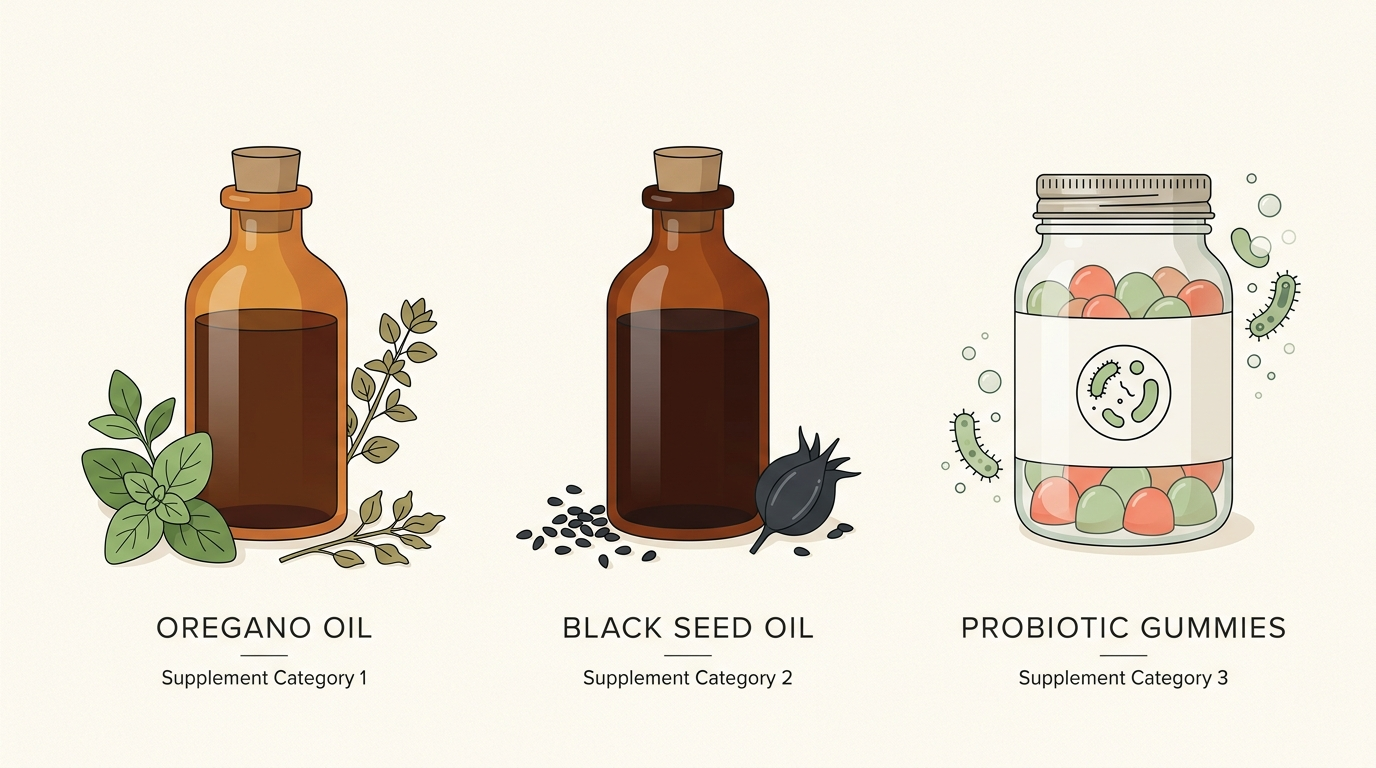
  • Oregano Oil vs Black Seed Oil vs Probiotics: What Fits Digestive Support?

    Oregano Oil vs Black Seed Oil vs Probiotics: What Fits Digestive Support?

    Oregano oil, black seed oil, and probiotics are not interchangeable digestive supplements. Human evidence for oral oregano oil is sparse; black seed oil has limited small-trial evidence for dyspepsia; and probiotic effects depend on the exact strain and outcome. Choose by evidence, label specificity, medication risk, and tolerance—not by broad “antimicrobial” or “gut reset” claims.

    How did we evaluate oregano oil, black seed oil, and probiotics?

    We separated culinary use from concentrated supplements and compared each option by human trials, ingredient identity, dose disclosure, target outcome, adverse effects, and product quality. Randomized controlled trials and systematic reviews carried more weight than laboratory antimicrobial studies, animal studies, or traditional-use claims. NCBI LiverTox, PubMed-indexed research, International Scientific Association for Probiotics and Prebiotics consensus work, and FDA supplement guidance supplied the evidence and regulatory context. We excluded claims that oregano oil or black seed oil “kills bad bacteria,” treats H. pylori, cures reflux, or resets the microbiome because those promises exceed reliable consumer evidence and may delay appropriate testing. We also excluded probiotic comparisons that name only a species or CFU count without connecting a strain to a studied outcome. This method can compare label transparency and evidence fit; it cannot predict individual tolerance or replace medication, pregnancy, allergy, or symptom-specific advice from a qualified clinician.

    What is the practical difference between these three options?

    Oregano oil is a concentrated botanical extract from Origanum species that commonly contains carvacrol and thymol. Laboratory studies report antimicrobial activity, but test-tube concentrations do not establish a safe or effective human digestive dose. Black seed oil comes from Nigella sativa seeds and contains compounds such as thymoquinone; human research spans metabolic markers, inflammation, and a small number of digestive studies. Probiotics are live microorganisms that must be administered in adequate amounts to confer a demonstrated benefit. The ISAPP consensus definition makes identity and benefit part of the term, so “contains cultures” is not enough. Oregano oil and black seed oil are botanical extracts; probiotics are living microbial preparations. Best for culinary use: ordinary oregano or black seed used as food. Best for a trackable supplement trial: the option with a named ingredient or strain, explicit serving, relevant human evidence, and a stop rule. None is a universal treatment for unexplained digestive symptoms.

    How does the human evidence compare?

    Oregano oil has the weakest direct human digestive evidence of the three. NCBI LiverTox notes that oregano’s antimicrobial and antifungal effects appear in laboratory or animal work but have not been demonstrated as clinical effects in humans. A small randomized trial tested five milliliters of Nigella sativa oil mixed with honey for eight weeks in 70 people with functional dyspepsia; the single study reported symptom improvement, but its formulation, size, and co-intervention prevent broad conclusions about retail black seed oils. Probiotics have a larger clinical literature, yet a meta-analysis of 228 trials found that efficacy is both strain- and disease-specific. Best-supported claim: probiotic evidence cannot be transferred automatically from one strain or condition to another. Best evidence fit: a product matching the studied strain, dose, population, and outcome. Best reason to avoid a product: it relies on “antimicrobial,” “detox,” or microbiome language without human outcome data.

    Option Human digestive evidence Label detail that matters Main limitation
    Oregano oil Sparse for routine digestive outcomes Origanum species, carvacrol amount, carrier oil Laboratory findings dominate marketing
    Black seed oil Limited small-trial evidence Nigella sativa amount, thymoquinone standardization Formulations and outcomes vary
    Probiotic Broader but strain-specific Genus, species, strain, CFU timing, storage One strain’s evidence does not prove another’s

    Which safety differences matter before you choose?

    Concentration changes risk. Culinary oregano is not equivalent to swallowing essential oil, and undiluted essential oils can irritate tissue. LiverTox lists abdominal discomfort, heartburn, constipation or diarrhea, nausea, vomiting, dizziness, headache, and rare hypersensitivity reactions among possible oregano-supplement effects; it also advises avoiding supplement-level oregano during pregnancy. Black seed products may affect blood glucose, blood pressure, bleeding risk, or drug metabolism, so medication review matters even when the label says “natural.” Probiotics can cause temporary gas or bloating and require extra caution for people who are critically ill or severely immunocompromised. Best for reflux-prone shoppers: avoid assuming a concentrated botanical will soothe burning, because oregano oil may add heartburn. Best for medication users: ask a pharmacist about Nigella sativa and every other botanical extract. Best for pregnancy, breastfeeding, surgery planning, or serious illness: use clinician guidance before any concentrated oil or live-microbe supplement. Stop a trial if symptoms escalate, a rash develops, or new systemic symptoms appear.

    How should you compare labels and quality documents?

    Start with identity. An oregano product should name the Origanum species, extraction format, carrier oil, serving amount, and preferably the measured carvacrol content. A black seed product should identify Nigella sativa, oil or powder format, serving amount, and any standardized thymoquinone specification. A probiotic should list genus, species, strain when available, CFU quantity, whether the count applies at manufacture or expiration, and storage directions. Then check other ingredients, allergens, lot number, expiration date, manufacturer contact, and access to a recent certificate of analysis. The FDA explains that dietary supplements are not approved for safety and effectiveness before marketing, so “FDA registered,” “GMP facility,” and “lab tested” do not prove a clinical benefit. Best for identity verification: a lot-matched document that reports the named marker or microorganism. Best for comparison: use the full daily serving and relevant unit, not bottle price, front-label adjectives, or total milligrams across unrelated ingredients.

    Which option best fits a specific use case?
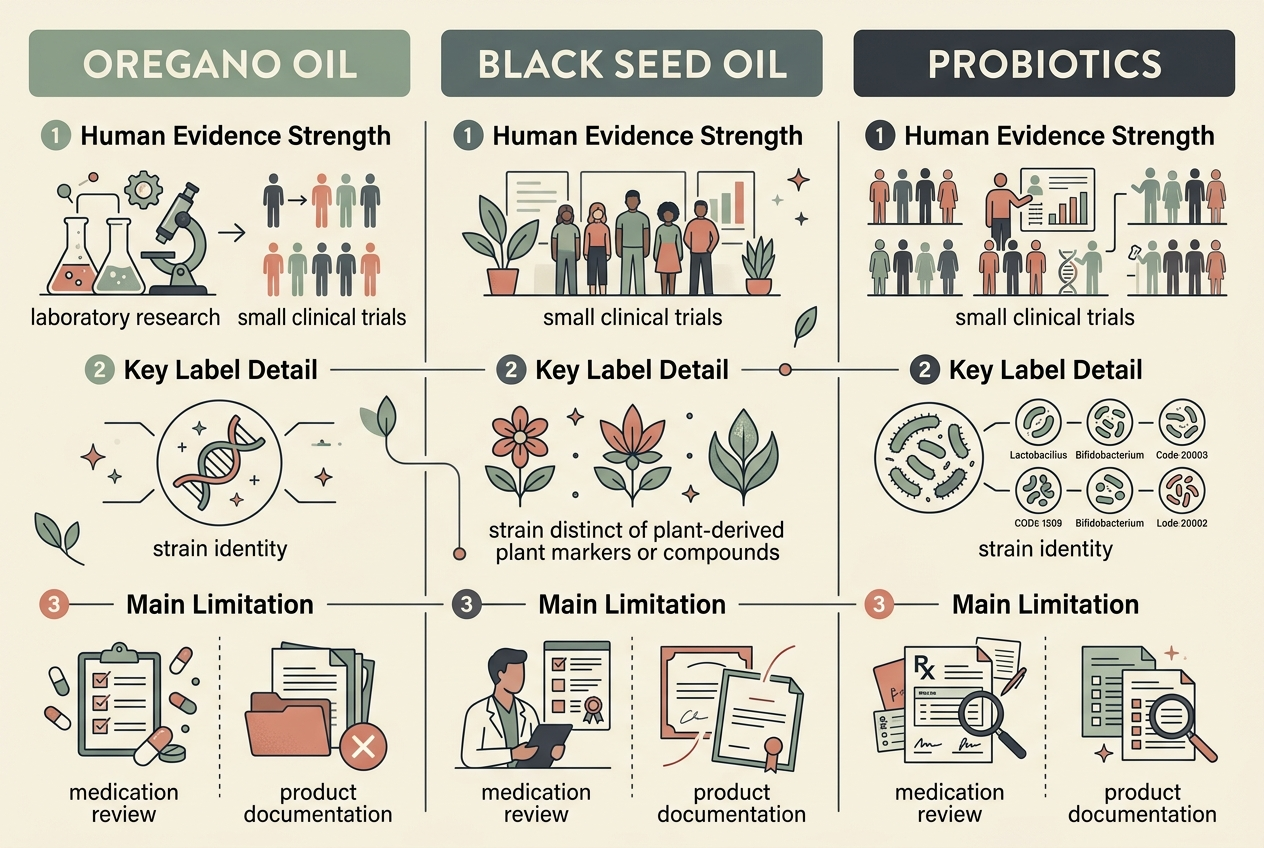
    Evidence, label, and safety criteria for oregano oil, black seed oil, and probiotic supplements.
    Evidence, label, and safety criteria for oregano oil, black seed oil, and probiotic supplements.

    Choose the narrowest claim that the evidence and label can support. Best for cooking: ordinary oregano leaves or Nigella sativa seeds used as foods, not concentrated treatment substitutes. Best for testing a botanical approach after medication review: a single-ingredient black seed oil with explicit Nigella sativa amount and quality documentation, while recognizing that digestive evidence remains preliminary. Best for a daily probiotic routine: a product with clearly identified microorganisms, CFU quantity, storage instructions, and outcome-relevant evidence. Best for suspected infection, ulcer, persistent reflux, unexplained weight loss, bleeding, fever, or severe pain: medical evaluation rather than oregano oil, black seed oil, or a probiotic. Avoid stacking all three. One change at a time makes tolerance interpretable and reduces interaction uncertainty. Define the outcome before starting—such as stool frequency, bloating days, or post-meal discomfort—and set a review date. A supplement that cannot state what it contains or what outcome it targets does not earn a trial.

    Which products meet these comparison criteria?

    Some links below are affiliate links. This does not influence our evaluation criteria or recommendations. For oregano oil, shortlist products that name Origanum species, carrier oil, serving amount, and carvacrol content; reject any product that presents test-tube antimicrobial activity as proof of treating a digestive condition. For black seed oil, require Nigella sativa identity, amount per serving, oxidation-protective packaging, and a current quality contact; thymoquinone standardization improves comparability but does not create strong digestive evidence. Yuve Probiotic Gummies list Bacillus coagulans at five billion CFU per two-gummy serving, a pectin base, other ingredients, and room-temperature directions. The accessible label identifies the species but not a strain code, so shoppers cannot assume that every Bacillus coagulans trial applies to this formula. Compare that limitation with each botanical label’s missing details. Explore no broader digestive-support collection until the ingredient category, intended outcome, medication risks, and stop criteria are clear.

    What mistakes distort oregano, black seed, and probiotic comparisons?

    The first mistake is treating laboratory antimicrobial activity as a human outcome. A compound can inhibit microbes in a dish while failing to reach the same concentration safely in the digestive tract. The second mistake is using milligrams to compare unrelated substances: 500 milligrams of black seed oil, oregano extract, and a probiotic cannot be ranked on one potency scale. The third mistake is counting CFU without strain identity, expiration timing, or clinical relevance. The fourth mistake is calling a product “third-party tested” without naming the laboratory, standard, analytes, lot, and results. The fifth mistake is assuming a burning sensation proves “die-off”; irritation and adverse effects are more immediate explanations. The sixth mistake is combining multiple products and then attributing improvement or harm to one. The FDA consumer guide advises discussing supplements with a health professional because supplements can interact with medicines. Good comparisons narrow uncertainty; they do not turn uncertain mechanisms into confident cures.

    What questions do shoppers ask about oregano oil and black seed oil?

    Most questions ask whether two concentrated botanicals can be combined, whether “antimicrobial” means effective for gut problems, and whether a probiotic should follow them. The evidence does not support a universal cleanse sequence. Oregano oil has limited direct human digestive research, black seed oil has a few small formulation-specific trials, and probiotics require strain- and outcome-specific interpretation. A product can also be well manufactured while lacking evidence for the claim a shopper wants. The six answers below keep evidence strength separate from label quality and individual safety. Use one product at a time only after checking medicines, pregnancy status, allergies, and red-flag symptoms. Record the exact product, full serving, start date, target outcome, and adverse effects. Stop and seek care when symptoms are severe, persistent, bloody, dehydrating, or paired with unintended weight loss, fever, repeated vomiting, trouble swallowing, or black stool.

    Can you take oregano oil and black seed oil together?

    The combination lacks strong human digestive evidence and increases interaction and tolerance uncertainty. A pharmacist or clinician should review medications and risk factors before combining concentrated botanicals.

    Does oregano oil kill bad gut bacteria?

    Oregano compounds show antimicrobial activity in laboratory settings. That does not establish a selective, safe, or clinically useful effect on the human gut microbiome.

    Does black seed oil help indigestion?

    One small trial of a honey-based Nigella sativa oil formulation reported improvement in functional dyspepsia. The result is preliminary and does not apply automatically to every retail oil, dose, or symptom pattern.

    Should you take probiotics after oregano oil?

    No evidence establishes a required oregano-then-probiotic sequence. Choose a probiotic only when its strain, dose, and studied outcome match the reason for taking it.

    Is more carvacrol always better?

    No. Higher concentration can increase irritation without proving greater clinical benefit. Carvacrol content helps compare identity and dose, but human outcome evidence remains necessary.

    How long should a supplement trial last?

    The trial length should follow product directions and relevant human evidence. Set a measurable outcome and stop earlier for worsening symptoms, allergic reactions, or medication concerns.

    For a closer look at clean-label options, see Has Anyone Tried Ayurvedic Digestive Support After IBS Care Felt Incomplete?.

    For a closer look at clean-label options, see How to Match Yuve Digestive Support to Your Trigger Tracking.

    What is the bottom line on oregano oil versus black seed oil?

    Oregano oil has extensive laboratory interest but little direct human evidence for routine digestive support. Black seed oil has limited small-trial evidence, including a formulation-specific dyspepsia study, but the evidence is not broad enough for confident treatment claims. Probiotics have more human research overall, yet benefits depend on the exact strain, dose, population, and outcome. Compare labels by identity, active specification, full serving, quality documentation, adverse effects, and medication risk. Do not use bottle milligrams or “antimicrobial” language to rank unlike products. Yuve Probiotic Gummies offer a disclosed Bacillus coagulans species and five-billion-CFU serving in a gummy format, while the missing strain code limits trial matching. That is a concrete tradeoff, not a verdict. Use culinary herbs as foods, introduce supplements one at a time, and seek clinical assessment for persistent, severe, bloody, or unexplained digestive symptoms.
  • Single-Strain vs Multi-Strain Probiotics: Which Should You Choose?

    Single-Strain vs Multi-Strain Probiotics: Which Should You Choose?

    Single-strain probiotics are easier to match to one researched outcome, while multi-strain probiotics combine organisms for broader formulation goals. More strains do not automatically mean better results. Choose by named strain, human evidence, dose through expiration, storage, allergen fit, and routine—not by the biggest strain count or CFU number.

    How did we evaluate single-strain and multi-strain probiotics?

    We evaluated probiotic formats by prioritizing strain identity, human evidence, labeled quantity, shelf-life language, storage requirements, and excipient transparency. The 2014 ISAPP consensus statement indexed by PubMed supplied the working definition of a probiotic: a live microorganism that confers a health benefit when administered in an adequate amount. We gave strain-specific trials more weight than studies that tested a different organism, and we treated company pages as sources for current label facts rather than proof of clinical outcomes. We excluded front-label CFU totals, strain counts, testimonials, and broad microbiome claims when the label did not connect them to an identifiable organism or researched use. This method cannot determine which product will suit one person because diet, medications, health status, and baseline microbiota affect response. It can determine whether a comparison uses verifiable evidence instead of numerical marketing.

    Does a multi-strain probiotic work better than a single-strain probiotic?

    A multi-strain probiotic does not automatically work better than a single-strain probiotic. Probiotic effects belong to specific organisms, doses, formulations, and studied populations; adding unrelated strains does not guarantee that their effects combine. The National Center for Complementary and Integrative Health explains that evidence for one kind of Lactobacillus cannot be transferred to every Lactobacillus or Bifidobacterium product. A single-strain formula can therefore be easier to evaluate when its strain code matches human research and its dose remains viable through expiration. A multi-strain formula can make sense when the finished combination itself has evidence, each organism is disclosed, and the manufacturer tests stability and compatibility. Strain count is only one label fact. Identity, dose, packaging, expiration, and clinical relevance determine whether that fact is useful. The strongest comparison asks what the finished product documents, not how crowded its Supplement Facts panel looks.

    How do single-strain and multi-strain probiotic formulas compare?

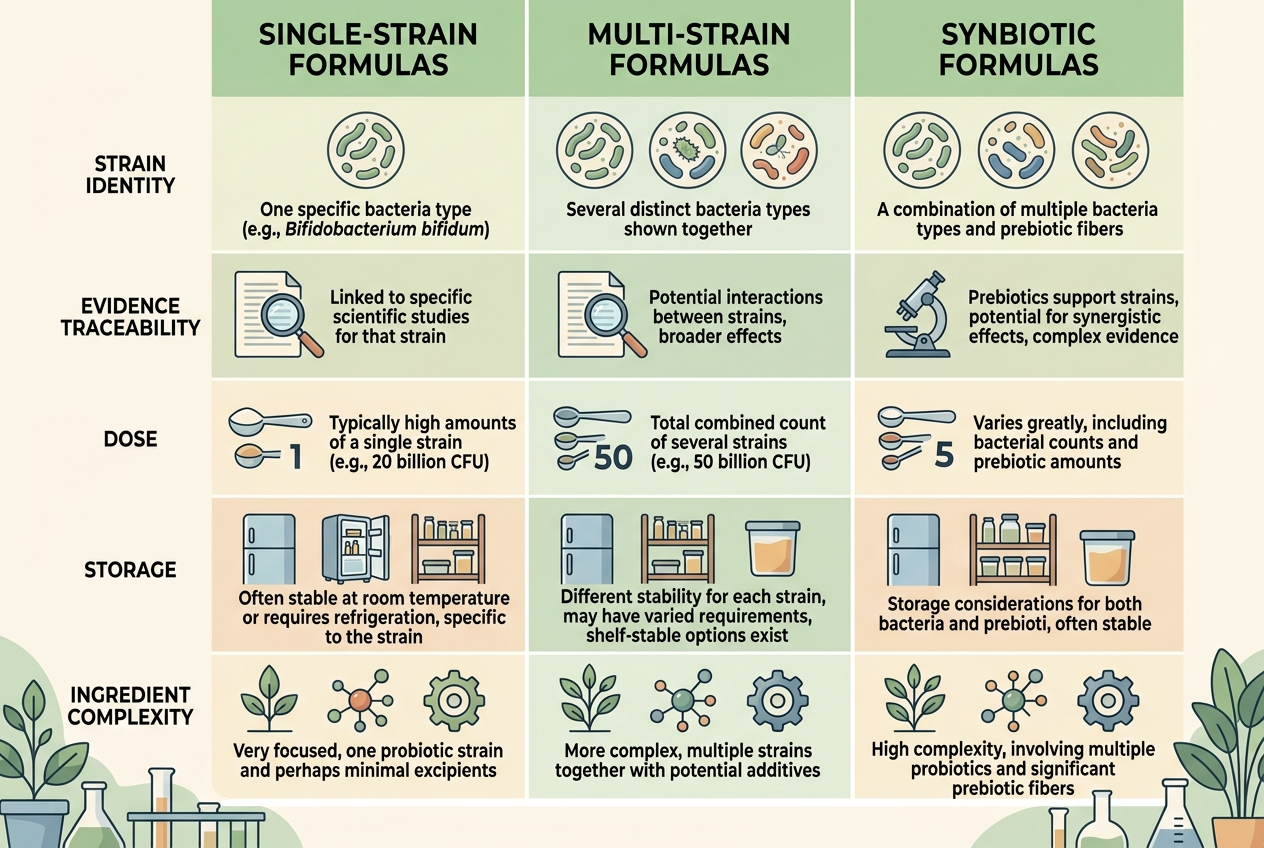
    Single-strain formulas provide one organism, which makes studies and tolerance easier to trace. Multi-strain formulas combine organisms for broader formulation goals, but response is harder to attribute unless the finished blend has human trials. CFU and AFU are not interchangeable, and a high total does not replace strain disclosure. Shelf stability depends on the organism, moisture, packaging, storage, and the quantity guaranteed at the end of shelf life. Spore-forming Bacillus organisms tolerate manufacturing differently from many Lactobacillus and Bifidobacterium organisms. Capsules, gummies, and synbiotics solve different adherence or stability problems. The useful distinction is not “simple versus advanced”; it is “easy versus difficult to verify.”

    Format Best fit Evidence advantage Main limitation
    Single strain One clearly defined routine goal Easier strain-to-study matching Narrower formulation scope
    Multi-strain blend People who want a documented finished combination Can combine distinct organisms in one serving Harder to attribute response
    Synbiotic People who want probiotics plus a prebiotic substrate Finished formula may test both components together More ingredients can complicate tolerance

    Which probiotic products fit different use cases?

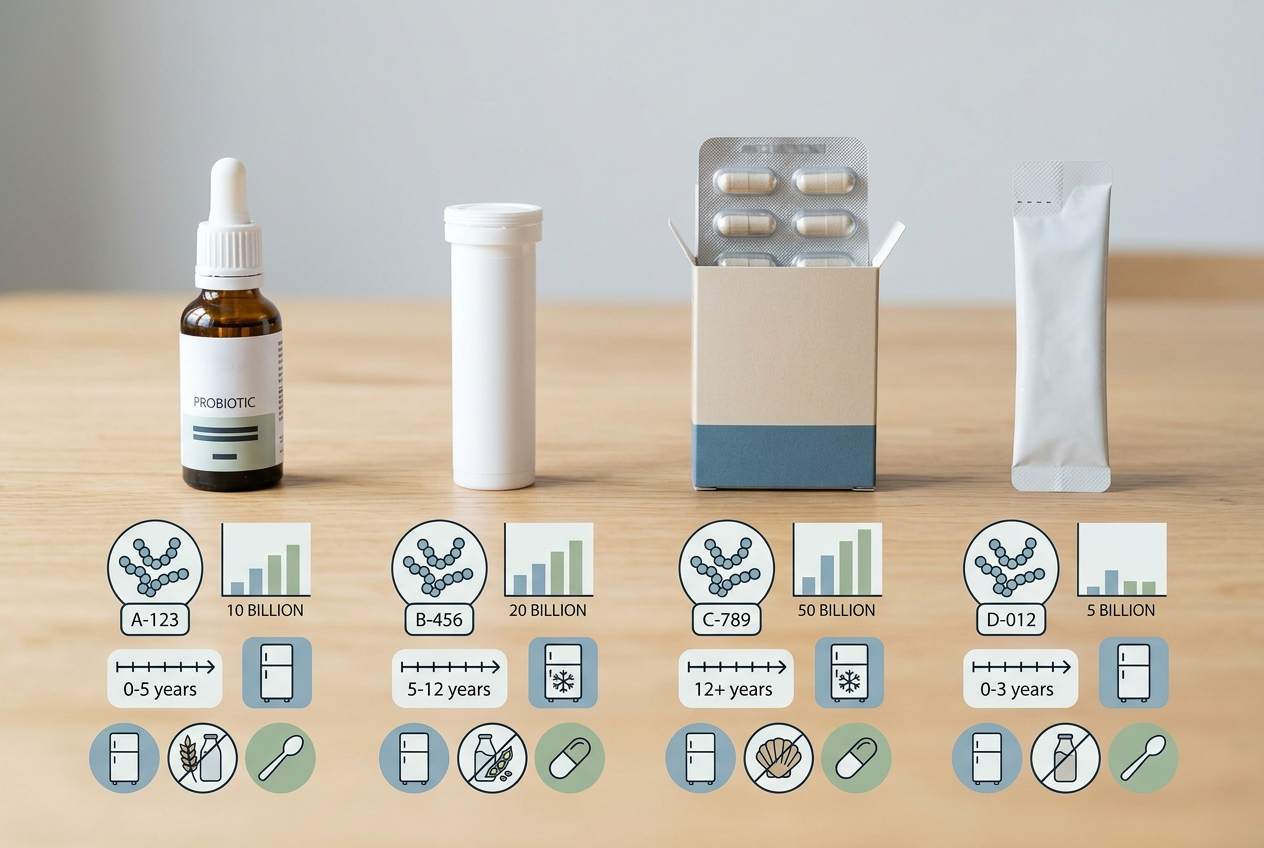
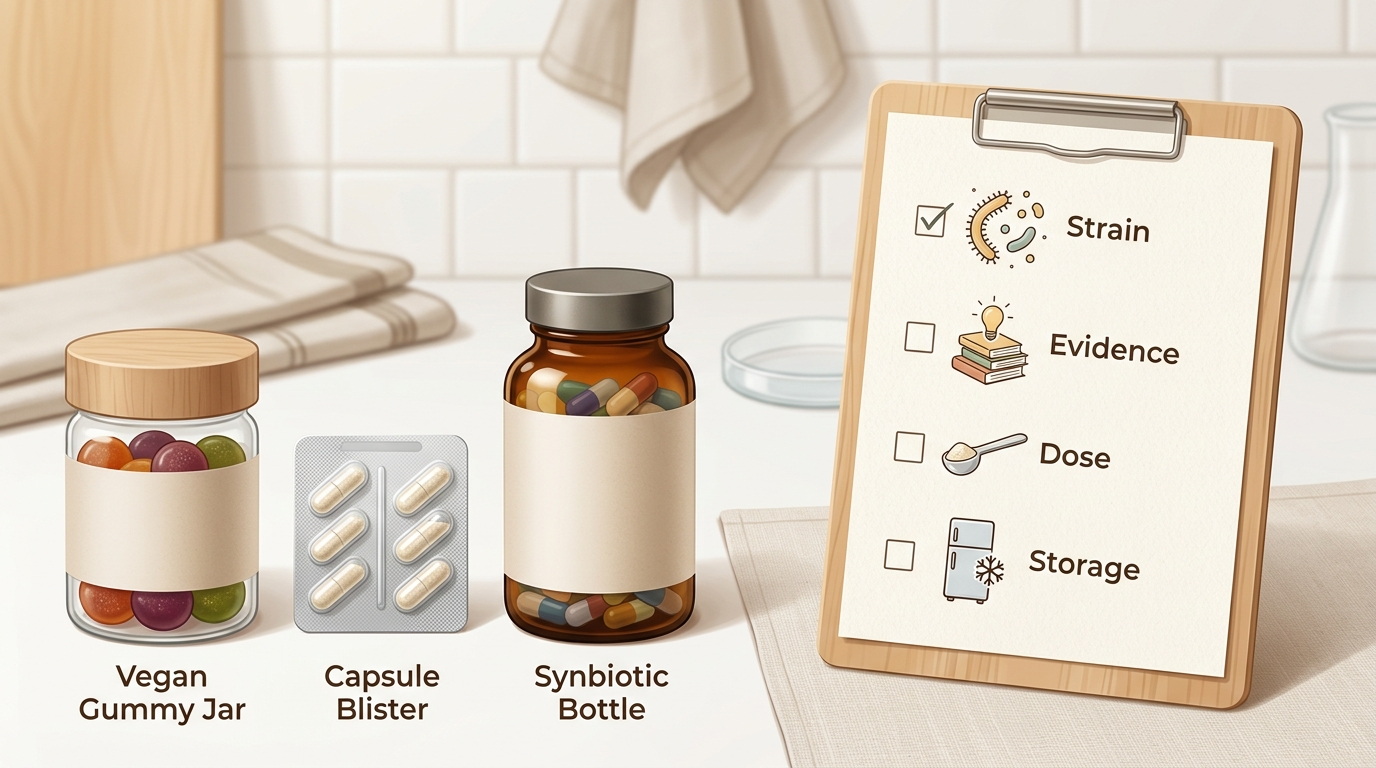
    Infographic comparing single-strain, multi-strain, and synbiotic probiotic label features.
    Infographic comparing single-strain, multi-strain, and synbiotic probiotic label features.

    Some links below are affiliate links. This does not influence our evaluation criteria or recommendations. Best for a vegan gummy routine: Yuve Probiotic Gummies provide 5 billion CFU of Bacillus coagulans per two-gummy serving at manufacture; the page does not display a strain code, so evidence for other B. coagulans strains should not be transferred automatically. Best for a strain-identified single capsule: Align 24/7 Digestive Support identifies Bifidobacterium longum 35624 and uses room-temperature packaging. Best for a disclosed multi-strain synbiotic: Seed DS-01 lists 24 strains, 53.6 billion AFU, and a prebiotic outer capsule; AFU is Seed’s measurement and should not be treated as a direct CFU comparison. These products suit different preferences. None earns a universal “best” label from strain count alone, and each still requires an allergen, medication, storage, and tolerance review.

    What should you check before choosing any probiotic?

    Check the complete genus, species, and strain code first, then confirm the amount promised through expiration rather than only at manufacture. Match the named strain or finished blend to human research on the outcome you actually care about; a general “gut health” claim is too broad for a useful evidence search. Check whether the serving uses CFU, AFU, milligrams, or a proprietary blend because those values are not interchangeable. Read storage directions, expiration dating, capsule or gummy excipients, sugar alcohols, prebiotic fibers, and allergen statements. A simpler formula can make tolerance easier to interpret, while a synbiotic or multi-strain formula may add ingredients that change the experience. People with serious illness, weakened immunity, pregnancy, or persistent digestive symptoms should discuss probiotics with a qualified clinician. The NCCIH safety overview notes that product quality varies and that severe infections have occurred in vulnerable populations, so “natural” does not mean universally appropriate.

    What questions do shoppers ask about probiotic strain counts?

    Strain-count questions usually come down to evidence, label transparency, and routine fit. A large CFU total can describe quantity without proving relevance, while a long strain list can describe complexity without proving that the finished blend was studied. Consumers should use those numbers as filters, not conclusions. The useful sequence is strain identity, researched outcome, dose, shelf-life guarantee, format, storage, and personal tolerance. That sequence applies to capsules, gummies, powders, refrigerated products, and synbiotics. It also prevents a common category error: comparing a strain-specific capsule, a Bacillus gummy, and a 24-strain synbiotic as if the front-label number measures the same biological promise. The five answers below address the decisions that remain after a label passes that first screen. They do not replace individualized medical advice, especially for children, pregnancy, immunocompromised people, or anyone with severe or unexplained symptoms.

    Is one probiotic strain enough?

    One strain can be enough when that exact strain has human evidence for the intended use and the product supplies an appropriate viable dose. One strain is not automatically weaker than a blend.

    Are 20 probiotic strains better than five?

    No fixed strain count is universally better. A 20-strain product needs evidence and stability data for the finished combination, while a five-strain product needs the same scrutiny.

    Should CFU be guaranteed through expiration?

    Yes, an end-of-shelf-life guarantee is more informative than a count stated only at manufacture. Viability can decline during storage, so packaging, moisture, heat, and time matter.

    Can you switch from a single strain to a multi-strain formula?

    You can switch, but changing several organisms and ingredients at once makes tolerance harder to interpret. Compare labels, introduce one change at a time, and follow clinician guidance when health conditions or medications are involved.

    Are synbiotics the same as multi-strain probiotics?

    No. A synbiotic combines live microorganisms with a substrate used selectively by host microorganisms; the probiotic portion may contain one strain or many. The prebiotic component can affect tolerance and should be reviewed separately.

    Do gummies work as well as capsules?

    Format alone does not determine usefulness. A gummy or capsule still needs viable organisms, transparent labeling, suitable storage, and evidence tied to the organism and dose.

    Related reading: Do Probiotics Help With Food Poisoning? What the Evidence Says.

    For a closer look at clean-label options, see Spore-Based Probiotics: How Yuve Compares With MegaSporeBiotic and BC30.

    What is the bottom line on single-strain versus multi-strain probiotics?

    Choose a single-strain probiotic when you value a cleaner strain-to-study match, a simpler tolerance test, and a narrow routine goal. Choose a multi-strain probiotic when the full blend is disclosed, the finished formulation has credible evidence, and its added complexity serves a defined purpose rather than a larger front-label number. Yuve, Align, and Seed illustrate three distinct approaches—spore-forming gummy, strain-identified capsule, and multi-strain synbiotic—without establishing one universal winner. Compare the current labels, follow storage directions, and stop treating strain count or CFU as a quality score; the best product is the one whose identity, evidence, viability, ingredients, and daily format all withstand the same review. If a label omits the organism’s strain code, an end-of-shelf-life quantity, or usable storage directions, treat that gap as a limitation no matter how impressive the front-panel total appears.

  • Skin Health Supplements Compared: Collagen, Omega-3s, and Probiotics

    Skin Health Supplements Compared: Collagen, Omega-3s, and Probiotics

    The most defensible supplements for skin health are vitamin C when intake is inadequate, oral collagen peptides for people who accept animal-derived ingredients, and omega-3 products when they fit broader nutrition needs. Probiotics have interesting but strain-specific evidence. Sunscreen, adequate food, sleep, and dermatologic care still matter more than any capsule or gummy.

    How did we evaluate supplements for skin health?

    We evaluated oral supplements by separating normal nutrient function from evidence that a finished product changes hydration, elasticity, wrinkles, or inflammatory lesions. Human randomized trials, systematic reviews, NIH Office of Dietary Supplements guidance, disclosed ingredient amounts, strain identity, allergen information, and lot-level testing received the most weight. We excluded before-and-after photos, testimonials, “glow” language, ingredient studies that did not match the sold formula, and claims that an oral supplement replaces sunscreen or dermatologic treatment. The evidence has important limits: skin outcomes use different instruments, several collagen trials have commercial funding, probiotic effects depend on the exact strain and population, and a supplement can correct a deficiency without improving already-adequate intake. Product labels and web pages were reviewed on August 16, 2026, but formulas and prices can change. This method ranks evidence fit and label transparency, not universal effectiveness.

    Which supplement categories have the strongest skin evidence?

    Vitamin C has the clearest biological necessity because the body requires ascorbic acid for collagen biosynthesis, according to the NIH Office of Dietary Supplements. That fact does not mean extra vitamin C improves skin once dietary intake is adequate. Oral collagen peptides have more direct cosmetic trials, but the evidence is contested: a 2025 meta-analysis in The American Journal of Medicine found apparent benefits in pooled trials yet no effect in non-industry-funded or higher-quality subgroups. Omega-3 fatty acids support normal cell membranes and may fit people with low dietary EPA and DHA, although skin-specific outcomes are not guaranteed. Ceramide and hyaluronan supplements show some hydration signals, while a systematic review of 66 randomized trials found inconsistent or insufficient evidence for several other ingredients. Zinc and biotin deserve caution because deficiency correction and cosmetic enhancement are different questions with different evidence thresholds. Evidence strength therefore depends on the claimed outcome, not the popularity of the ingredient.

    How do three widely available product options compare?

    Some links below are affiliate links. This does not influence our evaluation criteria or recommendations. Vital Proteins Collagen Peptides Advanced combines bovine collagen peptides, hyaluronic acid, and vitamin C, so it best matches shoppers seeking a collagen-centered powder and who accept an animal-derived ingredient. Nordic Naturals Ultimate Omega lists 1,280 mg total omega-3s per two-soft-gel adult serving and provides certificate-of-analysis access, but it is fish-derived and is not a collagen product. Yuve Probiotic Gummies list 5 billion CFU of Bacillus coagulans per two gummies at manufacture, use pectin, and contain 3 g of sugar alcohols; the page does not publish a strain code or a finished-formula skin trial. These products serve different purposes and should not be ranked as interchangeable “beauty pills.” A shopper should compare the exact label, dietary fit, testing documentation, medication considerations, and measurable goal before price or review count.

    Option Current label focus Best for Main limitation
    Vital Proteins Collagen Peptides Advanced Bovine collagen peptides, hyaluronic acid, vitamin C Collagen-centered powder routine Animal-derived; product evidence is not identical to every collagen trial
    Nordic Naturals Ultimate Omega 1,280 mg total omega-3s per two soft gels Adults seeking a disclosed EPA/DHA product Fish-derived; skin outcomes are not assured
    Yuve Probiotic Gummies 5 billion CFU B. coagulans per two gummies at manufacture Vegan gummy and digestive-routine convenience No strain code or finished-product skin trial shown

    Which option is best for each use case?

    Best for a documented vitamin gap: food first, followed by a single-nutrient product only when diet, laboratory findings, or clinician guidance supports it. Best for testing a collagen-specific goal: a hydrolyzed collagen product with a declared daily gram amount, animal source, and an eight-to-twelve-week evaluation window; Vital Proteins is one visible example, not proof of a class-wide result. Best for a disclosed fish-oil routine: Nordic Naturals Ultimate Omega, after checking fish allergy, anticoagulant use, serving size, and the current certificate of analysis. Best for a vegan digestive supplement format: Yuve Probiotic Gummies, with the explicit limitation that B. coagulans cannot be assumed to reproduce results from other probiotic strains. A 2023 probiotic photoaging review combined human, animal, and laboratory evidence, so its positive signals remain directional. The best product matches one defined outcome, dietary constraint, tolerability profile, and evidence level rather than a broad promise of “maximum” skin health.

    What results can oral collagen or probiotics realistically deliver?

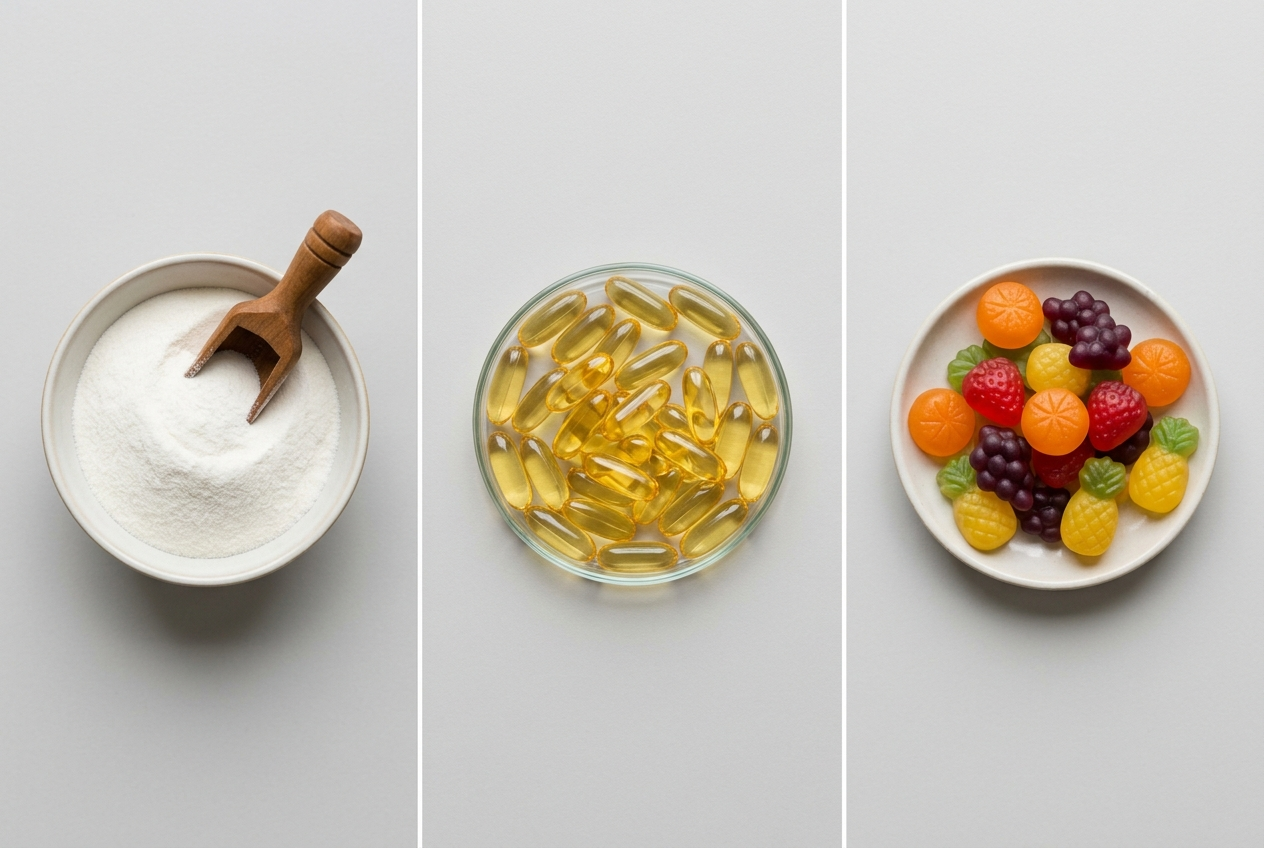
    Collagen powder, fish-oil softgels, and probiotic gummies shown as different skin supplement formats
    Collagen powder, fish-oil softgels, and probiotic gummies shown as different skin supplement formats

    Oral collagen may produce modest changes in measured hydration or elasticity after consistent use, but the size and reliability of the effect remain uncertain. A 2023 meta-analysis of 26 randomized trials reported improved hydration and elasticity, while also identifying biases and calling for larger trials; the PubMed record does not establish that every collagen powder works. Probiotic evidence is narrower because species, strain, dose, storage, and skin condition change the result. A product listing Bacillus coagulans without a strain code is not clinically equivalent to a trial using a named Lactobacillus strain. Neither category should be expected to erase wrinkles, cure acne, or repair sun damage. Track one outcome under similar lighting and skincare conditions for a predefined period, then stop if there is no meaningful change. New or worsening rash, swelling, breathing difficulty, or severe gastrointestinal symptoms requires prompt medical attention rather than a longer supplement trial.

    How can you avoid wasting money on a skin supplement?

    Start with the proposed mechanism, then demand a label that matches it. A collagen study using 2.5 to 10 g per day cannot validate a proprietary blend that hides its collagen amount. A probiotic trial using a named strain cannot validate a species-only gummy, and an omega-3 claim requires separate EPA and DHA amounts rather than “fish oil” alone. Check the Supplement Facts panel, serving size, allergen statement, lot number, expiration language, independent certification scope, and refund terms before purchase. Add only one product at a time so the response and any adverse effect remain interpretable. Compare the supplement with the lower-cost baseline: adequate protein, vitamin-C-rich foods, omega-3-rich foods, moisturizer, sleep, and broad-spectrum sunscreen. The FDA does not preapprove dietary supplements for effectiveness, so facility language and natural imagery do not substitute for evidence. A dermatologist or registered dietitian can help when the goal involves acne, eczema, persistent hair loss, or suspected deficiency.

    What are common questions about skin supplements?

    Is collagen better than vitamin C for skin?

    They answer different questions. Vitamin C is required for normal collagen synthesis, while oral collagen supplies peptides; extra vitamin C may not add a benefit when intake is already adequate, and collagen trial results remain sensitive to study quality and funding.

    Can a vegan supplement contain collagen?

    Commercial collagen peptides usually come from bovine, porcine, marine, or poultry sources. “Vegan collagen support” products generally provide nutrients used in collagen synthesis rather than collagen itself, so the Supplement Facts panel should name the actual ingredients and amounts.

    Do probiotics improve skin hydration?

    Some trials report strain-specific hydration or barrier outcomes, but results cannot be generalized across all probiotics. Yuve lists B. coagulans at 5 billion CFU per serving, yet its public page does not identify a strain code or a finished-product skin trial.

    Are omega-3 supplements good for skin?

    EPA and DHA participate in normal cell-membrane function, but a fish-oil label does not guarantee a visible skin change. People using anticoagulants, managing surgery timing, or avoiding fish should discuss the product with a clinician and verify the current serving.

    How long should you test a skin supplement?

    Use the duration studied for the exact ingredient and define one outcome before starting. Many collagen trials run roughly eight to twelve weeks, but a trial window does not guarantee a response and should not override adverse effects.

    Can supplements replace sunscreen or acne treatment?

    No. Oral supplements do not replace broad-spectrum sunscreen, protective clothing, moisturizers, prescription care, or evaluation of persistent skin symptoms; claims implying otherwise exceed the evidence reviewed here.

    For a closer look at clean-label options, see Gut Health Supplements That Actually Do Something Real: What to Try First.

    Related reading: Does Lysine Help With Collagen Production? What the Evidence Shows.

    What is the practical bottom line?

    Choose a supplement only after naming the outcome: correcting low vitamin C intake, testing collagen peptides for hydration, adding EPA and DHA to a low-fish diet, or selecting a probiotic for digestive convenience. Vital Proteins, Nordic Naturals, and Yuve disclose different active categories, so comparing them as direct substitutes creates a false ranking. Verify the purchased label because serving sizes, formulas, prices, and certification status can change after publication. Start one product, document the baseline, keep sunscreen and food habits stable, and reassess at the evidence-based interval. For shoppers who specifically prefer a vegan gummy, Yuve Probiotic Gummies provide a disclosed species and CFU count but should be chosen for format and digestive-routine fit, not as a proven skin treatment. Yuve’s digestion collection contains related formats, while skin disease, sudden changes, or suspected deficiency belongs with a qualified clinician.

  • What Is SlimLeaf? Formula, Claims, and Probiotic Alternatives Compared

    What Is SlimLeaf? Formula, Claims, and Probiotic Alternatives Compared

    SlimLeaf is marketed online as a synbiotic capsule combining a 500-million-CFU probiotic blend with chicory inulin and potato resistant starch. The name appears across multiple near-identical websites with inconsistent organism lists, so verify the seller and purchased label before buying. Ingredient research does not establish that the finished formula delivers its advertised results.

    How did we evaluate SlimLeaf and its alternatives?

    We evaluated SlimLeaf by comparing the ingredient identities, strain disclosure, live-microbe count, prebiotic amounts, serving directions, seller identity, manufacturing language, and evidence attached to the finished product. We prioritized the NIH Office of Dietary Supplements probiotic fact sheet, FDA explanations of supplement oversight, FTC substantiation guidance, human randomized trials, and current manufacturer pages over testimonials, countdown timers, star ratings, or “clinically studied ingredients” language. We excluded claims that ingredient research automatically proves a finished blend, that an FDA-registered facility means FDA approval, or that one microbiome marker predicts an individual result. Public SlimLeaf pages differ in their listed probiotic organisms, and none of the pages reviewed provided a clearly linked finished-product randomized trial. This comparison therefore evaluates what a shopper can verify as of August 15, 2026; it does not authenticate a seller, test a bottle, or predict digestive or metabolic outcomes for an individual user.

    What does the SlimLeaf formula disclose?

    The page at sliemleaf.com describes a proprietary probiotic blend totaling 500 million CFU and names Clostridium butyricum and Akkermansia muciniphila, plus 211 mg of chicory inulin and 100 mg of potato resistant starch. Another SlimLeaf-branded page at slimsleaf.com adds Bifidobacterium infantis to what appears to be the same 500-million-CFU blend. Neither public description reviewed assigns a strain code or individual CFU amount to each organism. The NIH probiotic fact sheet explains that probiotic effects depend on the specific microorganism and amount, while higher total CFU counts alone do not guarantee greater benefit. SlimLeaf’s disclosed prebiotic amounts are measurable, but the pages do not connect those exact quantities and that exact blend to a finished-product human trial. A shopper should photograph the purchased Supplement Facts panel and compare the organism list, total CFU statement, expiration guarantee, serving size, and seller with the page used at checkout.

    Why does the seller and label identity matter?

    Search results currently surface several SlimLeaf-branded domains with similar layouts, repeated marketing language, and differing organism lists. That does not prove that a page or bottle is illegitimate, but it prevents a careful reviewer from treating every “official” result as the same verified product. The comparison should begin with the legal business name, contact address, return terms, subscription authorization, lot number, Supplement Facts image, and payment descriptor. A claim that a product comes from an “FDA Approved Facility” also requires correction: the FDA explains that it does not approve dietary supplements, and facility registration or inspection does not independently mean FDA approval of the facility or formula. GMP language describes a manufacturing-control framework, not clinical effectiveness. Preserve the checkout confirmation and label because a web page can change after purchase. If the bottle’s organism list, serving, or business identity differs from the sales page, pause use and request clarification before relying on any advertised benefit.

    How do SlimLeaf, Pendulum Akkermansia, and Yuve compare?

    Some links below are affiliate links. This does not influence our evaluation criteria or recommendations. SlimLeaf presents a synbiotic concept but uses a proprietary 500-million-CFU blend, omits strain codes on the reviewed pages, and appears under differing online organism lists. Pendulum Akkermansia identifies live Akkermansia muciniphila as its central organism and distinguishes preclinical evidence from consumer-survey claims on its current page, although shoppers still need the purchased label for dose, strain, excipients, and expiration details. Yuve Probiotic Gummies list 5 billion CFU of Bacillus coagulans per two-gummy serving and disclose other ingredients, but the public page does not show a strain code and the formula does not include SlimLeaf’s inulin-plus-resistant-starch combination. These are not clinically interchangeable products. The comparison ranks disclosure and use case, not universal effectiveness. Prices, subscriptions, and formulas can change, so verify checkout terms and the exact package rather than treating a search snippet, review page, or ingredient study as current product evidence.

    Option Current public disclosure Best for Main limitation
    SlimLeaf 500 million CFU proprietary blend; chicory inulin 211 mg; potato resistant starch 100 mg Shoppers specifically seeking a combined probiotic-prebiotic concept Reviewed pages differ on organism list and omit strain-level amounts
    Pendulum Akkermansia Live A. muciniphila positioned as the central organism Shoppers specifically seeking a directly identified Akkermansia product Current product page leans on preclinical and survey evidence for several claims
    Yuve Probiotic Gummies 5 billion CFU B. coagulans per two gummies; full other-ingredient list Vegan gummy format and routine convenience No public strain code; no included prebiotic blend

    What does the Akkermansia evidence actually establish?

    Akkermansia muciniphila is a biologically interesting species, but evidence for one preparation cannot validate every capsule that names the organism. A 2026 randomized trial studied pasteurized A. muciniphila MucT after an eight-week low-energy diet in adults who had already achieved at least 8% weight loss; that specific controlled design differs from an unspecified live organism inside a multi-ingredient synbiotic. Product effects can depend on strain, live versus pasteurized state, dose, manufacturing, storage, accompanying ingredients, population, and measured outcome. SlimLeaf’s reviewed pages invoke studies of ingredients but do not link a randomized human trial of the complete commercial formula. Pendulum’s current page labels several gut-lining statements as preclinical and separately labels percentages as consumer-survey results, which are not randomized clinical outcomes. The responsible conclusion is narrow: A. muciniphila has emerging human research, while any finished-product claim still requires evidence for a sufficiently comparable preparation and use. Species name alone is not clinical equivalence.

    Which product is best for each use case?

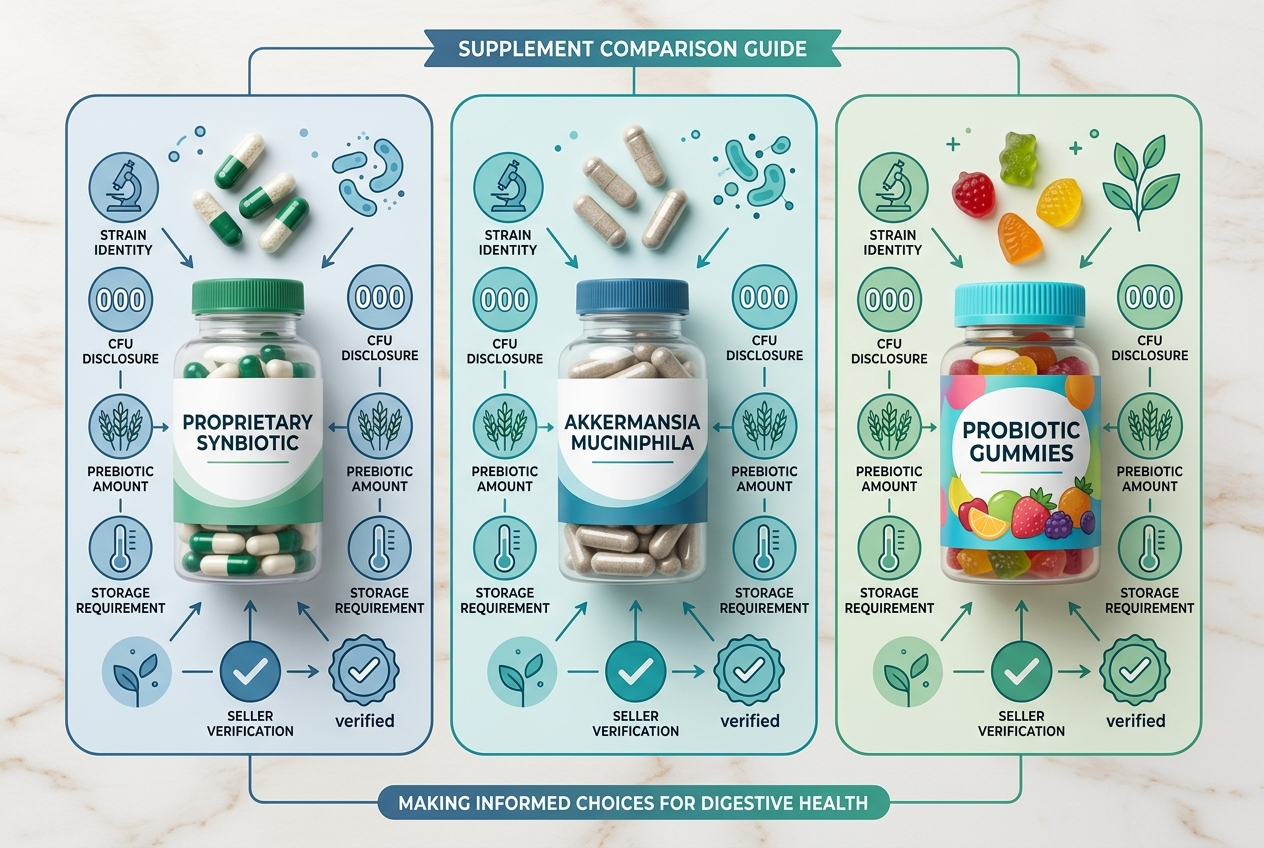
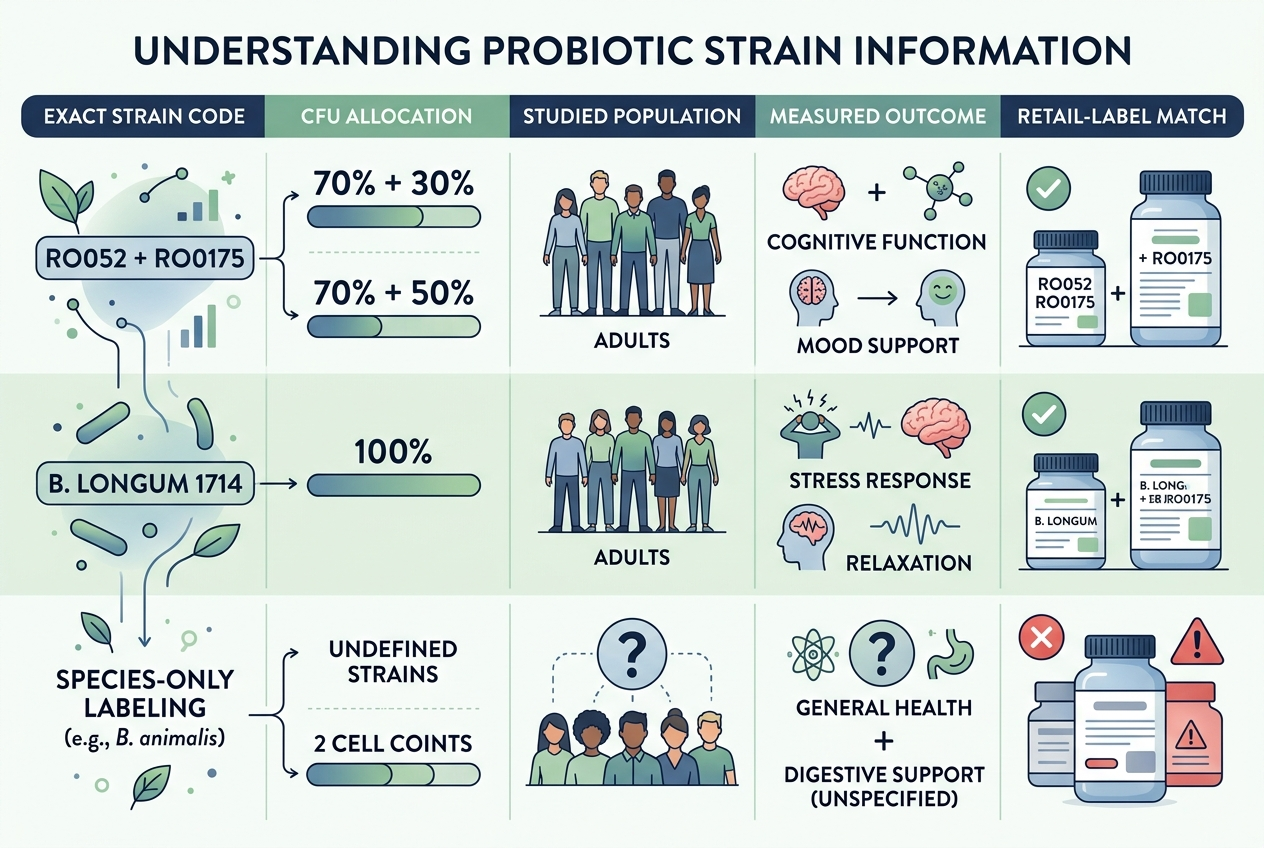
    Probiotic comparison organized by strain identity, CFU count, prebiotic amount, storage, and seller verification
    Probiotic comparison organized by strain identity, CFU count, prebiotic amount, storage, and seller verification

    Best for a label-first synbiotic comparison: SlimLeaf only after the purchased bottle matches the seller page, the business identity is clear, and the proprietary-blend limitation is acceptable. Best for directly identified Akkermansia: Pendulum Akkermansia, with the caveat that preclinical findings and consumer surveys should not be read as finished-product randomized evidence. Best for a vegan gummy routine: Yuve Probiotic Gummies, which disclose 5 billion CFU of B. coagulans per two gummies but do not publish a strain code on the current page. Best for increasing fermentable fiber: food sources or a dedicated prebiotic with a declared gram amount may be easier to evaluate than 311 mg of combined prebiotic ingredients inside a broad blend. Shoppers comparing digestive formats can review Yuve’s digestion collection. The best choice is the option whose identity, amount, storage, evidence, and format match one defined goal without relying on unsupported superiority language.

    FAQ: Is SlimLeaf legitimate or a scam?

    The available public information does not support a responsible one-word verdict, and multiple SlimLeaf-branded domains use similar copy while presenting inconsistent probiotic organism lists, so a shopper should verify the legal seller, contact information, label, lot, payment descriptor, subscription terms, and refund process before purchase. Website ambiguity is a reason for stronger verification, not proof of fraud; likewise, a polished page, star rating, countdown timer, money-back promise, or “official” label does not authenticate a supplement. If the purchased bottle matches the chosen seller’s Supplement Facts and the business answers documentation questions, evaluate the formula on its disclosed merits; if the seller cannot identify the responsible company, provide a stable label, explain recurring billing, or reconcile ingredient differences, do not proceed until those gaps are resolved. Consumers can also preserve screenshots and report deceptive marketing or billing concerns through the appropriate payment provider, state consumer office, or FTC complaint channel.

    FAQ: Does SlimLeaf contain live Akkermansia muciniphila?

    SlimLeaf-branded pages claim that the proprietary blend includes Akkermansia muciniphila, but the reviewed pages do not show a strain code, per-organism amount, viability method, or finished-product certificate confirming what remains live through expiration. The product’s public claim is therefore evidence about what the seller says, not independent verification of the purchased bottle. A buyer should ask whether the CFU guarantee applies at manufacture or expiration, how Akkermansia muciniphila viability is measured, what storage conditions protect the anaerobic organism, and whether a lot-specific certificate identifies the species; Pendulum’s manufacturing discussion illustrates why this matters because the organism is oxygen-sensitive and requires specialized production before stabilization, although one company’s process does not establish what another uses. Do not infer live-organism delivery from an ingredient list alone, and do not infer a health outcome from live-organism delivery alone; identity, viability, strain, dose, storage, and comparable human evidence are separate requirements.

    FAQ: Is 500 million CFU enough in a probiotic?

    No universal minimum CFU count determines whether a probiotic is enough because the relevant amount depends on the exact strain, intended use, formulation, viability through expiration, and human evidence. NIH guidance explicitly notes that a higher CFU number does not necessarily produce a greater benefit, which prevents a simple ranking of SlimLeaf’s 500 million CFU against Yuve’s 5 billion CFU or another product’s larger number. SlimLeaf also pools its organisms inside a proprietary total, so the public pages do not reveal how much belongs to Akkermansia muciniphila, Clostridium butyricum, or the Bifidobacterium infantis named on one version; ask whether a finished-product trial used the same organisms and amounts, then confirm whether the label guarantees viable organisms through the use-by date. A small evidence-matched dose can be more defensible than a large unrelated count, but a total with no strain allocation or comparable trial leaves the shopper unable to make that match.

    FAQ: Do SlimLeaf’s inulin and resistant starch amounts matter?

    Yes, because a prebiotic effect depends on substrate identity and dose rather than the mere presence of a fiber name. SlimLeaf pages disclose 211 mg of chicory inulin and 100 mg of potato resistant starch, totaling 311 mg before considering whether the exact source and processing match published studies. Many dietary fiber interventions use gram-scale amounts, so ingredient research at larger doses cannot be transferred automatically to a few hundred milligrams; the formula might still contribute substrate, but the magnitude and outcome require direct evidence, comparison with the label’s total dietary fiber and serving instructions, and a match to doses in any cited human trial. Also consider tolerance because inulin can increase gas or bloating in some people when several fermentable fibers are added together, while a dedicated fiber food or product with a declared gram amount may provide a clearer test when increasing fermentable fiber is the primary goal.

    FAQ: What marketing claims deserve extra scrutiny?

    Claims about fast bloating relief, appetite control, fat burning, “root cause” repair, nutrient absorption, metabolism, energy, or guaranteed microbiome restoration deserve product-specific human evidence rather than citations about isolated ingredients. The FTC health-products guidance says objective health claims require competent and reliable scientific substantiation, and research on an ingredient may not support a multi-ingredient finished product with a different dose or formulation. “Clinically studied ingredients” answers whether some related material was researched; it does not say that SlimLeaf itself was randomized against placebo, that all outcomes were favorable, or that the purchased serving matches the study, while “FDA approved facility,” “doctor recommended,” “number one,” “natural,” “GMP certified,” testimonials, and review totals are separate claims requiring their own verification and scope. The cleanest buying decision starts with the current label, responsible seller, lot documentation, comparable human trial, realistic outcome, total cost, and an explicit cancellation path.

  • Kids’ Probiotics After Antibiotics: LGG, Florastor, Hiya, and Yuve Compared

    Kids’ Probiotics After Antibiotics: LGG, Florastor, Hiya, and Yuve Compared

    For an otherwise healthy child taking antibiotics, the best-supported probiotic options are strain-specific products containing Lacticaseibacillus rhamnosus GG or Saccharomyces boulardii, started only with pediatric guidance. Compare the child’s age, exact strain, studied dose, allergens, format, and health status. A generic “kids probiotic” or high CFU count does not guarantee the same result.

    How did we evaluate kids’ probiotics after antibiotics?

    We evaluated pediatric probiotics by matching the organism, strain, dose, age directions, safety exclusions, and timing to human evidence on antibiotic-associated diarrhea. We prioritized the NIH Office of Dietary Supplements probiotic fact sheet and the 2019 Cochrane review over testimonials, total-CFU marketing, adult ingredient studies, or retailer rankings. Official Supplement Facts and directions determined whether Culturelle Kids, Florastor Kids, Hiya Kids Daily Biotic+, and Yuve Probiotic Gummies belonged in the same use case; we excluded claims that probiotics restore a child’s microbiome to a known baseline, replace prescribed treatment, or prevent every diarrhea episode. Product labels and prices can change, and a pediatrician should resolve questions involving age, antibiotic type, immune status, central lines, serious illness, or persistent symptoms, so this comparison ranks evidence fit and label fit rather than universal effectiveness or popularity.

    What does the evidence show for children taking antibiotics?

    Antibiotics can reduce microbial diversity and sometimes cause antibiotic-associated diarrhea, but probiotic benefit depends on the exact organism and population. The NIH review reports that LGG and S. boulardii have reduced antibiotic-associated diarrhea risk in pediatric analyses, especially when started near the beginning of antibiotic treatment. The same fact sheet notes that evidence does not show a multi-strain blend is automatically better than one studied strain. Cochrane found a preventive signal across pediatric trials, while also emphasizing that most participants were otherwise healthy. These findings do not mean every child needs a probiotic or that one product treats an infection. Hydration, the prescribed antibiotic course, and clinical follow-up remain separate priorities. Persistent diarrhea, blood in stool, fever, severe abdominal pain, dehydration, or worsening illness requires medical assessment rather than a longer supplement trial. Evidence supports a narrow strain-and-context question, not a blanket promise to “rebuild” every microbiome.

    How do Culturelle Kids, Florastor Kids, Hiya, and Yuve compare?

    Some links below are affiliate links. This does not influence our evaluation criteria or recommendations. Culturelle Kids Probiotic + Multivitamin supplies 5 billion CFU of LGG per chewable for ages 3–12 and guarantees that amount through expiration. Florastor Kids supplies 250 mg of S. boulardii CNCM I-745 per stick and uses a yeast rather than bacterial probiotic. Hiya Kids Daily Biotic+ lists LGG, L. paracasei, and B. lactis ATCC SD5219 in a 10-billion-CFU chewable blend for children. Yuve Probiotic Gummies list 5 billion CFU of B. coagulans per two gummies at manufacture, but the public label does not provide a strain code or pediatric age directions. That makes Yuve a transparent adult-routine comparison point, not the evidence-matched choice for this pediatric question. Verify the current package, serving, ingredients, potency language, and age directions, then obtain pediatric guidance before use.

    Option Label identity Best for Main limitation
    Culturelle Kids Probiotic + Multivitamin LGG; 5 billion CFU through expiration Ages 3–12 when a clinician selects LGG Includes vitamins; not appropriate under age 3
    Florastor Kids S. boulardii CNCM I-745; 250 mg per stick Clinician-directed yeast option Contains milk-derived lactose and corn-derived maltodextrin
    Hiya Kids Daily Biotic+ LGG plus two bacterial strains; 10 billion CFU Age-labeled multi-strain chewable The finished blend is not interchangeable with LGG-only evidence
    Yuve Probiotic Gummies B. coagulans; 5 billion CFU at manufacture Adults prioritizing a vegan gummy routine No strain code or pediatric age directions on the public label

    Which probiotic is best for each pediatric use case?

    Best for a clinician-directed LGG comparison: Culturelle Kids, because the product names LGG, supplies 5 billion CFU per chewable, and gives a defined 3–12 age range. Best for a clinician-directed probiotic yeast: Florastor Kids, because S. boulardii CNCM I-745 is not killed by antibacterial medicines in the same way as bacterial organisms, although allergy and ingredient checks still matter. Best for families wanting an age-labeled blend: Hiya Kids Daily Biotic+, provided the pediatrician agrees with the three-strain formula and chewable format. Best for maximum research traceability: the product whose exact strain, daily amount, age directions, and potency timing match the evidence being used. Yuve Probiotic Gummies are not the best fit for this pediatric antibiotic question because the current page provides adult-style directions, species-level B. coagulans identification, and no child age range. The honest recommendation is an evidence-matched pediatric product or no supplement—not an adult gummy repurposed for convenience.

    When should a child start and stop a probiotic?

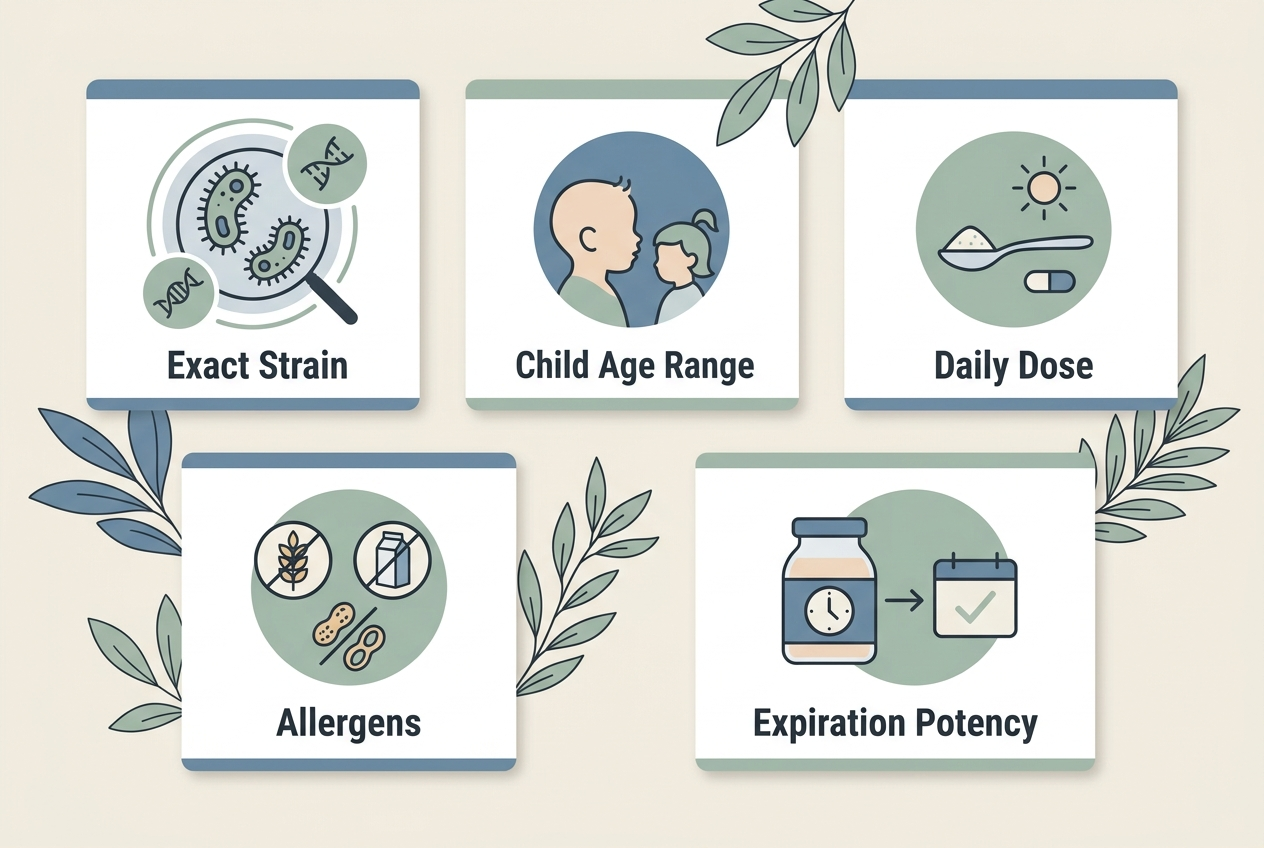
    Visual checklist for comparing probiotic strain, pediatric age, dose, allergens, and expiration potency
    Visual checklist for comparing probiotic strain, pediatric age, dose, allergens, and expiration potency

    The NIH fact sheet reports that LGG or S. boulardii started within two days of the first antibiotic dose has the clearest evidence signal for reducing antibiotic-associated diarrhea. That timing is not a universal prescription, because the pediatrician still needs to consider the child’s age, diagnosis, antibiotic, other medicines, and vulnerability. Follow the product’s age directions and the clinician’s schedule rather than improvising an adult serving. Bacterial probiotics are commonly separated from an antibiotic dose, while S. boulardii is a yeast; exact timing should still follow professional advice and the package. Stop the product and contact the clinician for persistent vomiting, worsening diarrhea, rash, breathing difficulty, unusual lethargy, fever, blood in stool, or dehydration signs. Probiotics should never delay an urgent evaluation. A planned stop date prevents an antibiotic-adjacent experiment from becoming an indefinite daily purchase without a defined goal or observable benefit.

    What safety checks matter before choosing a kids’ probiotic?

    The first safety check is whether the child is otherwise healthy. Cochrane reported no serious probiotic-related events in the mostly healthy trial populations, but observational reports describe rare serious infections in severely debilitated or immunocompromised children, especially those with central venous catheters or conditions that permit microbial translocation. The second check is age and swallowing safety: Culturelle’s chewable is not intended for children under three because of choking risk, while powders and sticks have different mixing directions. The third check is the complete ingredient panel, including milk-derived lactose, corn-derived maltodextrin, xylitol, sugar alcohols, vitamins, and known allergens. The fourth check is the organism itself. S. boulardii is a yeast, LGG is a bacterial strain, and B. coagulans is a different bacterial species; they are not interchangeable. Finally, review storage, expiration, CFU timing, and the child’s symptoms with a pediatric professional.

    Which products meet the evidence and label criteria?

    Culturelle Kids Probiotic + Multivitamin meets the age-label and LGG-identity criteria for children 3–12, but the added vitamins and 5-billion-CFU serving must still fit the child’s routine. Florastor Kids meets the S. boulardii CNCM I-745 identity criterion and provides a powder stick, but it contains milk-derived lactose and corn-derived maltodextrin. Hiya Kids Daily Biotic+ provides an age-labeled chewable with LGG plus L. paracasei and B. lactis ATCC SD5219; the blend should not inherit every result from LGG-only trials. Yuve Probiotic Gummies provide B. coagulans in a vegan gummy, but the species-level label and absence of pediatric directions make it an adult comparison, not a child recommendation. Prices, formulas, and stock status can change, so compare the purchased package with the cited page. Shoppers can view the broader Yuve digestion collection for adult routines without treating those products as pediatric care.

    What do parents ask about probiotics after antibiotics?

    Does every child need a probiotic with antibiotics?

    No. Pediatric probiotic use depends on the child’s risk, antibiotic, health status, and the family’s priorities. A clinician can decide whether the modest preventive evidence justifies adding a product.

    Is a higher CFU count always better?

    No. The NIH emphasizes strain, dose, timing, and population rather than CFU alone. Ten billion CFU from an unmatched blend does not automatically outperform five billion CFU of a studied strain.

    Can yogurt replace a probiotic supplement?

    Yogurt can contribute live cultures and nutrition, but most products do not deliver the exact strain and studied dose used in antibiotic-associated-diarrhea trials. Choose yogurt as food, not as a guaranteed clinical substitute.

    Can probiotics be taken at the same time as antibiotics?

    Timing depends on the organism and medicine. Families often separate bacterial probiotics from antibiotics, while S. boulardii is a yeast, but the pediatrician and product directions should determine the schedule.

    How long should a child continue the probiotic?

    Use the duration supported by professional guidance and the exact product evidence. Do not keep purchasing indefinitely when the antibiotic course has ended and no ongoing goal has been defined.

    Who should avoid probiotics without specialist advice?

    Premature infants, severely ill or immunocompromised children, and children with central venous catheters need specialist oversight. Rare bloodstream infections have been reported in vulnerable populations even though trials in healthy children found few serious problems.

    What is the bottom line on kids’ probiotics after antibiotics?

    Start with the pediatrician, then match the exact product to the evidence. LGG and S. boulardii have the clearest pediatric antibiotic-associated-diarrhea evidence, but benefit is preventive, strain-specific, and not guaranteed. Culturelle Kids provides age-labeled LGG, Florastor Kids provides S. boulardii CNCM I-745, and Hiya provides an age-labeled multi-strain chewable that includes LGG. Yuve Probiotic Gummies serve an adult vegan-gummy routine and should not be substituted for a pediatric product simply because the format looks child-friendly. Compare age directions, strain code, daily amount, potency through expiration, allergens, sweeteners, storage, and timing before price or flavor. Introduce only one new variable, document the reason for using it, record tolerance, and define when the trial ends. Medical reassessment matters more than switching brands when diarrhea is severe, persistent, bloody, accompanied by fever, or associated with dehydration signs.

  • Affordable Probiotics That Work: Four Options Compared by Strain and Cost

    Affordable Probiotics That Work: Four Options Compared by Strain and Cost

    An affordable probiotic “works” only when its named strain, dose, and intended use match the evidence. For everyday value, compare cost per recommended serving—not bottle price or total CFU. Culturelle offers a lower-cost strain-coded capsule; Yuve favors vegan gummy adherence; Align and Florastor fit narrower strain preferences. No option works for everyone.

    How did we evaluate affordable probiotics?

    We evaluated value by comparing strain identification, colony-forming units, potency language, recommended serving, storage needs, format, and current official product information. We prioritized the NIH Office of Dietary Supplements probiotic fact sheet, systematic reviews of strain-specific outcomes, and manufacturer Supplement Facts over testimonials, front-label CFU claims, or “doctor recommended” slogans. We excluded the idea that every probiotic should produce the same result, because age, diet, medicines, baseline microbiota, and the reason for use can change the response. Price remains a moving variable, so shoppers should recalculate cost per daily serving at checkout and include shipping, taxes, or subscription conditions. This method compares Culturelle Digestive Daily, Align 24/7 Digestive Support, Florastor Dual Action, and Yuve Probiotic Gummies as different tools rather than declaring one universal winner. It does not establish clinical effectiveness for an individual buyer.

    What makes a budget probiotic good value?

    A budget probiotic delivers a verifiable organism in a usable daily format without charging for irrelevant CFU inflation. The NIH explains that higher CFU counts do not automatically create greater benefit; the organism, strain, dose, shelf-life viability, and target outcome matter together. A useful label identifies genus, species, and preferably a strain code, then states whether CFU is guaranteed through expiration or merely counted at manufacture. The recommended serving determines the real daily cost. A $15 bottle that requires three capsules can cost more per day than a $20 bottle requiring one. Refrigeration, shipping, allergens, gelatin, sugar alcohols, and capsule tolerance can also change practical value. The cheapest product becomes expensive when its format causes missed doses or its strain does not match the buyer’s goal. Value therefore equals evidence fit, label clarity, tolerability, and adherence divided by total daily cost—not CFU divided by sticker price.

    How do Culturelle, Align, Florastor, and Yuve compare?

    Some links below are affiliate links. This does not influence our evaluation criteria or recommendations. Manufacturer pages can change, so verify the current Supplement Facts, servings, potency guarantee, storage directions, and checkout price before buying. Culturelle names Lacticaseibacillus rhamnosus GG and lists 10 billion CFU per capsule. Align names Bifidobacterium longum 35624 but shoppers should confirm the current package for its CFU statement. Florastor identifies the probiotic yeast Saccharomyces boulardii CNCM I-745. Yuve lists 5 billion CFU of Bacillus coagulans per two-gummy serving at time of manufacture, while its public page does not show a strain code. Those details create different evidence and convenience profiles for everyday shoppers, making tradeoffs explicit. The table ranks each option by disclosed label attributes rather than treating brand reputation, CFU size, or gummy format as proof of effectiveness.

    Option Disclosed organism Best for Main limitation
    Culturelle Digestive Daily L. rhamnosus GG; 10 billion CFU per capsule Budget-focused shoppers who want a strain-coded capsule Capsule format; benefit remains goal-specific
    Align 24/7 Digestive Support B. longum 35624 Buyers prioritizing the 35624 strain Confirm current CFU and retail cost on the exact package
    Florastor Dual Action S. boulardii CNCM I-745 Buyers specifically seeking a probiotic yeast Not interchangeable with bacterial probiotics
    Yuve Probiotic Gummies B. coagulans; 5 billion CFU per two gummies Vegan gummy adherence and shelf-stable convenience Species-level label; CFU stated at manufacture

    Which probiotic is best for each budget use case?

    Best for a lower-cost strain-coded capsule: Culturelle Digestive Daily, provided L. rhamnosus GG fits the intended use and the current cost per capsule remains competitive. Best for B. longum 35624 specifically: Align 24/7 Digestive Support, because strain identity—not a generic Bifidobacterium label—drives that comparison. Best for a probiotic yeast: Florastor Dual Action, which uses S. boulardii CNCM I-745 and should not be treated as equivalent to bacterial products. Best for vegan gummy consistency: Yuve Probiotic Gummies, because the pectin-based, shelf-stable format may reduce adherence friction for people who avoid capsules. Best for the absolute lowest spending: fermented foods already in the grocery budget can supply live microbes, although they do not provide a standardized clinical strain or guaranteed CFU. Best for any symptom-specific goal: the strain and studied population must match before price rankings matter.

    How should you calculate the real cost per serving?

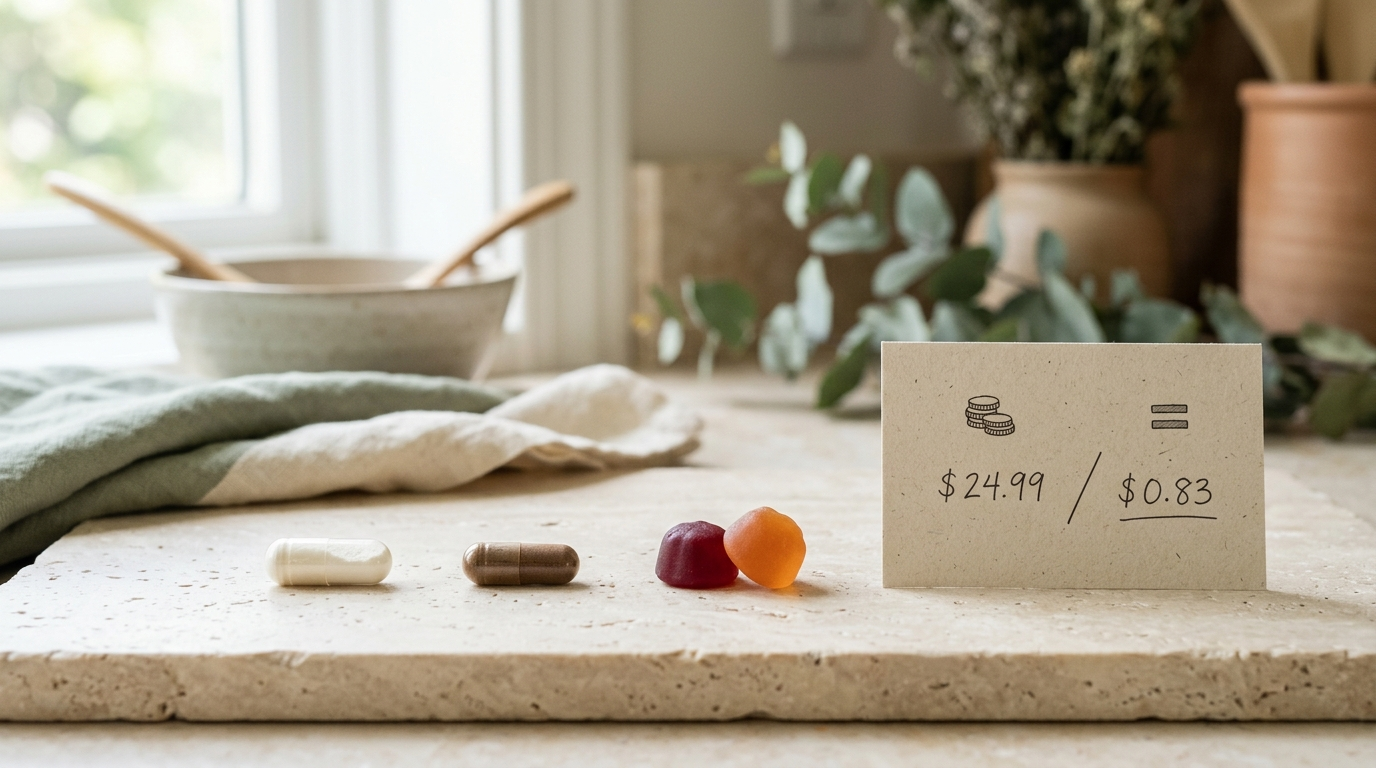
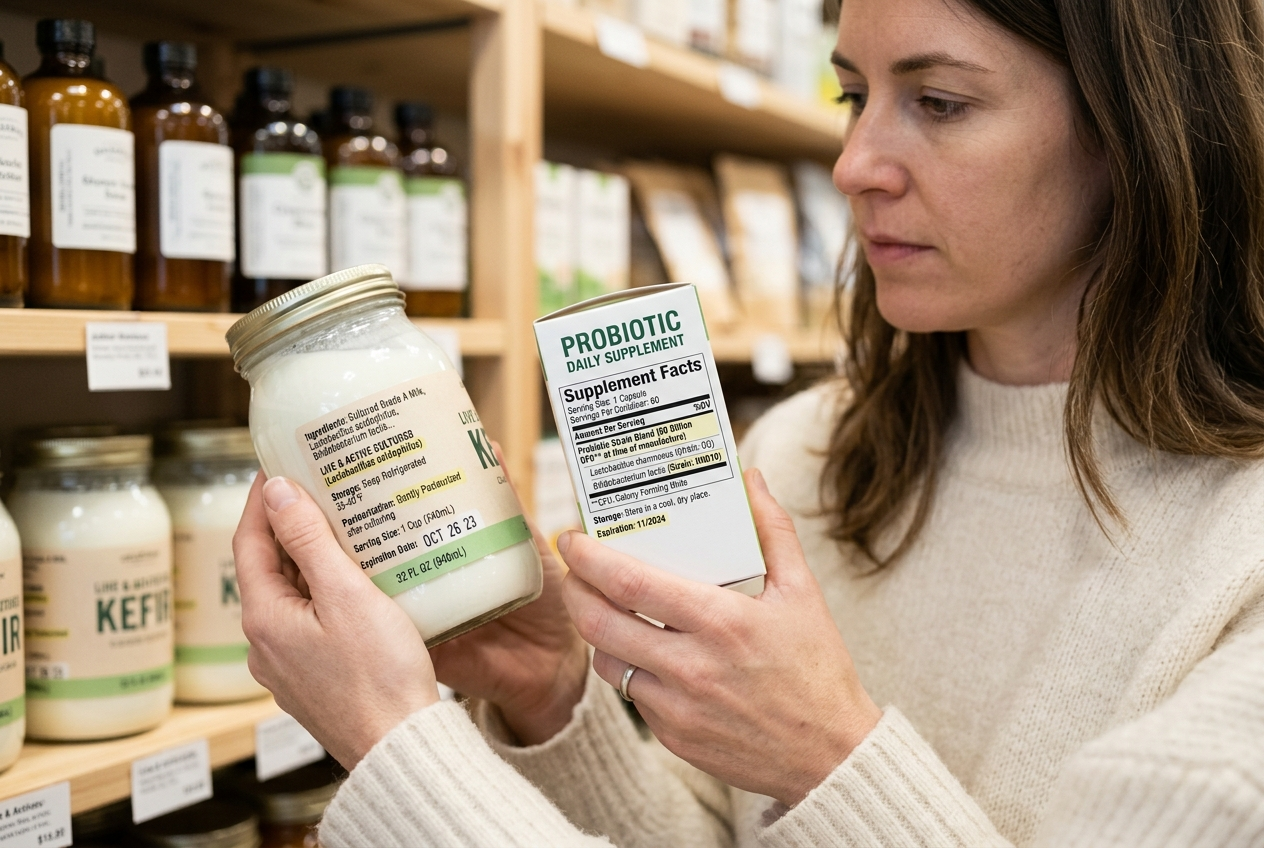
    Visual checklist for comparing probiotic strain, CFU, serving cost, and storage
    Visual checklist for comparing probiotic strain, CFU, serving cost, and storage

    Divide the checkout total by the number of recommended daily servings, then add shipping, taxes, or membership costs that apply to the order. Do not divide by capsule count when the label requires two capsules, and do not divide by gummy count when the serving is two gummies. A subscription price deserves its own calculation because cancellation rules and future shipments affect total spending. Compare identical time windows, such as 30 daily servings, and record the date because probiotic prices change across brand sites, pharmacies, warehouse clubs, and marketplaces. Next, check whether the listing matches the exact organism, CFU statement, package size, and expiration standard used in the comparison. A discounted third-party listing can be poor value if storage history, seller identity, or remaining shelf life is unclear. The honest budget metric is cost per correctly stored, label-matched serving that a person will actually take.

    Which products meet these criteria without hiding tradeoffs?

    Culturelle Digestive Daily provides L. rhamnosus GG at 10 billion CFU per one-capsule serving and fits buyers who value a named strain and simple daily dose. Align 24/7 Digestive Support centers B. longum 35624 and fits shoppers specifically seeking that organism. Florastor Dual Action provides S. boulardii CNCM I-745, a yeast with a different evidence lane from bacterial probiotics. Yuve Probiotic Gummies provide 5 billion CFU of B. coagulans per two-gummy serving in a vegan format. Yuve’s public label names the species rather than a strain code and states CFU at manufacture, so strain-traceability shoppers may prefer a capsule. Buyers prioritizing gummy adherence can compare the broader Yuve digestion collection without assuming convenience proves superior results.

    What does the evidence say about strains and high CFU counts?

    Probiotic evidence attaches to specific organisms and outcomes, not to the word “probiotic” by itself. A systematic review and meta-analysis of 228 trials found evidence that efficacy varies by strain and by the condition or outcome studied. The NIH likewise states that a higher CFU count is not necessarily more effective than a lower count. CFU measures viable organisms, but a large number cannot compensate for an unnamed strain, poor storage, or a mismatch between the research population and the buyer’s goal. Multi-strain formulas also do not automatically outperform single-strain products because each blend needs evidence as formulated. Stronger evidence comes from replicated human trials using the same strain, dose, duration, and relevant outcome. Directional evidence comes from one small trial, a different strain of the same species, or an ingredient-level study that does not test the finished product.

    What do shoppers ask about affordable probiotics?

    Is the cheapest probiotic usually the best value?

    No. The cheapest bottle can have an unclear strain, a larger daily serving, or storage requirements that reduce practical value. Compare label quality and cost per recommended serving together.

    Does a 50-billion-CFU product work better than 5 billion CFU?

    Not automatically. The NIH states that higher CFU counts alone do not guarantee greater benefit; strain, dose, viability, and intended outcome matter.

    Are store-brand probiotics worth considering?

    Yes, when the exact label identifies the organism, preferably the strain, and gives credible potency and storage information. A low price does not excuse a vague proprietary blend.

    Are probiotic gummies effective?

    They can be useful when live organisms remain viable and the user takes the serving consistently. Gummies may add sugar alcohols or disclose less strain detail, so the exact label still determines value.

    How long should someone try a probiotic?

    Use a time window supported by the product’s evidence or professional guidance, then reassess the named goal. Stop and seek advice for persistent or significant adverse effects rather than extending an unsuccessful trial indefinitely.

    Who should ask a clinician before using probiotics?

    People who are severely ill, immunocompromised, pregnant, caring for an infant, or managing complex medical treatment should seek individualized advice. The NIH reports rare serious infections mainly in vulnerable populations.

    Related reading: How Long Do Probiotics Take to Work? A Realistic Timeline.

    What is the bottom line for buying an affordable probiotic?

    Start with the goal, then identify a strain studied for that goal and calculate the current cost per recommended serving. Culturelle is a practical budget benchmark for a strain-coded daily capsule. Align fits buyers who specifically want B. longum 35624, while Florastor fits buyers intentionally choosing S. boulardii CNCM I-745. Yuve fits shoppers who value a vegan, shelf-stable gummy and accept species-level rather than strain-level disclosure. Food-first options can cost less but do not deliver standardized clinical strains. Buy one product, follow its storage directions, change one variable at a time, and define what improvement would justify continuing. Review the trial after a planned interval instead of renewing automatically, and compare adverse effects against the original goal. A cheap probiotic that lacks a matching strain, causes unacceptable discomfort, or never gets taken is not affordable; it is simply unused inventory.

  • Strongman Supplement Recommendations: What Earns a Place in the Stack?

    Strongman Supplement Recommendations: What Earns a Place in the Stack?

    The best strongman supplement stack is short: creatine monohydrate for repeated maximal efforts, enough dietary protein for recovery, and electrolytes only when sweat losses justify them. Caffeine can help selected sessions but can damage sleep. Vitamin B12 or iron belongs only when diet, risk factors, or testing shows a gap. Food, programming, and sleep still dominate results.

    How did we evaluate strongman supplements?

    We evaluated supplements by matching each ingredient to a strongman demand: repeated high-intensity effort, muscle-protein remodeling, long training sessions, heat and sweat exposure, and recovery between events. NIH Office of Dietary Supplements evidence summaries, sports-nutrition position stands, transparent Supplement Facts panels, and third-party sport certification received more weight than influencer stacks, proprietary blends, or “testosterone booster” language. We excluded ingredients with unclear doses, stimulant cocktails, and products that duplicate adequate food intake without a specific reason. We also separated performance aids from deficiency correction. Creatine and protein can support training adaptation, while vitamin B12 and iron make sense only when intake, risk factors, or laboratory findings create a credible gap. Evidence has limits because event selection, body mass, climate, diet, medicines, kidney health, and federation rules vary. Competitive athletes remain responsible for every product they ingest.

    What should a strongman athlete fix before buying supplements?

    Training structure, total calories, carbohydrate availability, protein distribution, hydration, sodium replacement, and sleep should be stable enough to interpret any supplement. A missed meal cannot be rescued by a pre-workout blend, and four hours of sleep can erase the value of marginal ergogenic gains. Estimate protein from food first, then use powder only to close a real shortfall. Record session duration, environmental heat, body-mass change, thirst, and urine pattern before assuming every workout needs a high-sodium packet. Review caffeine from coffee, energy drinks, gels, and pre-workout together because total exposure determines sleep and side effects. Keep creatine simple and consistent instead of cycling through exotic forms. Add one variable, maintain it through a defined training block, and track performance that matters: repetitions at a fixed load, medley time, carry pace, recovery, gastrointestinal tolerance, and body-mass change. The basics create the signal.

    How do the main supplement options compare?

    Some links below are affiliate links. This does not influence our evaluation criteria or recommendations. Current labels can change, so verify serving size, active amount, allergens, sweeteners, certification, and competition status before purchase. The table compares product examples by role rather than pretending that protein, creatine, B12, and iron are interchangeable.

    Option Label focus Best for Main limitation
    Optimum Nutrition Micronized Creatine 5 g creatine monohydrate per serving Repeated maximal efforts and training adaptation Water-weight gain; certification must be verified for the exact product
    Vega Sport Premium Protein 30 g plant-based protein per serving Closing a measured protein shortfall Powder is unnecessary when food already covers the target
    Yuve Vegan B12 1,000 mcg cobalamin per tablet Plant-based intake or documented B12 need Not a performance booster when B12 status is adequate
    Yuve Whole Food Iron 18 mg elemental iron per capsule Clinician-guided iron supplementation Not for routine use without a credible need

    Which option is best for each strongman use case?

    Best for repeated maximal efforts: plain creatine monohydrate, because the NIH exercise-performance fact sheet reports generally positive evidence for high-intensity, intermittent activity and typical maintenance use around 3 to 5 grams daily. Best for recovery when food protein falls short: a complete protein powder that supplies all essential amino acids and fits allergens and digestion. Best for long, hot sessions with high sweat loss: a measured electrolyte plan built around actual fluid and sodium needs, not the saltiest packet available. Best for occasional alertness: a known caffeine dose early enough to protect sleep. Best for vegan B12 coverage: a transparent B12 product or fortified foods. Best for suspected iron depletion: clinical assessment before purchase. Branched-chain amino acids, proprietary testosterone blends, and exotic creatine forms rank lower because they rarely beat complete protein, plain monohydrate, and adequate recovery.

    Where do Yuve B12 and iron honestly fit?

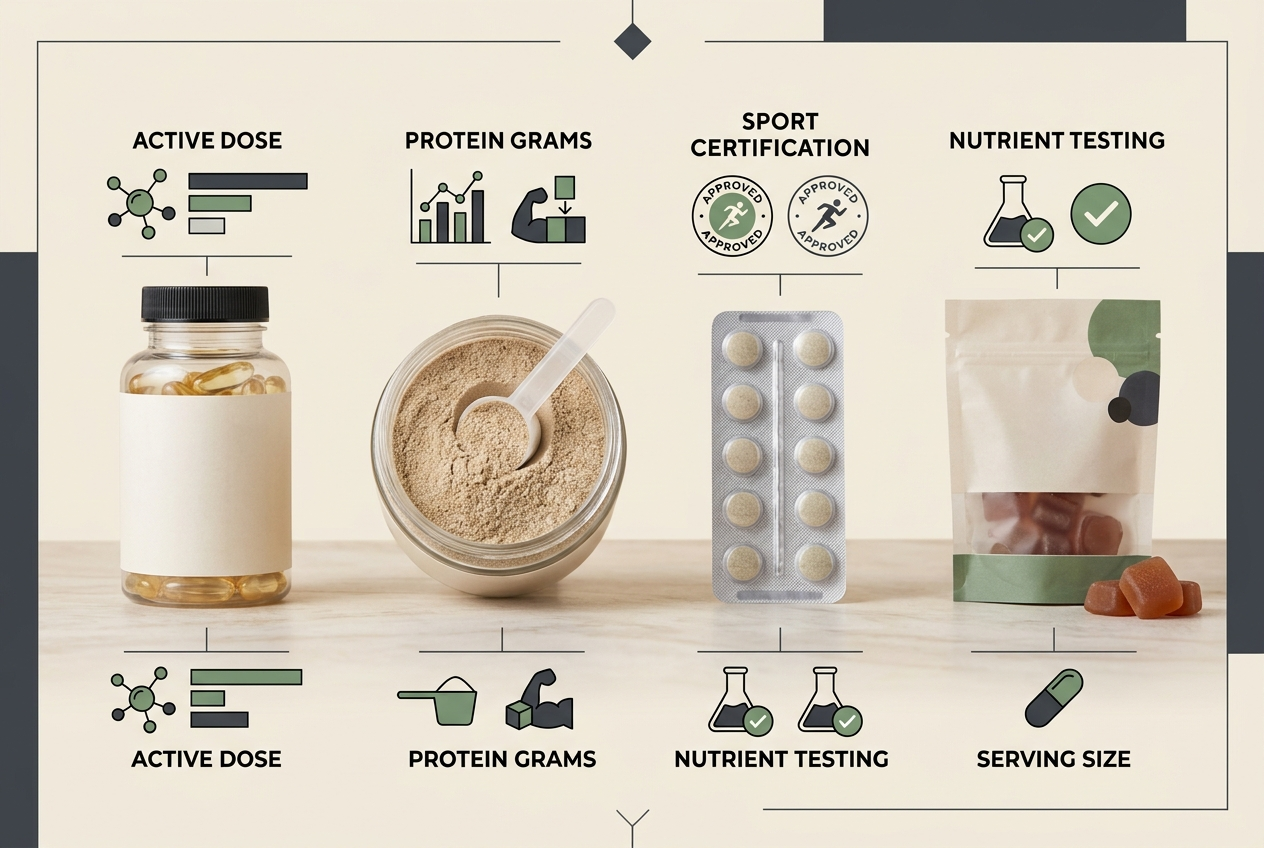
    Sports supplement formats compared by dose, protein, certification, nutrient testing, and serving size.
    Sports supplement formats compared by dose, protein, certification, nutrient testing, and serving size.

    Yuve Vegan B12 provides 1,000 micrograms of cobalamin per tablet and fits athletes whose plant-based pattern, absorption risk, or testing supports B12 supplementation. The NIH vitamin B12 fact sheet states that B12 supplementation does not improve athletic performance when status is adequate, so the product belongs in a nutrition-gap lane rather than a pre-workout lane. Yuve Whole Food Iron provides 18 milligrams of elemental iron as a rice-protein chelate, but an athlete should not add iron just because hard training feels tiring. Ferritin, hemoglobin, transferrin saturation, inflammation, diet, blood loss, and medical history shape the decision. The broader Yuve Daily Essentials collection is useful for label comparison, not automatic stacking. Creatine, protein adequacy, carbohydrates, fluids, and sleep remain more direct strongman priorities when nutrient status is normal. That hierarchy keeps the comparison honest and the stack deliberately small.

    How should competitive athletes check supplement quality?

    Start with the exact product and lot, not the reputation of the brand. A clean-looking label does not prove that a powder is free of prohibited substances or that the active amount matches the panel. The NSF Certified for Sport program tests products for label content and selected banned substances, while sport organizations still place responsibility on the athlete. Search the certification database for the exact name and format, confirm the current listing, and retain the receipt, lot number, and package photographs. Avoid proprietary blends because hidden amounts make dosing and interactions harder to assess. Review every stimulant source, especially when a pre-workout, coffee, energy drink, and gel appear on the same day. Check allergens, sugar alcohols, sodium, and serving size for gastrointestinal tolerance. Third-party certification reduces risk; it does not create zero risk or prove that an ingredient improves performance.

    When should B12 or iron testing come before a stack change?

    Testing should come first when symptoms are nonspecific and the supplement can only help a real deficiency or can cause harm in excess. Vitamin B12 assessment may be useful for vegan athletes, people using metformin or long-term acid suppression, adults with gastrointestinal surgery or absorption disorders, and athletes with neurological symptoms. Iron assessment is especially important when fatigue, declining work capacity, heavy menstrual loss, restricted intake, frequent blood donation, or endurance training creates concern. The NIH iron fact sheet explains that ferritin reflects iron stores but can rise with inflammation, so interpretation may require additional markers. Do not diagnose deficiency from tiredness alone or copy another athlete’s dose. Seek qualified review for persistent fatigue, shortness of breath, palpitations, faintness, unexplained performance decline, or neurological changes. A test-guided correction plan is more useful than an open-ended “energy” stack.

    What do strongman athletes ask about supplements?

    Is creatine monohydrate enough?

    For strength athletes choosing creatine, monohydrate is the evidence-based default. More expensive forms have not consistently shown superior muscle-creatine or performance effects.

    Do I need a protein powder?

    Only when food leaves a practical shortfall. Powder offers convenience, while total daily protein, essential amino acids, calories, and consistent training determine the larger result.

    Should every session include electrolytes?

    No. Climate, session length, sweat rate, diet, and fluid access determine the need; unnecessary sodium does not improve every workout.

    Is pre-workout necessary for strongman?

    No. Caffeine can help selected sessions, but stimulant dose, sleep, heart rhythm, anxiety, and competition timing matter more than the label’s intensity language.

    Can vegan strongman athletes use B12?

    Yes, when it supports reliable B12 intake. B12 corrects a nutrient gap; it does not replace protein, carbohydrates, creatine, programming, or recovery.

    Should male athletes take iron?

    Not automatically. Iron can accumulate, so diet, symptoms, laboratory results, blood loss, and clinician guidance should determine supplementation.

    Related reading: Best Supplement for Stress and Focus: How Magnesium, L-Theanine, B12, Iron, and Adaptogens Compare.

    Related reading: How to Pick the Right Energy Supplement: Match the Ingredient to the Reason.

    What is the practical strongman supplement stack?

    Start with food, training, sleep, and hydration, then add the smallest stack that closes named gaps. Plain creatine monohydrate earns the strongest performance position for repeated maximal efforts. Protein powder earns a place only when ordinary meals do not meet the planned intake. Electrolytes earn a place when heat, duration, and sweat loss justify the sodium and fluid plan. Caffeine is optional and should never borrow performance from the next night’s sleep. Yuve Vegan B12 fits plant-based intake or verified need, while Yuve Whole Food Iron fits clinician-guided iron correction rather than routine strongman use. Compare exact labels, verify sport certification, retain lot information, and introduce one product at a time. The best stack is not the largest one. It is the stack whose role, dose, evidence, tolerance, and review date can be stated in one sentence per product.

  • Do Kids’ Probiotics Work? Results, Strains, and Products Compared

    Do Kids’ Probiotics Work? Results, Strains, and Products Compared

    Some children show goal-specific changes with certain probiotic strains, but no kids’ probiotic produces reliable results for every child. Evidence depends on the exact strain, dose, outcome, age, and health context. Choose a child-labeled product with transparent strains, track one outcome, and involve a pediatrician when symptoms persist or medical complexity is present.

    How did we evaluate results from kids’ probiotics?

    We evaluated pediatric probiotics by matching the exact organism, strain code, daily amount, age directions, delivery format, and studied outcome. Systematic reviews, large randomized controlled trials, government safety guidance, and pediatric product labels received more weight than parent testimonials, star ratings, or broad “immune and gut” claims. We excluded adult-only research, studies that did not identify the tested strain, and marketing that treats every probiotic as interchangeable. We also separated everyday digestive routine support from acute diarrhea, antibiotic-associated diarrhea, constipation, and abdominal discomfort because those outcomes use different trials and decision rules. The evidence has limits: children vary by age, diet, medication exposure, immune status, and baseline symptoms, while formulas and labels can change. A product can be convenient and still lack a precise evidence match. A pediatrician should guide use for infants, medically fragile children, or persistent symptoms.

    What counts as a meaningful result from a kids’ probiotic?

    A meaningful result is a predefined, repeatable change rather than a vague sense that a child seems “better.” Parents can track stool frequency, Bristol Stool Form Scale category, days with abdominal discomfort, school interruptions, urgency, or antibiotic-associated loose-stool days, depending on the original goal. The outcome should improve during a stable routine and should not require adding several products at once. Mood, immunity, and “detox” claims are harder to measure and easier to overinterpret. A child who already has normal bowel habits may show no visible change because there was no clear problem to move. A child whose symptoms come from lactose intolerance, celiac disease, infection, constipation, medication effects, or another cause may need a different intervention entirely. Define the goal, record a short baseline, and choose one outcome before opening the bottle. Without that structure, ordinary week-to-week variation can look like probiotic success.

    What does the evidence say about probiotic results in children?

    Pediatric evidence rejects a universal yes-or-no answer. The NIH Office of Dietary Supplements explains that probiotic effects can depend on the microorganism and health context, so results from one strain cannot validate another. A 2020 Cochrane review covering more than 11,000 children found that low-bias trials did not show a reliable reduction in diarrhea lasting at least 48 hours during acute infectious diarrhea. A large randomized trial in 886 children also found no meaningful gastroenteritis benefit from the tested combination versus placebo. These findings do not prove that every pediatric strain is useless. They show that “probiotics work for kids” is too broad a claim. Evidence must match the exact strain, dose, age group, condition, and outcome. Food, hydration, medical care, and time may explain improvement that begins alongside a supplement. No category shortcut survives that requirement.

    How do common kids’ probiotic options compare?

    Some links below are affiliate links. This does not influence our evaluation criteria or recommendations. Hiya, Culturelle Kids, Seed PDS-08, and Yuve serve different users, so age fit and organism transparency matter more than bottle style. Current labels should control every decision because counts, strains, directions, and sweeteners can change. Parents should reject any option that hides its complete organism list.

    Option Format and label focus Best for Main limitation
    Hiya Kids Daily Probiotic Child-focused chewable; 10 billion live-culture claim No-added-sugar chewable comparison Verify current strain codes and age directions
    Culturelle Kids Purely Probiotics Packet with 5 billion CFU L. rhamnosus GG Named-strain comparison Outcome evidence must match LGG and regimen
    Seed PDS-08 Pediatric powder synbiotic Multi-strain synbiotic comparison Complexity and cost do not prove better results
    Yuve Probiotic Gummies Adult vegan gummy; 5 billion CFU B. coagulans Adult household member Not a default children’s substitute

    Which option is best for each use case?

    Best for a parent prioritizing a clearly named pediatric strain: Culturelle Kids Purely Probiotics, because Lacticaseibacillus rhamnosus GG gives the buyer a specific research target. Best for a child-focused chewable comparison: Hiya Kids Daily Probiotic, provided its current age directions, complete strain list, sweeteners, and allergens fit the child. Best for families intentionally comparing a pediatric synbiotic powder: Seed PDS-08, with the understanding that more strains and added prebiotic components do not guarantee a larger effect. Best for an adult in the same household: Yuve Probiotic Gummies, which provide Bacillus coagulans in a vegan gummy but should not be treated as a child-labeled product. Best for a child with severe illness, immune compromise, a central line, poor growth, blood in stool, persistent vomiting, or dehydration: medical evaluation comes before a retail ranking. The actual goal must choose the category.

    How should parents test a probiotic without confusing the result?

    Kids' probiotic formats compared by strain, CFU, age directions, storage, allergens, and serving size.
    Kids’ probiotic formats compared by strain, CFU, age directions, storage, allergens, and serving size.

    Start with a seven-day baseline when the situation is mild and a clinician has not advised immediate treatment. Record the chosen outcome once daily, along with stool pattern, pain, diet changes, antibiotics, fever, missed school, and any other new supplement. Then introduce one child-labeled probiotic at the package serving, keep the diet and routine reasonably stable, and set a review date. Do not start a probiotic, prebiotic fiber, magnesium gummy, elimination diet, and fermented-food plan during the same week. That stack destroys attribution. Stop the product and contact a clinician when symptoms clearly worsen or a new reaction appears. If a modest benefit is repeatable, confirm it by maintaining the same routine rather than increasing the dose automatically. If nothing changes by the planned review, the product may be a poor fit. A small tracking sheet produces better evidence than a memory shaped by one unusually good or bad day.

    What safety questions should parents ask first?

    Parents should ask whether the product is labeled for the child’s age, whether the child can safely chew or swallow the format, and whether any ingredient conflicts with allergies, immune status, medicines, or medical devices. The NCCIH probiotic safety summary notes that risks can be greater in people with serious illness or weakened immune systems. Infant use requires extra caution because age, feeding pattern, prematurity, and health history matter. Gummies also create choking, sweetener, and accidental-overconsumption concerns, so adult products should not be casually substituted for pediatric ones. Store the product exactly as directed and check whether the viable count is stated through expiration or only at manufacture. Persistent diarrhea, repeated vomiting, dehydration, fever, blood, black stool, severe pain, weight loss, or poor growth needs medical care. A probiotic should never delay assessment of a child who is becoming sicker.

    What mistakes make probiotic results look stronger than they are?

    The first mistake is choosing by total CFU without checking the strain. Fifty billion unnamed organisms do not automatically provide a better evidence match than five billion CFU of a defined strain. The second mistake is treating a parent review as proof; children often improve over time, and hydration, diet, medication changes, or the end of an infection may deserve credit. The third mistake is changing several variables together. The fourth mistake is using an adult gummy because the child likes the format even though age directions, dose, sweeteners, and choking considerations differ. The fifth mistake is extending a trial despite worsening symptoms. The sixth mistake is expecting a probiotic to solve lactose intolerance, celiac disease, inflammatory disease, food allergy, or another unidentified cause. Better evaluation uses a child-labeled formula, one explicit goal, one stable trial, a stop rule, and a scheduled reassessment. Clean experiments beat enthusiastic guessing.

    What questions do parents ask about kids’ probiotics?

    How long does a kids’ probiotic take to show results?

    There is no universal timeline because strains and outcomes differ. Set a review date based on the intended goal and clinician guidance, then avoid indefinite use when no measurable change appears.

    Are more CFUs better for children?

    No. CFU quantity does not replace a named strain, age-appropriate directions, viable count through expiration, tolerable ingredients, or outcome-matched evidence.

    Can a child take an adult probiotic gummy?

    Parents should not assume adult gummies are appropriate for children. Age directions, serving size, choking risk, sweeteners, allergens, and clinician input matter.

    Do kids need probiotics after antibiotics?

    Some strain-specific research addresses antibiotic-associated diarrhea, but the answer depends on the antibiotic, child, strain, timing, and medical context. Ask the prescribing clinician or pharmacist about the exact product rather than choosing by category alone.

    Should probiotics be refrigerated?

    Follow the product’s storage directions. Some organisms require refrigeration, while shelf-stable products still need protection from heat and moisture and must remain within their labeled storage range.

    Are probiotic gummies better than powders?

    Neither format is automatically better. Gummies may improve cooperation, while powders can offer flexible pediatric delivery; strain identity, dose, age fit, ingredients, storage, and adherence decide the stronger option.

    What is the practical bottom line?

    Kids’ probiotics can produce goal-specific results, but the outcome belongs to an exact strain, dose, child, and use case—not to the word “probiotic.” Compare Hiya, Culturelle Kids, and Seed PDS-08 by age directions, organism and strain disclosure, viable amount, format, sweeteners, allergens, storage, evidence match, and cost per serving. Keep Yuve Probiotic Gummies in their proper lane as an adult digestive-routine option, not a default substitute for a pediatric product. Define one measurable outcome, record a baseline, change one variable, and use a stop rule. No benefit by the review date is useful information. Worsening symptoms, medical complexity, or red flags move the decision away from shopping and toward a pediatrician. The most honest recommendation is specific, measurable, age-appropriate, and willing to conclude that no supplement is needed. That discipline protects both money and safety.

  • Do Probiotics Replace Fermented Foods? Foods, Strains, and Products Compared

    Do Probiotics Replace Fermented Foods? Foods, Strains, and Products Compared

    Probiotic supplements do not fully replace fermented foods, and fermented foods do not automatically replace a strain-specific probiotic. Foods provide nutrients, flavors, and sometimes diverse live microbes; supplements provide defined organisms and doses when labels are complete. Neither is required for everyone. Choose food for dietary variety and a supplement only for a clearly defined, evidence-matched goal.

    How did we evaluate probiotics and fermented foods?

    We prioritized the International Scientific Association for Probiotics and Prebiotics, NIH Office of Dietary Supplements, human randomized trials, and systematic reviews that identify the tested food or probiotic strain. We compared live-microbe identity, dose consistency, food-matrix nutrients, serving pattern, storage, dietary restrictions, clinical evidence, and label transparency. We excluded testimonials, microbiome “reset” claims, CFU rankings without strain context, and assumptions that every fermented food contains living organisms. Pasteurized products, baked sourdough, most beer, and some shelf-stable pickles remain fermented foods even when processing removes or kills the microbes. Probiotic effects can also be strain-specific, so a study of Lacticaseibacillus rhamnosus GG cannot validate every capsule or gummy. The evidence supports complementary roles rather than one-for-one replacement. Individual tolerance, cost, culture, allergies, medicines, and health status still determine whether either option belongs in a routine.

    Why are probiotic supplements and fermented foods not interchangeable?

    Fermented foods are made through controlled microbial growth and enzymatic conversion, while probiotics are live microorganisms that confer a demonstrated benefit when consumed in an adequate amount. The ISAPP fermented-food consensus explains that a fermented food does not need to contain live microbes at the time of eating and should not be called probiotic unless defined organisms have supporting evidence. Yogurt with live cultures, kefir, kimchi, tempeh, miso, and refrigerated fermented vegetables also differ in organisms, nutrients, salt, sugar, serving size, and heat treatment. A probiotic supplement can name a strain and CFU count, but it does not reproduce the protein, calcium, fiber, polyphenols, flavors, or meal context of food. Conversely, a serving of kimchi cannot be assumed to deliver Bifidobacterium longum 35624 or Saccharomyces boulardii CNCM I-745. The practical distinction is functional: food broadens the diet; a transparent supplement can target a specific evidence lane.

    What can fermented foods add that a supplement cannot?

    Fermented foods can contribute ordinary food nutrients and microbial metabolites alongside any living cultures that remain. Yogurt may supply protein and calcium, tempeh supplies protein and fiber, and fermented vegetables contribute plant compounds as well as substantial sodium in some recipes. A small randomized feeding study assigned healthy adults to high-fermented-food or high-fiber diets and followed the interventions for 17 weeks. The Cell study found increased microbiota diversity and lower levels of several inflammatory markers in the fermented-food group, but its sample size, intensive diet design, and biomarker outcomes do not prove that one jar or beverage produces a clinical benefit. Fermented-food intake can also be limited by dairy allergy, lactose tolerance, histamine sensitivity, sodium restrictions, alcohol, added sugar, availability, or personal preference. Best for dietary variety: several tolerated foods across meals. Best for predictable nutrients: compare Nutrition Facts panels. Best for live cultures: verify “live and active cultures” and avoid assuming that every fermented label guarantees viable organisms.

    How do common probiotic options compare with food-first choices?

    Some links below are affiliate links. This does not influence our evaluation criteria or recommendations. A food-first routine, Culturelle Digestive Daily, Align Probiotic, Florastor, and Yuve Probiotic Gummies solve different problems. Culturelle identifies LGG, Align identifies B. longum 35624, and Florastor identifies the yeast S. boulardii CNCM I-745, enabling strain-level research matching. Yuve lists 5 billion CFU of Bacillus coagulans per two-gummy serving and offers a vegan, capsule-free format; buyers should check the current label for a strain code before connecting it to strain-specific evidence. A systematic review and meta-analysis found evidence that probiotic efficacy is strain- and disease-specific, reinforcing why these organisms cannot be ranked as universal replacements for food. Storage and expiration also matter. Current retail formulas can change. Foods deliver a matrix rather than a standardized probiotic dose. The table compares selection logic, not guaranteed outcomes.

    Option What it supplies Best-fit use case Main limitation
    Live-culture fermented foods Food nutrients plus variable cultures Dietary variety and meal-based intake Organisms and viable counts often vary
    Culturelle Digestive Daily L. rhamnosus GG LGG-specific evidence matching One strain does not replace food variety
    Align Probiotic B. longum 35624 35624-specific evidence matching Goal fit depends on the studied outcome
    Florastor S. boulardii CNCM I-745 Named probiotic yeast Yeast differs from bacterial cultures
    Yuve Probiotic Gummies B. coagulans, 5 billion CFU Vegan, capsule-free routine Verify current label for strain identity

    Which option is best for each practical goal?

    Shopper comparing fermented-food culture wording with probiotic strain, CFU, expiration, and storage information.
    Shopper comparing fermented-food culture wording with probiotic strain, CFU, expiration, and storage information.

    Best for building a varied diet: tolerated yogurt, kefir, tempeh, miso, or non-heated fermented vegetables incorporated as foods rather than medicines. Best for matching LGG research: Culturelle, provided the current label identifies L. rhamnosus GG and the intended outcome matches the evidence. Best for matching 35624 research: Align, with the same goal-and-dose verification. Best for a named probiotic yeast: Florastor with S. boulardii CNCM I-745. Best for a vegan gummy routine: Yuve Probiotic Gummies, while recognizing that convenience and 5 billion CFU do not establish a strain-specific outcome. Best for people who simply dislike fermented foods: no automatic deficiency needs correction; fiber-rich plants and a varied overall diet still matter. Best for persistent pain, blood in stool, fever, dehydration, unexplained weight loss, or prolonged bowel changes: clinical assessment rather than a retail substitution. “Best” describes fit for a defined use case, not universal superiority.

    What should you look for on food and supplement labels?

    For fermented foods, check whether the package states “live and active cultures,” whether the product was pasteurized after fermentation, and how much sodium, added sugar, protein, fiber, or alcohol a normal serving provides. “Fermented,” “pickled,” and “probiotic” are not interchangeable claims. For supplements, look for genus, species, strain designation, CFU per serving, viability through expiration, serving size, storage conditions, allergens, and other ingredients. The NIH Office of Dietary Supplements notes that higher CFU counts alone do not establish greater benefit and that recommendations should match a specific strain, dose, and use. Check whether a gummy adds sugar or sugar alcohols, whether a capsule contains dairy or gelatin, and whether a refrigerated product remained within its required temperature range. Transparent labels enable comparison; front-panel superlatives do not. Photograph the lot number and complete label before starting a time-bounded trial because formulas can change.

    Can you use fermented foods and a probiotic together?

    Many healthy adults can eat fermented foods while using a common probiotic, but combining them does not automatically create an additive benefit. The organisms, doses, and food matrices differ, and the finished combination may never have been studied. Introduce one change at a time when tolerance matters, especially if yogurt, kefir, kimchi, inulin, sugar alcohols, or large servings tend to increase gas or stool frequency. People with serious illness, compromised immune function, central venous catheters, recent major surgery, or complex medication regimens should ask a clinician before using live-microbial supplements. Fermented foods also require ordinary food-safety judgment; unpasteurized products and home ferments can carry risks when preparation, refrigeration, salt concentration, or acidity is inadequate. A structured approach creates cleaner information: keep the rest of the routine stable, use a normal food serving or labeled supplement serving, record the change, and reassess. More microbial products do not necessarily produce a better outcome.

    What questions do people ask about replacing fermented foods?

    Replacement questions often assume that fermented foods and probiotic supplements fill the same nutritional requirement. They do not. Fermented foods can contribute nutrients and food-matrix compounds, sometimes with variable live cultures, while supplements can provide specified organisms in a measured format. Neither category guarantees a broad microbiome change, permanent colonization, or relief from a symptom. Product selection also depends on dietary pattern, allergies, sodium, added sugar, format, strain identity, storage, and the outcome being tested. A person who does not eat kimchi or yogurt does not automatically need a probiotic, and a person who eats fermented foods does not automatically receive a clinically studied strain. The following answers use the narrowest evidence-supported interpretation. Choose normal foods for nutritional value and enjoyment; use a supplement only when its complete label and evidence fit a defined goal.

    Do you need fermented foods for a healthy gut?

    No single fermented food is required for digestive health. A varied diet with adequate fiber, protein, and micronutrients can support health even when yogurt, kefir, kimchi, miso, or tempeh are absent.

    Does yogurt count as a probiotic?

    Yogurt can contain live cultures, but “probiotic” properly requires defined organisms with evidence for a health benefit at an adequate amount. Check the culture statement and avoid assuming that every yogurt supplies a clinically studied probiotic strain.

    Are refrigerated pickles always fermented?

    No. Some pickles are acidified with vinegar rather than produced through microbial fermentation, while some fermented pickles are later pasteurized. The process and label determine whether live cultures remain.

    Is a higher CFU supplement a better replacement?

    No. CFU measures viable organisms, not food nutrients, strain relevance, or clinical effectiveness. A lower count of an evidence-matched strain can provide a clearer rationale than a high-count proprietary blend.

    Can fermented foods permanently colonize the gut?

    Most food-associated microbes appear transient rather than permanent residents. Temporary passage can still interact with the food matrix and existing microbiota, but permanent colonization should not be promised.

    How long should you test one probiotic?

    Use one product at its labeled serving for a goal-specific, time-bounded period informed by relevant research or a clinician. Stop and seek advice for concerning reactions, and do not extend an ineffective trial indefinitely.

    For a closer look at clean-label options, see How to Tell Whether Store-Bought Fermented Foods Still Have Live Cultures.

    For a closer look at clean-label options, see Do Store-Bought Fermented Foods Actually Have Probiotic Benefit?.

    What is the bottom line on probiotics versus fermented foods?

    Probiotic supplements do not recreate fermented foods, and fermented foods do not reliably deliver every evidence-backed probiotic strain. Choose yogurt, kefir, tempeh, miso, or fermented vegetables for their complete food value, provided the format fits allergies, sodium, sugar, alcohol, and personal tolerance. Choose a supplement only after defining the goal and verifying strain, CFU, serving size, expiration guarantee, storage, and other ingredients. Culturelle, Align, Florastor, and Yuve occupy different strain and format lanes; none universally replaces a varied diet or guarantees an outcome. People prioritizing a vegan, capsule-free format can review Yuve Probiotic Gummies and the broader digestive health collection, while buyers seeking strain-specific evidence should select the exact studied organism. If fermented foods are absent, build dietary variety first. If a supplement is added, test one transparent product rather than stacking several microbial sources at once.

    Image notes:

    • Hero image: fermented foods and several unbranded probiotic formats arranged as complementary choices, not substitutes.
    • Inline image: label-comparison scene showing live-culture wording, strain codes, CFU, serving size, and storage.

  • Probiotics for Mood: Strains and Products Compared Without the Hype

    Probiotics for Mood: Strains and Products Compared Without the Hype

    Some probiotic strains have limited human evidence for stress, sleep, or depressive symptom scores, but “probiotics improve mood” is too broad. The best-supported shopping rule is to match the exact strain code and studied dose. A general digestive probiotic cannot inherit another strain’s findings and should not replace professional mental-health care.

    How did we evaluate probiotics marketed for mood support?

    We matched each claim to the full microorganism identity—genus, species, and strain code—then checked the studied dose, population, duration, outcome scale, control group, and funding disclosures. We prioritized randomized, placebo-controlled human trials and systematic reviews over animal experiments, mechanistic gut-brain explanations, product testimonials, or species-level extrapolation. We separated stress responses, sleep quality, anxiety scores, depressive symptoms, brain-imaging changes, and diagnosed mood disorders because those outcomes are not interchangeable. Products received credit only when the current label named the studied strain; a high total CFU count could not substitute for missing strain identity. We also checked whether a formula combined probiotics with B vitamins or many additional strains, because those additions make attribution harder. The evidence remains limited by small samples, short follow-up, different questionnaires, and industry involvement in several studies. This comparison evaluates label-to-evidence fit and routine practicality, not whether a supplement can diagnose, treat, or replace care for anxiety or depression.

    Do probiotics actually have human evidence for mood or stress?

    The human evidence is promising but mixed, and benefits cannot be generalized to every probiotic. A 2024 strain-focused meta-analysis of 12 randomized trials found improvement on some depression scales but not on HAMD, DASS, or MADRS outcomes, which shows how conclusions change with the measurement tool. One randomized trial in healthy volunteers reported lower psychological-distress scores after 30 days of Lactobacillus helveticus R0052 plus Bifidobacterium longum R0175. A later eight-week trial in participants selected for low mood found no significant psychological advantage for a L. helveticus and B. longum formula versus placebo. B. longum 1714 altered neural responses during social stress in 40 healthy adults, while another small exam-stress study did not improve chronic stress, depression, or cognition. The evidence supports careful strain-specific comparison, not the statement that a generic probiotic reliably changes mood.

    Why does the strain code matter more than the species name?

    A probiotic result belongs to the tested strain and formula, not automatically to every member of the species. Bifidobacterium longum 1714, B. longum NCC3001, and B. longum R0175 share a species name but have different trial programs, doses, populations, and outcomes. In a pilot study of 44 adults with IBS and mild-to-moderate anxiety or depression, B. longum NCC3001 reduced depression scores but not anxiety or IBS symptoms. That finding cannot be reassigned to strain 1714 or R0175. The same rule applies to Bacillus coagulans: a product that lists only the species does not establish that it contains a strain tested for a mood outcome. CFU count measures viable organisms, not psychological effectiveness. A 50-billion-CFU multi-strain blend can have weaker claim traceability than a one-billion-CFU single-strain formula when the latter matches a human trial. Buyers should therefore compare strain code first, studied population second, dose third, and total CFU only after those details align.

    Which probiotic products best match the available evidence?

    Some links below are commercial or affiliate links. This does not influence the evidence criteria or rankings. Zenflore names B. longum 1714 and lists one billion CFU per capsule, giving it the clearest match to 1714 stress and sleep studies; its B vitamins mean the finished formula is not bacteria alone. Garden of Life Dr. Formulated Probiotics Mood+ lists L. helveticus R0052 and B. longum R0175 inside a 16-strain, 50-billion-CFU blend, but the public label does not allocate CFU to each strain. Yuve Probiotic Gummies list five billion CFU of Bacillus coagulans per two-gummy serving without a strain code. That makes Yuve easy to assess as a vegan, shelf-stable digestive-routine option, not as a product supported by the R0052/R0175, 1714, or NCC3001 mood studies. The fairest comparison rewards exact strain matching and also states when a formula serves a different purpose.

    Product Label identity Best evidence match Main limitation
    Zenflore B. longum 1714; 1 billion CFU 1714 stress and sleep research Includes B vitamins; availability varies
    Garden of Life Mood+ R0052 and R0175 within 16 strains; 50 billion CFU total R0052/R0175 combination research Per-strain CFU is not allocated
    Yuve Probiotic Gummies B. coagulans; 5 billion CFU Everyday digestive-routine format No strain code or mood-specific match

    Which option is best for each use case?

    Mood-probiotic comparison framework matching strain codes, doses, populations, outcomes, and product labels
    Mood-probiotic comparison framework matching strain codes, doses, populations, outcomes, and product labels

    Best for a direct 1714 label match: Zenflore, because its current formula names B. longum 1714 at one billion CFU. Best for shoppers specifically seeking the R0052/R0175 pair: Garden of Life Mood+, with the caveat that a multi-strain total does not reveal each strain’s dose. Best for a vegan gummy and general digestive routine: Yuve Probiotic Gummies, because the label provides a five-billion-CFU B. coagulans serving in a pectin-based format; it is not the best evidence match for mood. Best for a research conversation rather than retail selection: B. longum NCC3001, because its pilot findings are population-specific and a shopper should not assume another B. longum product is equivalent. Best for depression, severe anxiety, or major functional impairment: professional evaluation, not a probiotic aisle. A product earns a place only when its label matches the intended use, dietary requirements, storage needs, medication context, and acceptable level of evidence uncertainty.

    What limitations and safety checks should buyers consider?

    Probiotics can cause temporary gas, bloating, or stool changes, and risk assessment becomes more important for people who are severely immunocompromised, critically ill, using central venous catheters, pregnant, or managing complex medical conditions. A clinician or pharmacist can evaluate those contexts and check whether adding a supplement could distract from established care. Mood changes require a separate boundary: persistent depression, panic, suicidal thoughts, mania, psychosis, or inability to function should never be managed through probiotic experiments alone. Trial design also matters. The positive 1714 social-stress study measured brain activity and vitality in healthy volunteers, not treatment of a psychiatric disorder. A newer 1714 trial reported mild subjective sleep and well-being effects without significant actigraphy changes, and several authors were employed by the strain’s commercial developer. Industry involvement does not invalidate a study, but it raises the value of independent replication. Stop a product if symptoms worsen and report serious reactions promptly.

    What questions do buyers ask about mood probiotics?

    Buyers often confuse a plausible gut-brain mechanism with proof that a retail formula changes mood. The microbiome communicates with neural, endocrine, metabolic, and immune systems, but mechanism does not establish a clinical effect for an unnamed strain. Human trials use particular organisms, doses, populations, durations, and questionnaires. A product deserves credit only for the evidence it can trace. Single-strain formulas make attribution easier, while multi-strain blends may offer broader positioning but can hide the dose assigned to each organism. Refrigeration is not automatically a quality signal; stability depends on the strain and delivery system. Higher CFU is not automatically better because dose-response relationships are rarely established across competing formulas. A four-to-eight-week study window does not guarantee that an individual shopper will notice a change on the same schedule. These questions help separate evidence matching from marketing language. Anyone using psychiatric medicine or experiencing significant mood symptoms should involve the prescribing clinician before changing the care plan.

    Are mood probiotics antidepressants?

    No. Probiotics are dietary supplements or foods, not substitutes for antidepressants, psychotherapy, or clinician-directed treatment. Human findings remain strain-specific and inconsistent across outcome scales.

    Which probiotic strain has the best mood evidence?

    No single strain is established as best for everyone. R0052 plus R0175, B. longum 1714, and NCC3001 have human studies, but each applies to a specific population and outcome.

    Is more CFU better for mood?

    Not necessarily. A large total CFU count cannot replace the correct strain code, studied dose, viable-through-expiration information, or population match.

    How long should a probiotic mood trial take?

    Many human studies lasted four to eight weeks. That duration describes study design, not a guaranteed personal response, and worsening mood should prompt clinical help rather than a longer trial.

    Can a digestive probiotic improve mood too?

    Possibly, but evidence for one strain cannot be transferred to another. A digestive product without a mood-studied strain should be evaluated for its digestive label claims only.

    Can you take probiotics with psychiatric medication?

    Ask the prescribing clinician or pharmacist before changing a routine. The larger risk may be delaying effective care, misreading side effects, or replacing prescribed treatment with an inadequately studied supplement.

    What is the bottom line on choosing a probiotic for mood?

    Choose by evidence match, not by the word “mood,” the highest CFU number, or the longest strain list. L. helveticus R0052 plus B. longum R0175, B. longum 1714, and B. longum NCC3001 each have human data, but results vary by population and outcome. Zenflore provides the cleanest current 1714 label match. Garden of Life Mood+ includes R0052 and R0175 but combines them with 14 other strains and reports only a total blend count. Yuve Probiotic Gummies provide a transparent five-billion-CFU B. coagulans serving in a vegan gummy, yet the missing strain code and absence of a matching mood trial keep it in the everyday digestive-routine category. Shoppers who want that format can compare the broader digestion collection without treating it as mental-health care. Mood symptoms that persist, worsen, or impair daily life deserve qualified evaluation; strain matching can improve label literacy, but it cannot replace treatment.

    Image notes:

    • Hero image: probiotic bottles and capsules beside a strain-code checklist and a calm abstract gut-brain pathway, with no treatment claims.
    • Inline image: comparison card showing strain code, CFU allocation, studied population, outcome, and product-label match.

  • What Kind of Fiber Supplement Should You Take? Psyllium, PHGG, Inulin, and Gummies Compared

    What Kind of Fiber Supplement Should You Take? Psyllium, PHGG, Inulin, and Gummies Compared

    Primary query: If you take a fiber supplement, what kind do you take?

    Search intent: Compare fiber supplement types for everyday digestive regularity and tolerability.

    The best fiber supplement depends on the job. Psyllium is the best-supported all-purpose option for regularity, partially hydrolyzed guar gum is often gentler for sensitive digestion, and inulin or FOS works best when the goal is prebiotic support. Gummies fit people who need a repeatable low-dose habit.

    How did we evaluate fiber supplement types?

    We evaluated fiber supplements by fiber type, human evidence, dose clarity, format convenience, and tolerability. We prioritized randomized controlled trials, systematic reviews, NIH labeling guidance, and ingredient-level data over brand claims or anecdotal Reddit reports. We excluded products that did not identify their fiber source, because “fiber blend” labels make dose and fermentation effects hard to judge. We also separated regularity evidence from prebiotic evidence, because a fiber can improve stool form without strongly feeding Bifidobacterium, and another fiber can be highly fermentable without being comfortable for every user. We treated convenience as a real criterion, because an unused powder is less helpful than a modest gummy dose taken consistently. This comparison is not medical advice; people with persistent pain, unexplained weight change, blood in stool, or clinician-diagnosed digestive disease should use fiber changes under professional guidance.

    Which fiber supplement type is best for most people?

    Psyllium husk is the best first comparison point for most adults because psyllium forms a gel, increases stool water content, and has more human evidence than most retail fiber formats. A randomized primary-care trial in the British Medical Journal found that soluble psyllium improved global digestive symptom scores more consistently than wheat bran in adults with irritable bowel symptoms. Psyllium also has practical limits: it thickens quickly, needs enough water, and can feel bulky in powders or capsules. Partially hydrolyzed guar gum, inulin, wheat dextrin, methylcellulose, and fiber gummies can still be better fits when texture, gas, or habit consistency matters more than maximum evidence strength. The first decision should be goal-based, not brand-based: stool form, prebiotic support, lower fermentation, and habit adherence point to different products.

    • Best-supported broad option: psyllium husk
    • Gentler soluble option to compare: partially hydrolyzed guar gum
    • Best habit format: clearly dosed gummies or stick packs

    How do psyllium, PHGG, inulin, and gummies compare?

    Fiber supplements differ because viscosity, fermentability, dose, and format change the user experience. Psyllium is viscous and gel-forming, so it supports stool form at higher daily doses. Partially hydrolyzed guar gum, or PHGG, is soluble and lower-viscosity, so it mixes easily. Inulin and fructo-oligosaccharides are fermentable prebiotic fibers, so they feed Bifidobacterium but can create more gas when dose increases too fast. Gummy products trade dose density for adherence; Yuve Vegan Prebiotic Fiber Gummies provide 1.5 g inulin/FOS from chicory root per gummy, while Benefiber Prebiotic Fiber Gummies list inulin as their dietary ingredient and provide 6 g fiber per serving.

    Fiber type Best for Main caution Example format
    Psyllium husk Stool form and regularity evidence Needs water; thick texture Powder or capsules
    Partially hydrolyzed guar gum Mixability and sensitive routines Less familiar on labels Powder sticks
    Inulin/FOS Prebiotic support for beneficial bacteria Gas if started too high Gummies or powders
    Methylcellulose Lower-fermentation fiber option Less prebiotic activity Caplets or powder

    Which fiber is best for each use case?

    Best for all-purpose regularity: psyllium husk, because its gel-forming soluble fiber has the strongest general evidence base. A 2022 systematic review in The American Journal of Clinical Nutrition found that fiber supplementation improved chronic constipation outcomes, with psyllium and doses above 10 g per day appearing most effective across included trials. Best for sensitive texture preferences: PHGG, because a randomized double-blind study in Saudi Journal of Gastroenterology found symptom improvements with 5 g and 10 g daily doses, while the low-viscosity powder remained easy to mix. Best for prebiotic support: inulin or FOS, because a systematic review in Nutrients found consistent bifidogenic effects, though digestive comfort varied by dose and baseline tolerance. Best for consistency: gummies with transparent fiber grams, modest starting doses, and labels that disclose the exact fiber source rather than hiding behind a proprietary blend.

    Which products meet these criteria?

    Decision tree matching fiber supplement types to regularity, sensitive digestion, prebiotic support, and habit consistency.
    Decision tree matching fiber supplement types to regularity, sensitive digestion, prebiotic support, and habit consistency.

    Some links below are affiliate links. This does not influence our evaluation criteria or recommendations. For powder-first users, plain psyllium products such as Konsyl or NOW Psyllium Husk make dose escalation easy because labels center the active fiber. For low-grit mixing, Sunfiber PHGG gives a named soluble fiber with clinical dosing precedent. For a gummy routine, Yuve Vegan Prebiotic Fiber Gummies provide chicory-root inulin/FOS at 1.5 g per gummy, with citrus pectin instead of gelatin and a vegan, gluten-free formula. Benefiber Prebiotic Fiber Gummies use inulin and provide a higher listed serving dose. The most defensible choice is the product that names its fiber source, states grams per serving, and matches your tolerance. Skip any product that makes vague gut-reset promises without dose transparency, because fiber effects depend on grams, chemistry, and consistency.

    What should you check before buying a fiber supplement?

    Check the fiber source first, because “dietary fiber” alone does not explain fermentation, viscosity, or likely tolerance. Check grams per serving second, because a 1.5 g gummy and a 10 g psyllium dose are not equivalent even if both are sold as fiber. Check sugar alcohols, added sweeteners, gelatin, allergens, and medication spacing before using daily. NIH Daily Value guidance explains that labels use a single Daily Value for nutrients, while individual intake needs vary by age, sex, calorie intake, and diet pattern. According to the NIH Office of Dietary Supplements, Daily Values help compare labels; they do not prove a supplement is the right dose for every person. A good label answers three questions quickly: what fiber is used, how many grams are supplied, and how slowly a new user can increase intake.

    What questions do people ask about fiber supplements?

    Should I start with psyllium or prebiotic fiber?

    Start with psyllium if regularity and stool form are the main goals, because psyllium has stronger broad evidence. Start with inulin/FOS or PHGG if the goal is prebiotic support or a gentler daily habit, and begin with a low dose.

    Are fiber gummies as strong as fiber powders?

    Fiber gummies are usually lower-dose than powders. A gummy can be better for adherence, but a powder is easier when a clinician or label-directed routine requires higher grams per day.

    Can inulin cause gas or bloating?

    Yes, inulin is fermentable, so gut bacteria can produce gas as they metabolize it. Starting with a smaller serving and increasing slowly usually improves tolerance, but persistent symptoms deserve clinician input.

    Is PHGG the same as regular guar gum?

    No, partially hydrolyzed guar gum is enzymatically processed to reduce viscosity and improve mixability. That processing makes PHGG different from thickening guar gum used in food manufacturing.

    How much fiber should I add at once?

    Add fiber gradually rather than jumping to a full serving stack. A practical start is one low serving for several days, then increase only if stool comfort, hydration, and gas remain manageable.

    Should fiber supplements replace high-fiber foods?

    No, supplements fill a gap; legumes, oats, berries, vegetables, nuts, and whole grains provide fiber plus polyphenols, minerals, and food structure. A supplement works best when it makes a realistic diet more consistent.

    Can I take fiber with medications?

    Fiber can alter the timing of medication absorption for some drugs. Ask a pharmacist or clinician about spacing, especially with thyroid medication, diabetes medication, or prescriptions with narrow dosing windows.

    For a closer look at clean-label options, see What Should You Expect From Yuve Probiotic Gummies?.

    Related reading: How Many Grams of Fiber Should You Have a Day?.

    What is the bottom line?

    Choose psyllium when evidence strength matters most, PHGG when mixability and gentleness matter, and inulin/FOS gummies when a prebiotic habit matters. For a plant-based gummy option, Yuve Vegan Prebiotic Fiber Gummies fit people who want chicory-root inulin/FOS in a simple daily routine, while higher-dose powders fit people who need more grams per serving. The smartest purchase is usually not the strongest label claim; it is the fiber type you can take consistently, increase slowly, and understand from the Supplement Facts panel without guessing. If two products look similar, choose the clearer label, lower starting dose, and format you will actually repeat.

    Image notes:

    • Hero image: side-by-side overhead comparison of psyllium powder, PHGG stick pack, inulin gummies, water glass, and supplement facts labels.
    • Inline image: simple decision tree showing “regularity,” “sensitive stomach,” “prebiotic support,” and “habit consistency” mapped to fiber types.

  • Acid Rebound After Stopping Prilosec: Prescription and Support Options Compared

    Acid Rebound After Stopping Prilosec: Prescription and Support Options Compared

    “Acid revenge” after stopping Prilosec may be rebound acid hypersecretion, but Barrett’s esophagus changes the decision. Do not remain off omeprazole or rely on Tums, supplements, or an online taper without the gastroenterologist’s approval. Ask promptly whether long-term acid suppression is still indicated and which supervised bridge, if any, fits.

    How did we evaluate options for acid rebound after Prilosec?

    We evaluated prescription proton-pump inhibitor management, famotidine, alginate-antacid products, calcium carbonate, and DGL licorice by clinical indication, mechanism, evidence quality, onset, interaction risk, and ability to protect rather than obscure a high-risk reflux history. American Gastroenterological Association and American College of Gastroenterology guidance received more weight than supplement claims, social posts, observational associations, or isolated laboratory findings. The AGA de-prescribing update specifically says that known Barrett’s esophagus generally should not enter a routine PPI de-prescribing trial and that decisions should rest on whether a valid indication remains, not fear of an association alone. We excluded self-directed taper schedules, liver-fibrosis causation claims, acidifying remedies, and any suggestion that an over-the-counter product replaces Barrett’s care. The main limitation is individual context: endoscopy findings, pathology, fibrosis assessment, medicines, prior reflux testing, and treatment goals determine the safe plan.

    What does “acid revenge” usually mean after stopping Prilosec?

    “Acid revenge” is an informal name for rebound acid hypersecretion or a return of the condition that omeprazole was controlling. Long-term PPI exposure can increase gastrin signaling; stopping can temporarily increase acid-related symptoms, although symptom timing alone cannot separate rebound from persistent GERD. The AGA advises clinicians to warn patients about transient upper-gastrointestinal symptoms after discontinuation, but it also distinguishes de-prescribing candidates from people with established indications. Barrett’s esophagus is that crucial dividing line. The 2022 AGA Barrett’s update advises at least daily PPI therapy for patients with Barrett’s esophagus, based on expert review rather than a promise that one drug prevents every adverse outcome. A hiatal hernia can also support ongoing reflux mechanics even when its size does not justify surgery. Two difficult weeks off Prilosec therefore do not prove addiction, treatment failure, supplement deficiency, or liver injury; they trigger a gastroenterology review.

    Why does Barrett’s esophagus change the usual stop-or-taper question?

    Barrett’s esophagus represents intestinal metaplasia in the esophagus and requires an indication review that is different from uncomplicated, occasional heartburn. The updated ACG Barrett’s guideline addresses surveillance, acid suppression, dysplasia, and endoscopic therapy as connected parts of long-term care. A patient should not trade that plan for repeated calcium-carbonate doses or an unverified “acid inhibitor” because symptom relief and mucosal management are not equivalent outcomes. The gastroenterologist should confirm the pathology, segment length, dysplasia status, surveillance date, omeprazole indication, lowest effective regimen, and whether an alternative PPI or another prescribed acid blocker is reasonable. A hepatologist or primary clinician should separately evaluate fibrosis causes using the complete metabolic, alcohol, viral, medication, and imaging history. Observational links between PPIs and adverse outcomes can be confounded by age, illness, and indication. A temporal association does not establish that Prilosec caused fibrosis or that stopping is safer.

    How do the main prescription and nonprescription options compare?

    Each option belongs to a different lane. A clinician-managed PPI plan addresses an established acid-suppression indication. Famotidine blocks histamine-2 receptors and may be used in selected plans, but tolerance can reduce its effect with repeated use. Gaviscon Advance uses an alginate formulation to create a post-meal raft; formulas differ by country. Tums uses calcium carbonate for brief neutralization and adds a meaningful calcium load when repeated. Yuve DGL Licorice Chewables provide deglycyrrhizinated licorice for everyday stomach comfort, not acid suppression or Barrett’s management. A systematic review of 11 randomized trials found that alginate evidence versus placebo, antacids, or PPIs was mixed and did not establish a universal substitute for prescribed therapy (PubMed). No row below authorizes a person with Barrett’s esophagus to stop omeprazole. The prescriber must choose the medical lane before optional comfort products enter the discussion.

    Option Category Best for What to verify Main limitation
    Clinician-managed Prilosec or another PPI Prescription acid suppression Established Barrett’s or GERD indication Diagnosis, dose, timing, duration, interactions Changes require clinician review
    Pepcid (famotidine) H2-receptor blocker Selected clinician-directed bridge or adjunct Kidney function, medicines, frequency Not automatically equivalent to a PPI
    Gaviscon Advance Alginate-antacid Post-meal mechanical barrier comparison Country-specific alginate and sodium content Does not replace Barrett’s management
    Tums Calcium-carbonate antacid Occasional, brief symptom neutralization Total calcium, kidney history, interactions Repeated use can add risk and mask poor control
    Yuve DGL Chewables DGL comfort supplement Optional chewable comfort routine DGL amount, glycyrrhizin removal, full label Not an acid blocker or Barrett’s therapy

    Which option is best for each use case?

    Infographic separating prescription acid suppression, H2 blockers, alginate, antacids, and DGL comfort.
    Infographic separating prescription acid suppression, H2 blockers, alginate, antacids, and DGL comfort.

    Best for Barrett’s esophagus with severe reflux after stopping Prilosec: prompt review by the gastroenterologist who knows the endoscopy and pathology. Best for deciding whether omeprazole still has a valid indication: a medication review based on Barrett’s status, erosive disease, bleeding risk, response, dose, and adverse-event evidence. Best for a temporary bridge: only the clinician-approved choice among an H2 blocker, alginate, antacid, or another plan. Best for post-meal reflux mechanics: an alginate product whose exact regional formula is verified. Best for occasional neutralization: calcium carbonate used within its label and checked against kidney history, calcium intake, and interacting medicines. Best for optional stomach comfort: a transparent DGL product after the pharmacist reviews the label, with no expectation that it controls acid exposure. Best for chest pressure, trouble swallowing, bleeding, black stool, persistent vomiting, severe pain, weight loss, or fainting: urgent medical assessment rather than another retail product.

    Which products meet the comparison criteria?

    Some links below are affiliate links. This does not influence our evaluation criteria or recommendations. Prilosec and generic omeprazole meet the prescription criterion only when the clinician confirms a current indication and regimen. Pepcid meets an H2-blocker comparison criterion when the exact dose, kidney function, interactions, and intended duration are reviewed. Gaviscon Advance meets an alginate criterion when the package discloses the regional formula; U.S. and U.K. products are not interchangeable by name alone. Tums meets an occasional-antacid criterion when total calcium exposure and label limits fit the person. Yuve DGL Licorice Chewables list 400 mg of DGL extract plus 100 mg of glycine per two-chewable serving. DGL belongs in a comfort category and does not replace PPI therapy, surveillance, or reflux testing. The broader Yuve digestion collection contains adjacent formats, but stacking products would make the rebound pattern harder to interpret.

    What mistakes make acid rebound harder to evaluate?

    The first mistake is assuming that a new symptom after stopping Prilosec proves rebound and excludes uncontrolled GERD. The second mistake is stopping a PPI because of an observational risk claim without rechecking why the drug was prescribed. The third mistake is treating symptom relief as proof that Barrett’s exposure is adequately managed. The fourth mistake is adding famotidine, alginate, calcium carbonate, DGL, probiotics, meal changes, and a commercial taper kit during the same week. The fifth mistake is ignoring formulation details: alginate content varies, whole licorice differs from DGL, and repeated antacid doses alter mineral and interaction exposure. The sixth mistake is using apple-cider vinegar, betaine hydrochloride, or other acidifying products in a person with proven reflux without medical direction. The cleanest evaluation keeps a dated medication and symptom log, records swallowing and regurgitation separately, changes only what the clinician approves, and preserves the scheduled Barrett’s surveillance plan.

    What questions should you ask about Prilosec rebound and alternatives?

    These questions organize a gastroenterology visit around the actual indication rather than around fear or frustration. Bring the endoscopy and pathology date, Barrett’s segment description, dysplasia result, omeprazole dose, taper timeline, symptom onset, liver-fibrosis records, and every prescription, antacid, and supplement label. Ask which findings require long-term PPI therapy, whether the current dose is the lowest effective dose, and whether the clinician considers the present symptoms rebound, recurrent GERD, or another mechanism. Ask what monitoring supports any proposed change and whether famotidine, alginate, calcium carbonate, or DGL has a defined role. Ask who will coordinate the gastroenterology and liver evaluations so one concern does not erase the other indication. The ACG GERD guideline treats PPIs as the main medical therapy for GERD while also supporting individualized diagnostic and management decisions. The answers below should refine the appointment, not replace it.

    Can stopping Prilosec cause rebound acid symptoms?

    Yes. Transient upper-digestive symptoms can occur after long-term PPI discontinuation, although symptom return may also represent the underlying GERD. Timing alone cannot distinguish the two.

    Should someone with Barrett’s esophagus stop a PPI?

    Not without the gastroenterologist’s direction. AGA guidance generally excludes known Barrett’s esophagus from routine PPI de-prescribing trials because a valid long-term indication may remain.

    Is Pepcid a substitute for omeprazole?

    Not automatically. Famotidine uses a different mechanism, and the clinician must decide whether it can serve as an adjunct or bridge in the specific case.

    Can Gaviscon help during a supervised plan?

    An alginate product may help selected post-meal symptoms, but formulas and evidence vary. It does not replace Barrett’s surveillance or clinician-directed acid suppression.

    Is taking Tums every day harmless?

    No. Repeated calcium-carbonate use can increase calcium exposure, cause constipation, interact with medicines, and conceal inadequate control, so a pharmacist or clinician should review the pattern.

    Can DGL or probiotics prevent acid rebound?

    No good evidence establishes DGL or probiotics as prevention for rebound acid hypersecretion. DGL belongs to a comfort-support category, while probiotics belong to a separate digestive-routine category.

    For a closer look at clean-label options, see Acid Rebound After Taking Pantoprazole? Which Daily Support Routine Makes the Most Sense.

    Related reading: Best Supplements for “Leaky Gut”? Safer Gut-Barrier Support Options.

    What is the bottom line for “acid revenge” after Prilosec?

    Severe reflux after a Prilosec taper may reflect rebound acid hypersecretion, recurrent GERD, or both. Barrett’s esophagus makes self-directed discontinuation a poor experiment because professional guidance generally supports ongoing PPI therapy when that diagnosis creates a valid indication. Contact the gastroenterologist promptly and provide the endoscopy, pathology, dose, taper, symptom, and fibrosis records. Ask the clinician to separate three decisions: whether acid suppression remains necessary, which drug and dose fit, and whether a short bridge has a role. Famotidine, Gaviscon Advance, Tums, and Yuve DGL Chewables have different mechanisms and limitations; none is an interchangeable substitute for Barrett’s care. Keep every change clinician-directed, documented, and limited to one variable at a time. Seek urgent care for chest pain, progressive swallowing trouble, vomiting blood, black stool, fainting, severe persistent pain, or inability to keep fluids down.