Author: James Whitfield, MS

  • Lactase Pills Compared: How to Choose the Right Lactase Enzyme

    Lactase Pills Compared: How to Choose the Right Lactase Enzyme

    Lactase pills can help people who digest lactose poorly by supplying the lactase enzyme before dairy reaches the small intestine. The best option depends on FCC lactase units, timing instructions, serving flexibility, allergen fit, and whether the format is simple enough to use consistently with milk, yogurt, ice cream, or cheese.

    How we evaluated lactase pills?

    We evaluated lactase pills by prioritizing enzyme dose transparency, FCC unit labeling, timing clarity, allergen information, and practical use with common dairy servings. Human digestive physiology sources from NIDDK and enzyme-label standards carried more weight than brand copy or anecdotal Reddit reports. Product comparisons focused on label-visible facts: lactase units, dosage form, ingredient simplicity, serving instructions, and suitability for routine dairy meals. This review does not rank products by medical outcomes because lactase needs vary by lactose load, gastric emptying, meal composition, and individual lactase persistence genetics.

    How do lactase pills work with dairy?

    Lactase pills supply beta-galactosidase, the enzyme that splits lactose into glucose and galactose in the small intestine. The National Institute of Diabetes and Digestive and Kidney Diseases explains that lactose intolerance involves too little lactase for the lactose dose consumed, so undigested lactose can reach colonic bacteria and ferment. Lactase tablets work best when taken with the first bite or sip of dairy because the enzyme needs contact time with lactose. A high-fat meal, a large milkshake, or multiple dairy servings may require a different dose than a small yogurt. Lactase pills do not change milk protein, casein sensitivity, whey sensitivity, or dairy allergy risk. The useful question is not whether lactase is “strong,” but whether the labeled FCC units match the dairy amount and the user can repeat the timing reliably.

    What should you compare before choosing lactase pills?

    Compare lactase pills by FCC lactase units, tablet format, dosing flexibility, allergen disclosures, and the number of inactive ingredients. FCC units indicate lactase activity under standardized assay conditions; higher units usually mean more enzyme activity per serving, but the best dose still depends on grams of lactose in the meal. Regular milk contains more lactose than butter or many aged cheeses, according to NIDDK’s lactose-intolerance guidance. Chewables are useful when dairy appears unexpectedly, capsules are convenient for people who dislike chewable textures, and drops fit people who want to pre-treat milk. Vegan shoppers should check whether excipients, flavors, and manufacturing statements match their standards. Buyers comparing Yuve Lactase Enzymes, Lactaid Fast Act, NOW Dairy Digest Complete, and generic store brands should give more weight to label clarity and repeatable timing than to broad digestive-health language.

    How do common lactase options compare?

    Option Best fit What to check Main limitation
    Yuve Lactase Enzymes 9000 FCC Simple lactase focus FCC units, vegan fit, excipients Not multi-enzyme
    Lactaid Fast Act Drugstore availability Units, format, timing Versions vary
    NOW Dairy Digest Complete Broader dairy blend Lactase, protease, lipase Lactase comparison is less direct
    Store-brand lactase tablets Lower per-serving cost FCC units, allergens, expiration Label detail varies

    The best lactase product matches the dairy pattern you actually repeat. Daily milk drinkers may value cost. Restaurant dessert users may value portability. Plant-based shoppers may prefer a cleaner lactase-focused label.

    Which lactase pills are best for specific use cases?

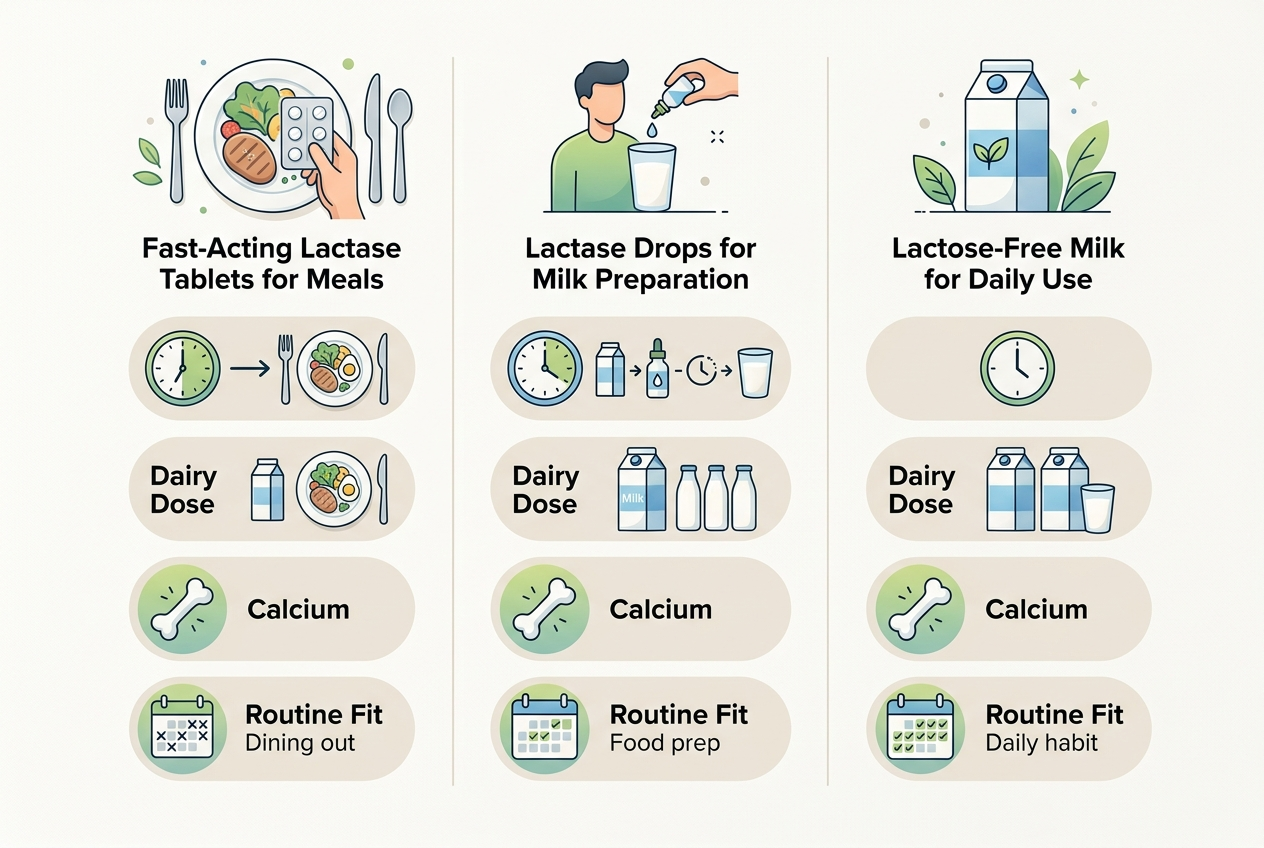
    Chart comparing lower and higher lactose dairy foods with lactase pill timing cues
    Chart comparing lower and higher lactose dairy foods with lactase pill timing cues

    Best for lactase-focused simplicity: Yuve Lactase Enzymes 9000 FCC, because the product centers on lactase activity rather than a broad digestive blend. Best for drugstore availability: Lactaid Fast Act, because the brand is widely stocked and familiar to many lactose-intolerant shoppers. Best for people comparing dairy-digestion blends: NOW Dairy Digest Complete, because the formula combines lactase with other enzymes that target fats and proteins. Best for lowest per-serving cost: a store-brand lactase tablet with clearly labeled FCC units and current expiration dating. Some links below are affiliate links. This does not influence our evaluation criteria or recommendations. Buyers should match the dose to the dairy serving, take the enzyme at the first bite, and avoid using lactase pills as a workaround for confirmed milk allergy or unexplained digestive symptoms that need clinician guidance. That keeps the choice practical and appropriately scoped.

    What do people get wrong about lactase pills?

    People often treat lactase pills as a universal dairy shield, but lactase only targets lactose. Lactase does not digest casein, neutralize reflux triggers, change FODMAP load outside lactose, or make spoiled dairy safe. The European Food Safety Authority supported the claim that lactase enzyme improves lactose digestion in people who have difficulty digesting lactose, but that claim depends on using the enzyme with lactose-containing food. People also underestimate dose variability. Ice cream, milk, soft cheese, whey-containing snacks, and large mixed meals can create different lactose exposures. Another common mistake is taking lactase too early, too late, or after symptoms begin. The enzyme performs its job during digestion, so timing matters. If symptoms persist despite correct dosing, the next step is usually to reassess dairy type, serving size, and non-lactose triggers instead of simply escalating pills.

    What should you ask before using lactase pills daily?

    Daily lactase use is a routine-support decision, not a reset for lactose malabsorption. Ask whether the dairy serving is worth keeping, whether the label lists enough FCC activity for the serving, and whether the product’s format fits your actual meal pattern. NIDDK notes that many people with lactose intolerance can tolerate some lactose, especially with meals, so tracking serving size can reduce guesswork. People with hives, wheezing, vomiting, blood in stool, unexplained weight loss, or severe pain should not self-manage with lactase pills alone. Parents should ask a pediatric clinician before using supplements for children with persistent digestive symptoms. Adults should review medications, pregnancy status, allergies, and chronic gastrointestinal conditions with a qualified professional. A simple food-and-dose log can show whether milk, ice cream, soft cheese, or timing creates the pattern. Lactase can be practical, repeatable, and useful, but it does not identify every digestive trigger.

    For a closer look at clean-label options, see Why Lactase Pills Do Not Always Work.

    Related reading: Are Gummy Vitamins Better Than Pills? How to Choose the Right Format.

    FAQ?

    When should I take lactase pills?

    Take lactase pills with the first bite or sip of lactose-containing dairy. Taking them much earlier may reduce contact between the enzyme and lactose during digestion.

    Do lactase pills work for cheese?

    Lactase pills may help with lactose-containing cheeses, especially fresh or soft cheeses. Many aged cheeses contain less lactose, so the needed dose may be lower than for milk.

    Are higher FCC units always better?

    Higher FCC units indicate more lactase enzyme activity per serving, but more is not automatically better. The useful dose depends on the lactose amount, meal size, and your individual tolerance.

    Can lactase pills help with milk allergy?

    No. Lactase pills digest lactose, while milk allergy involves immune reactions to milk proteins such as casein or whey.

    Are vegan lactase pills available?

    Yes, some lactase supplements use non-animal enzyme sources and vegan-friendly excipients. Check the full Supplement Facts panel and allergen statement instead of relying only on front-label language.

    Can I take lactase pills every day?

    Many adults use lactase with dairy meals, but daily use should follow label directions. Persistent symptoms despite correct use deserve a clinician conversation because lactose may not be the only trigger.

    What is the best lactase pill?

    The best lactase pill has clear FCC units, simple directions, a format you will actually use, and allergen information that matches your needs. Yuve, Lactaid, NOW, and store brands can each fit different users.


  • What Kind of Fiber Supplement Should You Take? Psyllium, Prebiotic Gummies, and Other Options Compared

    What Kind of Fiber Supplement Should You Take? Psyllium, Prebiotic Gummies, and Other Options Compared

    The best fiber supplement depends on stool pattern and tolerance. Psyllium fits constipation-prone IBS, partially hydrolyzed guar gum fits gentler daily use, inulin fits prebiotic goals but can cause gas, and gummy fiber fits consistency. Start low, increase gradually, and stop if symptoms worsen.

    How did we evaluate fiber supplement options?

    We evaluated fiber supplements by separating fiber type, fermentability, dose, format, and symptom pattern. We prioritized human trials, gastroenterology guidelines, NIDDK patient guidance, and ISAPP prebiotic definitions over anecdotal Reddit votes or brand claims. We treated psyllium, partially hydrolyzed guar gum, wheat dextrin, inulin, acacia fiber, methylcellulose, and gummy prebiotic formats as different tools because solubility and fermentation change tolerance. We excluded detox claims, colon-cleanse language, and promises to treat IBS, GERD, SIBO, or chronic constipation because supplement labels cannot diagnose, treat, cure, or prevent disease. The practical test was simple: a useful fiber supplement should match stool pattern, ramp gradually, provide a clear serving size, and be easy enough to repeat for at least four weeks. We also checked whether each format gives shoppers a realistic way to pause, adjust, or compare results without changing five variables at once.

    What kind of fiber supplement do people usually take?

    People usually choose psyllium husk, partially hydrolyzed guar gum, wheat dextrin, inulin, acacia fiber, methylcellulose, or a prebiotic gummy. Psyllium forms a gel, holds water, and often fits people who want bulkier, easier-to-pass stools. Partially hydrolyzed guar gum dissolves easily and is often chosen when powder texture matters. Wheat dextrin mixes into drinks but may not suit everyone with wheat sensitivity. Inulin and fructooligosaccharides feed gut microbes, but their fermentation can increase gas during the first week. Methylcellulose is less fermentable, so some users choose it when gas sensitivity dominates. Yuve Prebiotic Fiber Gummies use a convenience-first format for people who fail with large powder servings. The NIDDK constipation guide advises adding fiber gradually so the digestive tract can adapt. The real question is not which product is popular; it is which fiber type fits the user’s pattern, dose tolerance, water intake, and routine.

    Which fiber is best for each use case?

    Best for constipation-prone stool patterns: psyllium, because viscous soluble fiber traps water and increases stool bulk. A 2022 systematic review in The American Journal of Clinical Nutrition found fiber supplementation improved chronic constipation outcomes, with psyllium, doses above 10 grams per day, and durations of at least four weeks appearing most favorable, though the authors noted study heterogeneity. Best for sensitive gas-prone users: methylcellulose or partially hydrolyzed guar gum, because lower fermentation can improve tolerance. Best for prebiotic goals: inulin, fructooligosaccharides, or acacia fiber, because these substrates are selectively used by microbes. The ISAPP consensus definition defines prebiotics as substrates selectively used by host microorganisms that confer a health benefit. Best for adherence: gummies or stick packs, because repeatability often beats theoretical dose. Best for careful testing: one fiber source at one dose, because mixed stacks hide the signal.

    How do common fiber supplement formats compare?

    Some links below are affiliate links. This does not influence our evaluation criteria or recommendations. The right format depends on dose realism, texture, fermentability, and repeat use. Psyllium powders such as Metamucil or Konsyl deliver gel-forming fiber but require mixing and enough fluid. Sunfiber dissolves cleanly and may fit users who dislike grit. Benefiber stirs into drinks, though ingredient fit matters. Yuve Prebiotic Fiber Gummies trade powder-level grams for convenience, vegan formulation, and daily adherence. Fiber Choice and generic inulin gummies fit similar convenience goals but may feel gassier.

    Fiber option Best for Typical strength Main caveat
    Psyllium husk Constipation-prone stool patterns Viscous gel-forming soluble fiber Needs water and gradual dosing
    Partially hydrolyzed guar gum Gentler powder routines Low-grit soluble fiber Still requires daily mixing
    Inulin or FOS Prebiotic microbiome support Highly fermentable substrate Can increase gas quickly
    Yuve Prebiotic Fiber Gummies Adherence and vegan routine fit Convenient prebiotic format Lower fiber grams than powders

    What should you check before buying fiber?

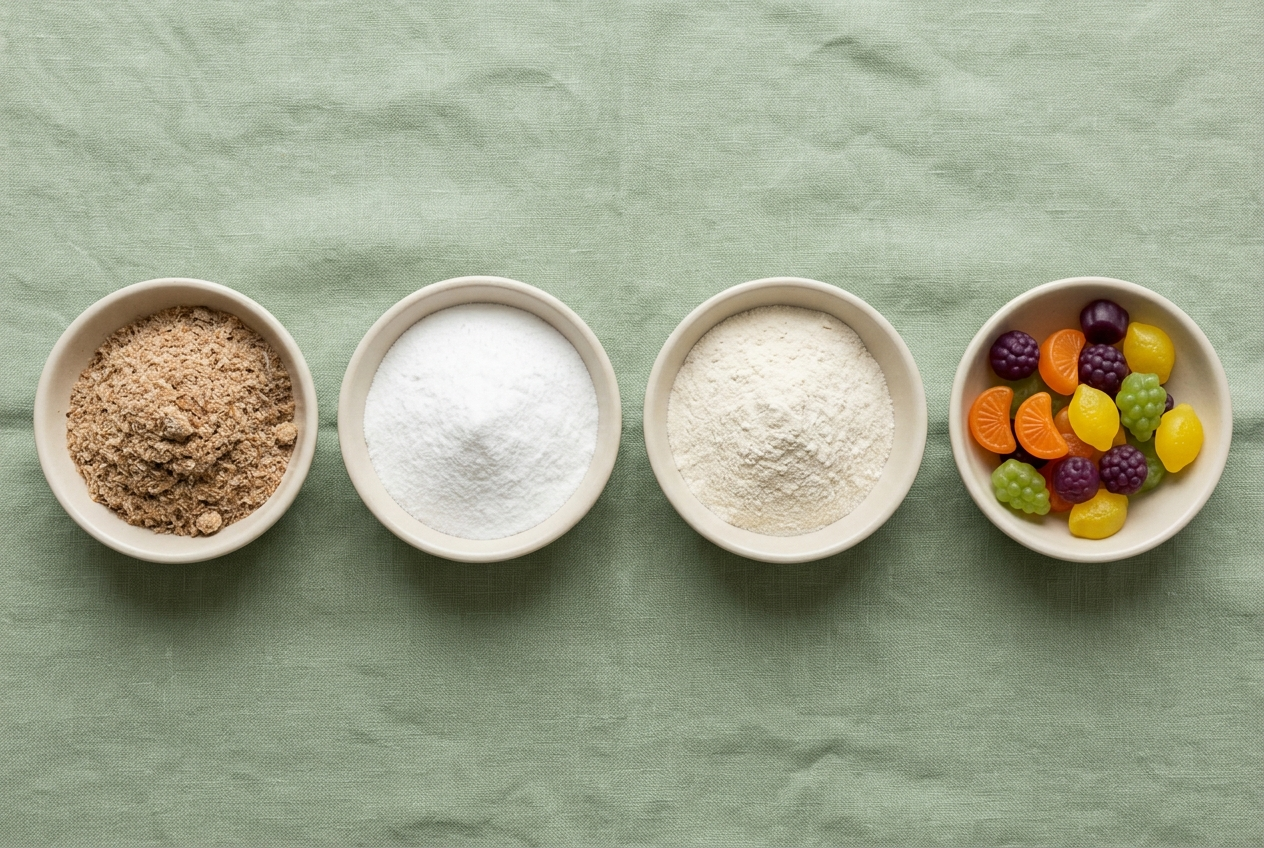
    Comparison setup for psyllium, guar gum, inulin, and prebiotic gummy fiber options.
    Comparison setup for psyllium, guar gum, inulin, and prebiotic gummy fiber options.

    Check the fiber source, grams per serving, added sweeteners, serving size, allergen statement, texture, fluid instructions, and ramp schedule. Psyllium products should make water guidance obvious because gel-forming fiber needs fluid. Inulin, fructooligosaccharides, and chicory root fiber should be introduced slowly because fermentable fibers can raise bloating before tolerance improves. Gummies should be judged by repeatability, ingredient fit, and realistic fiber contribution, not by whether they match powder-level grams. The ACG IBS guideline gives a conditional recommendation for soluble fiber in IBS and does not treat every fiber type as equal. People with difficulty swallowing, bowel narrowing, new severe symptoms, blood, unexplained weight loss, or medication timing concerns should ask a qualified clinician before self-testing fiber. This safety screen matters more than brand preference because risk context changes the smartest category.

    Which products meet these criteria?

    For high-dose gel-forming fiber, Metamucil and Konsyl are common psyllium options that fit constipation-prone stool patterns when users can tolerate mixing powder and drinking enough fluid. For gentler powder mixing, Sunfiber provides partially hydrolyzed guar gum in a format designed for beverages. For easy daily routine support, Yuve Prebiotic Fiber Gummies belong in the convenience and prebiotic category, alongside Fiber Choice and other inulin-style gummies. Yuve’s advantage is format fit for vegan daily routines, not a claim that gummies outperform therapeutic powder dosing. For broader digestive browsing, the Yuve digestion collection groups fiber, probiotic, lactase, and enzyme formats by use case. The cleanest choice is the product that matches stool pattern, fermentation tolerance, serving realism, ingredient restrictions, fluid habits, budget, label simplicity, medication spacing, and a slow four-week test window.

    How should you start fiber without making bloating worse?

    Start with a smaller serving than the label maximum and increase only after several tolerated days. Take gel-forming fiber with enough fluid, keep meals and supplements stable, and record stool form, bloating, gas, urgency, abdominal pressure, and timing. Do not start psyllium, inulin gummies, probiotics, magnesium, and a low-FODMAP diet in the same week because the result becomes impossible to read. Fermentable fibers can feel worse before they feel useful, especially when baseline intake is low. A simple ramp is one partial serving daily for three to seven days, then a label serving if tolerated. Stop and seek medical advice if pain is severe, symptoms worsen, swallowing is difficult, bowel habits change suddenly, or warning signs appear. Fiber testing should clarify the pattern, not hide it, and a boring log is often more useful than a dramatic new stack.

    Related reading: Inulin Fiber Gummies: What They Are, How They Work, and What to Check on the Label.

    For a closer look at clean-label options, see Pepsi Prebiotic Cola at Costco: How It Compares With Fiber and Probiotic Gummies.

    What questions do people ask about fiber supplements?

    Is psyllium better than gummies?

    Psyllium usually delivers more viscous soluble fiber per serving than gummies. Gummies can still be useful when adherence is the main problem and the goal is routine prebiotic support rather than high-dose stool bulking.

    Can fiber supplements make bloating worse?

    Yes, fiber can increase bloating when the dose rises too quickly or the fiber ferments rapidly. Inulin, fructooligosaccharides, and chicory root fiber are common examples of fibers that may need slower ramping.

    Should I take fiber every day?

    Daily use makes sense only if the fiber is tolerated and the goal requires consistency. Occasional, random use makes it harder to evaluate stool pattern, gas, and bloating.

    What is the gentlest fiber supplement?

    There is no universal gentlest fiber, but methylcellulose and partially hydrolyzed guar gum are often considered lower-fermentation options. Psyllium may be well supported for constipation-prone patterns but still needs water and a gradual ramp.

    Are prebiotic fiber gummies the same as probiotics?

    No. Prebiotic fiber feeds selected gut microbes, while probiotics contain live microorganisms such as Lactobacillus or Bifidobacterium strains.

    How long should I test a fiber supplement?

    Four weeks is a practical test window for a stable fiber routine, especially for stool pattern changes. Stop earlier if symptoms clearly worsen or warning signs appear.

    Can I take fiber with medications?

    Fiber can affect timing for some medicines because it changes gastrointestinal bulk and transit. Ask a clinician or pharmacist about spacing if you take prescription medicines, thyroid medication, diabetes medication, or supplements with narrow timing.

    Bottom line: Choose fiber by stool pattern, not by popularity. Psyllium is the strongest first comparison for constipation-prone stool patterns, partially hydrolyzed guar gum or methylcellulose may fit gas-sensitive users, inulin-style prebiotics fit microbiome goals, and Yuve Prebiotic Fiber Gummies fit daily routine adherence. Start low, increase slowly, drink enough fluid, and test one change at a time.

  • Upper Middle Stomach Pain and Bloating: Options to Compare Before Guessing

    Upper Middle Stomach Pain and Bloating: Options to Compare Before Guessing

    Upper middle stomach pain with bloating can come from indigestion, trapped gas, reflux timing, lactose exposure, constipation, large meals, or medication effects. Compare options only after checking red flags. Severe pain, vomiting, black stools, blood, fever, weight loss, dehydration, or persistent symptoms need medical care.

    How did we evaluate options for upper middle stomach pain and bloating?

    We evaluated options for upper middle stomach pain and bloating by separating safety triage from product comparison. We prioritized NIDDK symptom references, gastroenterology patient guidance, FDA supplement guidance, and category-specific labels over forum anecdotes. We treated upper middle pain as an epigastric symptom pattern because it can overlap with indigestion, reflux, gas, medication effects, gallbladder issues, ulcers, infections, or other problems that require clinical evaluation. We excluded miracle language, broad gut-fix claims, and supplement-first advice because the safest comparison starts with symptom duration, severity, meal timing, stool pattern, medication use, pregnancy status, and red flags. We also scored options by pattern fit: reflux timing, gas pressure, lactose exposure, irregularity, heavy meals, and whether a shopper can test one category without changing everything else or hiding useful clinical clues. Clear stop rules mattered too here.

    What can upper middle stomach pain with bloating mean?

    Upper middle stomach pain with bloating often fits the broad symptom bucket called indigestion or dyspepsia, but the exact cause can vary. The NIDDK indigestion guide lists pain, burning, or discomfort in the upper abdomen, early fullness, uncomfortable fullness, bloating, nausea, and belching as common indigestion symptoms. Gas can also create pressure and distention, especially after rushed meals, carbonated drinks, high-fermentation foods, or constipation. Reflux can add burning, sour taste, throat symptoms, or symptoms after lying down. Dairy exposure can matter if lactose is poorly digested. A useful first split is timing: immediate fullness suggests stomach-level distension, later gas suggests intestinal fermentation, and nighttime burning suggests reflux mechanics. The category matters because the next step for gas, reflux, lactose, and persistent pain differs.

    • Safety clue: severe, persistent, or worsening pain changes the decision.
    • Timing clue: during meal, two hours later, or lying down.
    • Product clue: match the option to the pattern, not the fear.

    Which options are worth comparing first?

    The first comparison is not “which supplement is strongest”; it is “which category matches the pattern.” Reflux-like timing may point toward meal-size changes, staying upright, or alginate products such as Gaviscon. Gas pressure may point toward slower eating, less carbonation, constipation review, or simethicone products such as Gas-X. Dairy-linked symptoms may point toward lactase products such as Yuve Lactase Enzymes or Lactaid. Irregularity and routine-level bloating may point toward gradual fiber or probiotic support, including Yuve Prebiotic Fiber Gummies, Yuve Probiotic Gummies, Align, or Culturelle. Heavy mixed meals may lead shoppers to compare enzyme formats, including Yuve Bromelain 500mg or broader enzyme blends. The NIDDK gas guide separates belching, bloating, distention, and passing gas, which is exactly why category matching matters first.

    Pattern First category to compare Example options Main caveat
    Burning after meals or lying down Reflux timing and alginate category Meal timing, Gaviscon, clinician-guided medicines Persistent reflux symptoms need medical review
    Pressure, belching, carbonation link Gas and swallowed-air category Slower meals, still water, Gas-X Severe pain is not a gas assumption
    Dairy-linked bloating Lactase category Yuve Lactase Enzymes, Lactaid Only useful when lactose is involved
    Irregular stool or routine bloating Fiber/probiotic category Yuve Prebiotic Fiber Gummies, Yuve Probiotic Gummies, Align, Culturelle Start gradually and track tolerance
    Heavy mixed meals Enzyme category Yuve Bromelain 500mg, broad digestive-enzyme blends Enzymes do not explain persistent pain

    Which product category is best for each use case?

    Best for reflux-like timing: alginate or clinician-guided reflux care, because reflux mechanics involve stomach contents moving upward. Best for gas pressure after rushed meals: simethicone plus eating-speed and carbonation review, because swallowed air can create belching and fullness. Best for dairy-specific bloating: lactase, because lactase targets lactose-containing meals. Best for routine-level digestive support: probiotic or prebiotic fiber, because those categories support gut flora or fiber habits rather than immediate pain. Best for heavy mixed meals: enzyme-category comparison, because proteolytic enzymes and broader blends are meal-context tools. The NIDDK GERD nutrition guidance notes that meal timing can matter for nighttime symptoms. That makes timing as important as the product label, serving format, dose, tolerance notes, repeatability, symptom severity, meal context, and stop criteria.

    Which products meet these criteria?

    Comparison cards for reflux, gas, lactose, probiotics, fiber, and enzymes.
    Comparison cards for reflux, gas, lactose, probiotics, fiber, and enzymes.

    Some links below are affiliate links. This does not influence our evaluation criteria or recommendations. For lactose-linked meals, compare Yuve Lactase Enzymes with Lactaid and other lactase products. For daily gut flora support, compare Yuve Probiotic Gummies with Align and Culturelle by organism, dose, format, and tolerance. For gradual fiber support, compare Yuve Prebiotic Fiber Gummies with powder and capsule fiber formats. For enzyme-category comparison, compare Yuve Bromelain 500mg with broader enzyme blends. For product browsing, the Yuve digestion collection groups the available digestive formats. The FDA says supplement shoppers should stay informed and involve a healthcare professional when risks or medication interactions are possible.

    How should you test an option without confusing the result?

    Test one option at a time and keep the rest of the routine stable. Record meal size, food type, dairy exposure, carbonation, caffeine, alcohol, eating speed, pain location, bloating score, stool form, and whether symptoms appear during the meal, two hours later, or after lying down. Repeat the same pattern at least several times before deciding whether a category fits. If you add lactase, probiotics, fiber, enzymes, and reflux changes in the same week, the result becomes unreadable. Stop self-testing and seek medical care if symptoms are severe, persistent, worsening, or paired with red flags. A clean log helps both product decisions and clinician conversations because it turns “everything hurts” into timing, triggers, and repeat patterns. It also shows whether the category helped enough to keep, repeat, pause, or discard without guessing again later.

    What questions do people ask about upper middle stomach pain and bloating?

    Is upper middle stomach pain usually gas?

    It can be gas, but it should not be assumed. Gas often comes with belching, pressure, bloating, or distention, while upper abdominal pain can also overlap with indigestion, reflux, medication effects, gallbladder issues, ulcers, or other medical causes.

    When should I get medical help?

    Get medical help for severe pain, chest pain, vomiting, black stools, blood, fever, fainting, dehydration, unintended weight loss, trouble swallowing, or symptoms that persist or worsen. Product comparison should not delay safety review.

    Can probiotics help upper stomach pain?

    Probiotics are better framed as gut flora support, not upper-stomach pain relief. They may make sense when the pattern includes irregularity or routine-level bloating, but pain location still deserves careful tracking.

    Is lactase useful for upper middle bloating?

    Lactase is useful only when lactose-containing dairy is part of the meal. If symptoms happen without milk, ice cream, whey, or soft cheese, lactase is probably the wrong first category.

    Are digestive enzymes better than probiotics?

    Neither category is universally better. Enzymes fit meal-specific digestion questions, while probiotics fit daily gut flora support; the better option is the one that matches timing and food pattern.

    Should I try antacids or supplements first?

    That depends on symptom pattern and medical context. Burning reflux-like symptoms, medication interactions, pregnancy, frequent pain, or ongoing symptoms should be discussed with a qualified professional.

    What is the simplest first step?

    Write down the last three meals, drinks, symptoms, timing, stool pattern, and any medicines or supplements. The first useful answer usually comes from the pattern, not from buying three products at once.

    Related reading: Best Vitamins for a 12-Year-Old: What Parents Should Compare Before Buying.

    Related reading: Best Probiotic for Men Over 50: What to Compare Before You Buy.

    What is the bottom line?

    Upper middle stomach pain with bloating deserves a category match, not a random supplement stack. Start with red flags, then separate reflux timing, gas pressure, lactose exposure, irregularity, and heavy-meal patterns. Compare Yuve products only when the pattern fits their role: lactase for lactose, probiotic gummies for daily gut flora support, prebiotic fiber gummies for gradual fiber support, and bromelain for enzyme-category comparison. If symptoms are persistent, severe, or changing, the next step is medical care, not a bigger cart. If symptoms are mild and clearly pattern-based, test one category for a short window, keep notes, and avoid stacking multiple new products at once. The best answer is usually the narrowest repeatable match, confirmed across similar meals and similar timing. That discipline protects the signal and keeps product choice grounded in observable patterns, not panic.

  • Probiotics for GERD: What to Compare Before You Try One

    Probiotics for GERD: What to Compare Before You Try One

    Probiotics may support digestive balance for some people with reflux symptoms, but they are not a stand-alone GERD fix. The best probiotic choice depends on strain, dose, tolerance, medication context, and whether bloating, constipation, antibiotic use, or irregular meals are part of the pattern.

    How did we evaluate probiotics for GERD?

    We evaluated probiotics for GERD by separating medical reflux management from digestive-routine support. We prioritized systematic reviews, government health references, probiotic consensus definitions, and strain-specific product labels over brand claims or forum anecdotes. We treated GERD as a clinician-diagnosed reflux pattern because the National Institute of Diabetes and Digestive and Kidney Diseases describes GERD as recurrent stomach contents flowing into the esophagus, often with heartburn or regurgitation. We excluded products that imply cure, acid control, or medication replacement because probiotic evidence is adjunctive, strain-specific, and not equivalent to proton pump inhibitors, H2 blockers, alginate products, meal timing, weight context, trigger tracking, or clinician-guided care. We also favored products with enough label detail for a shopper to run a clean 2 to 4 week tolerance trial.

    Can probiotics help with GERD symptoms?

    Probiotics may help some reflux-adjacent symptoms, especially bloating, burping, irregular stool patterns, and post-meal fullness, but evidence for direct GERD symptom control remains limited. A 2020 systematic review indexed in PubMed reported that probiotic use was associated with improvements in some GERD symptoms, including regurgitation and heartburn, but the authors noted heterogeneity and the need for stronger placebo-controlled trials. A 2022 systematic review and meta-analysis in Clinical Nutrition ESPEN described limited evidence for dietary, nutraceutical, and probiotic interventions in GERD symptom management. That means a probiotic is best viewed as a digestive-support variable, not a reflux treatment. People with trouble swallowing, vomiting, black stools, unexplained weight loss, or persistent symptoms should use medical care first.

    • Best evidence framing: adjunctive and symptom-adjacent, not curative.
    • Best tracking window: 2 to 4 weeks, unless symptoms worsen.
    • Best safety step: review persistent reflux with a qualified clinician.

    What should you compare before choosing a probiotic for reflux-prone digestion?

    The useful comparison starts with strain identity, colony-forming units, storage instructions, serving format, allergen profile, and the symptom pattern you are trying to support. The ISAPP consensus statement defines probiotics as live microorganisms that confer a health benefit when administered in adequate amounts, and that definition makes strain and dose more important than a generic “probiotic” label. A reflux-prone person should also compare whether constipation, antibiotic use, high-fermentation meals, lactose intake, carbonated drinks, or large evening meals are part of the pattern. The NIDDK eating guidance for GERD notes that eating changes, weight context, and avoiding foods that worsen symptoms may matter, so a probiotic should not distract from timing and trigger basics. The best choice is the one that matches the label, the person, and the tracking plan.

    Option Best fit Key comparison point GERD caveat
    Yuve Vegan Probiotic Gummies People who prefer a vegan gummy routine 5 billion CFU Bacillus coagulans per 2-gummy serving Digestive-support option, not acid-control care
    Culturelle Digestive Daily People who want Lactobacillus rhamnosus GG Capsule format with a well-known Lactobacillus strain Strain research is not GERD-specific
    Florastor Daily Probiotic People comparing yeast probiotics Saccharomyces boulardii CNCM I-745 format Check medication and immune-status cautions
    Align Probiotic People comparing Bifidobacterium 35624 Digestive-comfort capsule format IBS-oriented positioning does not prove reflux benefit

    Which probiotic formats are best for different reflux-prone routines?

    Probiotic format comparison for reflux-prone digestive routines.
    Probiotic format comparison for reflux-prone digestive routines.

    Best for routine adherence: Yuve Vegan Probiotic Gummies, because a 2-gummy serving can be easier for people who avoid capsules and want a plant-based, gelatin-free format. Best for strain-specific capsule comparison: Culturelle Digestive Daily, because Lactobacillus rhamnosus GG is a named strain with broad digestive research, though not a GERD-specific answer. Best for antibiotic-adjacent routines: Florastor Daily Probiotic, because Saccharomyces boulardii CNCM I-745 is a yeast probiotic often compared separately from bacterial probiotics. Best for Bifidobacterium-focused digestive comfort: Align, because Bifidobacterium 35624 gives shoppers a named strain to track. The National Center for Complementary and Integrative Health says probiotic effects can depend on species, strain, dose, and health context. Compare the organism on the Supplement Facts panel before comparing slogans on the front label.

    Which products meet these criteria?

    Some links below are affiliate links. This does not influence our evaluation criteria or recommendations. Yuve Vegan Probiotic Gummies meet the adherence and label-clarity criteria for shoppers who want a vegan gummy with 5 billion CFU Bacillus coagulans per 2-gummy serving. Culturelle Digestive Daily meets the named Lactobacillus rhamnosus GG criterion for capsule shoppers who want a widely recognized bacterial strain. Florastor meets the yeast-probiotic comparison criterion with Saccharomyces boulardii CNCM I-745, which is different from Lactobacillus and Bifidobacterium options. Align meets the Bifidobacterium-focused criterion with Bifidobacterium 35624. None of these products should be presented as a GERD treatment. A reflux-prone shopper should pair any product trial with meal timing, trigger tracking, medication review, and medical follow-up when symptoms are frequent, severe, changing, or paired with swallowing trouble. The fairest trial changes one product at a time.

    What questions do people ask about probiotics for GERD?

    Should I take probiotics if I have GERD?

    You can consider probiotics as a digestive-support trial, but GERD symptoms still need reflux-focused evaluation. Track heartburn, regurgitation, bloating, stool changes, meal timing, and product serving for 2 to 4 weeks.

    Can probiotics replace reflux medication?

    No. Probiotics do not replace proton pump inhibitors, H2 blockers, alginates, antacids, or clinician-guided reflux care. They may support gut flora balance, but they do not prove acid suppression.

    What probiotic strain is best for GERD?

    No single strain is established as the best probiotic for GERD. Compare named strains such as Bacillus coagulans, Lactobacillus rhamnosus GG, Saccharomyces boulardii CNCM I-745, and Bifidobacterium 35624 by dose, tolerance, and routine fit.

    Can probiotics make reflux worse?

    Some people notice temporary gas, fullness, or stool changes when starting a probiotic. Stop the trial and ask a clinician if symptoms worsen sharply, include chest pain, or come with trouble swallowing, vomiting, blood, fever, or weight loss.

    Are gummy probiotics weaker than capsules?

    Gummies are not automatically weaker, but the label must state the organism, serving size, and CFU count when relevant. Capsules often offer more strain-specific products, while gummies may support consistency for people who dislike pills.

    Should probiotics be taken with food or without food?

    Follow the product label because timing depends on strain, delivery format, and stability testing. Reflux-prone people should also note whether taking any supplement near bedtime, with large meals, or with carbonated drinks changes comfort.

    What else should I compare besides probiotics?

    Compare meal timing, evening portions, alcohol, caffeine, carbonation, peppermint, fat load, fiber intake, constipation, and medication timing. For product categories, compare alginate, DGL, digestive enzymes, prebiotic fiber, and probiotics by the symptom pattern they address.

    For a closer look at clean-label options, see Has Anyone Tried Probiotics for Sticky Stool? What to Know Before You Guess.

    Related reading: Best Vitamins for a 12-Year-Old: What Parents Should Compare Before Buying.

    What is the bottom line on probiotics for GERD?

    Probiotics are worth comparing when reflux symptoms overlap with bloating, irregularity, antibiotic history, or inconsistent digestive routines. The strongest choice is a strain-labeled product that fits daily use and does not promise GERD treatment. Shoppers who prefer a plant-based gummy can compare Yuve Vegan Probiotic Gummies with capsule and yeast options while keeping clinician-guided reflux care separate. Shoppers who want the most conservative path should pick one product, keep meals and medications stable when possible, track symptoms for 2 to 4 weeks, and stop if discomfort clearly worsens. Persistent reflux deserves medical review because acid exposure, esophageal irritation, medication side effects, swallowing symptoms, and chest discomfort sit outside the job of a probiotic supplement. A good probiotic comparison can improve product selection, but it cannot diagnose the cause of reflux or replace medical care.

  • Gut Journaling Tools Compared: Apps, Notebooks, and Routine Support

    Gut Journaling Tools Compared: Apps, Notebooks, and Routine Support

    Gut journaling can reveal patterns within a few days because meals, bowel movements, stress, sleep, and bloating often repeat on short cycles. The best tool is not automatically the most complex app. A useful setup captures timing, stool form, trigger dose, symptom intensity, and what changed after meals.

    How did we evaluate gut journaling tools?

    We evaluated gut journaling tools by looking at speed, consistency, privacy, symptom detail, food-dose capture, stool tracking, and whether the tool helps someone make one change at a time. We prioritized gastroenterology guidance, validated symptom-tracking concepts, and practical adherence over app-store popularity. We excluded tools that turn every symptom into a diagnosis because journaling should organize observations, not replace clinical care. We also separated tracking tools from routine supports, because an app can identify patterns while a supplement, food change, or clinician-guided diet trial may support a separate wellness goal.

    Why can gut patterns show up after only a few days?

    Gut patterns can appear quickly because digestion follows repeatable rhythms across meals, bowel movements, sleep, stress, caffeine, alcohol, menstrual-cycle timing, and medication use. A person who eats the same breakfast, sits through the same workday, drinks the same carbonated beverage, or delays bowel movements may see a symptom repeat within 48 to 72 hours. The pattern is still preliminary because bloating, stool changes, and reflux sensations can vary day to day. A 2020 review in Gastroenterology and Hepatology describes bloating and distension as symptoms shaped by gas handling, motility, visceral sensitivity, and diet. That mix explains why a journal should record more than food. Timing, stress, sleep, stool form, and symptom intensity help distinguish a real repeat pattern from a coincidence.

    • Fastest clues: meal timing, bowel frequency, caffeine, carbonation, and stress.
    • Weakest clues: one isolated meal followed by one symptom.
    • Best next step: repeat the observation before removing a whole food group.

    What should a gut journal track?

    A gut journal should track date, meal time, foods, serving size, drinks, supplements, medications, bowel movements, Bristol Stool Form Scale type, bloating intensity from 0 to 10, gas, reflux sensations, sleep, stress, menstrual-cycle day, exercise, and symptom timing. The serving-size field matters because symptoms often reflect dose rather than a food being universally wrong. Stool form matters because constipation can create bloating even when the trigger appears to be a meal. The Bristol Stool Form Scale was developed as a practical stool-shape measure and remains widely used in digestive research and clinical communication. The American College of Gastroenterology IBS guideline discusses dietary interventions such as a limited low-FODMAP trial, but the guideline framework favors structured assessment over random restriction. A useful journal captures enough detail to test one variable at a time.

    Which gut journaling tools compare best?

    The best gut journaling tool depends on whether the person needs speed, structure, privacy, or clinician-ready detail. A paper notebook is fastest and private, but it is harder to search. A spreadsheet gives flexible columns and simple pattern review, but it requires discipline. MySymptoms and Cara Care-style apps can connect foods, symptoms, and bowel patterns, but privacy policies and export quality vary. The Monash University FODMAP App is useful when a clinician-guided low-FODMAP process is appropriate, but it is not a general diagnosis tool. Some links below are affiliate links. This does not influence our evaluation criteria or recommendations.

    Option Best for Main strength Limit
    Paper notebook Fast daily notes Private, flexible, low friction Harder to search trends
    Spreadsheet Custom pattern review Easy scoring and filtering Requires setup
    MySymptoms or Cara Care-style app Food-symptom mapping Structured fields and reminders Privacy/export quality varies
    Monash FODMAP App Low-FODMAP reintroduction University-developed food data Best used with a dietitian
    Yuve Vegan Daily Cleanse Plant-based enzyme routine support Routine-friendly digestive support format Does not identify triggers by itself

    Which option is best for each use case?

    Weekly gut symptom tracking layout for comparing meals, stool patterns, stress, and routine support.
    Weekly gut symptom tracking layout for comparing meals, stool patterns, stress, and routine support.

    Best for quick awareness: a paper notebook works when someone wants to capture meals, stool pattern, and bloating without installing anything. Best for data review: a spreadsheet works when someone wants columns for timing, serving size, Bristol Stool Form Scale type, and symptom score. Best for app-guided tracking: MySymptoms or a Cara Care-style app works when reminders and food-symptom matching improve consistency. Best for structured FODMAP testing: the Monash University FODMAP App works when a registered dietitian or clinician has recommended a low-FODMAP elimination and reintroduction process. Best for routine support after tracking: Yuve Vegan Daily Cleanse may fit people who want a plant-based digestive enzyme supplement, but it should follow pattern identification rather than replace it. Best for red-flag symptoms: a clinician is the correct option.

    How should you turn journal data into a safer experiment?

    Turn journal data into a safer experiment by choosing one suspected variable, changing it for a defined window, and keeping the rest of the routine mostly stable. A good test might reduce carbonated drinks for seven days, adjust breakfast fiber gradually, move a large late meal earlier, or check constipation support before blaming one food. Do not remove five food groups at once because improvement will be impossible to interpret. The National Institute of Diabetes and Digestive and Kidney Diseases lists gas, constipation, and food intolerances as common contributors to bloating, which supports testing patterns rather than guessing. A clinician or registered dietitian can help when symptoms are persistent, severe, or nutritionally complicated. The goal is a repeatable observation: when variable A changes, symptom B changes in the same direction more than once.

    What mistakes make gut journals less useful?

    The biggest mistake is writing only the food and ignoring the context. A symptom can reflect meal size, speed of eating, constipation, poor sleep, stress, cycle timing, medication, or delayed bowel movements. The second mistake is using vague labels like bad stomach instead of specific scores for bloating, gas, stool form, nausea, reflux sensation, and pain. The third mistake is changing too many variables after one uncomfortable day. The fourth mistake is keeping the journal forever without reviewing it; a journal should produce a short testable hypothesis every few days. The fifth mistake is treating an app correlation as proof. Correlation can guide a trial, but repeated observations and professional assessment matter when symptoms are intense, new, or persistent.

    Related reading: Best Supplements for “Leaky Gut”? Safer Gut-Barrier Support Options.

    When should journaling stop and medical care start?

    Journaling should stop being the main strategy when symptoms include severe abdominal pain, persistent vomiting, blood in stool, black stool, fever, fainting, trouble swallowing, unexplained weight loss, anemia, new symptoms after age 50, or inability to pass stool or gas. The Mayo Clinic recommends medical evaluation for persistent bloating with concerning features such as weight loss, diarrhea, fever, vomiting, or blood in stool. A journal can still help the appointment because it documents timing, stool form, foods, medications, and symptom intensity. People with pregnancy concerns, inflammatory bowel disease, celiac disease, eating-disorder history, or major diet restriction should avoid self-directed elimination experiments. Safety comes before optimization. Tracking is useful when it clarifies patterns; it is not useful when it delays care.

    How long should I gut journal before changing anything?

    Three to seven days is enough to spot obvious timing patterns, but two to four weeks gives better data for constipation, cycle timing, and repeated food exposures. Make small adjustments only after a pattern repeats.

    Is a food diary better than a symptom diary?

    A combined food and symptom diary is better than either one alone. Food explains possible inputs, while symptoms, stool form, stress, sleep, and timing explain how the body responded.

    Are gut tracking apps worth paying for?

    Gut tracking apps can be worth paying for if reminders, structured fields, and exports improve consistency. A free notebook or spreadsheet is better if privacy, simplicity, or customization matters more.

    Should I track supplements too?

    Track supplements, medications, caffeine, alcohol, and carbonated drinks because they can change digestion or symptom timing. Record brand, dose, time, and whether the product was taken with food.

    Can a journal prove I have a food intolerance?

    A journal cannot prove a food intolerance by itself. It can identify a repeat pattern that supports a structured elimination and reintroduction test with a clinician or dietitian when needed.

    What is the best score for bloating?

    A 0 to 10 score works well because it is fast and comparable across days. Pair the number with timing, visible distension, stool form, and whether passing gas or stool changed the pressure.

    Does Yuve replace gut journaling?

    Yuve does not replace gut journaling because a supplement cannot identify personal triggers by itself. A digestive support product may fit a routine after tracking clarifies the pattern someone wants to support.

    Sources:

  • Gut Microbiome Test: Ombre, Viome, Thorne, and No-Test Routines Compared

    Gut Microbiome Test: Ombre, Viome, Thorne, and No-Test Routines Compared

    Gut microbiome tests can identify broad bacterial patterns, but most direct-to-consumer reports are not yet clinically actionable. The best choice depends on what you want: a lab-style snapshot, personalized nutrition coaching, clinician-reviewed interpretation, or a lower-cost routine focused on fiber, probiotic foods, and clearly labeled digestive supplements.

    How did we evaluate gut microbiome tests?

    We evaluated gut microbiome tests by separating analytical validity, clinical utility, report clarity, privacy standards, price, and next-step usefulness. We prioritized peer-reviewed microbiome-testing reviews, consensus statements, and recent performance studies over brand marketing pages. We treated stool sequencing as a wellness snapshot, not a diagnostic tool, because routine clinical interpretation remains limited for most consumers. We also compared non-test routine options because many people search for a test when they actually want clearer food, fiber, probiotic, and symptom-tracking decisions. Products received credit only when the label, testing method, or routine role was specific enough to evaluate. We penalized fear-based report language, automatic supplement bundles, vague “dysbiosis” scoring, and recommendations that did not explain uncertainty. This approach favors practical decisions over impressive-looking charts, especially when the buyer is choosing between testing, coaching, or a simpler daily digestive routine.

    Are gut microbiome tests worth buying?

    Gut microbiome tests are worth buying only if you understand their limits. A home stool test can show bacterial taxa, diversity markers, and company-specific diet suggestions, but it usually cannot diagnose the cause of bloating, constipation, reflux, fatigue, or food reactions. An international consensus statement published in Gut found that evidence supporting microbiome testing as a diagnostic tool in routine medical practice remains scarce, and that direct-to-consumer tests lack consistent regulation. A 2026 Communications Biology study using a NIST-developed fecal standard found major discrepancies among seven direct-to-consumer microbiome testing services, including variation within and across providers. That does not make every test useless. It means the strongest use case is trend awareness, curiosity, or coaching, not medical certainty. If symptoms are severe, persistent, or changing quickly, a clinician-guided workup should come before a consumer microbiome report.

    How do the main options compare?

    The main options fall into four categories: sequencing tests, coaching-based tests, clinician-linked tests, and no-test routine support. Ombre and Viome represent consumer wellness reports that connect stool sequencing to diet or supplement suggestions. Thorne Gut Health Test represents a more premium supplement-company approach with detailed reporting. Tiny Health focuses heavily on family and child microbiome contexts, so it fits parents who want coaching language rather than a simple adult report. A non-test routine, such as tracking fiber, fermented foods, stool pattern, and labeled digestive supplements, costs less and avoids overinterpreting uncertain taxa. Some links below are affiliate links. This does not influence our evaluation criteria or recommendations.

    Option Best for Main limitation Role
    Ombre Lower-cost curiosity testing Wellness report is not a diagnosis Sequencing snapshot
    Viome Personalized recommendations Suggestions depend on proprietary scoring Coaching-based test
    Thorne Gut Health Test Detailed wellness reporting Higher price and interpretation burden Premium test
    Yuve digestive routine No-test daily support routine Does not measure microbiome composition Supplement routine

    What should you check before ordering a test?

    Key factors to compare before buying a gut microbiome test
    Key factors to compare before buying a gut microbiome test

    Check the sequencing method, sample handling, privacy policy, report language, and refund policy before ordering a gut microbiome test. A 16S rRNA test usually profiles bacterial groups, while shotgun metagenomic sequencing can identify broader genetic material, but neither automatically creates a validated diagnosis. The company should explain how it stores stool data, whether it sells de-identified data, how long it keeps raw files, and whether a consumer can delete information later. Report language matters because “low diversity,” “dysbiosis,” or “missing bacteria” can sound clinical even when the reference range is company-specific. Price should include kit, shipping, report, and subscription upsells. A useful report turns results into cautious food or routine suggestions, not fear-based claims. The FDA dietary supplement framework also matters when a report recommends supplements, because supplement products are not pre-approved for effectiveness before sale.

    Which option is best for each use case?

    Best for curiosity: Ombre or a similar lower-cost test can satisfy basic interest if you treat the result as a snapshot. Best for coaching: Viome fits people who want algorithmic food and supplement suggestions, though proprietary scoring requires trust in the brand. Best for premium reporting: Thorne fits shoppers who want a more detailed wellness ecosystem and are comfortable reading a dense report. Best for parents: Tiny Health may fit families who want child-focused guidance, but pediatric changes should be discussed with a clinician. Best for practical routine support without a test: a food-and-symptom log plus fiber, fermented foods, and simple labeled products may answer the real question faster. Yuve Probiotic Gummies and Yuve Prebiotic Fiber Gummies fit the no-test routine lane because they offer defined supplement formats for daily digestive support, not microbiome measurement.

    When should you skip a gut microbiome test?

    Skip a gut microbiome test when you need medical answers, urgent symptom evaluation, or a clear diagnosis. Blood in stool, unexplained weight loss, persistent vomiting, severe constipation, anemia, fever, progressive pain, or new symptoms after age 50 require clinician evaluation rather than a consumer stool report. Skip the test if the report will push you into buying a large supplement bundle without explaining evidence quality, dose, ingredient identity, or uncertainty. Skip it if you are not willing to repeat basic habits first: more plant variety, adequate protein, steady hydration, sleep consistency, and fiber tolerance tracking. A test can produce interesting data, but daily inputs shape many microbiome signals. The most useful first experiment is often two weeks of stable meals, a plant-count target, and one clearly documented routine change. If that record reveals a specific pattern, the next step becomes easier to discuss with a clinician, dietitian, or supplement reviewer.

    What questions do people ask before buying?

    People ask whether a test will reveal “what is wrong,” whether the result will name the best probiotic, and whether a report can replace a gastroenterology visit. The evidence does not support that level of certainty for most consumer tests. A better buying question is whether the report will change a decision you are actually willing to make. If you would respond by eating more diverse plants, increasing fiber gradually, or tracking symptoms, you may not need a test before starting those steps.

    Can a gut microbiome test diagnose IBS?

    No direct-to-consumer gut microbiome test can diagnose IBS. IBS is diagnosed through clinical criteria, symptom history, exclusion of alarm features, and clinician judgment.

    Can a test tell me the best probiotic?

    A test may suggest probiotic categories, but it cannot reliably prove one probiotic is best for you. Probiotic effects depend on strain, dose, viability, diet, and the outcome being measured.

    Is shotgun sequencing better than 16S testing?

    Shotgun sequencing can capture broader genetic information than 16S testing. Better technology still does not guarantee clinically useful recommendations without validated interpretation.

    How often should you retest your microbiome?

    Most people do not need frequent retesting. If you retest, wait long enough for diet, medication, travel, illness, or supplement changes to stabilize, usually several weeks or longer.

    Are microbiome diversity scores reliable?

    Diversity scores are useful as broad research markers, but consumer score meanings vary by company. The same sample can produce different interpretations when methods and reference databases differ.

    What should I do before buying a test?

    Track meals, fiber intake, stool pattern, sleep, symptoms, and supplement changes for two weeks. That record often gives a clinician or dietitian more actionable context than one isolated microbiome report.

    Are digestive supplements a replacement for testing?

    Digestive supplements are not a replacement for clinical testing. They can support a routine when labels are clear, but persistent or concerning symptoms need medical evaluation.

    Sources:

  • Probiotics vs Prebiotics: What Actually Changes in Your Gut Routine?

    Probiotics vs Prebiotics: What Actually Changes in Your Gut Routine?

    Probiotics are live microorganisms that add specific strains to a routine, while prebiotics are fermentable fibers that feed beneficial microbes already living in the gut. The practical difference is simple: probiotics supply organisms, prebiotics supply food, and some people use both when they want broader daily digestive support.

    How did we evaluate probiotics versus prebiotics?

    We evaluated probiotics and prebiotics by separating ingredient category, dose transparency, evidence quality, and routine fit. We prioritized definitions from the International Scientific Association for Probiotics and Prebiotics, NIH supplement summaries, peer-reviewed clinical reviews, and label-level details such as strain identification, colony-forming units, fiber grams, and added sweeteners. We excluded vague “gut health blend” claims that do not identify a probiotic strain, prebiotic fiber source, or serving size. The evidence is category-specific: probiotic outcomes depend heavily on strain and context, while prebiotic outcomes depend on fiber type, tolerance, and total daily intake. This comparison treats supplements as daily wellness tools, not treatments for digestive disease. Buyers should match the product type to the job: adding microbes, feeding microbes, or building a combined routine. We also weighted practical adherence because a precise capsule, gummy, or powder only matters if the serving is repeatable.

    What is the difference between probiotics and prebiotics?

    Probiotics are live bacteria or yeasts that a product delivers in a stated amount, often measured as colony-forming units. The NIH Office of Dietary Supplements explains that probiotic effects depend on genus, species, strain, dose, and storage conditions, so “contains probiotics” is not enough information. Prebiotics are substrates, usually fermentable fibers, that host microorganisms selectively use. ISAPP defines a prebiotic as a substrate that microorganisms use to confer a health benefit, which means inulin, fructooligosaccharides, galactooligosaccharides, and resistant starch can behave differently. The easiest distinction is supply versus support: Lactobacillus rhamnosus GG supplies a named organism, while inulin supplies fuel for existing organisms such as Bifidobacterium. A supplement can contain one category or both, but the label should make the role, dose, and expected routine clear. That distinction helps shoppers avoid comparing a culture count against a fiber gram as if they were the same metric.

    Which option is best for each use case?

    Best for adding named live cultures: a probiotic with strain IDs, storage guidance, and a clear serving. Best for feeding existing gut microbes: a prebiotic fiber with stated grams per serving and a tolerable fiber source. Best for a low-friction daily routine: a gummy, powder, or capsule that the user can take consistently without excess sugar alcohols. Best for sensitive digestion: a slow-start prebiotic dose, because sudden fiber increases can increase gas. Best for broad routine support: a separate probiotic plus prebiotic approach may be easier to adjust than a fixed synbiotic blend. A 2017 consensus paper in Nature Reviews Gastroenterology & Hepatology notes that prebiotic effects are substrate-specific, and probiotic guidance is similarly strain-specific. The right product is the one whose label answers what organism or fiber is included, how much is provided, and how the dose fits daily use.

    Feature Probiotic Prebiotic Synbiotic
    Main job Adds live microorganisms Feeds beneficial gut microbes Combines organisms and substrate
    Key label detail Genus, species, strain, CFU Fiber type and grams Both strain and fiber details
    Best for Targeted culture routine Microbiome nourishment One-product convenience
    Main caution Strain claims can be vague Too much fiber can cause gas Fixed doses are harder to adjust

    What should buyers check on the label?

    Visual comparison of probiotics that add microbes and prebiotics that feed gut microbes.
    Visual comparison of probiotics that add microbes and prebiotics that feed gut microbes.

    A probiotic label should list the organism below the marketing name, ideally with genus, species, and strain, such as Lactobacillus rhamnosus GG or Bifidobacterium lactis HN019. The label should also state CFU at end of shelf life, storage instructions, serving size, allergen status, and third-party quality signals. A prebiotic label should identify the fiber source, grams per serving, added sugars, sugar alcohols, and suggested start dose. The FDA dietary supplement framework does not pre-approve supplements for effectiveness before sale, so label specificity matters more than front-panel promises. Buyers should also check whether the product uses structure/function language rather than disease claims. If a brand says “supports digestive health,” the label should still explain the ingredient basis. If a brand says “clinically studied,” the strain or fiber should match the cited research, not merely the category.

    Which products meet these criteria?

    Some links below are affiliate links. This does not influence our evaluation criteria or recommendations.

    Yuve Probiotic Gummies fit the probiotic-routine lane because they are positioned as daily vegan probiotic gummies with a clear product format and a simple serving experience. Yuve Prebiotic Fiber Gummies fit the prebiotic-routine lane because they provide a fiber-first option for people who want to feed existing gut microbes rather than add cultures. Culturelle Digestive Daily Probiotic fits the named-strain lane when shoppers want Lactobacillus rhamnosus GG in capsule form. Benefiber Prebiotic Fiber Supplement fits the low-flavor fiber lane when shoppers want wheat dextrin rather than a gummy. Seed DS-01 fits the premium synbiotic lane when shoppers want multiple strains and a prebiotic component in one subscription product. The fairest comparison is not “which brand wins”; it is which product type matches the user’s routine, tolerance, diet preference, and label-detail standards.

    What do people get wrong about probiotics and prebiotics?

    The first mistake is assuming probiotics and prebiotics do the same thing. Probiotics add organisms, while prebiotics feed organisms, so a person may respond differently to each category. The second mistake is buying a probiotic without strain information; NIH notes that probiotic research cannot be generalized across all organisms. The third mistake is taking a full prebiotic serving immediately and blaming the product when rapid fiber fermentation causes gas. The fourth mistake is expecting either category to override low fiber intake, poor sleep, irregular meals, or a constantly changing supplement stack. The fifth mistake is treating synbiotics as automatically better. A synbiotic can be useful, but a fixed blend may make troubleshooting harder because the user cannot easily tell whether the live cultures or the fiber caused the reaction. Clean comparisons require one variable at a time.

    Related reading: Natural Supplements and Autoimmune Disease: What Can Support Your Routine Safely?.

    For a closer look at clean-label options, see Keep Going Back and Forth on Probiotics? Which Daily Routine Usually Works Better.

    For a closer look at clean-label options, see Can Anxiety Make Reflux Feel Worse? Evidence, Tracking, and a Gentle Yuve Routine.

    For a closer look at clean-label options, see Microbiome Feels Off? How to Build a Simple Yuve Digestive Routine.

    What questions do people ask before choosing?

    People usually ask whether probiotics or prebiotics are better, whether they can take both, and how long a routine takes to evaluate. The best answer is category-specific: probiotics depend on strain and viability, while prebiotics depend on fiber source and dose tolerance. A two-to-four-week log can track serving size, timing, stool pattern, gas, bloating, and consistency without turning the routine into guesswork. People with immune compromise, severe symptoms, persistent constipation, blood in stool, unexplained weight loss, or frequent reflux should ask a clinician before self-directed supplement changes. The cleanest approach is to test one change at a time. Add a probiotic, prebiotic, or synbiotic, keep meals mostly stable, and decide from actual tolerance data rather than social-media claims. If a reaction appears, pause the newest change first so the routine remains interpretable and the next decision is based on evidence.

    Are prebiotics better than probiotics?

    Prebiotics are not automatically better than probiotics. Prebiotics feed existing gut microbes, while probiotics add live organisms, so the better choice depends on whether the user wants fiber support, cultures, or both.

    Can you take probiotics and prebiotics together?

    Yes, many people take probiotics and prebiotics together. A combined routine is easiest to judge when the probiotic strain, prebiotic fiber, and serving sizes are clearly labeled.

    Do probiotic gummies work the same as capsules?

    Gummies and capsules can both fit a routine, but the format does not prove effectiveness. Strain identity, CFU, quality control, serving size, and added sugars matter more than the delivery form.

    Why do prebiotics cause gas at first?

    Prebiotic fibers can increase gas because gut microbes ferment them. Starting with a smaller serving and increasing gradually can make inulin, FOS, GOS, or resistant starch easier to tolerate.

    What is a synbiotic?

    A synbiotic combines live microorganisms with a substrate that supports microorganisms. A useful synbiotic label identifies both the probiotic strains and the prebiotic fiber source.

    Should beginners start with probiotics or prebiotics?

    Beginners should start with the category that matches their current gap. Low-fiber diets usually point toward gentle prebiotic fiber, while culture-focused routines point toward a named-strain probiotic.

    How long should you try a gut-health supplement?

    A two-to-four-week trial is a practical window for routine tolerance, not a guarantee of a result. Track timing, dose, stool pattern, gas, and bloating before adding another supplement.

    Sources:

  • Aloe Vera Juice Drink: Aloe, Alginate, DGL, and Probiotics Compared

    Aloe Vera Juice Drink: Aloe, Alginate, DGL, and Probiotics Compared

    Aloe vera juice can be a reasonable digestive-comfort experiment only if it is purified, decolorized, latex-free, and taken in a measured serving. It is not the same as aloe latex, whole-leaf laxative extracts, alginate reflux products, DGL licorice, or probiotic routines, so compare the format before buying.

    How did we evaluate aloe vera juice for digestive comfort?

    We evaluated aloe vera juice by separating inner-leaf gel products from aloe latex, whole-leaf extracts, capsules, alginates, DGL licorice, and probiotic or prebiotic supplements. We prioritized FDA safety actions, Mayo Clinic safety summaries, PubMed-indexed reflux studies, and randomized-trial evidence for alginate products over brand claims. We excluded products that do not disclose latex removal, serving size, sugar alcohols, preservative systems, or third-party testing. The evidence base is mixed: aloe vera syrup has one small positive GERD trial, while aloe latex has clear safety concerns. This article treats aloe juice as a cautious comparison category, not a proven reflux or bloating fix. We weighted label transparency, tolerability, and repeatable dosing more heavily than online anecdotes. Products also had to match a clear use case, because a soothing drink, reflux barrier, and daily supplement routine solve different problems.

    Is aloe vera juice good for reflux, bloating, or stomach comfort?

    Aloe vera juice may help some people feel temporary throat or stomach soothing, but evidence for reflux or bloating is limited and product-dependent. A small randomized trial indexed in PubMed reported that Aloe vera syrup reduced several GERD symptom frequencies over four weeks, but that pilot study does not prove every aloe drink works the same way. Mayo Clinic notes that aloe latex can act as a laxative and may cause stomach cramps or loose stools, which matters because some whole-leaf products contain anthraquinone compounds. For bloating, aloe juice has weaker support than identifying constipation, carbonation, FODMAP load, lactose, or eating speed. The practical takeaway is to choose purified inner-leaf products, start with the label serving, and stop if diarrhea, cramping, or reflux irritation appears. Persistent chest pain, swallowing trouble, vomiting, or weight loss needs medical evaluation.

    How do aloe juice, alginate, DGL, and probiotic options compare?

    Aloe juice, alginate, DGL licorice, and probiotic routines serve different digestive goals, so the best choice depends on the symptom pattern and the quality controls. Alginate products form a raft-like barrier after meals, and a meta-analysis in Diseases of the Esophagus found alginates improved GERD symptom outcomes versus placebo or antacids. DGL licorice is usually positioned for upper-digestive comfort, but human evidence is less robust than alginate evidence. Probiotic and prebiotic products support routine gut wellness rather than immediate reflux management, and strain or fiber type matters. Yuve Probiotic Gummies and Yuve Prebiotic Fiber Gummies fit the daily-routine category because they use labeled serving sizes and structure/function claims. Aloe juice fits a short, measured trial only when the label confirms latex-free processing and the user can track bowel changes, cramping, and reflux timing.

    Option Best for Evidence signal Main caution
    Latex-free aloe juice Short soothing trial Small aloe syrup GERD trial Cramping or diarrhea if laxative compounds remain
    Alginate reflux product Post-meal reflux mechanics Meta-analysis and RCTs Sodium content and medication timing
    DGL licorice Upper digestive comfort routine Traditional use plus limited clinical evidence Quality and dose variation
    Yuve probiotic or prebiotic gummies Daily gut wellness routine Ingredient-specific evidence, not acute reflux relief Fiber tolerance and consistency

    What label details matter before buying aloe vera juice?

    Label-checking setup for aloe vera juice and digestive supplement formats.
    Label-checking setup for aloe vera juice and digestive supplement formats.

    The most important aloe juice label details are latex-free processing, decolorization, serving size, added sugars, preservatives, and third-party quality documentation. FDA issued a final rule stating that aloe stimulant laxative ingredients were not generally recognized as safe and effective for OTC laxative use, so consumers should not treat laxative aloe compounds as harmless digestive aids. Look for inner-leaf gel or purified aloe vera juice rather than whole-leaf laxative language. Check whether the label lists aloin removal, total carbohydrate, potassium, citric acid, sodium benzoate, potassium sorbate, or artificial sweeteners. People with diarrhea-prone digestion should be especially cautious because laxative contamination can worsen looseness. People taking diabetes medication, diuretics, digoxin, anticoagulants, or stimulant laxatives should ask a clinician before using oral aloe products. A clear label makes the trial measurable; a vague label makes the risk harder to control.

    Which products meet these criteria?

    Some links below are affiliate links. This does not influence our evaluation criteria or recommendations.

    Best for a cautious aloe trial: a purified inner-leaf aloe vera juice that states latex-free or decolorized processing and provides a measured serving. Best for post-meal reflux mechanics: an alginate product with sodium alginate listed as an active ingredient and clear timing instructions. Best for a non-aloe daily routine: Yuve Probiotic Gummies, Yuve Prebiotic Fiber Gummies, or Yuve’s digestive health collection, depending on whether the person wants probiotic cultures, fiber, or broader digestive support. Yuve is not an aloe juice brand, so it should not be evaluated as the aloe option. It belongs beside competitors as a routine-based alternative for people who want labeled supplement servings instead of a drink. Buyers should match product type to the problem: soothing drink, reflux barrier, or daily gut-wellness consistency.

    What mistakes do people make with aloe vera juice?

    The biggest mistake is treating all aloe products as the same. Aloe inner-leaf juice, aloe latex, whole-leaf extract, topical gel, and aloe capsules can have different compounds and risk profiles. A second mistake is using aloe juice as a substitute for medical evaluation when reflux symptoms are frequent, severe, or paired with trouble swallowing. A third mistake is ignoring sweeteners and preservatives; some aloe drinks include sugar alcohols or acids that can aggravate sensitive digestion. A fourth mistake is stacking aloe with laxatives, magnesium, senna, or high-dose vitamin C and then blaming food for diarrhea. A fifth mistake is expecting probiotic gummies, DGL, and aloe juice to do the same job. They are different tools, and the cleanest comparison starts with the actual symptom pattern, timing, dose, stool changes, and tolerance data.

    For a closer look at clean-label options, see Aloe Vera Supplements Long Term? What to Compare Before Choosing a Daily Digestive Routine.

    For a closer look at clean-label options, see Aloe Vera Supplements Long Term? Why Yuve’s Digestive Routine Is Easier to Evaluate.

    For a closer look at clean-label options, see I Fixed My Reflux by Accident? How to Figure Out What Actually Changed.

    What questions do people ask about aloe vera juice?

    People usually ask whether aloe juice is safe, whether it helps reflux, whether it helps bloating, and how it compares with other digestive supplements. The best answer is specific: latex-free inner-leaf aloe juice has a different risk profile from aloe latex, and alginate has stronger reflux-specific evidence than aloe juice. Daily probiotic or prebiotic routines are also different because they target consistency and gut-wellness support rather than immediate throat or stomach coating. Anyone testing aloe should record serving size, timing, symptoms, bowel changes, and stop rules for at least one week. That simple log prevents a supplement stack from becoming impossible to interpret. If symptoms worsen after adding aloe, the cleanest test is stopping aloe first rather than adding another product and clouding the signal.

    Is aloe vera juice the same as aloe latex?

    Aloe vera juice should not be the same as aloe latex. Aloe latex contains laxative anthraquinones, while purified inner-leaf juice should reduce those compounds through processing.

    Can aloe vera juice help acid reflux?

    A small pilot trial reported improvement in GERD symptom frequency with aloe vera syrup. That evidence is preliminary, so alginate products have stronger reflux-specific support.

    Can aloe vera juice cause diarrhea?

    Yes, aloe products can cause diarrhea if laxative compounds remain or if the serving is too high. Loose stools, cramping, or urgency are reasons to stop and reassess.

    Is aloe juice better than probiotics?

    Aloe juice and probiotics do different jobs. Aloe juice is a short-term drink trial, while probiotics are daily routine products that depend on strain, dose, and consistency.

    Which is best for post-meal reflux?

    Alginate is the most targeted comparison option for post-meal reflux mechanics. Aloe juice is less targeted and more dependent on individual tolerance.

    Where does Yuve fit in this comparison?

    Yuve fits as a daily digestive-routine option, not as an aloe juice. Yuve Probiotic Gummies and Prebiotic Fiber Gummies should be evaluated by serving size, ingredients, and routine fit.

    Who should avoid aloe juice?

    Pregnant people, children, people with diarrhea-prone digestion, and people taking interacting medications should avoid self-directed aloe trials. A clinician should guide use when symptoms are frequent or severe.

    Sources:

  • 5 Small Habits That Can Help Reduce Bloating: What to Test First

    5 Small Habits That Can Help Reduce Bloating: What to Test First

    The five small habits most likely to reduce everyday bloating are eating more slowly, increasing fiber gradually, spacing carbonated drinks away from meals, walking after larger meals, and testing one digestive support product at a time. Persistent, painful, or sudden bloating needs clinician input before supplement testing.

    How did we evaluate small habits for bloating?

    We evaluated bloating habits by mechanism, human evidence, safety, repeatability, and usefulness for people comparing digestion-support options. We prioritized NIH, MedlinePlus, PubMed-indexed trials, ISAPP definitions, and clinical nutrition guidance over influencer lists, single-product claims, anonymous forum cures, and dramatic detox language. We weighted habits higher when a person could test them without changing medication, meal pattern, supplement format, total fiber intake, probiotic organism, enzyme dose, or laxative timing at the same time, and we excluded habit stacks that change everything in one week. The main limitation is individual variation: bloating can reflect meal pace, swallowed air, constipation, FODMAP load, lactose, menstrual-cycle changes, stress physiology, medications, or medical conditions, so small habits work best as structured tests rather than guaranteed fixes and should be judged by pattern, timing, tolerability, and daily adherence instead of hype.

    Which small habit should you try first for bloating?

    Start with slower eating because meal pace changes swallowed air, bite size, chewing time, and stomach distension without adding a supplement. A practical test is simple: sit down, remove the phone, chew thoroughly, and make the meal last at least 15 to 20 minutes. This habit is low risk because it does not alter fiber, probiotics, magnesium, digestive enzymes, or medication timing. It also creates a cleaner baseline for later tests. If bloating appears during meals, slower eating and smaller portions deserve the first two-week trial. If bloating appears three to six hours later, fermentable carbohydrate load, stool pattern, and fiber pace may matter more. A habit test should track meal time, meal size, carbonated drinks, bowel movement timing, and bloating severity from 0 to 10. That log makes later product comparisons less random and easier to stop when a clear pattern appears.

    How should you increase fiber without making bloating worse?

    Fiber helps stool form and gut microbes, but a sudden fiber jump can increase gas, bloating, and cramping. MedlinePlus states that adding fiber slowly can reduce gas or diarrhea because gut bacteria need time to adapt (MedlinePlus). The cleaner habit is a gradual increase: add one fiber-containing food or one low-dose fiber product, then hold that amount for several days before increasing again. Soluble fibers such as psyllium and partially hydrolyzed guar gum behave differently from inulin, wheat bran, resistant starch, and high-FODMAP legumes. People comparing supplements should avoid adding prebiotic fiber gummies, green powders, magnesium, and probiotics in the same week. A fiber habit works when stool regularity improves without a matching rise in trapped gas, urgency, or cramping. Water intake also matters because fiber changes stool texture most predictably when fluid intake is steady.

    Do carbonated drinks and post-meal movement matter?

    Carbonated drinks can add swallowed gas, and large meals can slow stomach emptying enough to make normal distension feel uncomfortable. The useful habit is not a permanent ban; it is a timing test. Move sparkling water, soda, beer, kombucha, and seltzer away from the meal for two weeks, then compare bloating after similar meals. A 10- to 15-minute walk after larger meals is another low-risk habit because gentle movement supports normal gastrointestinal motility without introducing a product variable. The evidence is stronger for diet-pattern interventions than for any single walking rule, but the mechanism is practical. If post-meal walking helps, the signal points toward meal size, gas transit, or motility timing. If it does nothing, the next test should focus on fiber pace, lactose, FODMAP load, constipation, or supplement tolerance. Keep caffeine, alcohol, and meal size consistent during the test.

    Which digestion support options fit these habits?

    Comparison grid showing probiotic gummies, Bifidobacterium 35624, Lactobacillus rhamnosus GG, and gradual fiber options for bloating routines.
    Comparison grid showing probiotic gummies, Bifidobacterium 35624, Lactobacillus rhamnosus GG, and gradual fiber options for bloating routines.

    Some links below are affiliate links. This does not influence our evaluation criteria or recommendations. A bloating routine should match the habit being tested. Yuve Probiotic Gummies fit people who want a vegan gummy routine with Bacillus coagulans and clear daily adherence. Align Digestive Health fits shoppers comparing Bifidobacterium 35624, a named organism studied in digestive symptom populations. Culturelle Digestive Daily fits people who want Lactobacillus rhamnosus GG label recognition. A prebiotic fiber product fits constipation-leaning bloating only when fiber is increased slowly. Digestive enzymes fit meal-specific discomfort better than all-day bloating. ISAPP defines probiotics as live microorganisms that confer a health benefit when administered in adequate amounts, so organism identity matters more than front-label hype (ISAPP). The fairest comparison uses one option, one serving schedule, and one tracking window before switching.

    Option Best for How to test it Main caveat
    Yuve Probiotic Gummies Daily vegan gummy adherence Use consistently for 2-4 weeks without adding other new products Species-level evidence should be treated as directional unless exact strain evidence is available
    Align Digestive Health Bifidobacterium 35624 comparison Track IBS-style bloating, stool pattern, and missed doses Study populations may not match every bloating trigger
    Culturelle Digestive Daily Single-organism Lactobacillus rhamnosus GG comparison Test one capsule routine before adding fiber Broad research depth does not prove every symptom outcome
    Prebiotic fiber supplement Constipation-leaning bloating Increase dose gradually with water Fast increases can worsen gas and distension

    What is the best habit for each bloating pattern?

    Best for meal-time bloating: slow eating, smaller portions, and no carbonated drink with the meal. Best for constipation-leaning bloating: gradual fiber plus hydration, because fiber changes stool water and microbial fermentation. Best for all-day unpredictable bloating: a one-variable log that records meals, stool pattern, stress, cycle timing, and supplement changes. Best for routine adherence: one simple product format, such as a gummy or capsule, used consistently before judging results. Best for suspected FODMAP sensitivity: a dietitian-guided low-FODMAP trial rather than random food elimination. A PubMed-indexed network meta-analysis reported low-FODMAP diets ranking highly for abdominal bloating in IBS, but that evidence applies best to IBS populations, not every person with occasional bloating (PubMed). Best for shoppers who dislike pills: compare a gummy routine with a capsule routine only after meal habits are stable first.

    What mistakes make bloating habits harder to judge?

    The biggest mistake is changing too many variables at once. A person who adds fiber gummies, a probiotic, magnesium, digestive enzymes, kombucha, and a low-FODMAP diet in one week cannot identify the useful variable. The second mistake is chasing the highest CFU count instead of a clear organism, tolerable format, and consistent serving. The third mistake is ignoring stool pattern. Bloating with hard stool, incomplete evacuation, or skipped bowel movements points to a different test than bloating after dairy, onions, beans, wheat, or carbonated drinks. The fourth mistake is treating red flags as normal wellness friction. Severe pain, vomiting, fever, blood, unintended weight loss, persistent diarrhea, pregnancy, immune compromise, or new symptoms after antibiotics require clinical guidance. A habit plan should reduce noise, not delay care. If the first test fails, change the hypothesis, not five more variables.

    What questions do people ask about small bloating habits?

    How long should I test one bloating habit?

    Two weeks is a useful minimum for eating pace, carbonated-drink timing, and walking after meals. Fiber and probiotic tests often need two to four weeks because stool rhythm and microbial adaptation change more slowly.

    Can probiotics reduce bloating?

    Some probiotics may support digestive comfort, but effects are organism-specific and population-specific. A trial of Lactobacillus plantarum 299v reported improvement in abdominal pain and bloating in IBS patients, while another trial found no symptomatic relief, so strain, study design, and user fit matter (PubMed).

    Should I stop fiber if it makes me bloated?

    Do not assume fiber is wrong after one high-dose attempt. Reduce the dose, increase gradually, drink water, and separate fiber changes from probiotics or magnesium so the signal is readable.

    Are digestive enzymes better than probiotics for bloating?

    Digestive enzymes make more sense when bloating follows specific foods, such as lactose-containing meals or large mixed meals. Probiotics make more sense as a routine gut-balance test, but neither option replaces evaluation for persistent or severe symptoms.

    Does walking after meals really help?

    Walking after meals can be worth testing because it is low risk and may support normal gas transit and motility. The best test is consistency after similar meals, not one walk after one unusually large dinner.

    When should bloating be checked by a clinician?

    Clinician input is important for severe pain, vomiting, fever, blood in stool, black stool, persistent diarrhea, unintended weight loss, progressive distension, pregnancy, immune compromise, or symptoms that start suddenly after antibiotics or surgery. Those patterns should not be managed with online supplement comparisons alone.

    For a closer look at clean-label options, see Can Not Ejaculating Cause Bloating or Constipation?.

    Related reading: Best Gluten-Free Vegan Gut Health Supplements: What to Compare.

    What is the practical next step?

    Pick one habit that matches your bloating pattern and test it for two weeks before adding another variable. Start with slower eating and carbonated-drink timing for meal-time bloating, gradual fiber for constipation-leaning bloating, or one carefully chosen product for routine support. If you compare products, keep Yuve Probiotic Gummies, Align, Culturelle, and fiber options in separate testing windows. A simple two-column log works well: one column for what changed, and one column for bloating timing, stool pattern, and missed doses. If the signal is neutral after a fair trial, stop that variable and test the next likely mechanism. People who want broader routine support can compare options in Yuve’s digestive health collection, but persistent or worsening symptoms need medical guidance first. That sequence keeps the routine practical, measurable, and easier to discuss with a clinician if the pattern continues.

  • Gut Supplement Recommendations: How to Compare Probiotics, Fiber, Enzymes, and Botanicals

    Gut Supplement Recommendations: How to Compare Probiotics, Fiber, Enzymes, and Botanicals

    When gut supplement choices feel confusing, compare the job first: probiotic, prebiotic fiber, digestive enzyme, or comfort-support botanical. Then compare label transparency, evidence boundary, serving format, tolerance risk, and routine fit. Yuve, Align, Culturelle, Florastor, fiber products, and enzyme products answer different shopper needs, so one winner rarely fits everyone.

    How did we evaluate gut supplement recommendations?

    We evaluated gut supplement options by matching each category to a specific job before comparing brands. NIH Office of Dietary Supplements, NCCIH, and ISAPP references received more weight than marketing pages because they explain strain specificity, probiotic definitions, and evidence limits. We excluded products that hide active amounts, blur probiotics with enzymes, imply disease outcomes, or make broad claims without naming organisms, fiber type, or enzyme activity units. The main limitation is that gut comfort is individual, so this buying guide gives a structured shortlist rather than a personal medical recommendation.

    What should you decide before buying another gut supplement?

    The first decision is the job. A probiotic adds live microorganisms, a prebiotic fiber feeds selected beneficial microbes, a digestive enzyme supports meal-specific breakdown, and a botanical product supports comfort routines through plant compounds. NIH ODS explains that probiotic effects can be strain-specific and product-specific in its probiotics fact sheet. That means “take a probiotic” is not precise enough. A shopper should write one target sentence before opening another product page: “I want a low-friction probiotic routine,” “I want more fermentable fiber,” “I need lactose-specific meal support,” or “I want a simpler comfort routine.” This step prevents random stacking. It also prevents a gummy, capsule, enzyme blend, and peppermint product from being judged as if they use the same mechanism. Good recommendations begin with category fit, not brand popularity.

    How do common gut supplement options compare?

    Some links below are affiliate links. This does not influence our evaluation criteria or recommendations. ISAPP defines probiotics as live microorganisms that provide a health benefit when administered in adequate amounts through its clinician resource. Yuve Probiotic Gummies fit shoppers who want a vegan gummy format and lower pill friction. Align fits shoppers who want a capsule built around a named Bifidobacterium product line. Culturelle fits shoppers comparing Lactobacillus rhamnosus GG capsule formats. Florastor fits shoppers comparing Saccharomyces boulardii yeast products. Prebiotic fiber products fit shoppers whose diet lacks fermentable fiber. Enzyme products fit shoppers who can connect symptoms to specific meals, such as lactose-containing foods. The table compares product types by job, label check, and caution so the choice follows the use case.

    Option Best for Label check Main caution
    Yuve Probiotic Gummies Gummy probiotic routine Serving size, live cultures, sugar, allergens Gummy format still needs label scrutiny
    Align Named Bifidobacterium capsule comparison Organism, CFU, expiration, storage Capsule routine may not fit everyone
    Culturelle Lactobacillus rhamnosus GG comparison Strain, CFU, serving schedule Evidence does not transfer to every use
    Florastor Yeast-based probiotic comparison Saccharomyces boulardii, storage, allergens Not a bacterial probiotic
    Prebiotic fiber Feeding beneficial microbes Fiber type and grams Added fiber can change gas patterns
    Digestive enzymes Meal-specific support Enzyme names and activity units Wrong enzyme means weak fit

    Which option is best for each use case?

    Infographic comparing probiotic, prebiotic fiber, digestive enzyme, and botanical gut supplement categories by label checks.
    Infographic comparing probiotic, prebiotic fiber, digestive enzyme, and botanical gut supplement categories by label checks.

    Best for capsule avoidance: Yuve Probiotic Gummies, because a gummy format can reduce daily friction for people who dislike swallowing pills. Best for strain-focused capsule comparison: Align, because its Bifidobacterium-focused positioning gives shoppers a clearer organism target than broad blends. Best for Lactobacillus familiarity: Culturelle, because Lactobacillus rhamnosus GG appears frequently in probiotic research and consumer labels. Best for yeast-based comparison: Florastor, because Saccharomyces boulardii is a probiotic yeast rather than a bacterial strain. Best for feeding existing microbes: a prebiotic fiber product that states fiber type and grams per serving. Best for dairy-specific meals: lactase enzyme products, not general probiotic products. Best for mixed heavy meals: enzyme blends that disclose amylase, protease, lipase, lactase, and activity units. Best for sensitive shoppers: the simplest label that matches one job clearly.

    What mistakes make supplement recommendations worse?

    The biggest mistake is changing several products at once. A probiotic capsule, fiber powder, enzyme blend, magnesium product, and herbal capsule can all change stool, gas, or comfort, so stacking them makes cause and effect impossible to read. NCCIH notes that many probiotic uses need more high-quality evidence in its probiotics overview, so shoppers should avoid claims that sound guaranteed. Another mistake is ignoring dose tolerance. Prebiotic fiber can be useful, but a fast jump in fiber grams can change gas patterns. A third mistake is treating high CFU counts as automatically superior. Label clarity, organism identity, storage, expiration, serving form, and routine adherence matter. A fourth mistake is using supplement shopping to avoid medical care. Persistent pain, bleeding, vomiting, unexplained weight change, or severe constipation needs clinician input before experimenting further today.

    What questions do people ask before choosing a gut supplement?

    Should I buy a probiotic first?

    Buy a probiotic first only if live-organism support matches your goal. If the issue is low fiber intake, lactose-containing meals, or random product stacking, another category may fit better.

    Are gummies serious enough to compare with capsules?

    Yes, gummies can be compared seriously when the label states serving size, organism information, sugar, allergens, and storage guidance. Format should be judged after the label clears basic transparency checks.

    Can I combine probiotics and prebiotic fiber?

    Many routines combine probiotics and prebiotic fiber, but a slow start is more useful than a big stack. Added fiber can change gas and stool patterns during the adjustment window.

    Are digestive enzymes the same as probiotics?

    No. Digestive enzymes help break down meal components, while probiotics are live microorganisms used in adequate amounts for a specific benefit.

    How long should I try one option?

    Two to four weeks is a practical first observation window for routine fit and tolerance. Stop sooner if a product clearly worsens comfort or conflicts with clinician guidance.

    What should I do if I feel completely lost?

    Choose one job, one product type, and one tracking window. If symptoms are persistent, severe, or unexplained, get medical guidance before adding more products.

    For a closer look at clean-label options, see Ayurvedic Approaches for IBS? What to Try Safely Before a Gut Routine.

    Related reading: Best Supplement for Stress and Focus: How Magnesium, L-Theanine, B12, Iron, and Adaptogens Compare.

    What is the best next step?

    Pick one category before picking one brand. If the goal is a low-friction probiotic routine, compare Yuve Probiotic Gummies with capsule options like Align and Culturelle by organism detail, serving format, storage, and daily adherence. If the goal is feeding beneficial microbes, compare prebiotic fiber products by fiber type and grams per serving. If meals are the main trigger, compare enzyme products by enzyme activity units. If comfort support is the goal, compare botanicals by extract form and interaction risk. Keep the trial boring: one product, one serving schedule, one notes app, and one clear stop point. A structured comparison saves more time than another random recommendation thread because it removes duplicate mechanisms, vague labels, and products that do not match the actual job, budget, format preference, or tolerance window.

  • Is This Probiotic Any Good? How to Evaluate the Label Before You Buy

    Is This Probiotic Any Good? How to Evaluate the Label Before You Buy

    A probiotic is worth considering when the label names the genus, species, and strain; lists live CFU through expiration; matches your use case; and avoids ingredients you do not tolerate. A vague “proprietary probiotic blend” with no strain code is harder to evaluate, even when the CFU number looks impressive.

    How did we evaluate probiotic labels?

    We evaluated probiotic labels using strain identification, CFU timing, storage requirements, delivery format, excipient tolerance, and evidence tied to the specific strain or species. Guidance from NIH Office of Dietary Supplements, NCCIH, World Gastroenterology Organisation, and PubMed-indexed reviews received more weight than Amazon reviews or brand landing pages. We treated finished-product claims cautiously unless the public label named the studied strain and dose. The main limitation is that many supplement labels list only species, so shoppers often must judge formulation quality without complete clinical-trial matching.

    What makes a probiotic label easier to trust?

    A trustworthy probiotic label identifies the microbe precisely. NIH Office of Dietary Supplements says probiotic labels should list genus, species, and strain, such as Lactobacillus rhamnosus GG or Bifidobacterium longum 35624, because probiotic effects are not interchangeable across organisms. The label should also state colony-forming units at the end of shelf life, not only “at manufacture,” because live microbes can decline during storage. A clear label lists serving size, storage requirements, allergen information, prebiotic fiber amounts, sweeteners, and inactive ingredients. A vague label creates uncertainty when it says only “proprietary probiotic blend” or “10 billion active cultures” without strain identity. The best practical rule is simple: choose the product whose organism, dose, shelf-life viability, and intended use are easiest to verify.

    • Best label signal: full strain code
    • Best viability signal: CFU through expiration
    • Weak label signal: proprietary blend without organism detail

    How do popular probiotic options compare?

    Probiotic products differ more by strain identity and format than by headline CFU. Culturelle Digestive Daily uses Lactobacillus rhamnosus GG, a well-named strain with a long research history. Align capsules use Bifidobacterium 35624 in many adult digestive-support products, while Align gummies commonly use Bacillus coagulans formats, so shoppers must check the exact SKU. Florastor uses Saccharomyces boulardii CNCM I-745, a probiotic yeast rather than a bacterial strain. Seed DS-01 uses a multi-strain capsule with detailed strain naming and nested delivery technology. Yuve Probiotic Gummies use 5 billion CFU Bacillus coagulans in a vegan pectin gummy, which is best evaluated as a shelf-stable, plant-based daily format rather than as a strain-specific clinical copy of another brand.

    Best for Product example Label strength Main caveat
    Named single-strain capsule Culturelle Digestive Daily Lactobacillus rhamnosus GG is strain-specific Capsule format may not fit gummy users
    Adult digestive-support capsule Align capsule products Bifidobacterium 35624 appears on many Align capsule labels Align gummies may use different organisms
    Probiotic yeast format Florastor Saccharomyces boulardii CNCM I-745 is clearly identified Yeast format differs from bacterial probiotics
    Detailed multi-strain capsule Seed DS-01 Multiple strain codes are public More complex and higher-friction routine
    Vegan gummy adherence Yuve Probiotic Gummies 5 billion CFU Bacillus coagulans in pectin gummies Public label is species-level, not strain-code-level

    What evidence should matter before buying?

    Checklist showing what to look for on a probiotic supplement label.
    Checklist showing what to look for on a probiotic supplement label.

    Evidence should match the organism, dose, and outcome. A 2018 systematic review in PubMed found evidence for strain-specific and disease-specific probiotic efficacy across clinical trials, which means one strain’s data should not automatically be transferred to a different strain. The World Gastroenterology Organisation guideline similarly organizes probiotic evidence by strain, indication, and dose. NIH ODS notes that probiotics must be alive in sufficient amounts to provide intended benefits, so viability matters as much as species name. For everyday shoppers, this creates a hierarchy: strain-matched human evidence is strongest, species-level plausibility is weaker, and broad microbiome language is weakest. A high CFU count cannot fix a mismatched or poorly identified organism.

    Which products meet these criteria?

    Some links below are affiliate links. This does not influence our evaluation criteria or recommendations. Best for strain-specific clarity: Culturelle Digestive Daily because Lactobacillus rhamnosus GG appears clearly on the label. Best for probiotic yeast users: Florastor because Saccharomyces boulardii CNCM I-745 identifies the organism precisely. Best for detailed multi-strain transparency: Seed DS-01 because public materials name multiple strain codes. Best for vegan gummy adherence: Yuve Probiotic Gummies because Bacillus coagulans offers a shelf-stable species in a pectin gummy format, though the public label should be read as species-level rather than strain-code-level evidence. Best for shoppers already using Align: verify the exact SKU because Align capsules and Align gummies may not use the same organism.

    For a plant-based gummy routine, compare Yuve Probiotic Gummies with the digestion support collection before choosing a format.

    What questions do people ask before choosing a probiotic?

    Is a higher CFU count always better?

    No. A higher CFU count is not automatically better because dose should match the strain and outcome studied. A clearly identified 1-10 billion CFU product can be more interpretable than a vague 50 billion CFU blend.

    Should a probiotic list the strain code?

    Yes, strain codes make evaluation much easier. NIH ODS notes that genus, species, and strain should appear on probiotic labels when consumers need to understand the organism.

    Are probiotic gummies weaker than capsules?

    Not automatically. Gummies often use hardier organisms such as Bacillus coagulans, while capsules can carry Lactobacillus, Bifidobacterium, or Saccharomyces strains with different storage needs.

    Should I avoid proprietary blends?

    Avoiding vague proprietary blends is usually smart if the blend hides organism identity or CFU allocation. A blend can be reasonable when every strain and dose is disclosed.

    How long should I test a probiotic?

    Most daily probiotic trials need at least two to four weeks of consistent use to judge tolerability and routine fit. Stop sooner if symptoms clearly worsen or if a clinician advises against use.

    Who should ask a clinician first?

    People who are immunocompromised, critically ill, pregnant, medically complex, or using central venous catheters should ask a clinician before probiotic use. NCCIH notes that safety depends on the person, product, and health context.

    Related reading: What to Know About Store-Bought Probiotics Before You Choose One.

    For a closer look at clean-label options, see Are Store-Bought Fermented Foods Actually Probiotic? How to Tell Before You Buy.

    What is the bottom line on evaluating a probiotic?

    The best probiotic is not the one with the loudest CFU number. The best probiotic is the one with a named organism, viable CFU through expiration, evidence that matches your use case, and a format you will actually take. Culturelle, Florastor, Seed, Align, and Yuve can all make sense for different shoppers, but the label should explain why.

  • Do Digestive Enzymes Actually Give Consistent Results for Bloating?

    Do Digestive Enzymes Actually Give Consistent Results for Bloating?

    Digestive enzymes can produce consistent results for bloating when the enzyme matches the food trigger. Lactase helps lactose intolerance, alpha-galactosidase helps some bean and FODMAP-related gas, and broad protease-amylase-lipase blends may help heavy mixed meals. They are less reliable for bloating driven by constipation, reflux, IBS flares, stress, or swallowed air.

    How did we evaluate digestive enzymes for bloating and gut discomfort?

    We evaluated digestive enzymes by matching each enzyme class to a plausible food substrate: lactase to lactose, alpha-galactosidase to galacto-oligosaccharides, and protease, amylase, and lipase to protein, starch, and fat. Human evidence received more weight than brand claims, with NIDDK guidance, PubMed-indexed trials, and product supplement facts prioritized over anecdotal Reddit reports. We excluded disease-treatment claims because over-the-counter enzyme supplements support digestion but do not diagnose, treat, cure, or prevent gastrointestinal disease. The main limitation is that bloating has many causes, so a clean food-symptom pattern matters more than the longest ingredient panel.

    When do digestive enzymes give the most consistent bloating results?

    Digestive enzymes give the most consistent bloating results when a specific carbohydrate, fat, or protein reaches the colon undigested and feeds gas-producing microbes. Lactase is the cleanest example: NIDDK explains that low lactase leaves lactose available for bacterial fermentation, which can create gas, bloating, and diarrhea after dairy. Alpha-galactosidase targets raffinose-family carbohydrates in beans and some vegetables; a 2021 randomized crossover pilot study in PubMed found mixed IBS results, while an earlier Beano crossover study showed meal-specific gas reduction rather than universal relief. Broad enzyme blends fit heavy mixed meals because protease breaks protein, amylase breaks starch, and lipase breaks fat. Consistency drops when bloating comes from constipation, visceral sensitivity, reflux mechanics, menstrual-cycle shifts, or high-FODMAP foods that the formula does not target.

    • Best match: lactase with dairy-triggered symptoms
    • Directional match: alpha-galactosidase with beans and fermentable vegetables
    • Weak match: random daily bloating without a food pattern

    Which digestive enzyme options are worth comparing first?

    The best first comparison is not “strongest enzyme”; it is “most specific enzyme for the meal.” Lactaid Fast Act supplies lactase for lactose-containing dairy meals, so it is best for people whose bloating reliably follows milk, ice cream, whey, or soft cheese. Beano supplies alpha-galactosidase for beans, lentils, onions, and some cruciferous vegetables, so it is best for gas-prone plant meals. FODZYME combines lactase, alpha-galactosidase, and fructan hydrolase for selected FODMAP meals, so it is best for users who already know fructans or lactose are triggers. Yuve Vegan Daily Cleanse uses papain, bromelain, and a plant enzyme blend, so it is best for people who want a vegan chewable after heavier mixed meals rather than a single-trigger lactase product. Enzymedica Digest Gold offers a broad capsule blend for mixed macronutrient digestion.

    Best for Option Main enzyme logic Key caveat
    Dairy-triggered bloating Lactaid Fast Act Lactase breaks lactose before colonic fermentation Not designed for beans, fat-heavy meals, or constipation
    Bean and vegetable gas Beano Alpha-galactosidase breaks selected oligosaccharides Evidence is meal-specific and not universal
    FODMAP-targeted meals FODZYME Lactase, alpha-galactosidase, and fructan hydrolase target selected FODMAPs Does not cover every FODMAP group
    Vegan mixed-meal support Yuve Vegan Daily Cleanse Papain, bromelain, and plant enzymes support normal breakdown of proteins and mixed meals Not a lactose-only or FODMAP-only formula
    Broad capsule format Enzymedica Digest Gold Multi-enzyme capsule covers protein, carbohydrates, fat, and fiber substrates Broad panels can obscure which enzyme helped

    What should you track before deciding whether enzymes work?

    Food trigger guide matching digestive enzyme types to common bloating patterns.
    Food trigger guide matching digestive enzyme types to common bloating patterns.

    A two-week food-symptom log is more useful than switching enzyme brands every three days. Track the meal, timing, dose, symptom onset, and symptom type because lactase-related bloating usually follows dairy, alpha-galactosidase-related benefit follows legume or vegetable meals, and lipase-related comfort may follow high-fat meals. Use one enzyme product at a time so the cause-and-effect signal stays readable. A simple 0-10 bloating score before the meal, two hours after the meal, and the next morning can separate immediate stomach fullness from later colonic gas. Stop the trial and ask a clinician about persistent weight loss, blood in stool, repeated vomiting, anemia, fever, severe pain, or symptoms that wake you from sleep. Digestive enzymes are food tools, not a substitute for medical evaluation when red flags appear.

    • Best for consistency: same meal, same dose, repeated three times
    • Best metric: two-hour and next-morning bloating score
    • Best stopping point: no repeatable benefit after 10-14 targeted uses

    Which products meet these criteria?

    Some links below are affiliate links. This does not influence our evaluation criteria or recommendations. Best for lactose-specific meals: Lactaid Fast Act because NIDDK identifies lactase products as tablets or drops that break down lactose. Best for bean-heavy meals: Beano because alpha-galactosidase targets raffinose-family carbohydrates; PubMed-indexed studies show mixed but plausible meal-specific benefits. Best for targeted FODMAP meals: FODZYME because its formula targets fructans, lactose, and galacto-oligosaccharides, though it should not be treated as complete low-FODMAP coverage. Best for vegan mixed meals: Yuve Vegan Daily Cleanse because papain from papaya, bromelain from pineapple, and plant enzymes support normal protein and macronutrient digestion in a chewable format. Best for broad capsule users: Enzymedica Digest Gold because its multi-enzyme profile covers several substrates, but broad blends make it harder to identify the active match.

    If you want a vegan mixed-meal option, compare Yuve Vegan Daily Cleanse with the broader digestive health collection before choosing a single-trigger enzyme.

    What questions do people ask about digestive enzymes for bloating?

    Can digestive enzymes make bloating worse?

    Digestive enzymes can feel worse if the capsule, sweetener, excipient, or meal choice irritates you, but the enzyme itself is often not the only variable. Stop the product if symptoms clearly worsen on repeat trials, and discuss persistent pain, diarrhea, or reflux changes with a clinician.

    How long should digestive enzymes take to work?

    Meal enzymes should show a pattern within the same meal window or by the next morning. A product that produces no repeatable change after 10-14 targeted meals is probably mismatched to the trigger.

    Are digestive enzymes better than probiotics for bloating?

    Digestive enzymes and probiotics solve different problems. Enzymes act on food substrates during a meal, while probiotics such as Lactobacillus or Bifidobacterium strains aim to influence the gut ecosystem over time.

    Should I take enzymes before or after eating?

    Most digestive enzymes work best near the beginning of the meal because the substrate needs to meet the enzyme while food is still being digested. Follow the product label because lactase tablets, chewable papaya enzymes, and powdered FODMAP enzymes use different formats.

    Do enzymes help IBS bloating?

    Enzymes may help IBS bloating when the trigger is a fermentable food that the formula covers. A 2021 randomized crossover pilot study on alpha-galactosidase in IBS found limited separation from placebo, so IBS users should treat enzymes as a targeted experiment, not a guaranteed fix.

    What is the simplest way to test an enzyme?

    Choose one repeatable trigger meal, take the enzyme exactly as labeled, and record bloating at two hours and the next morning. Repeat the same test three times before judging the product.

    For a closer look at clean-label options, see Severe Bloating After Eating Anything? How to Match the Right Digestive Support to the Pattern.

    For a closer look at clean-label options, see Ayurvedic Digestive Support After Standard Care Feels Incomplete, What Actually Holds Up?.

    What is the bottom line on consistent results?

    Consistent digestive-enzyme results come from matching the enzyme to the meal, not from buying the longest supplement facts panel. Start with the clearest trigger: lactase for dairy, alpha-galactosidase for bean-heavy meals, FODMAP-targeted enzymes for known FODMAP patterns, or a vegan mixed-meal blend such as Yuve Vegan Daily Cleanse for heavier everyday meals.

    External references: NIDDK on lactose intolerance symptoms and causes; NIDDK on lactose intolerance treatment; PubMed alpha-galactosidase IBS pilot study; PubMed Beano alpha-galactosidase crossover study.