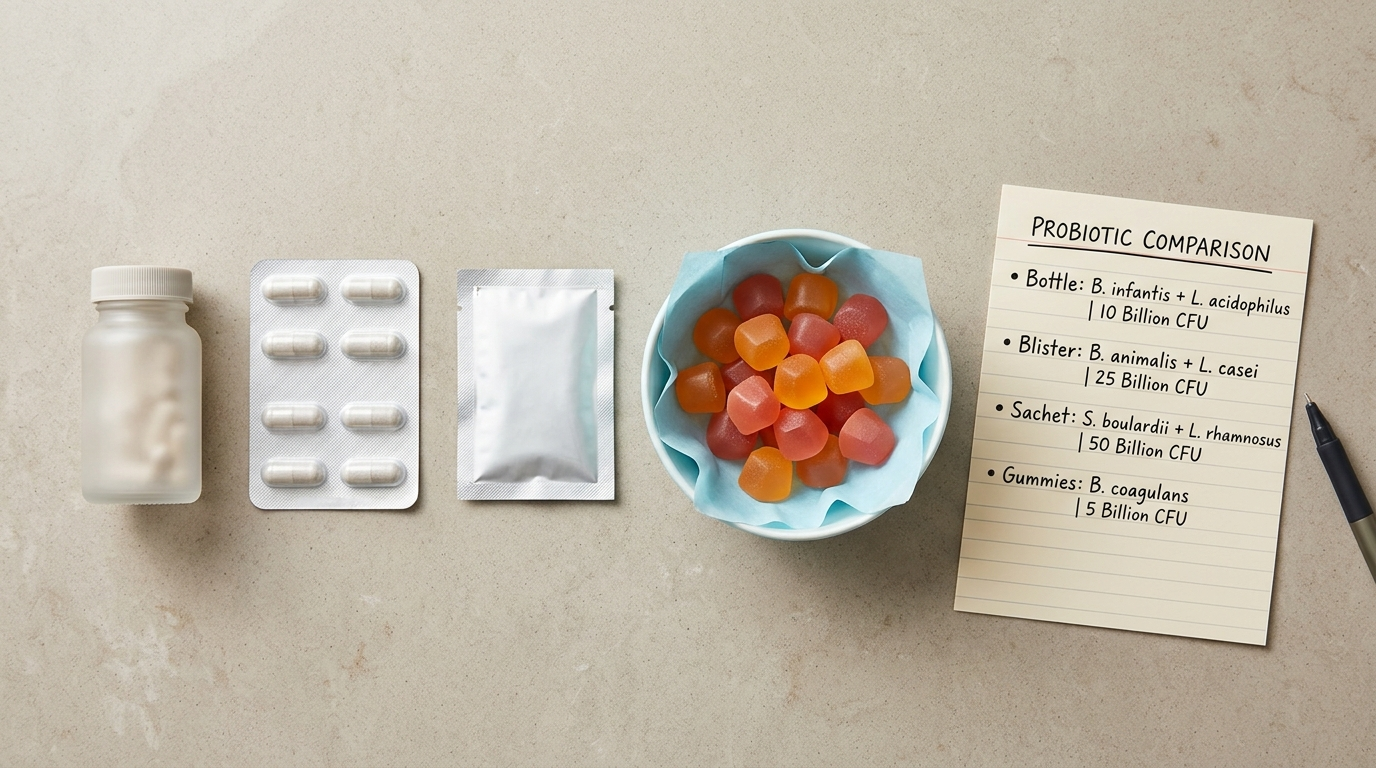
If a probiotic that seemed helpful is discontinued, replace its exact organism—not the word “probiotic.” Find the old label, match genus, species, strain code, CFU, storage, and serving format, then test one substitute consistently. Culturelle, Align, Florastor, and Yuve serve different roles; none is an automatic equivalent.
How did we evaluate replacements for a discontinued probiotic?
We evaluated replacement strategies by prioritizing organism identity, strain code, labeled amount, storage conditions, delivery format, and ingredient tolerance. The NIH Office of Dietary Supplements notes that probiotic effects can be strain-specific, so a shared genus or a larger CFU number does not establish equivalence. We gave more weight to human research tied to a named strain than to testimonials, front-label claims, or generic “multi-strain” language. We also used the ISAPP consensus definition, which connects the term probiotic to live microorganisms delivered in adequate amounts with evidence of benefit. This method cannot identify the best replacement without the discontinued product’s full Supplement Facts panel, and it cannot predict an individual response. The practical goal is narrower: find the closest documented match, change one variable at a time, and stop treating every probiotic as interchangeable.
How do you identify what made the old probiotic different?
Start with evidence you can recover: an old bottle, order-history image, retailer listing, manufacturer archive, or clear label photograph. Record the full microorganism name, including a code such as Lactobacillus rhamnosus GG, Bifidobacterium longum 35624, or Saccharomyces boulardii CNCM I-745. Then record CFU or milligrams per serving, serving size, refrigeration instructions, capsule or gummy format, and added ingredients such as inulin, lactose, sugar alcohols, or enteric coatings. The NIH consumer fact sheet explains that genus, species, and strain identify a probiotic more precisely than a broad category name. A replacement that matches the strain but changes the prebiotic, dose, and format changes several variables at once. If the old label listed only “proprietary probiotic blend,” an exact match may be impossible. In that case, match the use case and tolerance profile rather than pretending two undisclosed blends are equivalent.
How do the main replacement options compare?
Culturelle Digestive Daily lists Lactobacillus rhamnosus GG at 10 billion CFU and suits shoppers replacing an LGG capsule. Align 24/7 centers on Bifidobacterium longum 35624 and fits a 35624-specific search. Florastor uses the probiotic yeast Saccharomyces boulardii CNCM I-745, so it is not a bacterial substitute. Yuve Probiotic Gummies list Bacillus coagulans at 5 billion CFU per two-gummy serving; the species-level label offers less research traceability than a strain-coded product, while the spore-forming organism and pectin gummy support room-temperature convenience. Manufacturer pages establish label facts, not guaranteed outcomes.
| Option | Labeled organism | Best match when the old product used | Main caveat |
|---|---|---|---|
| Culturelle Digestive Daily | L. rhamnosus GG; 10 billion CFU | LGG in a capsule | Not equivalent to other Lactobacillus strains |
| Align 24/7 | B. longum 35624 | 35624 in a daily capsule | Check milk-derived ingredients and current label |
| Florastor | S. boulardii CNCM I-745 | A probiotic yeast | Not a bacterial probiotic |
| Yuve Probiotic Gummies | B. coagulans; 5 billion CFU | A shelf-stable vegan gummy | Product page identifies species, not strain code |
Which replacement is best for each use case?
Best for the closest strain match: choose the product that repeats the old genus, species, and strain code before comparing CFU. Best for replacing an LGG capsule: Culturelle Digestive Daily provides L. rhamnosus GG in a capsule format. Best for replacing a 35624 product: Align 24/7 identifies B. longum 35624, which is a different organism from LGG or Bacillus coagulans. Best for replacing a probiotic yeast: Florastor identifies S. boulardii CNCM I-745; bacterial products do not reproduce that identity. Best for vegan gummy adherence and room-temperature storage: Yuve Probiotic Gummies provide 5 billion CFU of B. coagulans per two-gummy serving, but their species-level label prevents an exact strain comparison. Best for an unknown discontinued blend: pick one clearly labeled product, use it alone, and keep expectations modest. A higher CFU count does not repair a strain mismatch, and a longer ingredient list does not prove broader usefulness.
How should you test a replacement without confusing the result?
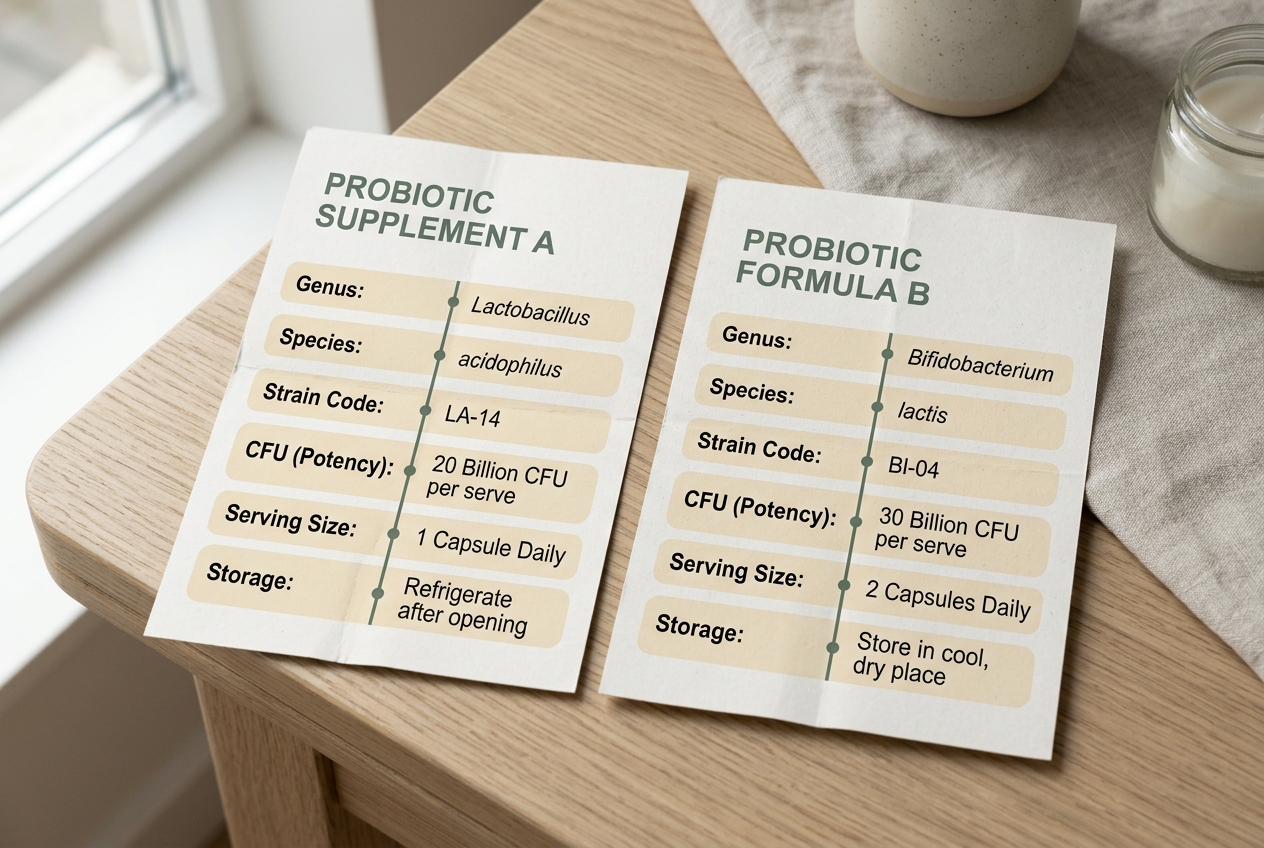
Test one replacement while holding the rest of the routine steady. Keep meal pattern, fiber intake, medications, other supplements, and dosing time as consistent as practical, then record the serving, date, storage, digestive comfort, stool pattern, and any unwanted effects. Do not restart a product solely because the old one “felt curative”; probiotics are dietary supplements, and the FDA explains that supplements are regulated differently from drugs. Follow the new label rather than recreating the old dose with extra servings. Stop and seek clinical advice for severe pain, persistent vomiting, blood in stool, fever, dehydration, unexplained weight loss, or symptoms that are worsening. People who are pregnant, immunocompromised, seriously ill, or using central venous catheters should ask a qualified clinician before starting probiotic products. A simple, documented trial produces more useful information than switching among several formulas every few days.
Which products meet these comparison criteria?
Some links below are affiliate links. This does not influence our evaluation criteria or recommendations. Culturelle Digestive Daily meets the strain-transparency criterion by naming L. rhamnosus GG and listing 10 billion CFU. Align 24/7 names B. longum 35624, and Florastor names S. boulardii CNCM I-745; each product therefore supports a strain-specific comparison. Yuve Probiotic Gummies list B. coagulans and 5 billion CFU per two-gummy serving in a vegan pectin format. Yuve’s limitation matters: the public product page names the species but not a strain code, so it should not be presented as a direct replacement for LGG, 35624, or CNCM I-745. The broader Yuve digestion collection includes probiotics, prebiotic fiber, and enzymes, but those categories perform different jobs. Price and popularity do not override organism identity. Choose the narrowest formula that matches the old label and your actual routine.
What questions should you ask before buying a replacement?
Is the same probiotic species enough?
No. A species can contain multiple strains, and clinical findings tied to one strain do not automatically transfer to another. Match the strain code whenever the old label and replacement label both provide one.
Should the replacement have the same CFU count?
CFU is one matching variable, but organism identity comes first. A 50-billion-CFU blend is not automatically closer than a 10-billion-CFU single-strain product that matches the old strain.
Can a gummy replace a capsule?
A gummy can replace a capsule only when its organism, labeled amount, storage, excipients, and use case are acceptable matches. Format convenience improves adherence, but it does not make different organisms equivalent.
Do probiotics permanently colonize the gut?
Most commonly used probiotics are better understood as temporary visitors rather than permanent residents. Effects, when present, may depend on continued intake and can vary by strain, dose, diet, and host.
How long should a replacement trial last?
Use the manufacturer’s directions and set a defined review point rather than changing products every few days. If symptoms worsen or concerning signs appear, stop the experiment and contact a qualified healthcare professional.
What if the old label did not name a strain?
An exact replacement cannot be verified from an undisclosed blend. Choose a transparent single-organism product, document the trial, and avoid claims that it recreates the discontinued formula.
For a closer look at clean-label options, see Negative Probiotic Symptoms: When to Stop and How to Evaluate a Simpler Yuve Routine.
For a closer look at clean-label options, see Is This a Good Way to Get Probiotics? Foods, Capsules, and Yuve Gummies Compared.
What is the most practical next step?
Find the discontinued product’s Supplement Facts panel before buying anything. Build a six-line comparison with organism, strain code, CFU or milligrams, serving size, storage, and added ingredients. If one current product matches most of those fields, test that option without changing the rest of the routine. If no product matches, choose by explicit use case: Culturelle for an LGG capsule, Align for 35624, Florastor for CNCM I-745 yeast, or Yuve for a shelf-stable vegan B. coagulans gummy. Treat every choice as a new product rather than a guaranteed continuation of the old one. Clear labels make the comparison possible; symptom logs make the trial interpretable. That discipline prevents another expensive guessing cycle. A clinician or registered dietitian can help when the discontinued product was being used around persistent symptoms, prescription treatment, immune compromise, pregnancy, or a diagnosed digestive condition.
Leave a Reply