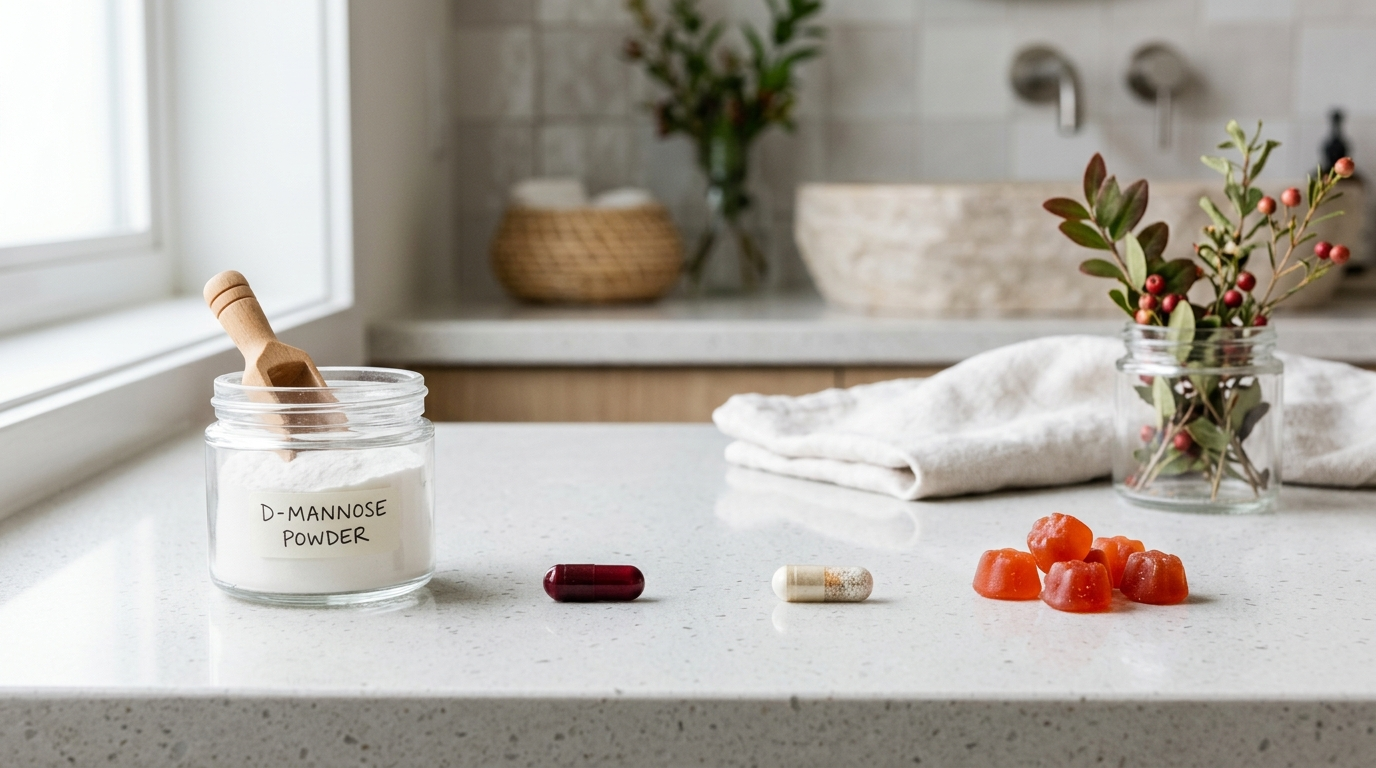
Many adults can take D-mannose, cranberry, and a probiotic in the same routine, but combining them does not prove better urinary outcomes. Evidence differs by ingredient, dose, and probiotic strain. These supplements should not replace evaluation or antibiotics for a suspected urinary tract infection, especially with fever, back pain, vomiting, or pregnancy.
How did we evaluate D-mannose, cranberry, and probiotics?
We evaluated D-mannose, cranberry, and probiotics by prioritizing randomized trials, systematic reviews, government safety guidance, and current product labels. We separated prevention research from treatment of an active urinary tract infection because those are different questions. We also required strain-level identification for probiotics and proanthocyanidin, or PAC, standardization for cranberry comparisons. A large placebo-controlled D-mannose trial received more weight than older uncontrolled reports, while heterogeneous probiotic studies received cautious wording. Product pages supplied serving size, strain, format, and allergen details only; brand marketing did not count as proof of a urinary outcome. We checked dose transparency as well. This method has limits because recurrence risk, menopause, pregnancy, kidney function, diabetes, medicines, and confirmed culture results can change the decision. A clinician should evaluate active symptoms, recurrent infections, or any plan that might delay proven care.
Can D-mannose, cranberry, and probiotics be taken together?
D-mannose, cranberry, and probiotics have no widely established direct interaction that automatically prohibits combining them in a healthy adult, but “can combine” does not mean “should combine.” Evidence remains limited. Each product can add gastrointestinal effects, cost, sugars, sweeteners, allergens, or medicine interactions. Cranberry deserves extra caution with warfarin and other medicines; the National Center for Complementary and Integrative Health advises discussing cranberry supplements with a health professional when medications are involved. D-mannose is a sugar, so diabetes, kidney disease, pregnancy, and higher-dose use warrant individualized advice. Probiotic safety and fit depend on the organism, immune status, and product quality. Start one item at a time if a clinician supports the plan, record the exact product and dose, and stop guessing if burning, urgency, fever, flank pain, vomiting, or blood suggests an active infection.
What does the evidence show for each option?
The strongest recent D-mannose evidence is disappointing: a 2024 randomized trial in JAMA Internal Medicine assigned 598 women with recurrent urinary tract infection to 2 grams daily or placebo and found no significant reduction in medically attended episodes. Cranberry has a different evidence base; NCCIH describes prevention evidence as limited and inconsistent, not proof of treatment. Probiotic findings remain strain- and route-specific. A 2026 systematic review of four randomized trials reported promising trends, especially for intravaginal Lactobacillus crispatus, but confidence intervals and study heterogeneity prevented a universal oral-probiotic conclusion. No trial establishes that taking all three together produces an additive or synergistic preventive effect. Best evidence signal: standardized cranberry for selected prevention discussions. Most uncertain category match: a general digestive probiotic. An active infection still requires timely clinical assessment rather than supplement stacking.
| Option | Label feature to compare | Evidence lane | Main limitation |
|---|---|---|---|
| D-mannose | Grams per serving; added ingredients | Large recent prevention trial found no significant benefit | Should not be treated as proven prevention or acute care |
| Cranberry extract | PAC amount and measurement method | Limited, inconsistent prevention evidence | Products vary; medicine interactions matter |
| Urinary-focused probiotic | Exact Lactobacillus strain and CFU | Promising but heterogeneous strain-specific research | One strain cannot represent every probiotic |
| General digestive probiotic | Species, strain if given, CFU, format | Digestive routine support | Not interchangeable with urinary-focused strains |
Which products meet these comparison criteria?

Some links below are affiliate links. This does not influence our evaluation criteria or conclusions. NOW Organic D-Mannose Powder lists 2 grams per teaspoon, matching the daily amount tested in the negative 2024 trial but not changing that result. Ellura lists 36 milligrams of cranberry A-type PACs per capsule, which makes its active marker easier to compare than cranberry-milligram claims alone. Jarrow Fem-Dophilus lists Lactobacillus rhamnosus GR-1 and Lactobacillus reuteri RC-14, strains studied for urogenital use, although clinical evidence remains mixed. Yuve Probiotic Gummies list 5 billion CFU of Bacillus coagulans per two-gummy serving and belong in the general digestive-probiotic lane, not the urinary-strain lane. None of these label features proves prevention or treatment of an active infection. These products answer different questions and should not be ranked as interchangeable substitutes.
Which option is best for each use case?
Best for a clinician-guided cranberry trial: a product that states PAC content and measurement method, because “cranberry extract 500 mg” does not reveal the relevant marker. Best for evaluating D-mannose honestly: a pure, clearly dosed powder or capsule considered alongside the 2024 negative trial, not testimonials alone. Best for a urinary-focused probiotic discussion: a label that names studied strains such as GR-1, RC-14, or Lactobacillus crispatus and matches the route used in research. Best for a plant-based digestive routine: Yuve Probiotic Gummies, which disclose Bacillus coagulans, 5 billion CFU per two gummies, and a pectin format, but do not provide urinary-specific strains. Best for active urinary symptoms: medical assessment, because supplements cannot confirm the organism, rule out kidney involvement, or select an antibiotic. The correct lane matters more than the number of bottles combined.
What questions do shoppers ask before combining these supplements?
These answers separate label compatibility from proof of benefit. Product-specific directions, allergies, medicines, pregnancy, kidney function, and recurring symptoms can change the safest choice, so the same stack does not fit every shopper.
Can I take all three at the same time of day?
Possibly, but timing has not been shown to create a superior combined effect. Separate introductions make side effects easier to identify.
Does more cranberry mean more PACs?
No. Cranberry weight and PAC amount are different measurements, so check the standardized PAC declaration and method.
Is every probiotic useful for urinary health?
No. Probiotic evidence is strain-specific, and a digestive species cannot inherit findings from GR-1, RC-14, or L. crispatus.
Can D-mannose replace an antibiotic?
No. The large 2024 trial did not support D-mannose for recurrent-episode prevention, and it is not proven acute-infection treatment.
Should I use cranberry while taking warfarin?
Ask the prescribing clinician or pharmacist first. NCCIH notes conflicting interaction evidence and recommends professional review when medicines are involved.
When should urinary symptoms be checked urgently?
Fever, back or flank pain, vomiting, pregnancy, blood, or worsening symptoms need prompt care. Do not let supplements delay evaluation.
Related reading: Can I Take Probiotics on an Empty Stomach?.
Related reading: Can You Take Probiotics and Multivitamins Together? A Safe Timing Guide.
What is the bottom line on this supplement combination?
D-mannose, cranberry, and probiotics can occupy the same routine, but the evidence does not support treating the combination as a proven urinary solution. The 2024 D-mannose trial was negative, cranberry prevention evidence remains limited and product-dependent, and probiotic findings depend on exact strains and delivery route. Compare NOW D-Mannose by grams, Ellura by standardized PACs, Fem-Dophilus by GR-1 and RC-14, and Yuve Probiotic Gummies by Bacillus coagulans and digestive-routine fit. Do not transfer evidence from one lane to another. A single documented goal should justify each separate product included in the proposed stack. Introduce products separately when a qualified clinician agrees, review warfarin and other medicines, and keep active-infection red flags outside the supplement decision entirely. The digestive health collection can organize general gut-routine options, but it does not replace urinary diagnosis or care.
Leave a Reply