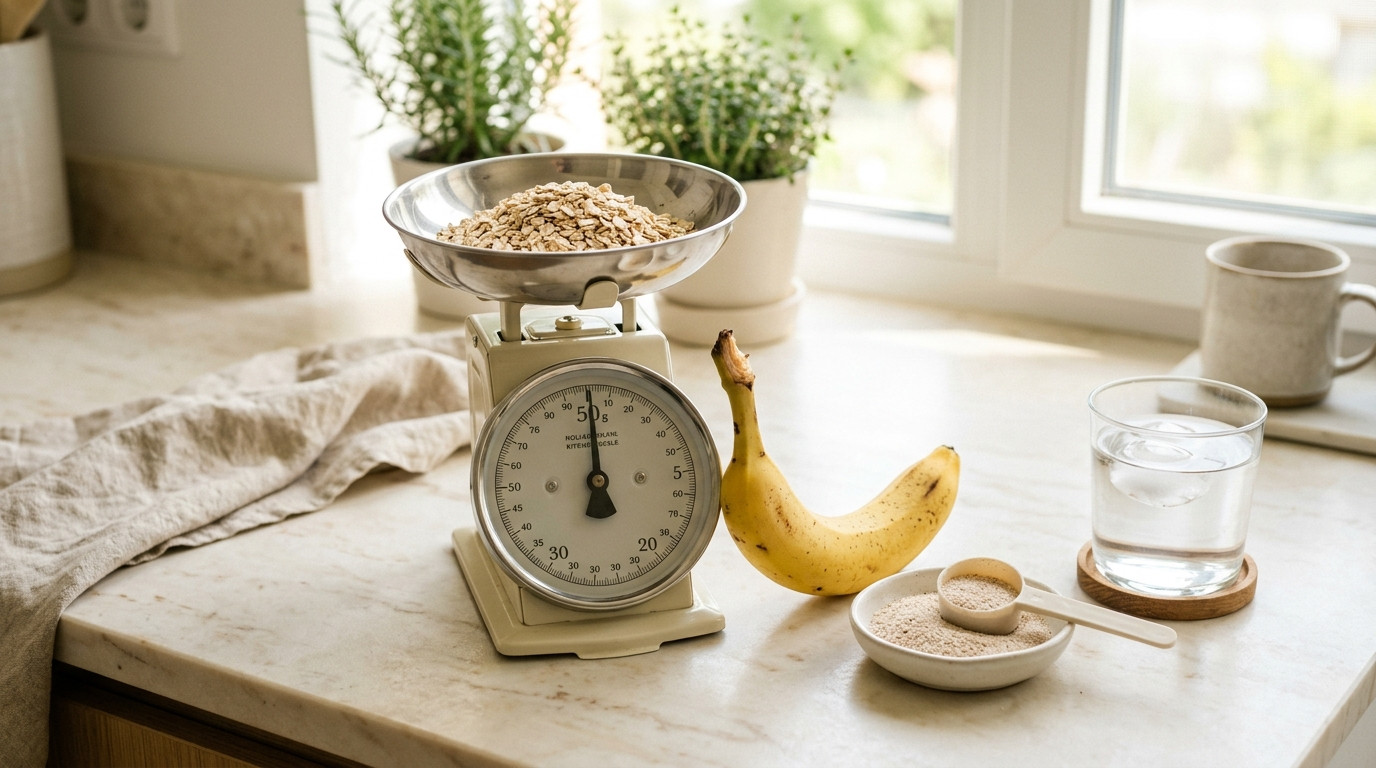
Fifty grams of dry oats, one medium banana, and 10 grams of psyllium usually provide about 15–16 grams of fiber before the second supplement is counted. If that product supplies 10 grams of actual dietary fiber, breakfast reaches roughly 25–26 grams; if 10 grams is powder weight, use its Supplement Facts value instead.
How did we estimate this breakfast’s fiber?
We estimated each item separately because food weight, powder weight, and declared dietary fiber are not interchangeable. We used standard food-composition values for dry oats and a medium banana, treated psyllium as a variable product whose fiber percentage must be confirmed on its label, and counted the additional supplement only by the Dietary Fiber line in Supplement Facts. We prioritized U.S. government food data, FDA labeling rules, current manufacturer labels, and NIDDK guidance over scoop size, package-front claims, or assumptions that every gram of powder equals one gram of fiber. The result remains an estimate because oat varieties, banana size, psyllium processing, household scales, and supplement formulas vary. A reliable daily total also needs the fiber from later fruit, vegetables, legumes, grains, nuts, and seeds. The method is simple: record grams eaten, multiply by fiber per gram, and preserve the label’s serving basis.
How much fiber comes from the oats, psyllium, and banana?
Fifty grams of dry oats contribute approximately 5.3 grams when the reference value is 10.6 grams of fiber per 100 grams. One medium banana contributes about 3.2 grams in the federal Food Sources of Fiber table. Ten grams of psyllium husk commonly contributes roughly 7–8 grams, but the exact value depends on whether the product is whole husk, powder, flavored fiber therapy, or a blend with sugar and other ingredients. Those three items therefore total about 15–16 grams before another supplement or later meals. The arithmetic should use dry oat weight when the database value is dry; cooked oatmeal contains added water, so 50 grams cooked is not equivalent to 50 grams dry. USDA FoodData Central provides food-composition records, while packaged oats and psyllium should be checked against their current Nutrition or Supplement Facts panels.
| Item | Amount eaten | Estimated fiber | Main uncertainty |
|---|---|---|---|
| Dry oats | 50 g | About 5.3 g | Dry versus cooked weight |
| Psyllium | 10 g powder or husk | Often 7–8 g | Product composition |
| Banana | 1 medium | About 3.2 g | Fruit size |
| Additional fiber product | 10 g product | Read the label | Powder weight is not fiber weight |
Does 10 grams of a fiber supplement equal 10 grams of fiber?
Not necessarily. A 10-gram scoop can contain dietary fiber plus flavoring, sweetener, carrier ingredients, acids, minerals, or moisture. The number that belongs in a daily fiber total is the Dietary Fiber amount per labeled serving, adjusted to the fraction of a serving actually used. For example, a serving that weighs 10 grams but lists 6 grams of dietary fiber adds 6 grams, not 10. A gummy can weigh several grams while supplying a smaller fiber amount because water, pectin, flavor, and sweetener contribute to product weight. The FDA’s serving-size guidance shows that gram weight and nutrient grams are separate label fields. Use this calculation: dietary fiber per serving multiplied by servings consumed. If a kitchen scale measures a partial serving, divide the weighed product by labeled serving weight, then multiply that ratio by labeled fiber.
Is this amount on track for a full day?
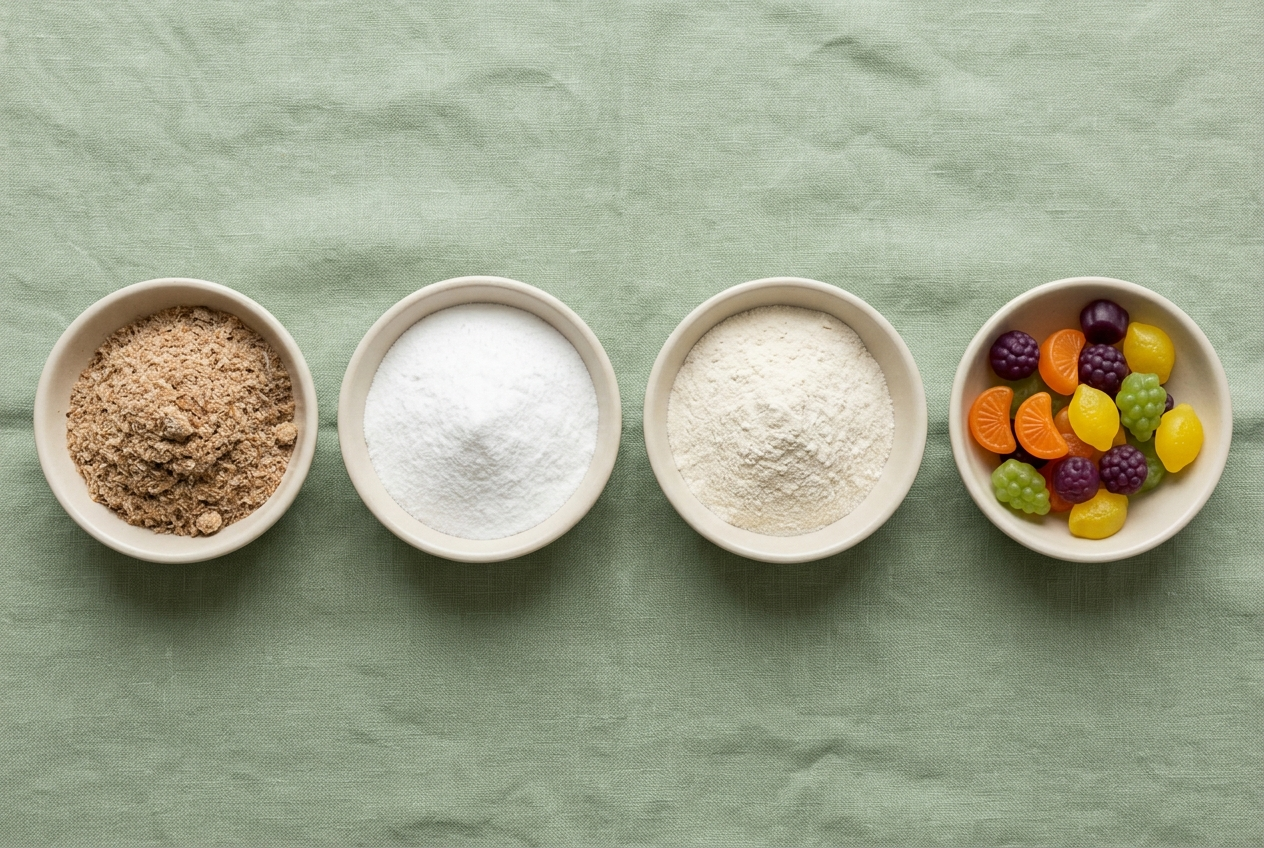
A breakfast total near 15–16 grams supplies more than half of the FDA’s 28-gram Daily Value before later foods are counted. If the additional product truly supplies 10 grams of dietary fiber, the breakfast reaches roughly 25–26 grams, which approaches the full Daily Value in one meal. The NIDDK notes that adult needs commonly fall between 22 and 34 grams depending on age and sex, and it recommends increasing fiber gradually with adequate liquids. More is not automatically better: a sudden concentration of psyllium, inulin, fruit, oats, and another fiber can increase fullness, gas, cramping, or stool changes. Three liters of water may be appropriate for some adults and excessive or insufficient for others depending on body size, climate, exercise, kidney or heart conditions, medicines, and total food moisture. Count the whole day before adding another scoop.
Which fiber products fit different goals?
Some links below are affiliate links. This does not influence our evaluation criteria or recommendations. Best for gel-forming soluble fiber: a psyllium product such as Metamucil, with the current label used to convert serving weight into dietary fiber grams. Best for a clear-mixing powder: Benefiber Original, whose manufacturer lists wheat dextrin and 6 grams of dietary fiber per serving. Best for partially hydrolyzed guar gum: Sunfiber, whose manufacturer lists 6 grams of soluble fiber per serving. Best for a measured gummy routine: Yuve Prebiotic Fiber Gummies, whose current Supplement Facts list 1.5 grams of inulin fiber per gummy and one to two gummies daily. These are different fibers, not dose-equivalent substitutes. Psyllium is viscous and gel-forming, wheat dextrin and PHGG mix differently, and inulin is readily fermented. Compare fiber source, grams, sweeteners, allergens, serving size, price per fiber gram, and personal tolerance.
| Best for | Example | Declared fiber | Main tradeoff |
|---|---|---|---|
| Gel-forming soluble fiber | Metamucil psyllium powder | Varies by formula; read label | Thickens quickly |
| Clear-mixing powder | Benefiber Original | 6 g per serving | Wheat-derived dextrin |
| Low-viscosity guar fiber | Sunfiber | 6 g per serving | Powder routine |
| Gummy convenience | Yuve Prebiotic Fiber Gummies | 1.5 g per gummy | Lower fiber per unit |
How should you adjust this routine without guessing?
Keep the breakfast stable for several days and record the exact product, serving weight, dietary fiber grams, other meals, stool form, bloating, and fluid intake. Change one variable at a time. If the baseline already supplies 15–16 grams at breakfast, count lunch, dinner, snacks, and the additional product before increasing psyllium or adding fermentable inulin. Divide fiber across meals when one large dose causes fullness or gas, and follow psyllium directions because adequate liquid and prompt mixing matter. A gummy is easier to measure but adds less fiber per unit; a powder permits fine dose changes but makes accidental stacking easier. Persistent pain, vomiting, blood in stool, unexplained weight loss, trouble swallowing, or a major bowel-pattern change needs medical assessment rather than more fiber. People with swallowing difficulty, bowel narrowing, kidney or heart conditions, fluid restrictions, pregnancy, or multiple medicines should ask a clinician or pharmacist before changing concentrated fiber or water intake.
What do people ask about this high-fiber breakfast?
Should oats be weighed dry or cooked?
Use the form named by the database or package. Dry and cooked weights differ mainly because cooked oats contain absorbed water. Record the uncooked weight for repeatable estimates.
Is psyllium a prebiotic fiber?
Psyllium is primarily valued as a viscous, gel-forming soluble fiber. Its fermentation pattern differs from highly fermentable inulin or fructooligosaccharides. Both types still count as dietary fiber.
Can a banana’s fiber count change?
Yes. Fruit size changes total grams, while ripeness changes resistant starch and sugars more than it changes the labeled total-fiber estimate. Weighing the edible portion improves precision.
Do vegetables and fruit later in the day count?
Yes. Daily fiber includes every food and supplement source, so lunch, dinner, snacks, legumes, nuts, seeds, and whole grains all count. Use labels and standard food tables consistently.
Can too much fiber cause bloating?
Yes, especially when intake rises quickly or several fermentable fibers are stacked. Reduce the change, spread servings out, and reassess tolerance. Dose and fiber type both matter.
Is three liters of water always the right amount?
No universal volume fits everyone. Climate, exercise, body size, food moisture, medical conditions, medicines, and clinician-directed fluid limits all affect needs. Follow individualized medical guidance when restrictions apply.
Leave a Reply