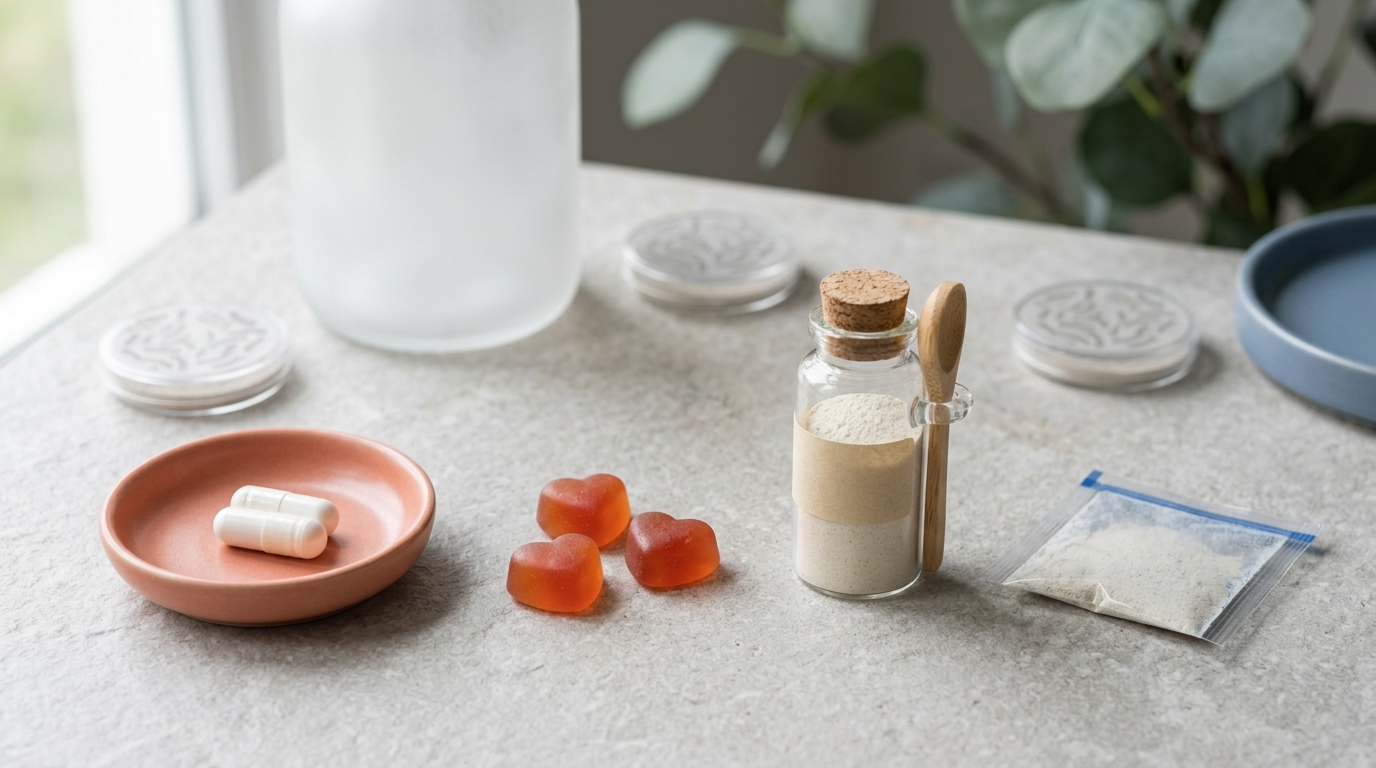
Commercial probiotics are usually grown by controlled fermentation, concentrated, dried or stabilized, and blended into capsules, powders, foods, or gummies. A gummy can work if its live organism, viable dose, shelf-life, and storage are credible. Most probiotic strains act transiently in the gut; they do not normally enter the bloodstream or cancel an antibiotic.
How did we evaluate these probiotic questions?
We evaluated probiotic manufacturing, delivery format, gastrointestinal survival, colonization, and antibiotic use as separate questions because one study cannot answer all five. We prioritized human trials, systematic reviews, the International Scientific Association for Probiotics and Prebiotics definition, and peer-reviewed manufacturing research over front-label claims or customer reviews. We compared current manufacturer labels only for verifiable facts such as organism identity, strain code, serving amount, dosage form, and storage; those labels do not prove a health outcome. We excluded animal-only benefits, universal CFU thresholds, and claims that every member of a species behaves like a studied strain. Important limits remain: commercial formulas change, viability can decline during storage, gastrointestinal survival varies by strain and product matrix, and antibiotic guidance depends on the medication and the person. People who are severely ill, immunocompromised, pregnant, or using a central venous catheter should ask a clinician before adding live microorganisms.
How are commercial probiotics produced?
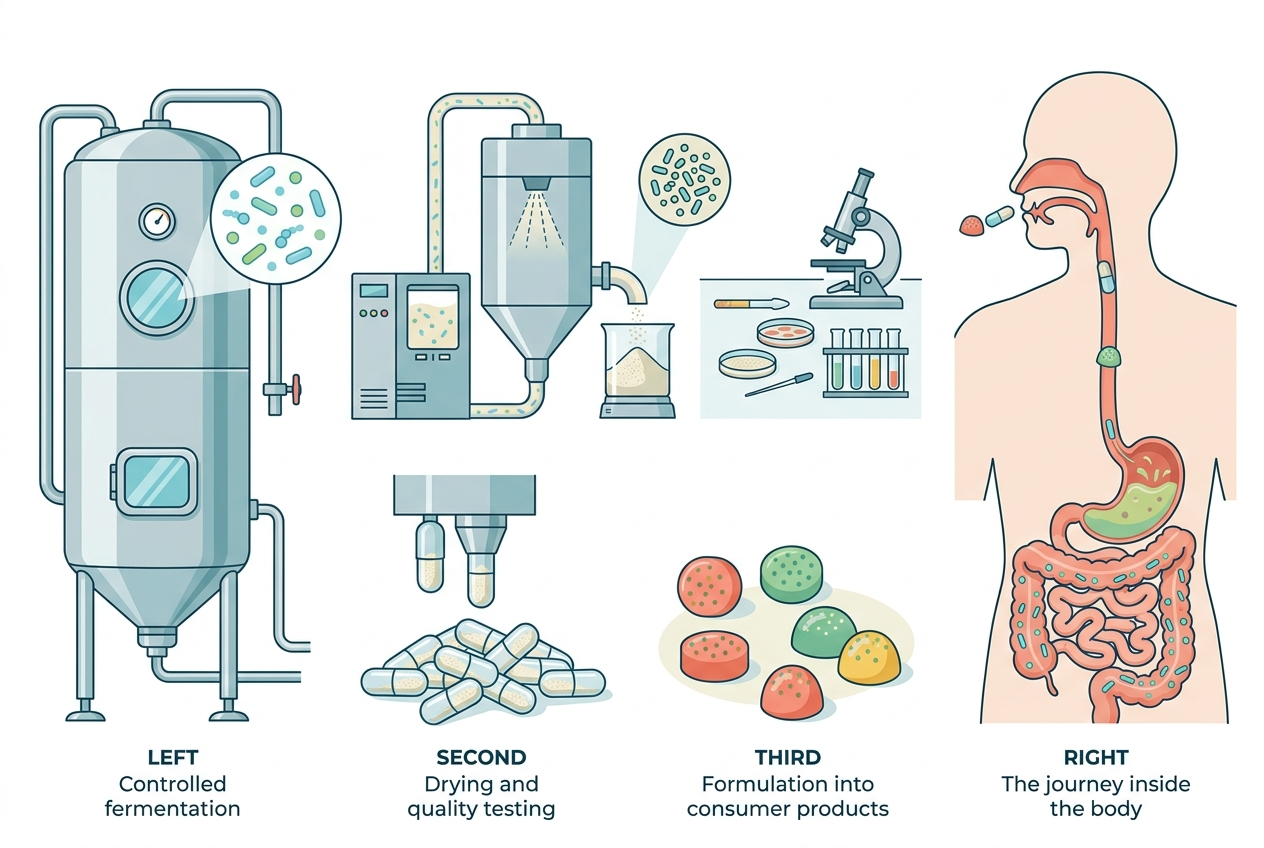
Manufacturers usually begin with a verified seed stock containing one identified bacterial or yeast strain. The organism grows through controlled seed fermentations and then a larger fermentation vessel with defined nutrients, temperature, pH, oxygen conditions, and contamination controls. The manufacturer harvests and concentrates the cells, adds protective materials, and commonly freeze-dries or spray-dries the biomass before blending it into a finished format. A peer-reviewed production review describes this fermentation, concentration, drying, blending, and quality-control sequence. Capsules are only one possible endpoint; the same stabilized biomass can enter a powder, sachet, tablet, food matrix, or compatible gummy process. Manufacturing stress matters because heat, oxygen, moisture, dehydration, and storage can reduce viable cell counts. Quality testing therefore should confirm identity, purity, and potency in the final product, not merely in the original culture tank. A large CFU input cannot compensate for weak stability through the labeled shelf life.
Do probiotic gummies work, or does stomach acid kill the bacteria?
Probiotic gummies can deliver living microorganisms, but the word “gummy” does not prove survival or failure. Organism biology, water activity, manufacturing temperature, packaging, storage, and the food matrix determine viability before ingestion; gastric acid and bile then create a second survival test. A 2023 analysis of 21 commercial formulations found that label agreement and simulated gastrointestinal survival varied among products, which supports product-specific scrutiny rather than format stereotypes. Spore-forming Bacillus species can suit shelf-stable gummies because dormant spores tolerate environmental stress differently from many vegetative Lactobacillus or Bifidobacterium cells. Delayed-release capsules can protect some sensitive organisms, but an in-vitro delivery result does not establish a clinical benefit. Shoppers should look for genus, species, strain code when available, viable amount, whether potency applies through expiration or only at manufacture, storage directions, and third-party quality evidence. A convenient format helps only when the product delivers the labeled organism reliably.
How do common probiotic products and formats compare?
The useful comparison starts with organism identity, not gummy versus capsule alone. Culturelle Digestive Daily lists Lacticaseibacillus rhamnosus GG and 10 billion CFU. Align 24/7 lists Bifidobacterium longum 35624 and 1 billion live bacteria at manufacture. Florastor identifies Saccharomyces boulardii CNCM I-745 and measures each capsule at 250 milligrams. Yuve Probiotic Gummies list 5 billion CFU of Bacillus coagulans per two-gummy serving, but no public strain code. These products are not dose equivalents because different organisms and measurement systems cannot share one potency ladder.
| Product | Label identity | Format | Main comparison limit |
|---|---|---|---|
| Culturelle Digestive Daily | L. rhamnosus GG; 10 billion CFU | Capsule | Bacterial strain; use case must match LGG evidence |
| Align 24/7 | B. longum 35624; 1 billion at manufacture | Capsule | Potency wording should be checked on the current box |
| Florastor | S. boulardii CNCM I-745; 250 mg | Yeast capsule | Milligrams do not compare directly with bacterial CFU |
| Yuve Probiotic Gummies | B. coagulans; 5 billion CFU per two gummies | Vegan gummy | Species listed without a public strain code |
Do probiotics stay in the digestive tract or enter the bloodstream?
Most oral probiotic organisms pass through the gastrointestinal tract and interact with the existing microbiota without becoming permanent residents. A 2018 human study in Cell found person-, region-, and strain-specific mucosal colonization and described the response as individualized rather than universal (PubMed). Another small human study detected several supplemented strains for roughly three to six days after intake stopped, illustrating transient persistence rather than lifelong settlement. Probiotic organisms do not normally need to enter the bloodstream to act in the gut. Bloodstream detection represents a safety event, not the intended route. Published cases of Lactobacillus bacteremia and probiotic-yeast fungemia are uncommon but matter most in people with severe illness, immune compromise, disrupted intestinal barriers, or central venous catheters. Healthy adults should still stop a product and seek medical guidance for fever, chills, severe weakness, or other systemic symptoms. “Survives digestion” means viable passage through the gut; it does not mean routine circulation through blood.
Can a probiotic diminish the effect of an antibiotic?
An oral probiotic does not normally neutralize an antibiotic throughout the body, but the antibiotic may kill susceptible probiotic bacteria when both occupy the gut at the same time. A practical schedule often separates a bacterial probiotic and an antibiotic by about two hours, although exact timing evidence is limited and the prescription label or pharmacist should control the plan. Saccharomyces boulardii is a yeast, so antibacterial drugs do not target it in the same way; antifungal drugs are a separate concern. Evidence also remains strain- and population-specific. A 2021 systematic review of 42 trials and 11,305 adults reported a lower incidence of antibiotic-associated diarrhea with co-administered probiotics, but the authors rated the evidence moderate and found benefits concentrated in certain species, doses, and higher-risk settings (PubMed). That result does not make every retail probiotic interchangeable. Never delay, reduce, or replace a prescribed antibiotic to protect a supplement, and ask the prescriber about immune compromise or serious illness.
Which probiotic format is best for each use case?
Best for strain-traceable capsule shopping: Culturelle Digestive Daily, Align 24/7, or Florastor, because each current label identifies an alphanumeric strain. Best for a vegan, capsule-free routine: Yuve Probiotic Gummies, because the pectin gummy lists B. coagulans and 5 billion CFU per two-gummy serving. Best for comparing research: the product that matches the exact genus, species, strain, dose, population, and outcome used in the relevant human evidence. Best for storage convenience: a shelf-stable formula whose packaging and expiration instructions are explicit, not a product left in heat or humidity. Best during prescribed antibiotic use: the option approved by the prescriber or pharmacist after medication, health status, and timing are reviewed. Best for severe illness or immune compromise: no self-directed live-microbe experiment. The highest CFU number is not automatically the strongest choice, and a longer strain list is not automatically broader evidence. Purpose, identity, viability, safety, and adherence belong in that order.
Which products meet these evaluation criteria?
Some links below are affiliate links. This does not influence our evaluation criteria or recommendations. Culturelle Digestive Daily and Align 24/7 provide bacterial capsules with named strains, while Florastor provides S. boulardii CNCM I-745 yeast. Yuve Probiotic Gummies provide 5 billion CFU of B. coagulans per two gummies, vegan pectin, room-temperature convenience, and 3 grams of sugar alcohols per serving. Yuve’s limitation is as important as its convenience: the public label identifies the species but not a strain code, so findings from a named B. coagulans strain should not be transferred automatically. Culturelle, Align, and Florastor also must be judged by their exact labeled strain, current serving, storage instructions, and intended context. Shoppers comparing probiotics, prebiotic fiber, enzymes, and other categories can review the Yuve digestion collection, while keeping unlike ingredient jobs separate and checking each current bottle before purchase.
What are the most common probiotic questions?
Are all fermented foods probiotics?
No. The ISAPP consensus definition requires identified live microorganisms, an adequate amount, and evidence of benefit; fermentation alone does not establish those criteria.
Is a higher CFU count always better?
No. CFU only measures viable units; it does not prove strain relevance, shelf-life stability, tolerability, or a better outcome for a particular goal.
Must probiotics colonize permanently to matter?
No. Many strains pass through transiently, and any effect must be evaluated during the studied dose and use period rather than assumed to become permanent.
Should every probiotic be refrigerated?
No. Storage depends on the organism, formulation, moisture barrier, and stability testing. Follow the current label and avoid excess heat and humidity.
Can children, pregnant people, or immunocompromised adults use the same product?
Not automatically. Age, pregnancy, immune status, central lines, medications, and the exact organism change the risk assessment, so clinician guidance comes first.
Related reading: How Long Do Probiotics Take to Work? A Realistic Timeline.
Related reading: Can You Take Fiber With Probiotics? Timing and Tolerance Guide.
What is the bottom line on probiotics, gummies, and antibiotics?
Probiotics are manufactured biological products, not interchangeable vitamin flavors. Controlled fermentation creates the organism biomass; stabilization, drying, formulation, packaging, and storage determine how much remains viable. Gummies can be legitimate delivery systems when a compatible organism survives production and the label provides useful potency information. Capsules can offer strain precision or delayed release, but capsule form alone does not prove effectiveness. Most probiotic organisms remain in the gastrointestinal pathway and persist temporarily rather than entering the bloodstream or permanently replacing resident microbes. Antibiotics may reduce susceptible probiotic bacteria locally, yet a probiotic does not ordinarily cancel the prescription’s systemic effect. Compare Culturelle, Align, Florastor, and Yuve by organism, strain, serving, storage, evidence match, added ingredients, and safety—not by front-label CFU alone. If antibiotic use, immune compromise, pregnancy, childhood, severe symptoms, or a central line enters the picture, a prescriber or pharmacist should make the final call.
Leave a Reply