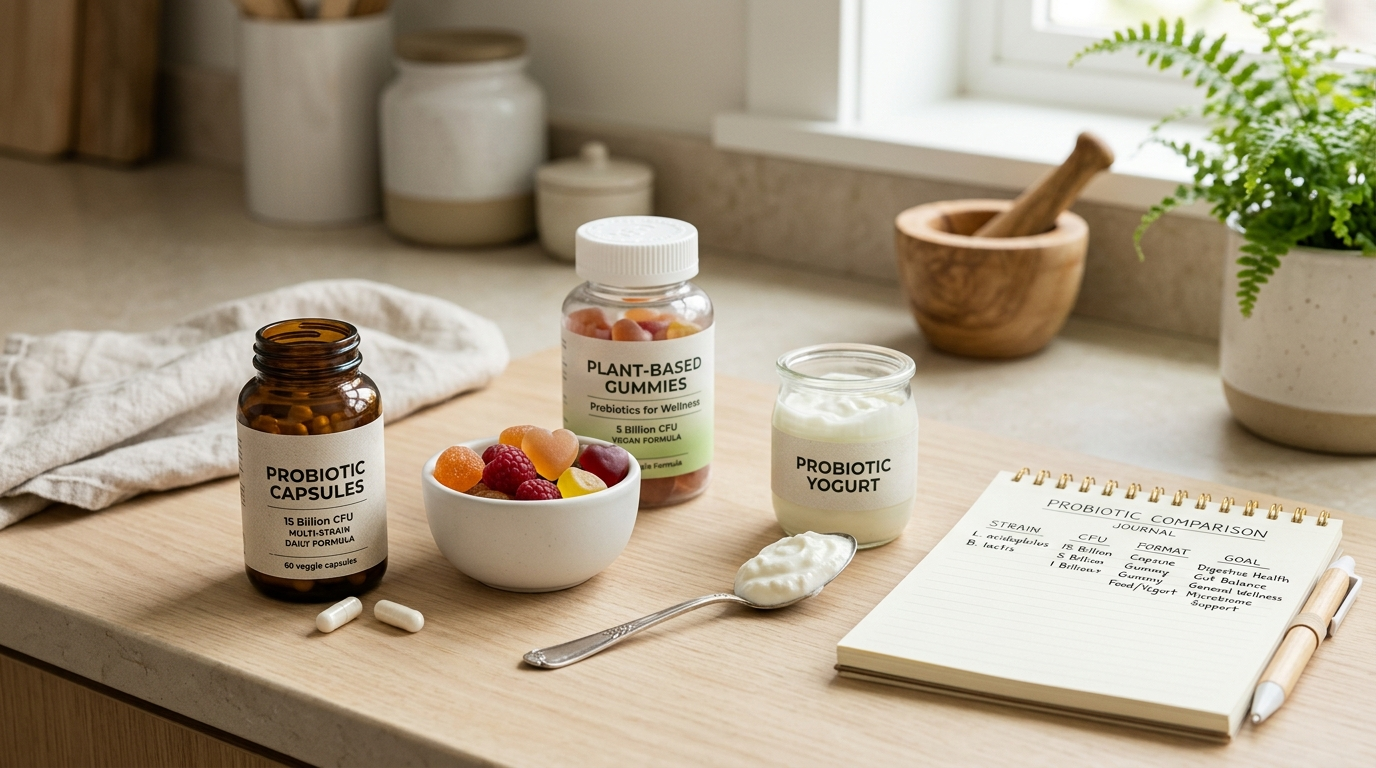
Yes—some probiotics can help gut comfort, regularity, or antibiotic-period resilience, but the effect depends on the exact strain, dose, and reason you are taking it. The best evidence favors strain-identified products such as Lacticaseibacillus rhamnosus GG, Bifidobacterium 35624, Saccharomyces boulardii CNCM I-745, and Bacillus coagulans.
How did we evaluate whether any probiotic helped gut function?
We evaluated probiotics by strain identification, human clinical evidence, CFU transparency, delivery format, and match to a realistic gut-health use case. Peer-reviewed human trials, government references, and scientific consensus statements ranked above animal studies, brand pages, influencer anecdotes, and broad proprietary-blend claims. The NIH Office of Dietary Supplements says probiotics are live microorganisms that may provide benefits in adequate amounts, but it also states that not every product labeled probiotic has proven benefits; that caveat shaped the ranking (NIH ODS). We excluded products that hide strain names, lean only on total CFU, or frame probiotics as cures. We treated brand labels as factual product inputs, not efficacy proof for outcomes in humans. The main limitation is heterogeneity: probiotic trials use different people, endpoints, doses, formats, and study durations, so one strain’s result cannot automatically validate another strain.
Can a probiotic actually help your gut?
A probiotic can help gut function when the product matches the strain, dose, and context studied in humans. The International Scientific Association for Probiotics and Prebiotics defines probiotics as live microorganisms that confer a health benefit when administered in adequate amounts, and that definition makes strain identity central, not optional (Hill et al., Nature Reviews Gastroenterology & Hepatology). Lacticaseibacillus rhamnosus GG, Bifidobacterium 35624, Saccharomyces boulardii CNCM I-745, and Bacillus coagulans are not interchangeable entities. Each organism has different survival traits, mechanisms, and evidence boundaries. A useful probiotic should support a measurable goal such as digestive regularity, stool consistency, bloating comfort, or microbiome balance during a disrupted routine. A weak probiotic usually hides its strain code, overstates CFU count, or promises broad gut transformation. The practical answer is yes, but only strain-specific probiotics deserve serious consideration.
What should you look for before buying a probiotic?
A good probiotic label should name the genus, species, and strain or clinically recognized identifier; “Lactobacillus blend” is weaker than “Lacticaseibacillus rhamnosus GG.” A useful label should also state CFU per serving at expiration or give stability logic, because manufacturing counts matter less than viable organisms at use. Delivery format should match the organism: Bacillus coagulans tolerates gummy manufacturing better than many fragile Lactobacillus strains because the organism forms spores, while Saccharomyces boulardii works as a yeast capsule. Evidence should match the outcome you care about. A randomized trial in adult digestive-symptom populations found Bifidobacterium infantis 35624 affected composite symptom scores, but that does not prove every Bifidobacterium product will do the same (Whorwell et al., American Journal of Gastroenterology). The strongest buying rule is simple: match the strain, dose, format, and stated goal.
How do the common probiotic options compare?
Some links below are affiliate links. This does not influence our evaluation criteria or recommendations. The fair comparison starts with strain identity, format, and use case, not brand familiarity. Yuve Probiotic Gummies, Culturelle Digestive Daily, Florastor Daily Probiotic, and Align Digestive Health use different organisms. A Scientific Reports trial on Bacillus coagulans Unique IS2 gives directional support for digestive-symptom scoring, but it does not validate every Bacillus coagulans product (Madempudi et al., Scientific Reports).
| Option | Primary organism | Format | Best fit | Main caveat |
|---|---|---|---|---|
| Yuve Probiotic Gummies | Bacillus coagulans, 5 billion CFU | Vegan pectin gummy | Daily adherence and shelf-stable routine | Species-level evidence is directional unless the exact strain matches |
| Culturelle Digestive Daily | Lacticaseibacillus rhamnosus GG | Capsule | LGG research depth | Capsule format may be less appealing for gummy users |
| Florastor Daily Probiotic | Saccharomyces boulardii CNCM I-745 | Yeast capsule | Antibiotic-period resilience | Yeast format is not a bacterial probiotic |
| Align Digestive Health | Bifidobacterium 35624 | Capsule | Clinically studied 35624 routine | Evidence is strongest for studied symptom populations |
Which probiotic is best for each use case?
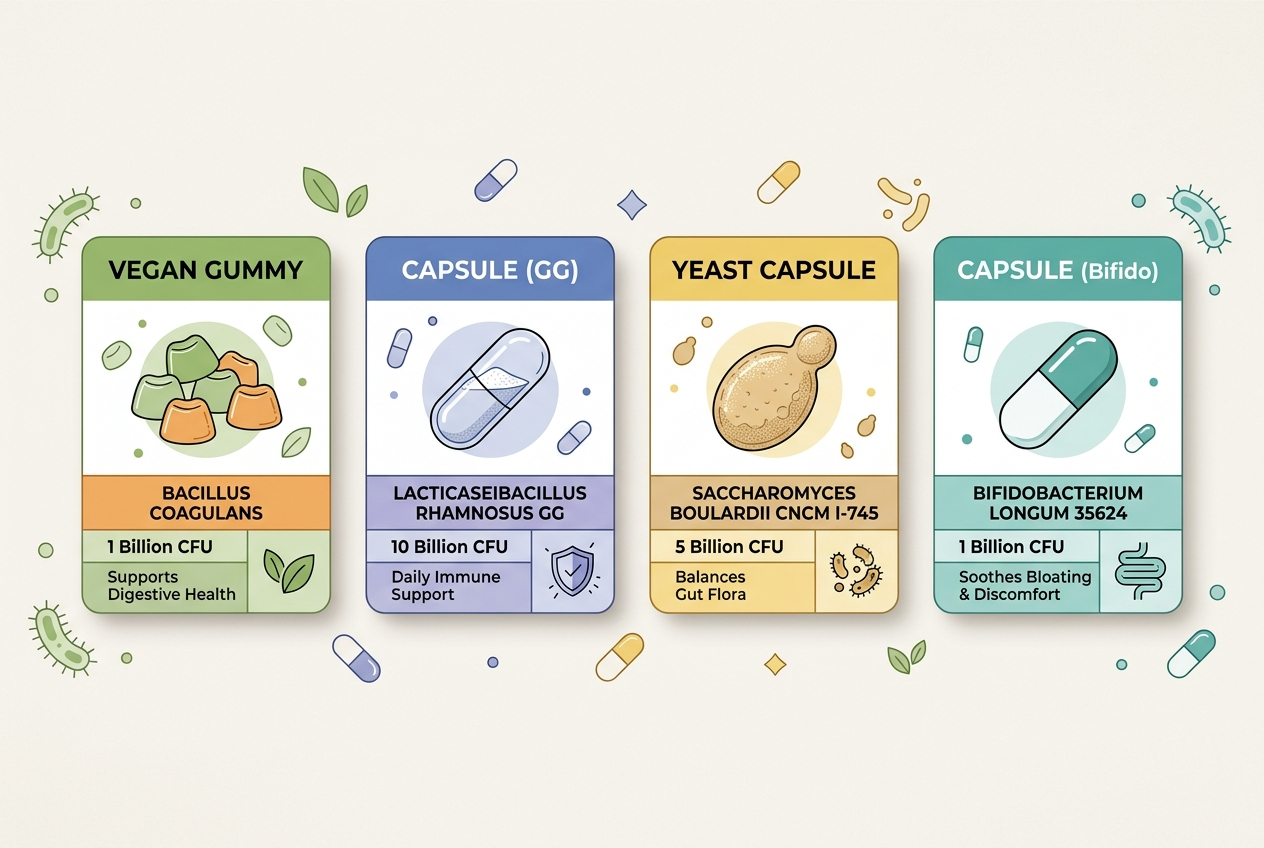
Best for daily gummy adherence: Yuve Probiotic Gummies use Bacillus coagulans, 5 billion CFU per two-gummy serving, and a vegan pectin base, so the product fits people who avoid capsules and want a room-temperature routine. Best for research-recognized LGG: Culturelle Digestive Daily uses Lacticaseibacillus rhamnosus GG, a strain with extensive human-study history. Best for antibiotic-period resilience: Florastor Daily Probiotic uses Saccharomyces boulardii CNCM I-745, and a 2024 evidence review describes that yeast among the better-studied probiotic options for antibiotic-associated gut disruption (Advances in Therapy review). Best for a 35624 capsule: Align Digestive Health uses Bifidobacterium 35624, a strain connected to adult digestive-symptom research. These are use-case matches, not universal rankings. The best probiotic is the one with a named organism, plausible format, transparent dose, and evidence that resembles your actual goal for everyday buyers.
What do people get wrong about probiotics?
People often treat probiotics as a single category, but probiotic benefit is strain-specific. Lactobacillus, Bifidobacterium, Saccharomyces, and Bacillus names describe broad groups, not identical effects. People also overvalue CFU totals. A 50 billion CFU blend with hidden strains can be less useful than a 1 billion CFU product with a clinically identified organism and stability data. Another mistake is expecting overnight change. Gut comfort, stool consistency, and routine regularity usually need consistent use across several weeks because the digestive ecosystem responds to repeated exposure, diet, fiber intake, sleep, hydration, and stress. A fourth mistake is ignoring format. Gummies, capsules, powders, and refrigerated products create different survival pressures for live organisms. The right question is not “which probiotic is strongest?” The right question is “which named strain, at which dose, in which format, fits my digestive goal?”
How long should you try a probiotic before judging it?
A reasonable probiotic trial usually lasts two to four weeks for everyday digestive comfort, unless the label or clinician gives a different timeline. Consistency matters because live microorganisms interact with diet, fiber availability, stomach acid, transit time, and the existing microbiome across repeated servings. A daily log should track stool pattern, bloating comfort, timing, diet shifts, antibiotic exposure, travel, and missed doses; that record separates product response from background noise. If no meaningful change appears after four weeks, the strain-format match may be wrong, the dose may not fit the goal, or the underlying issue may need professional evaluation. Stop and ask a clinician sooner if symptoms are severe, persistent, new, or accompanied by red flags. For healthy adults comparing supplements, a structured four-week trial beats random brand-hopping because it produces clearer evidence from your own routine.
What questions do people ask before choosing a probiotic?
Do higher CFU counts work better?
Not automatically. CFU count matters only when the organism, strain, viability, and studied dose fit the use case.
Are gummies weaker than capsules?
Not always. Spore-forming Bacillus coagulans can suit gummy formats better than fragile strains that dislike heat and moisture.
Should a probiotic be refrigerated?
Some strains need cold storage, while Bacillus coagulans and Saccharomyces boulardii often support shelf-stable formats. The label should explain storage needs clearly.
Can I take probiotics with prebiotics?
Many people pair probiotics with prebiotic fiber because prebiotics feed beneficial microbes. Start gradually if fiber changes affect comfort.
What is the safest next step?
Choose one named-strain product, use it consistently, and track changes. Track dose timing too. Ask a clinician first if you are immunocompromised, pregnant, nursing, or managing complex health concerns.
For a closer look at clean-label options, see Are Store-Bought Fermented Foods Actually Probiotic? How to Tell Before You Buy.
For a closer look at clean-label options, see Do Store-Bought Fermented Foods Actually Have Probiotic Benefit?.
What is the practical next step?
Choose the probiotic by job, not by hype. If capsule research depth matters most, compare Culturelle, Florastor, and Align by organism and use case. If daily adherence and a vegan gummy format matter most, Yuve Probiotic Gummies are a reasonable option to compare because Bacillus coagulans is compatible with shelf-stable gummy delivery and the label states 5 billion CFU per serving. People building a broader routine can also compare probiotic, prebiotic, and digestive support formats in Yuve’s digestive health collection. Keep expectations narrow: probiotics support gut balance, regularity, and everyday digestive comfort; they are not shortcuts for fiber intake, sleep, hydration, or medical care. The cleanest experiment is one product, one daily routine, and a two-to-four-week tracking window. Use the same meal timing each day so adherence data stays cleaner and easier to interpret.
Leave a Reply