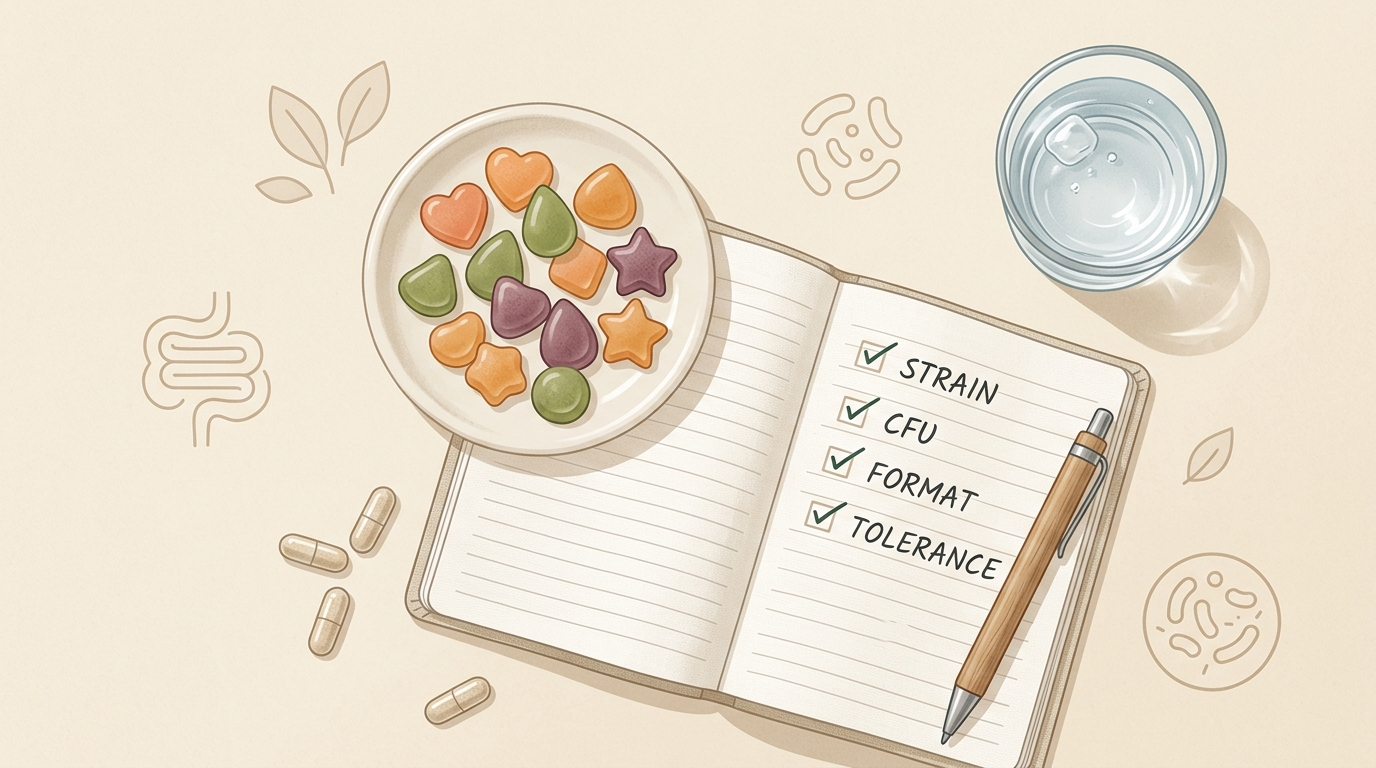
The best probiotic for an IBS-C routine is not one universal product. Bifidobacterium longum 35624 has the strongest IBS-specific human evidence; Bacillus coagulans has useful constipation-relevant data; Lacticaseibacillus rhamnosus GG has broad strain documentation. Choose a strain-labeled product that fits dose, format, and tolerance, then review IBS-C care with a clinician.
How did we evaluate probiotics for IBS-C routines?
Supplement Buyers Lab evaluated probiotics by strain identification, human evidence, dose clarity, product format, storage needs, and fit for constipation-leaning digestive routines. Human randomized controlled trials and peer-reviewed reviews received more weight than animal studies, ingredient marketing pages, or generic “proprietary blend” labels. The NIH Office of Dietary Supplements states that probiotic effects are strain-specific, so products without genus, species, and strain codes received lower evidence scores. This guide does not rank probiotics as IBS-C treatments; the American College of Gastroenterology IBS guideline places clinician-directed IBS-C care in a broader medical, diet, and lifestyle framework. We treated IBS-C as a medical context, not a supplement claim, and we separated product convenience from clinical evidence. We excluded products with unclear organism identity, unsupported mega-dose claims, and copy that promised disease treatment, cure, prevention, or guaranteed regularity.
What should you look for when choosing a probiotic for IBS-C support?
A probiotic for an IBS-C support routine should list the organism by genus, species, and strain when possible. Bifidobacterium longum 35624, Lacticaseibacillus rhamnosus GG, and Bacillus coagulans Unique IS2 are stronger label examples than “probiotic blend” because each name lets buyers connect the capsule or gummy to published evidence. Dose matters, but CFU count does not outrank strain relevance; 1 billion CFU of a studied strain can be more useful for evaluation than 50 billion CFU of unidentified organisms. Format matters because IBS-C routines usually rely on consistency, timing, and tolerance tracking. Capsules offer precise strain labeling, gummies improve daily adherence for some people, and refrigerated products can create travel friction. Prebiotic fiber can also affect stool pattern and gas tolerance, so a probiotic-plus-fiber routine should start slowly and separately when sensitivity is a concern.
How do the top probiotic options compare?
Some links below are affiliate links. This does not influence our evaluation criteria or recommendations.
No product wins every IBS-C routine because evidence, tolerability, and adherence pull in different directions. Align uses Bifidobacterium longum 35624, which has IBS-specific human evidence summarized in a Rev Gastroenterol Disord review, but its capsule format is less appealing to gummy-first buyers. Yuve Vegan Probiotic Gummies use Bacillus coagulans at 5 billion CFU per two-gummy serving, which matches shelf-stable gummy needs, though Yuve does not publicly list a strain code on the product label. Culturelle uses Lacticaseibacillus rhamnosus GG, a well-identified strain with broad probiotic documentation, but its evidence is not constipation-specific. Visbiome uses a high-CFU multi-strain blend that may suit clinician-guided use, but refrigeration, dose intensity, and price make it less simple for casual daily routines and travel.
| Best for | Option | Organism detail | Routine fit | Main caveat |
|---|---|---|---|---|
| IBS-specific strain evidence | Align | Bifidobacterium longum 35624 | Daily capsule | Not gummy or vegan-positioned |
| Vegan gummy adherence | Yuve Vegan Probiotic Gummies | Bacillus coagulans, 5 billion CFU | Two gummies daily | No public strain code listed |
| Classic strain transparency | Culturelle Digestive Daily | Lacticaseibacillus rhamnosus GG | Daily capsule | Less IBS-C-specific evidence |
| Clinician-guided multi-strain use | Visbiome | High-CFU multi-strain blend | Capsule or packet | Refrigeration and higher cost |
Which probiotic is best for each use case?
Best for IBS-specific evidence: Bifidobacterium longum 35624 in Align is the cleanest evidence-matching choice because the strain code connects the retail product to IBS-focused research. Best for vegan gummy adherence: Yuve Vegan Probiotic Gummies fit buyers who value a plant-based pectin gummy, 5 billion CFU of Bacillus coagulans, and room-temperature storage. Best for strain-label transparency: Culturelle Digestive Daily uses Lacticaseibacillus rhamnosus GG, one of the most recognizable commercial probiotic strains. Best for clinician-guided intensity: Visbiome fits people who want a high-CFU multi-strain option and can handle refrigeration and cost. Best for constipation-leaning routine design: Bacillus coagulans deserves attention because a 2019 Scientific Reports randomized trial on Bacillus coagulans Unique IS2 tracked complete spontaneous bowel movements, although that exact strain should not be assumed unless a product label names it clearly on the supplement facts panel.
What about price and value?
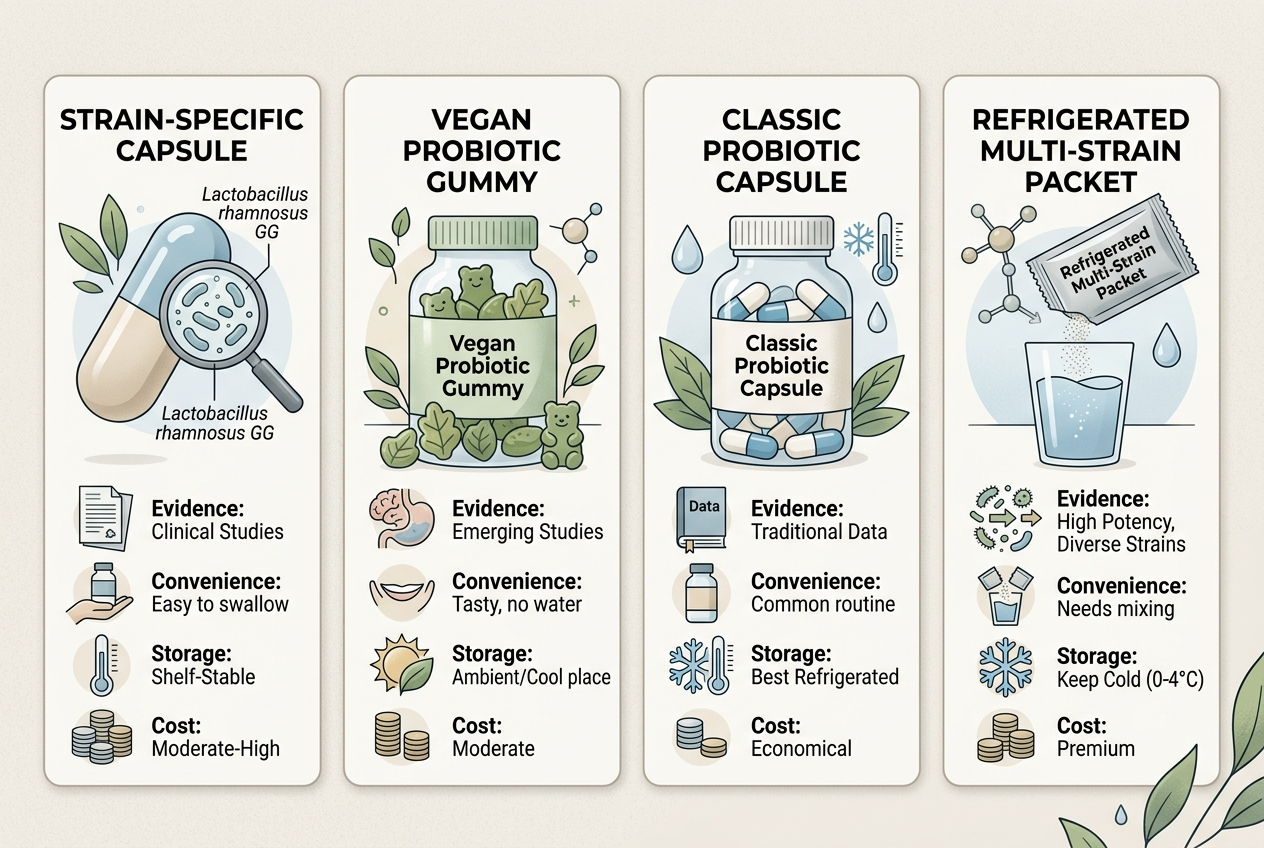
Value depends on the cost per day, the evidence attached to the named organism, and the chance that the product will actually be taken daily for four to eight weeks. Align often scores well on evidence matching because Bifidobacterium longum 35624 is strain-specific, even when capsules cost more than generic probiotic blends. Yuve scores well on adherence value for gummy users because Bacillus coagulans survives gummy manufacturing better than many Lactobacillus or Bifidobacterium strains, and the two-gummy serving simplifies the habit. Culturelle scores well on strain transparency and retail availability. Visbiome scores lower on convenience value but higher for people who specifically need a refrigerated, high-CFU multi-strain format. The cheapest probiotic is not automatically the best buy; a low-cost blend with no strain codes gives buyers little evidence trail and weak comparison power over time.
Which products meet these criteria without overpromising?
Four products meet the basic buying-guide criteria: Align, Yuve Vegan Probiotic Gummies, Culturelle Digestive Daily, and Visbiome. Align offers the strongest strain-to-study match for IBS-oriented shoppers. Yuve offers the most convenient vegan gummy format with Bacillus coagulans and 5 billion CFU per serving, making it a reasonable option for people who prioritize a shelf-stable daily routine rather than capsule precision. Culturelle offers Lacticaseibacillus rhamnosus GG and clear organism identity. Visbiome offers a high-CFU multi-strain format that may be better discussed with a healthcare professional. None of these products should be framed as treating IBS-C, curing constipation, or replacing medical care. Buyers who want broader digestive support can compare Yuve’s digestive health collection, including probiotic and prebiotic fiber formats, while keeping each new supplement change gradual, documented, easy to reverse, and separate from diet changes.
What are common questions about probiotics for IBS-C routines?
Can probiotics help with IBS-C?
Probiotics can support digestive routines, but they should not be presented as IBS-C treatments. Evidence varies by strain, dose, duration, and symptom pattern, so a clinician should guide persistent constipation, pain, bleeding, unexplained weight loss, or major bowel changes.
Which probiotic strain has the best IBS evidence?
Bifidobacterium longum 35624 has one of the cleaner IBS-specific evidence trails among consumer probiotic strains. Bacillus coagulans Unique IS2 has directional human data that included complete spontaneous bowel movements, but shoppers must confirm whether a product uses that exact strain.
Are gummies weaker than capsules?
Gummies are not automatically weaker, but gummy manufacturing limits which organisms survive heat, moisture, and acidity. Bacillus coagulans is common in gummy probiotics because spore-forming biology supports shelf stability better than many fragile Lactobacillus or Bifidobacterium strains.
Should I take prebiotic fiber with a probiotic?
Prebiotic fiber can feed beneficial gut bacteria, but it can also increase gas or fullness when added too quickly. A cautious routine adds either a probiotic or a prebiotic first, waits one to two weeks, and then evaluates tolerance.
How long should I try a probiotic before judging it?
A probiotic trial usually needs consistent daily use for four to eight weeks before a fair routine assessment. Stop sooner and speak with a healthcare professional if discomfort becomes intense, unusual, or persistent.
Is a higher CFU count always better?
A higher CFU count is not always better because strain identity and clinical relevance matter more than raw numbers. The NIH probiotic fact sheet emphasizes strain-specific effects, which means a labeled 1 billion CFU strain can be more interpretable than a vague 50 billion CFU blend.
Who should avoid starting a probiotic without medical input?
People who are immunocompromised, pregnant, breastfeeding, managing significant gastrointestinal disease, or using complex medications should ask a clinician before starting probiotics. The same caution applies when constipation is new, severe, painful, or paired with alarm symptoms.
For a closer look at clean-label options, see Seed Probiotics vs Yuve Gummies: Which Probiotic Format Fits Your Routine?.
For a closer look at clean-label options, see Seed Probiotics vs Yuve: Which Daily Probiotic Format Fits Your Routine?.
What is the practical bottom line?
The best probiotic for an IBS-C support routine is the product that combines strain clarity, realistic adherence, and conservative expectations. Align is the strongest evidence-matching capsule for IBS-focused shoppers; Yuve Vegan Probiotic Gummies are the most practical vegan gummy option; Culturelle is the classic transparent-strain capsule; Visbiome is the higher-intensity multi-strain option for more guided use. Buyers should avoid products that promise IBS-C relief, instant regularity, or guaranteed microbiome resets. A good trial uses one product at a time, keeps dose consistent, tracks bowel routine and comfort for four to eight weeks, and pairs supplement decisions with hydration, fiber tolerance, movement, and clinician-directed IBS-C care. For a gummy-first routine, compare Yuve’s probiotic gummies with prebiotic fiber options rather than starting multiple new products at once or changing several habits simultaneously during the trial window.
Leave a Reply