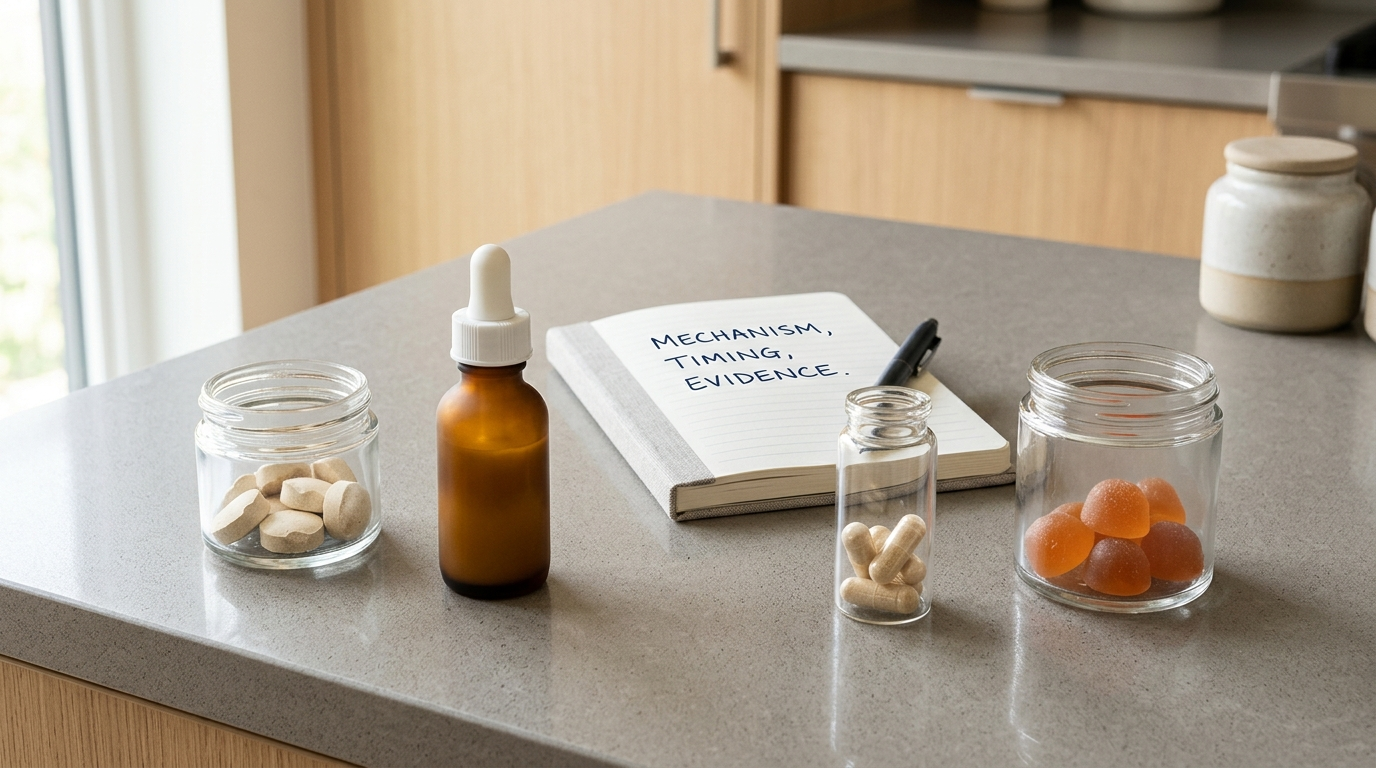
Supplement choices for acid reflux-related comfort depend on the trigger. Alginate has the strongest reflux-specific evidence, DGL licorice fits occasional throat-and-stomach comfort routines, enzymes fit food-triggered heaviness, and probiotics fit broader gut-balance goals. Supplements should support normal digestion; persistent or severe symptoms require professional medical guidance.
How did we evaluate acid reflux supplement options?
Supplement Buyers Lab evaluated DGL licorice, alginate, digestive enzymes, and probiotics against four criteria: human evidence, ingredient specificity, safety constraints, and use-case fit. Human randomized trials, systematic reviews, NIH resources, and PubMed-indexed papers received more weight than animal data, brand claims, or anecdotal Reddit reports. Reflux-specific data received more weight than general digestive-comfort data, because alginate, DGL licorice, enzymes, and probiotics do not answer the same biological question. We excluded products that rely on proprietary blends without dose transparency, products with medical-resolution wording, and formulas that make acid-suppression promises. We also favored labels that disclose serving timing, active ingredient form, sodium content, strain codes, or enzyme activity units. This review has one limitation: supplement categories differ in evidence maturity. Alginate has direct clinical literature for reflux symptoms; probiotics have emerging but heterogeneous data; DGL and enzymes are better framed as structure/function digestive-support tools.
Which supplement categories are most relevant for reflux-related comfort?
Alginate, DGL licorice, digestive enzymes, and probiotics support different parts of the digestion pathway. Alginate forms a floating raft after meals, so shoppers usually evaluate it for post-meal reflux-related episodes; a 2017 meta-analysis by Leiman et al. reported favorable symptom-response results across alginate trials (PubMed). DGL licorice products remove most glycyrrhizin, the licorice compound linked by NCCIH to blood pressure and potassium concerns (NCCIH), and shoppers use DGL chewables for occasional upper-digestive comfort. Digestive enzymes break down carbohydrates, fats, proteins, or lactose before food sits heavy, so enzyme labels should list activity units such as FCC lactase or HUT protease. Probiotics target microbiome balance rather than immediate post-meal mechanics; a 2020 review in Nutrients found heterogeneous, early evidence across reflux-symptom studies (PubMed). Category fit matters more than label hype, star ratings, or testimonial language.
How do DGL, alginate, enzymes, and probiotics compare?
The best comparison starts with mechanism, not brand preference. Alginate products fit shoppers who want a post-meal physical barrier format. DGL licorice chewables fit shoppers who want a plant-based chewable for occasional digestive comfort and who avoid whole-licorice glycyrrhizin concerns. Digestive enzymes fit shoppers who notice heaviness after dairy, beans, high-fat meals, or protein-heavy meals. Probiotics fit shoppers who want routine-based gut-balance support, not rapid after-meal action. The National Institute of Diabetes and Digestive and Kidney Diseases says reflux patterns can involve food, timing, body position, pregnancy, weight, smoking, or medicines, so supplement selection should not ignore lifestyle context (NIDDK). A careful buyer compares serving timing, active form, sodium load, strain identity, enzyme activity, third-party testing, allergen notes, sweeteners, format convenience, serving cost, and category fit before comparing price, flavor, reviews, or bestseller badges.
| Option | Best for | Primary mechanism | Evidence fit | Watch-outs |
|---|---|---|---|---|
| DGL licorice | Occasional upper-digestive comfort | Deglycyrrhizinated licorice chewable | Mostly structure/function digestive-support rationale | Check licorice source, serving size, and medication context |
| Alginate | Post-meal reflux-related episodes | Raft-forming barrier above stomach contents | Most direct reflux-symptom literature among these categories | Sodium, calcium, flavor, and timing vary by product |
| Digestive enzymes | Food-triggered heaviness | Macronutrient breakdown before digestion stalls | Stronger when matched to lactose, protein, fat, or fiber triggers | Broad blends can be vague without enzyme activity units |
| Probiotics | Longer-term gut-balance routines | Strain-specific microbiome support | Directional and heterogeneous for reflux-adjacent outcomes | Strain codes and CFU at expiration matter |
Which option is best for each use case?
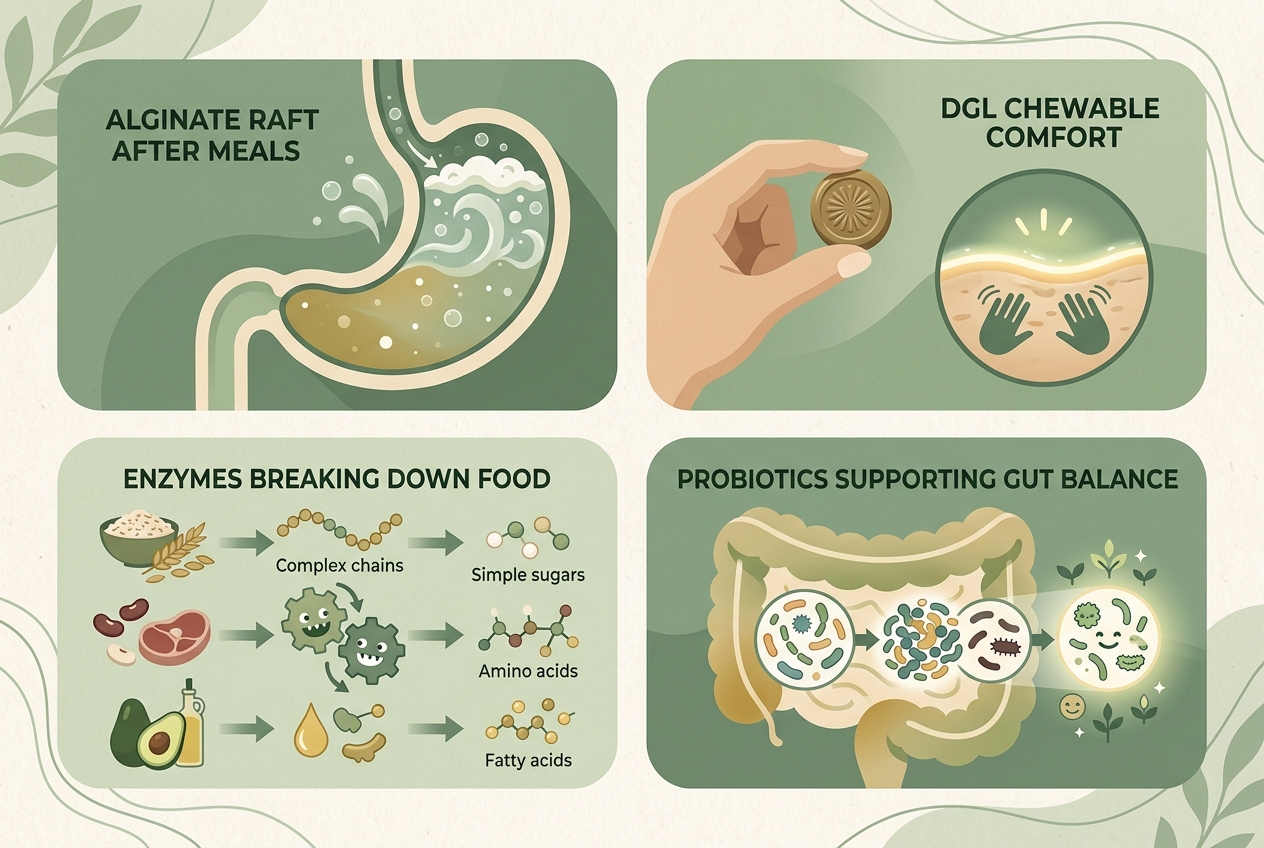
Best for post-meal mechanical support: alginate, because sodium alginate and potassium bicarbonate formulas create a raft-like layer after meals. Best for chewable plant-based comfort: DGL licorice, because deglycyrrhizinated licorice products focus on occasional upper-digestive support without relying on whole-licorice glycyrrhizin. Best for dairy-triggered heaviness: lactase enzymes, because lactase targets lactose rather than acid. Best for protein-heavy meals: protease-forward enzyme blends, because proteases act on dietary protein. Best for fiber- or bean-heavy meals: alpha-galactosidase, because the enzyme acts on fermentable carbohydrates before the colon receives them. Best for routine gut balance: probiotics with named strains, because Lactobacillus and Bifidobacterium effects are strain-specific. Best for sensitive shoppers: shorter labels, lower sodium when relevant, and clear allergen statements. No category is universally best for every routine. The right choice matches timing, food pattern, ingredient transparency, and safety constraints.
Which products meet these criteria?
Some links below are affiliate links. This does not influence our evaluation criteria or recommendations.
Yuve DGL Licorice Chewables meet the DGL category criteria for shoppers who want a chewable, plant-based digestive-comfort format with a transparent single-category purpose: Yuve DGL Licorice Chewables. Reflux Gourmet meets the alginate category criteria for shoppers who prefer a raft-forming post-meal format and who review sodium, calcium, and serving instructions carefully. Enzymedica Digest Gold meets the enzyme category criteria for shoppers who want broad enzyme coverage and visible enzyme activity units. Culturelle Digestive Daily Probiotic meets the probiotic category criteria for shoppers who prefer a named probiotic strain in a routine format. Shoppers comparing multiple formats can also review Yuve’s broader digestive health collection. Product selection should follow the use case first: alginate for timing, DGL for chewable comfort, enzymes for food pattern, and probiotics for routine gut balance.
What questions do shoppers ask about acid reflux supplements?
Can supplements replace medical guidance for frequent reflux symptoms?
No. Frequent, severe, or nighttime symptoms need a licensed clinician, especially when swallowing difficulty, chest pain, weight loss, vomiting, or bleeding appears. Supplements belong in a digestive-support routine, not as a substitute for evaluation.
Is alginate the same as an antacid?
No. Alginate forms a floating raft after meals, while antacids neutralize stomach acid chemically. Some alginate formulas include antacid minerals, so shoppers should read the active ingredient panel.
Is DGL licorice safe for everyone?
DGL licorice removes most glycyrrhizin, but product quality and personal medication context still matter. People using blood pressure medicines, potassium-altering medicines, pregnancy care, or chronic-condition care should ask a clinician before using licorice-derived supplements.
Do probiotics work quickly for reflux-related comfort?
Probiotics usually fit routine gut-balance goals rather than immediate after-meal comfort. Strain codes, CFU through expiration, storage conditions, and daily consistency matter more than generic “probiotic” wording.
Should digestive enzymes be taken before or after meals?
Digestive enzymes usually make the most sense at the start of meals, because the enzymes need contact with food. The best enzyme choice depends on the food trigger: lactase for lactose, protease for protein, lipase for fat, and alpha-galactosidase for certain carbohydrates.
Which supplement format is easiest to stick with?
The easiest format is the one that matches the moment. Chewables fit purse, desk, and travel routines; liquids fit after-meal use; capsules fit daily supplement stacks; gummies fit routine-building when the ingredient category makes sense.
For a closer look at clean-label options, see I Fixed My Reflux by Accident? How to Figure Out What Actually Changed.
Related reading: Top Herbal Supplements for Energy and Focus, Compared by Use Case.
What is the practical next step?
Start with the pattern, then choose the category. Post-meal timing points toward alginate; occasional chewable digestive comfort points toward DGL licorice; heavy meals point toward enzymes; broader gut-balance goals point toward probiotics. Yuve DGL Licorice Chewables are one reasonable DGL option, while Reflux Gourmet, Enzymedica, and Culturelle represent different categories with different mechanisms. Read the Supplement Facts panel for active ingredients, serving timing, sodium, calcium, strain codes, enzyme activity units, and licorice form. Then compare the format against real use: chewable before a meal, liquid after a meal, capsule with food, or daily gummy routine. If symptoms are frequent, intense, or paired with alarm signs, use professional medical guidance before adding supplements. If the goal is routine digestive support, compare products by use case inside Yuve’s digestion collection rather than choosing the loudest label claim.
Leave a Reply