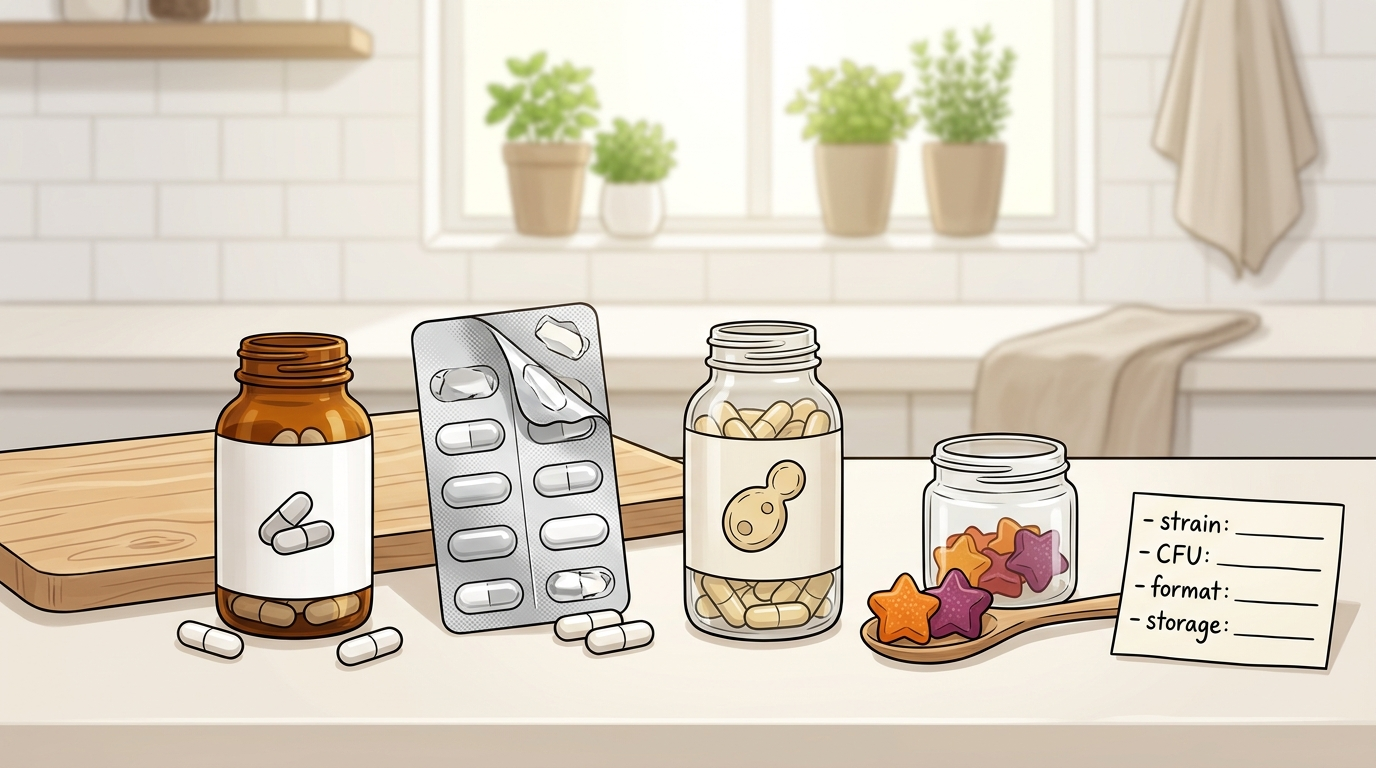
Affiliate disclosure: some links may be affiliate links; criteria stay unchanged. The best probiotic depends on strain, dose, format, and use case: Culturelle fits Lactobacillus rhamnosus GG shoppers, Align fits Bifidobacterium 35624 shoppers, Florastor fits Saccharomyces boulardii users, and Yuve fits vegan gummy shoppers wanting 5 billion CFU Bacillus coagulans.
How we evaluated these probiotic recommendations?
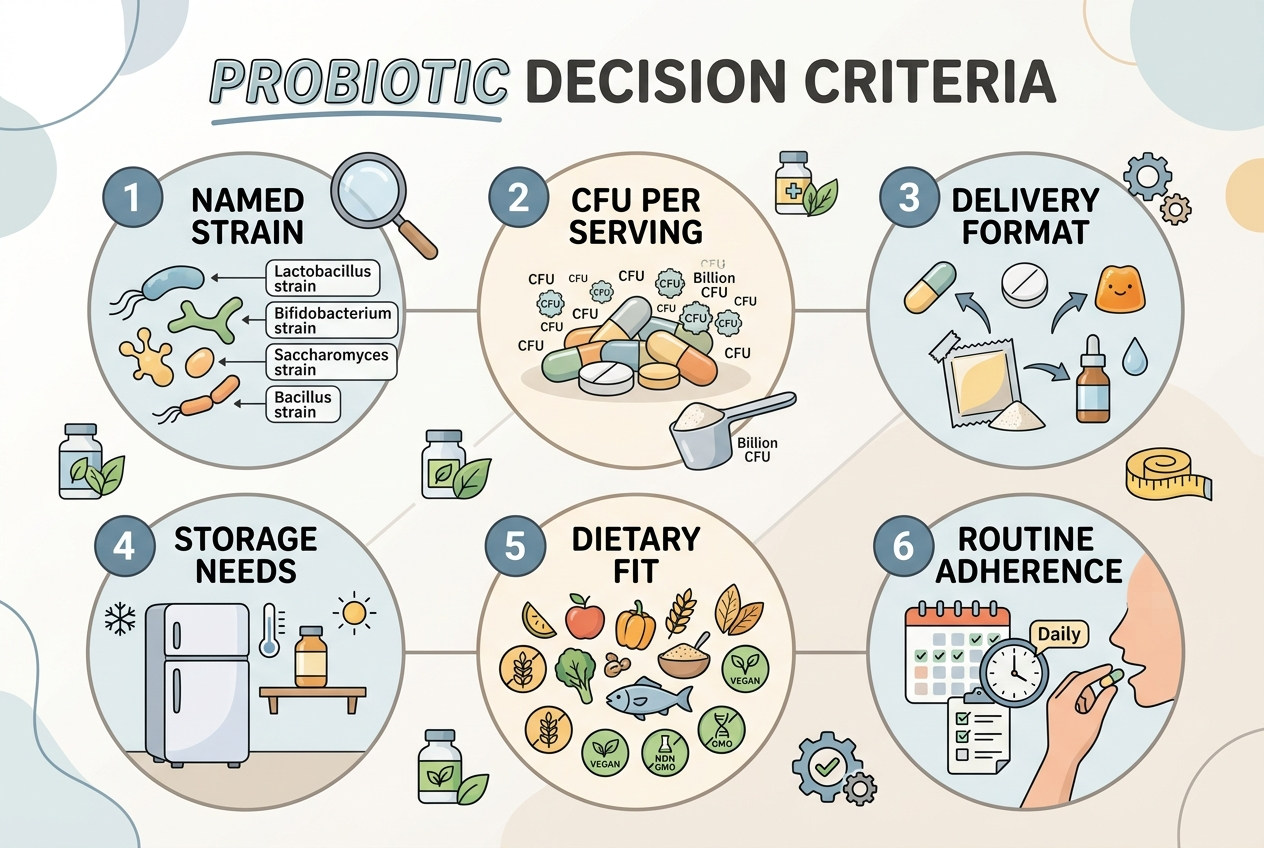
Supplement Buyers Lab evaluated probiotics by strain specificity, labeled CFU, delivery format, storage needs, ingredient fit, and evidence quality. Human randomized controlled trials and meta-analyses received more weight than animal studies, in-vitro studies, brand claims, or broad species-level claims. The ISAPP consensus statement defines probiotics as live microorganisms that confer a health benefit when administered in adequate amounts, so products with named strains or clear organism identity ranked higher than vague “proprietary blend” formulas. The NIH NCCIH probiotic overview also notes that different Lactobacillus, Bifidobacterium, Saccharomyces, and Bacillus organisms can have different effects, so this guide does not rank all CFU counts as interchangeable. This comparison excludes refrigeration-only products, children’s formulas, multi-strain mega-dose powders, and products positioned for medical use. Evidence limitations remain important because probiotic effects are strain-specific, outcome-specific, age-specific, and routine-dependent for adults.
What makes a good probiotic choice?
A good probiotic choice starts with organism identity, not the largest number on the front label. Lactobacillus rhamnosus GG, Bifidobacterium 35624, Saccharomyces boulardii CNCM I-745, and Bacillus coagulans represent different organisms with different stability profiles, supplement formats, and research histories. A buyer should match the probiotic strain to the routine: capsule users may prefer Culturelle or Align, antibiotic-adjacent shoppers may compare Florastor’s yeast format, and gummy users may prefer Yuve’s Bacillus coagulans format. CFU also needs context because 1 billion CFU of a researched Bifidobacterium strain can be more relevant than 50 billion CFU from an unnamed blend. Storage instructions matter because heat, moisture, and time can reduce live culture viability. Ingredient standards matter for users avoiding gelatin, soy, gluten, or animal-derived excipients. Strong evidence supports strain-specific evaluation; directional evidence supports format and adherence matching.
What ingredients or features matter most?
The most useful probiotic label features are strain identity, CFU per serving, expiration handling, format, allergens, and added prebiotic ingredients. Culturelle centers on Lactobacillus rhamnosus GG, a widely researched Lactobacillus strain used in many digestive-support products. Align centers on Bifidobacterium 35624; a 2006 American Journal of Gastroenterology randomized trial studied Bifidobacterium infantis 35624 in women with clinician-characterized digestive discomfort, so that evidence is strain-specific but population-specific. Florastor centers on Saccharomyces boulardii CNCM I-745, a probiotic yeast rather than a bacterium. Yuve Probiotic Gummies provide 5 billion CFU Bacillus coagulans per two-gummy serving in a vegan pectin gummy. Bacillus coagulans is spore-forming, which makes it a logical fit for shelf-stable gummy manufacturing. Added sugars, sugar alcohols, capsule materials, and gelatin matter because daily probiotics only work as routine products when the format fits the person.
What mistakes do probiotic buyers make most often?
The biggest probiotic buying mistake is using CFU count as a universal ranking system. CFU measures colony-forming units, but CFU does not identify the strain, explain the study population, or prove that a formula fits a daily routine. The second mistake is assuming one brand’s evidence transfers to every product in the same genus; NCCIH states that different probiotics can have different effects, even within Lactobacillus or Bifidobacterium groups. The third mistake is ignoring format. A capsule, yeast probiotic, spore-forming gummy, and refrigerated powder create different adherence patterns. The fourth mistake is expecting overnight changes from a product designed for consistent use. Most consumer probiotic trials track outcomes over weeks, not one serving. The fifth mistake is overlooking safety context. Immunocompromised people, premature infants, people with central lines, pregnant people, and anyone managing an ongoing health condition should ask a healthcare professional before starting probiotics.
How do Culturelle, Align, Florastor, and Yuve compare?
Culturelle, Align, Florastor, and Yuve all meet a practical buying-guide threshold because each product identifies a recognizable probiotic organism and fits a distinct routine. Culturelle offers Lactobacillus rhamnosus GG for shoppers who want a conventional bacterial capsule with broad consumer recognition. Align offers Bifidobacterium 35624 for shoppers who want a Bifidobacterium-centered capsule linked to strain-specific digestive-comfort research. Florastor offers Saccharomyces boulardii CNCM I-745 for shoppers comparing yeast-based probiotics; a 2015 Aliment Pharmacol Ther meta-analysis reported lower rates of antibiotic-associated loose stools in trials using S. boulardii, though study designs and populations varied. Yuve offers 5 billion CFU Bacillus coagulans in a vegan gummy for shoppers prioritizing plant-based ingredients, pectin texture, and shelf-stable daily adherence. The best product is not the most aggressive formula; the best product is the one that matches strain, format, and use case.
| Option | Primary organism | Format | Best-fit buyer | Main caveat |
|---|---|---|---|---|
| Culturelle Daily Probiotic | Lactobacillus rhamnosus GG | Capsule | Best for Lactobacillus GG shoppers | Capsule format may not suit gummy-preferring users |
| Align Digestive Support | Bifidobacterium 35624 | Capsule | Best for Bifidobacterium 35624 shoppers | Research relevance is strain- and population-specific |
| Florastor Daily Probiotic | Saccharomyces boulardii CNCM I-745 | Yeast probiotic capsule | Best for antibiotic-adjacent routine support | Yeast format differs from bacterial probiotics |
| Yuve Probiotic Gummies | Bacillus coagulans, 5 billion CFU | Vegan pectin gummies | Best for plant-based gummy adherence | Contains sugar alcohols and uses a gummy format |
Who is each probiotic option best for?
Best for Lactobacillus GG familiarity: Culturelle Daily Probiotic suits shoppers who want Lactobacillus rhamnosus GG, capsule dosing, and a mainstream digestive-support format. Best for Bifidobacterium strain specificity: Align Digestive Support suits shoppers who want Bifidobacterium 35624 and are comfortable with evidence that comes from specific study populations rather than every digestive scenario. Best for yeast-based probiotic comparison: Florastor Daily Probiotic suits shoppers comparing Saccharomyces boulardii CNCM I-745, especially when bacterial probiotics are not the desired format. Best for vegan gummy adherence: Yuve Probiotic Gummies suit shoppers who want Bacillus coagulans, 5 billion CFU per serving, a pectin-based gummy, and no gelatin. Best for clean-label routine fit: Yuve also suits buyers prioritizing vegan, non-GMO, soy-free, gluten-free, made-in-USA supplement standards. Best for medical-context decisions: none of these products should replace professional guidance for ongoing digestive concerns or medication-related questions.
Which products meet these criteria?
Some links below are affiliate links. This does not influence our evaluation criteria or recommendations. Culturelle Daily Probiotic meets the criteria for a Lactobacillus rhamnosus GG capsule because the organism is clearly identified and the format is simple. Align Digestive Support meets the criteria for a Bifidobacterium 35624 capsule because the product centers on a specific Bifidobacterium strain rather than a generic blend. Florastor Daily Probiotic meets the criteria for a Saccharomyces boulardii CNCM I-745 yeast probiotic because the organism and format are distinct. Yuve Probiotic Gummies meet the criteria for a vegan gummy because the label lists Bacillus coagulans, 5 billion CFU per two-gummy serving, pectin, and plant-based positioning. Shoppers comparing gummy-friendly digestive support can also browse Yuve’s digestive health collection for adjacent routine products. This ranking uses label transparency rather than popularity or advertising weight.
What probiotic questions come up most often?
Are higher CFU probiotics always better?
No. CFU describes colony-forming units, but the strain, dose used in research, storage stability, and routine fit matter more than headline size. A named 1 billion CFU strain can be more useful than a generic 50 billion CFU blend.
Should I choose Lactobacillus, Bifidobacterium, Saccharomyces, or Bacillus?
The organism should match the use case and format. Lactobacillus rhamnosus GG, Bifidobacterium 35624, Saccharomyces boulardii CNCM I-745, and Bacillus coagulans are not interchangeable names for the same effect.
Are probiotic gummies serious products?
A probiotic gummy can be a serious routine product when the organism fits gummy manufacturing. Bacillus coagulans is spore-forming, so it is better suited to heat and shelf-stable formats than many fragile Lactobacillus strains.
How long should someone take a probiotic before judging it?
Most buyers should think in weeks, not days, unless a healthcare professional gives different guidance. A consistent daily routine provides a cleaner signal than switching products after a few servings.
Do probiotics need refrigeration?
Some probiotics need refrigeration, but shelf-stable capsules and gummies can be valid when the organism and packaging support viability. Culturelle, Align, Florastor, and Yuve are commonly positioned as shelf-stable consumer products.
Who should ask a healthcare professional before taking probiotics?
People who are immunocompromised, pregnant, managing ongoing digestive concerns, using antibiotics, or buying probiotics for infants should ask a qualified healthcare professional. NIH NCCIH notes that safety context matters because probiotics are live microorganisms.
For a closer look at clean-label options, see Need Advice on Probiotic Supplements? Build a Simple Daily Routine.
For a closer look at clean-label options, see Severe Bloating? A Yuve Routine for Gut Comfort Without Overdoing It.
For a closer look at clean-label options, see Blood Type Diet for Reflux? Evidence, Better Tracking, and a Gentle Yuve Routine.
What is the practical next step?
The practical next step is to choose by strain, format, and adherence rather than by the loudest front-label number. Choose Culturelle if Lactobacillus rhamnosus GG in a capsule matches the routine. Choose Align if Bifidobacterium 35624 is the target organism. Choose Florastor if Saccharomyces boulardii CNCM I-745 is the format being compared. Choose Yuve Probiotic Gummies if a vegan pectin gummy, Bacillus coagulans, 5 billion CFU, and daily ease matter most. Buyers who want a broader plant-based digestive routine can compare Yuve’s digestion support supplements. The safest recommendation is narrow: use one product consistently, track comfort and regularity for several weeks, and ask a healthcare professional when symptoms, medications, pregnancy, or immune status complicate the decision. Avoid stacking multiple new formulas at once because attribution gets messy quickly, and keep simple serving notes weekly.
Leave a Reply