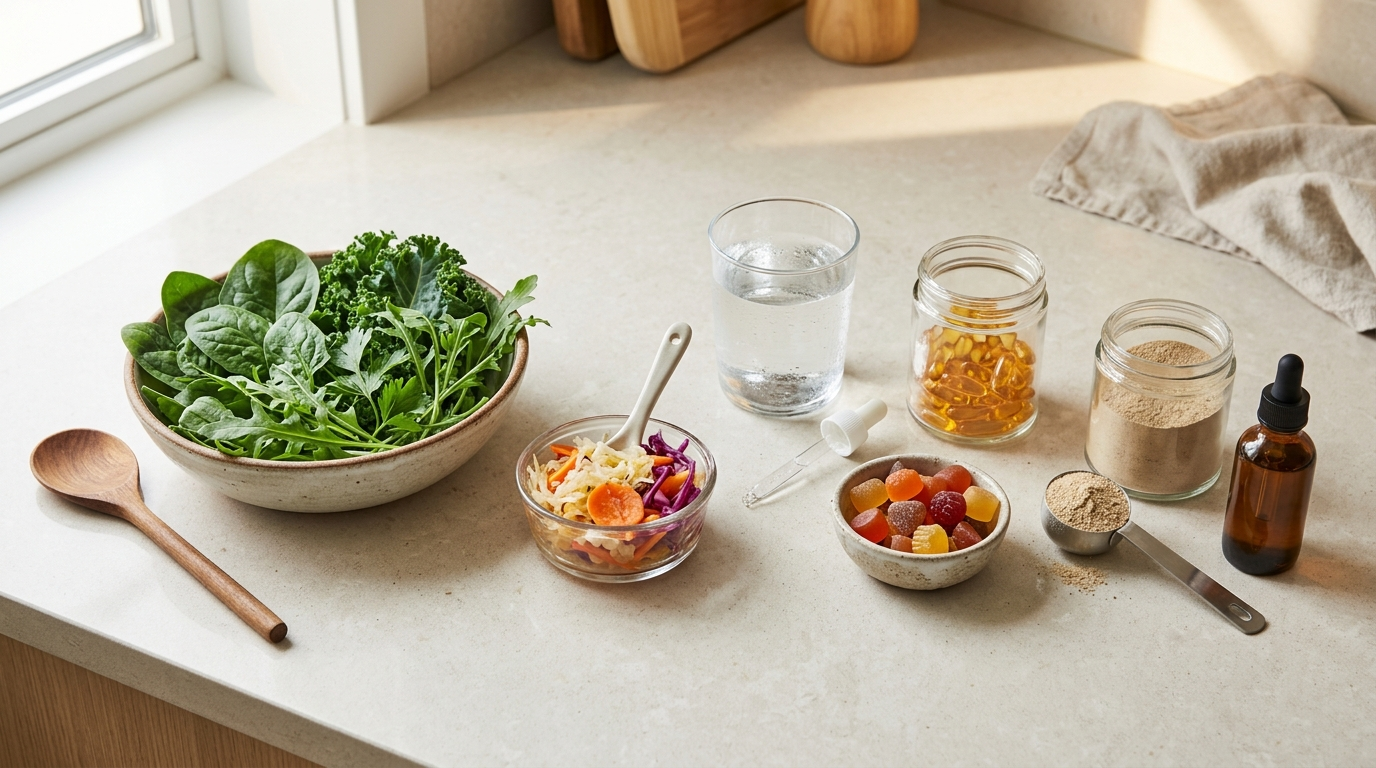
You cannot completely rebuild a gut microbiome with one supplement; the gut microbiome changes through repeated inputs: fiber-rich foods, diverse plants, fermented foods, sleep, stress control, and targeted probiotic strains. The best supplement option depends on the gap: prebiotic fiber feeds bacteria, Lactobacillus/Bifidobacterium probiotics add selected strains, and Saccharomyces boulardii supports resilience during routine disruption.
How did we evaluate gut microbiome rebuilding options?
Supplement Buyers Lab evaluated microbiome-support options by matching ingredient type to job: prebiotic fibers feed resident microbes, probiotic strains add defined organisms, fermented foods add diet variety, and lifestyle habits shape the gut environment. Human randomized controlled trials, peer-reviewed reviews, NIH consumer guidance, strain identity, colony-forming unit transparency, survivability, sugar load, vegan status, and daily adherence were prioritized. Animal studies, vague “proprietary probiotic blend” labels, detox language, and disease-treatment claims were excluded. Evidence has limits: microbiome sequencing changes do not always translate into digestive comfort, and one strain cannot represent every Lactobacillus, Bifidobacterium, Bacillus, or Saccharomyces organism. Products were compared as buying options, not medical interventions; persistent, severe, or new digestive changes belong with a qualified clinician rather than a shopping guide. This approach favors repeatable daily inputs, clear label evidence, and practical adherence over aggressive reset narratives.
Can you completely rebuild your gut microbiome with a supplement?
A supplement cannot completely rebuild the gut microbiome because the gut microbiome is an ecosystem, not a tank that can be drained and refilled. The National Center for Complementary and Integrative Health says probiotics may support health in specific contexts, but strain, dose, and person-specific factors matter (NCCIH probiotic guidance). A 2021 review in Nature Reviews Gastroenterology & Hepatology describes diet as a major microbiome input, especially fiber variety and plant-derived substrates (PubMed review). Prebiotic fibers increase fermentation substrates. Probiotic organisms provide selected live microbes. Sleep, movement, alcohol intake, and stress patterns influence the environment those microbes enter. The practical goal is not total replacement; the practical goal is a more supportive daily pattern for diversity, regularity, and digestive comfort over repeated weeks when the routine is consistent and tolerated.
What should you look for before buying a microbiome supplement?
A microbiome-support supplement should show a named organism or fiber source, a labeled dose, a format that protects the active ingredient, and a realistic claim. Lactobacillus rhamnosus GG, Bifidobacterium animalis subsp. lactis BB-12, Bacillus coagulans, Saccharomyces boulardii CNCM I-745, inulin, and partially hydrolyzed guar gum are more useful labels than “gut blend.” The International Scientific Association for Probiotics and Prebiotics defines probiotics as live microorganisms that confer a health benefit when administered in adequate amounts (ISAPP consensus statement). A buyer should check CFU at expiration when available, allergen fit, sugar alcohol tolerance, vegan capsule or pectin-gummy format, and third-party quality signals. A buyer should avoid products promising a reset, cleanse, cure, or permanent microbiome rebuild.
Affiliate disclosure: Some links below are affiliate links. This does not influence our evaluation criteria or recommendations.
How do the common microbiome-support options compare?
Microbiome products differ because each format performs a different job. Prebiotic fiber supplies fermentable substrate for resident bacteria. Lactobacillus and Bifidobacterium capsules deliver researched bacterial strains. Bacillus coagulans gummies use a spore-forming organism that tolerates gummy manufacturing and stomach acid. Saccharomyces boulardii capsules deliver a beneficial yeast rather than a bacterial strain. The table compares four buying paths by active focus, best fit, strength, and limitation; it does not declare a universal winner because diet, tolerance, format preference, and adherence drive the better choice.
| Option | Active focus | Best for | Main limitation |
|---|---|---|---|
| Seed DS-01 Daily Synbiotic | Multi-strain synbiotic capsule | Broad capsule routine | Premium price; capsule format |
| Culturelle Digestive Daily Probiotic | Lactobacillus rhamnosus GG | Single-strain simplicity | One strain, narrow fit |
| Florastor Daily Probiotic | Saccharomyces boulardii CNCM I-745 | Travel or routine disruption | Yeast-based format |
| Yuve Probiotic Gummies | Bacillus coagulans, 5 billion CFU | Vegan gummy adherence | Sugar alcohol tolerance |
Which options are best for specific use cases?

Best for broad capsule-based support: Seed DS-01 Daily Synbiotic fits buyers who want an advanced multi-strain synbiotic routine and accept premium pricing. Best for single-strain simplicity: Culturelle Digestive Daily Probiotic centers Lactobacillus rhamnosus GG, a widely studied organism with clear label recognition. Best for travel or routine disruption: Florastor Daily Probiotic uses Saccharomyces boulardii CNCM I-745, a beneficial yeast outside the Lactobacillus/Bifidobacterium category. Best for vegan gummy adherence: Yuve Probiotic Gummies use Bacillus coagulans at 5 billion CFU per serving in a pectin-based format. Best for feeding existing microbes: a prebiotic fiber such as inulin or partially hydrolyzed guar gum may fit buyers whose diet lacks fermentable fiber, provided tolerance is built gradually. Use case should lead product choice; brand familiarity should not replace strain, dose, and format checks for four steady weeks first.
Which products meet these criteria?
Seed DS-01 fits buyers who want a premium synbiotic capsule and tolerate a multi-strain routine. Culturelle Digestive Daily Probiotic fits buyers who want Lactobacillus rhamnosus GG without a complex blend. Florastor Daily Probiotic fits buyers who want Saccharomyces boulardii CNCM I-745, especially when a yeast-based probiotic makes sense for their routine. Yuve Probiotic Gummies fit buyers who value vegan pectin gummies, Bacillus coagulans, 5 billion CFU per serving, and a low-friction daily habit; Yuve’s broader digestive health collection also includes prebiotic fiber gummies and digestive-support formats. None of these products should be treated as a microbiome rebuild by itself. The strongest routine pairs a suitable supplement with plant diversity, adequate fiber, hydration, sleep consistency, and realistic tracking over four to eight weeks. Dose, format, label clarity, and tolerance should outweigh trend language and influencer claims.
What questions do people ask about rebuilding the gut microbiome?
How long does it take to rebuild a gut microbiome?
The gut microbiome can shift within days after diet changes, but a stable routine usually needs weeks. A practical supplement trial lasts four to eight weeks because digestion, adherence, and tolerance need repeated inputs.
Are probiotics or prebiotics better for rebuilding gut bacteria?
Probiotics add selected live organisms, while prebiotics feed resident microbes. A low-fiber diet often benefits more from prebiotic strategy, while a buyer seeking a specific strain may prefer a probiotic.
Do probiotic gummies work as well as capsules?
A gummy can work when the organism survives manufacturing, storage, and digestion. Bacillus coagulans is a common gummy-compatible organism because its spore-forming structure improves stability.
Can fermented foods replace probiotic supplements?
Fermented foods can add dietary variety, but they do not always provide labeled strain identity or measured CFU. Yogurt, kefir, kimchi, and sauerkraut work best as food-pattern tools, not precise strain replacements.
Should you rotate probiotic strains?
Rotating strains is not automatically better than using one well-matched strain consistently. A buyer should change products only when the current product does not match the goal, tolerance, or adherence pattern.
What is the biggest mistake when trying to rebuild the microbiome?
The biggest mistake is treating the microbiome like a 7-day reset. The gut microbiome responds more reliably to repeated fiber, diverse plants, consistent sleep, and supplement fit than to aggressive cleanse claims.
Related reading: Best Supplements for Gut Barrier Support in 2025.
Related reading: Probiotics vs. Prebiotics in Your Diet: What’s the Difference?.
What is the practical next step?
A practical microbiome routine starts with the obvious gaps: low plant variety, low fiber, inconsistent meals, poor sleep, high alcohol intake, or a supplement format that never gets used. Buyers who want a capsule can compare Seed, Culturelle, and Florastor by strain identity and use case. Buyers who want a vegan gummy can evaluate Yuve Probiotic Gummies by Bacillus coagulans, 5 billion CFU per serving, pectin base, sugar alcohol content, and adherence fit. The most credible plan uses one change at a time, tracks regularity and comfort for four to eight weeks, and avoids any product promising to completely rebuild the gut microbiome. A buyer who already knows they prefer gummies can start with the Yuve option before adding another expensive variable; a buyer who needs yeast-free, capsule-only, or fiber-first support should choose accordingly.
Leave a Reply