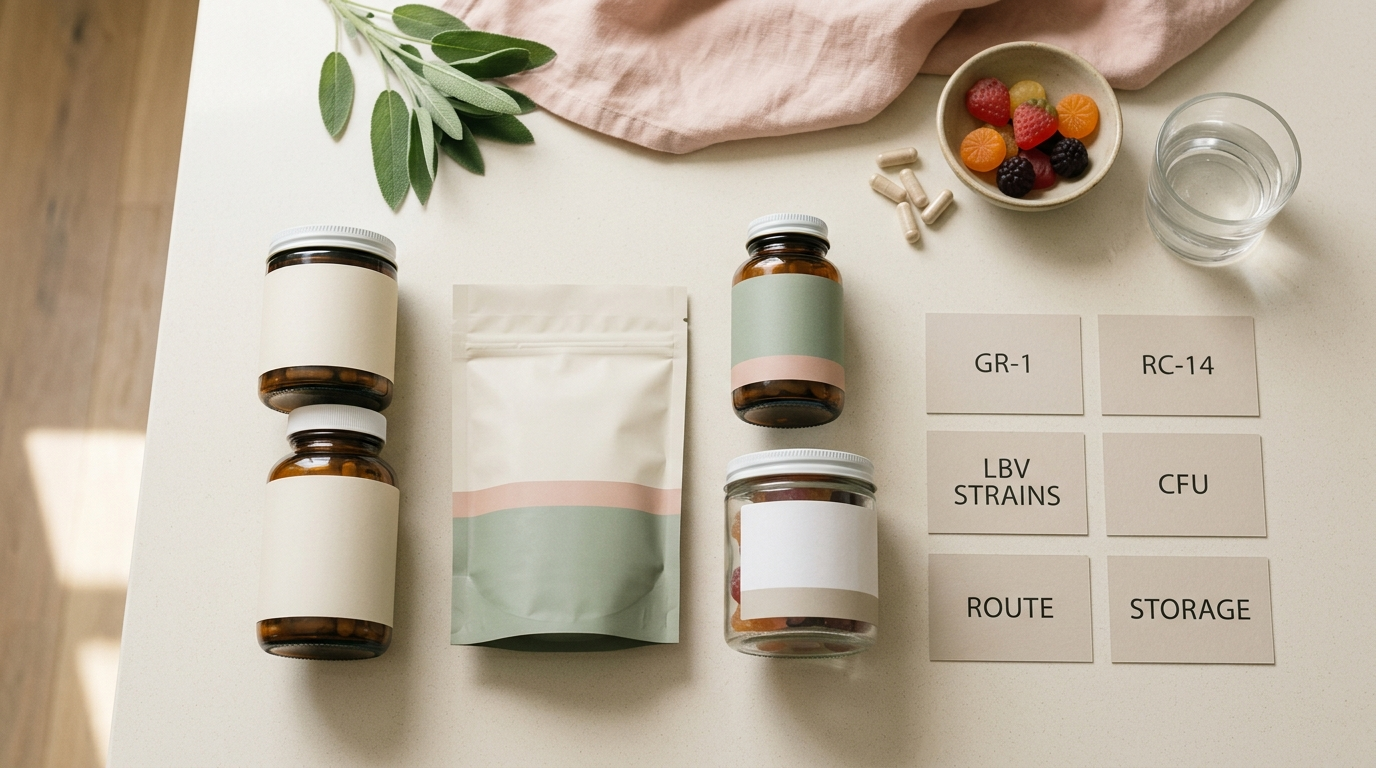
The best vaginal probiotic is not the bottle with the highest CFU count. Choose a product that names strains studied for the vaginal microbiome, states viability through expiration, and fits the intended use. GR-1 plus RC-14 has direct research, but results remain mixed and probiotics do not replace evaluation or prescribed treatment for symptoms.
How did we evaluate vaginal probiotics?
We prioritized human randomized trials, systematic reviews, and current product labels that identify organisms at the strain level. We gave more weight to studies measuring vaginal microbiota, Nugent score, recurrence, or clinician-confirmed outcomes than to testimonials, digestive claims, or species-level ingredient lists. We compared each product by strain identity, CFU at time of consumption, serving format, storage, allergens, intended use, and evidence match. We excluded products that rely only on a high organism count or the phrase “women’s probiotic” without enough label detail to connect the formula to research. Evidence remains limited by small samples, different populations, inconsistent regimens, and mixed findings across trials. This comparison therefore identifies the clearest label-to-evidence matches; it does not predict an individual result or substitute for testing when odor, discharge, itching, pain, urinary symptoms, pregnancy, or recurrent symptoms require clinical assessment.
Why do strain names matter for vaginal probiotics?
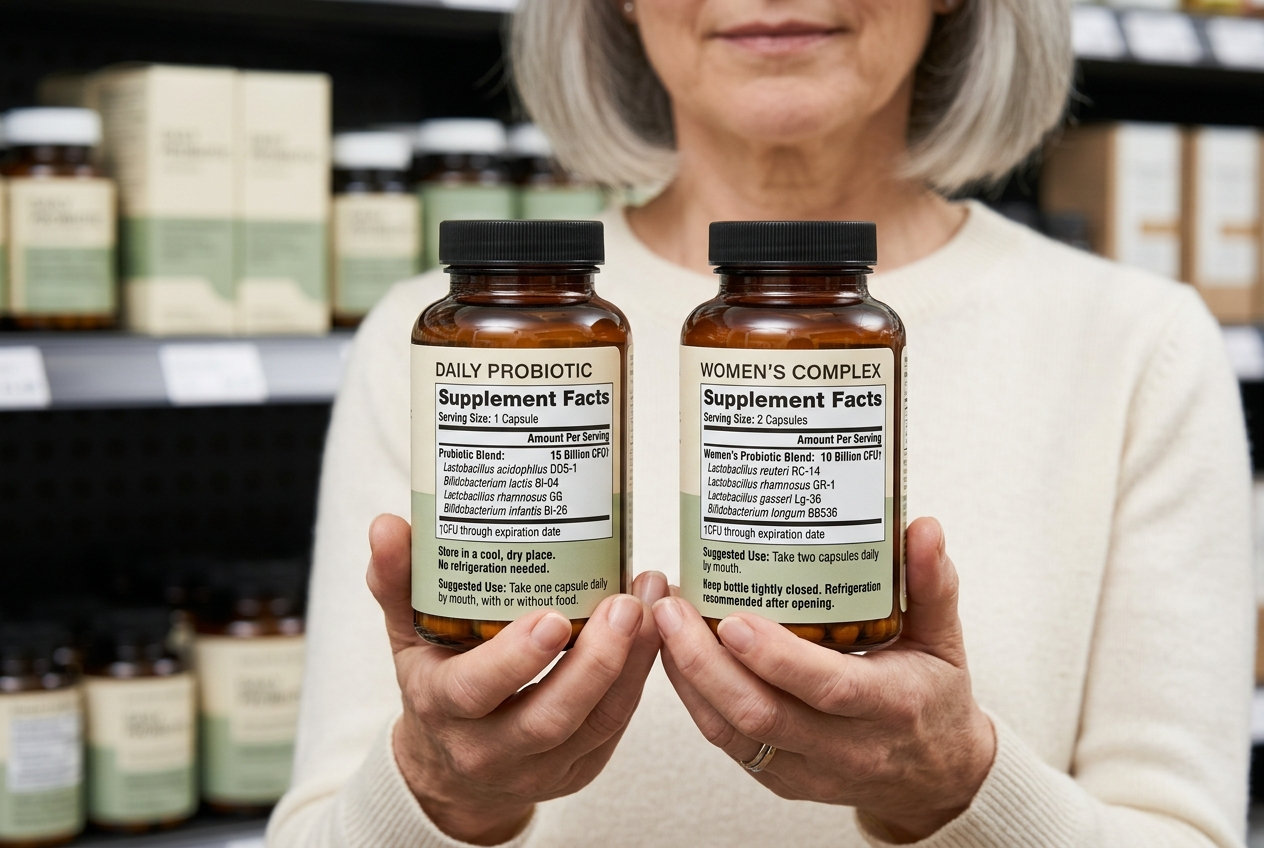
Probiotic effects belong to specific strains and formulations, not to every member of a genus or species. Lacticaseibacillus rhamnosus GR-1 and Limosilactobacillus reuteri RC-14 have been studied together, while L. rhamnosus GG has a different research history and cannot be treated as an equivalent substitute. The NIH Office of Dietary Supplements explains that probiotic recommendations should be strain-specific because effects can differ below the species level. A label that says only “Lactobacillus blend” prevents a clean match to a trial. CFU also needs context: 15 billion unspecified organisms do not automatically provide a better evidence match than 5 billion organisms with complete strain codes. Buyers should record the exact genus, species, strain, dose, storage method, and expiration guarantee. Those identifiers let a shopper compare the finished product with the microorganism and regimen actually evaluated in human research.
How do leading vaginal probiotic options compare?
Some links below are affiliate links. This does not influence our evaluation criteria or recommendations. Jarrow Fem-Dophilus 5 Billion names GR-1 and RC-14 and guarantees 5 billion viable cells under refrigerated storage. Culturelle Women’s 4-in-1 lists LGG plus four LBV-coded vaginal strains and 15 billion CFU, creating a different evidence lane. Yuve Probiotic Gummies provide 5 billion CFU of Bacillus coagulans in a vegan gummy, but the label does not position the organism as a vaginal-specific strain. Optibac For Women lists GR-1, RC-14, and F-19 in a capsule. These differences matter because a named strain pair, a broader multi-strain blend, and a digestive gummy answer different buying questions rather than forming a simple potency ranking. Product pages establish label facts, not clinical outcomes, and formulas can change. Buyers should verify the bottle before purchase.
| Option | Named organisms | Format | Best-fit use case | Main limitation |
|---|---|---|---|---|
| Jarrow Fem-Dophilus | GR-1 + RC-14 | Refrigerated capsule | Closest match to research on that pair | Cold storage and mixed trial findings |
| Optibac For Women | GR-1 + RC-14 + F-19 | Capsule | GR-1/RC-14 shoppers seeking an added strain | Finished blend differs from two-strain trials |
| Culturelle Women’s 4-in-1 | LGG + four LBV strains | Capsule | Broader labeled women’s blend | Evidence must match the complete formula |
| Yuve Probiotic Gummies | B. coagulans, 5 billion CFU | Vegan gummy | Capsule-free digestive routine | Not a vaginal-specific evidence match |
Which probiotic is best for each use case?
Best for matching GR-1 and RC-14 research: Jarrow Fem-Dophilus provides those two named strains in a 5-billion-CFU refrigerated capsule. Best for a GR-1/RC-14 formula with an additional organism: Optibac For Women adds Lactobacillus paracasei F-19, although evidence on the two-strain combination cannot automatically validate the three-strain finished product. Best for a broader labeled women’s formula: Culturelle Women’s 4-in-1 identifies LGG, LBV 88, LBV 96, LBV 150N, and LBV 116. Best for a vegan gummy used primarily for digestive routine adherence: Yuve supplies B. coagulans, not the vaginal-specific strains emphasized in this comparison. Best for active odor, unusual discharge, itching, burning, pelvic pain, or repeated urinary symptoms: no retail probiotic replaces diagnosis. Vaginal symptoms can have different causes that require different care, so choosing the “strongest” probiotic before identifying the problem can waste time and blur whether symptoms are changing.
What does research say about GR-1 and RC-14?
GR-1 and RC-14 have direct human research, but the findings do not support a universal promise. A small randomized trial in 64 healthy women reported changes in vaginal flora after oral use, which makes the strain pair more traceable than a generic women’s blend. However, a later randomized trial in pregnant women found that normal Nugent scores occurred in 30% of both probiotic and placebo groups, so that study did not show a between-group advantage. A 2019 systematic review of vaginal lactobacilli products also highlighted substantial differences in strains, routes, doses, outcomes, and study quality. The useful conclusion is narrower than “vaginal probiotics work”: named strains permit evidence matching, some trials are encouraging, and other trials are neutral. Replication across comparable trials remains important. Population, route, companion treatment, and clinical endpoint materially affect interpretation.
Can a probiotic treat bacterial vaginosis, yeast infection, or a UTI?
A dietary supplement should not be treated as a self-diagnosis tool or a guaranteed treatment for bacterial vaginosis, vulvovaginal candidiasis, or urinary tract infection. These conditions can overlap in symptoms while requiring different testing and management. Research has evaluated selected probiotics as adjuncts in defined populations, but an adjunctive study does not prove that a retail supplement can replace an antimicrobial, antifungal, urine test, vaginal swab, or clinician-directed plan. One randomized study found that adding GR-1 and RC-14 to metronidazole did not increase the bacterial-vaginosis cure rate, underscoring why strain recognition is not the same as guaranteed effectiveness. Seek prompt care for fever, pelvic or back pain, pregnancy, blood, severe symptoms, or symptoms that recur after treatment. A probiotic trial is most defensible as a documented, time-bounded wellness experiment discussed with a clinician, not as a reason to postpone diagnosis.
Are oral and vaginal probiotic products interchangeable?
Oral capsules, oral gummies, and vaginal products use different routes, formulations, excipients, stability requirements, and studied regimens. A capsule designed to be swallowed should not be inserted vaginally unless its labeling and a qualified clinician explicitly direct that route. Oral research on GR-1 and RC-14 does not automatically validate every vaginal suppository, while data on a vaginal product do not validate an oral gummy containing another organism. Route influences where the microorganisms are delivered and how researchers measure adherence, viability, and outcomes. Buyers should follow the finished product’s labeled directions, preserve the lot number and expiration date, and verify storage requirements. Refrigerated Jarrow Fem-Dophilus, shelf-stable capsules, and spore-forming B. coagulans gummies solve different formulation problems. The correct comparison asks whether the exact product, organism, dose, and route align with relevant evidence—not whether two packages both use the word “probiotic.”
How long should you try a vaginal probiotic?
No universal trial period applies because studies use different strains, doses, routes, populations, and endpoints. A structured trial starts with one product, one defined goal, the labeled serving, and consistent storage. Record the full strain code, start date, dose, menstrual timing, medication or antibiotic use, symptoms, and any other routine change that could affect interpretation. Avoid starting several probiotics, washes, suppositories, and dietary supplements at once; multiple variables prevent useful attribution and can irritate sensitive tissue. Use the duration studied for the same strain and use case when credible research exists, or ask a clinician to set a review point. Stop and seek advice for worsening symptoms or a concerning reaction. Pregnancy, immune suppression, serious illness, and recurrent infections deserve individualized guidance before live-microbial supplementation. A time-bounded trial can test one hypothesis; indefinite brand switching cannot identify what helped or whether the original problem needs different care.
What should the label disclose before you buy?
A useful label names genus, species, and strain; reports CFU per serving through expiration; lists serving size, storage, allergens, and other ingredients; and provides a lot number and contactable manufacturer. “Women’s balance,” “50 billion,” and “clinically inspired” are not substitutes for a strain code or finished-product evidence. Check whether the CFU claim applies at manufacture or at consumption, because live-cell counts can decline over shelf life. Review refrigeration and shipping requirements before ordering a temperature-sensitive product. Compare capsules, delayed-release shells, gummies, and added prebiotics for practical tolerance rather than assuming a technical format is superior. Yuve’s vegan gummy may make a digestive routine easier to repeat, while GR-1/RC-14 capsules provide a clearer vaginal-research match. Buyers can browse the broader digestive health collection when their goal is digestive support. Transparent limits make a label more useful than expansive promises.
Related reading: How to Compare Vaginal Probiotics: Price, Potency, Strains, and Shelf Life.
What is the bottom line on choosing a vaginal probiotic?
The most defensible starting point is a product whose named strains match the intended use and whose label guarantees viability under realistic storage. Jarrow Fem-Dophilus and Optibac For Women provide recognizable GR-1 and RC-14 identifiers; Culturelle Women’s 4-in-1 supplies a different multi-strain formula; Yuve supplies a convenient B. coagulans gummy for digestive routine adherence rather than a vaginal-specific evidence match. No option earns a universal “best” label because trials remain heterogeneous and individual symptoms require context. Compare the exact strain, dose, route, expiration guarantee, other ingredients, and evidence for the finished regimen. Use one product at a time, document the trial carefully, and reassess it at a defined decision point. When symptoms are active, recurrent, severe, or associated with pregnancy or urinary concerns, testing and clinician-directed care should come before another supplement purchase.
Leave a Reply