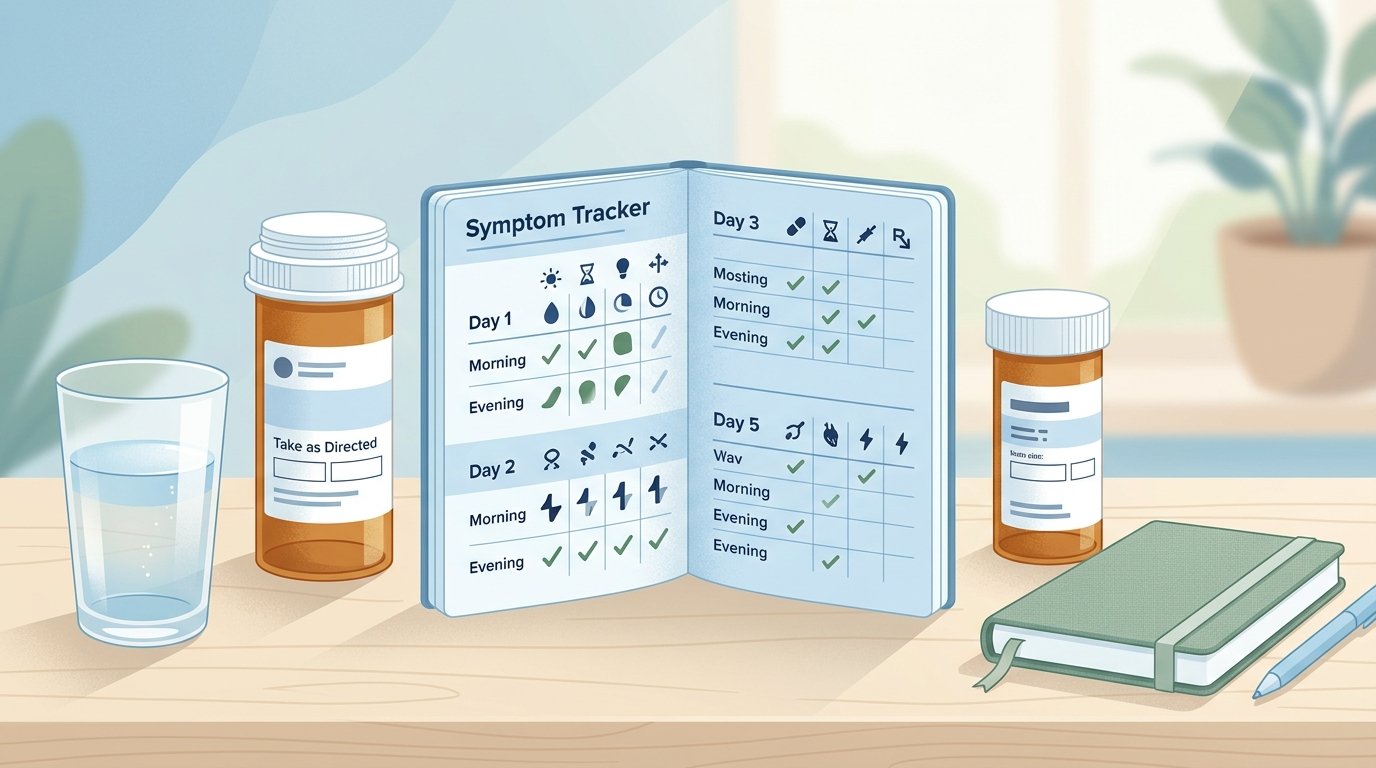
Rabeprazole and Voquezna can both coincide with bloating, gas, abdominal pain, constipation, or diarrhea, but they suppress acid through different mechanisms. Do not switch, combine, stop, or change either prescription on your own. Record the timing, food pattern, bowel changes, and dose, then ask the prescriber whether the medication, the underlying condition, or another factor fits the pattern.
How did we evaluate rabeprazole, Voquezna, and digestive support options?
We evaluated rabeprazole, Voquezna, alginate products, DGL licorice, and probiotic routines by mechanism, current labeling, adverse-event data, evidence quality, medication interaction risk, and ability to clarify rather than confuse a symptom pattern. FDA prescribing information and the American College of Gastroenterology guideline received more weight than reviews, social posts, brand claims, animal research, or “low stomach acid” theories. The ACG GERD guideline treats proton-pump inhibitors as medical therapy and recommends careful evaluation when symptoms persist despite treatment. We excluded dosing changes, taper schedules, medication substitutions, acid-adding products, and claims that a supplement treats reflux disease. This comparison has a key limitation: bloating and gas can reflect medication effects, constipation, swallowed air, dietary fermentation, functional dyspepsia, irritable bowel patterns, infection, or the condition being treated. A temporal association identifies a question; it does not prove that either drug caused the symptom.
Why can rabeprazole and Voquezna both coincide with bloating or gas?
Rabeprazole and Voquezna both reduce gastric acidity, but rabeprazole is a proton-pump inhibitor and vonoprazan, the active drug in Voquezna, is a potassium-competitive acid blocker. Similar digestive complaints can appear even when mechanisms differ. The current FDA rabeprazole label reports flatulence in 3% of rabeprazole-treated adults versus 1% with placebo in selected acute trials, while constipation appeared in 2% versus 1%. The 2025 FDA Voquezna label lists abdominal distension among common reactions during erosive-esophagitis healing and lists abdominal pain, constipation, diarrhea, and nausea for non-erosive GERD. Those percentages come from different trial programs and cannot be compared as a head-to-head risk ranking. Acid suppression may also overlap with meal changes, slower bowel transit, carbonated drinks, added fiber, anxiety, or baseline functional symptoms.
What should you track before deciding that the medication is the cause?
Track the prescription name, dose, dosing time, indication, start date, symptom onset, meal timing, bowel frequency, Bristol Stool Form Scale type, carbonation, fiber changes, and every new medication or supplement. A symptom that begins within days of one change and improves after a clinician-directed adjustment is more informative than a vague memory that digestion “got worse.” Record abdominal size or pressure at the same time each day rather than comparing a morning baseline with an evening meal response. Separate gas, visible distension, upper-abdominal fullness, constipation, diarrhea, and heartburn because one word—bloating—can hide several patterns. Do not run an unsupervised stop-and-restart test with rabeprazole or Voquezna. Acid-suppression changes can alter symptoms, and the prescription may be treating erosive disease or another defined indication. Bring a seven-day log, the prescription bottle, and the exact supplement labels to the prescriber or pharmacist before changing the plan.
How do the main options compare when bloating appears?
The fairest comparison separates prescription acid suppression from mechanical barrier products, stomach-comfort supplements, and microbiome routines. Rabeprazole and Voquezna belong to the medication lane; the prescriber determines the diagnosis, dose, duration, and switching logic. Gaviscon Advance belongs to an alginate lane that forms a post-meal raft, although formulations vary by country and package. Yuve DGL Licorice Chewables belong to a structure/function comfort lane, not an acid-suppression lane. Culturelle Digestive Daily belongs to a probiotic lane associated with Lacticaseibacillus rhamnosus GG, not reflux treatment. A 2022 randomized phase 2 trial found no statistically significant efficacy or safety difference among vonoprazan and esomeprazole groups in a selected PPI-partial-response population, illustrating why stronger acid suppression does not answer every symptom question (PubMed). None of these options should be stacked casually when the goal is identifying a new adverse pattern.
| Option | Category | Best for | Key label check | Main limitation |
|---|---|---|---|---|
| Rabeprazole | Proton-pump inhibitor | Prescriber-defined acid-related indication | Dose, timing, duration, interactions | Flatulence and constipation appear in FDA trial data |
| Voquezna | Potassium-competitive acid blocker | FDA-labeled GERD or H. pylori indication | Indication-specific dose and duration | Abdominal distension or bowel changes can occur |
| Gaviscon Advance | Alginate product | Post-meal mechanical barrier comparison | Country-specific sodium alginate formula | Not a prescription substitute |
| Yuve DGL Chewables | DGL comfort supplement | Chewable everyday stomach-comfort routine | 400 mg DGL plus 100 mg glycine per serving | Not proven to treat GERD or medication effects |
| Culturelle Digestive Daily | LGG probiotic | Strain-identified digestive routine | Current strain, CFU, storage, other ingredients | Can add gas and is not reflux therapy |
Which option is best for each use case?
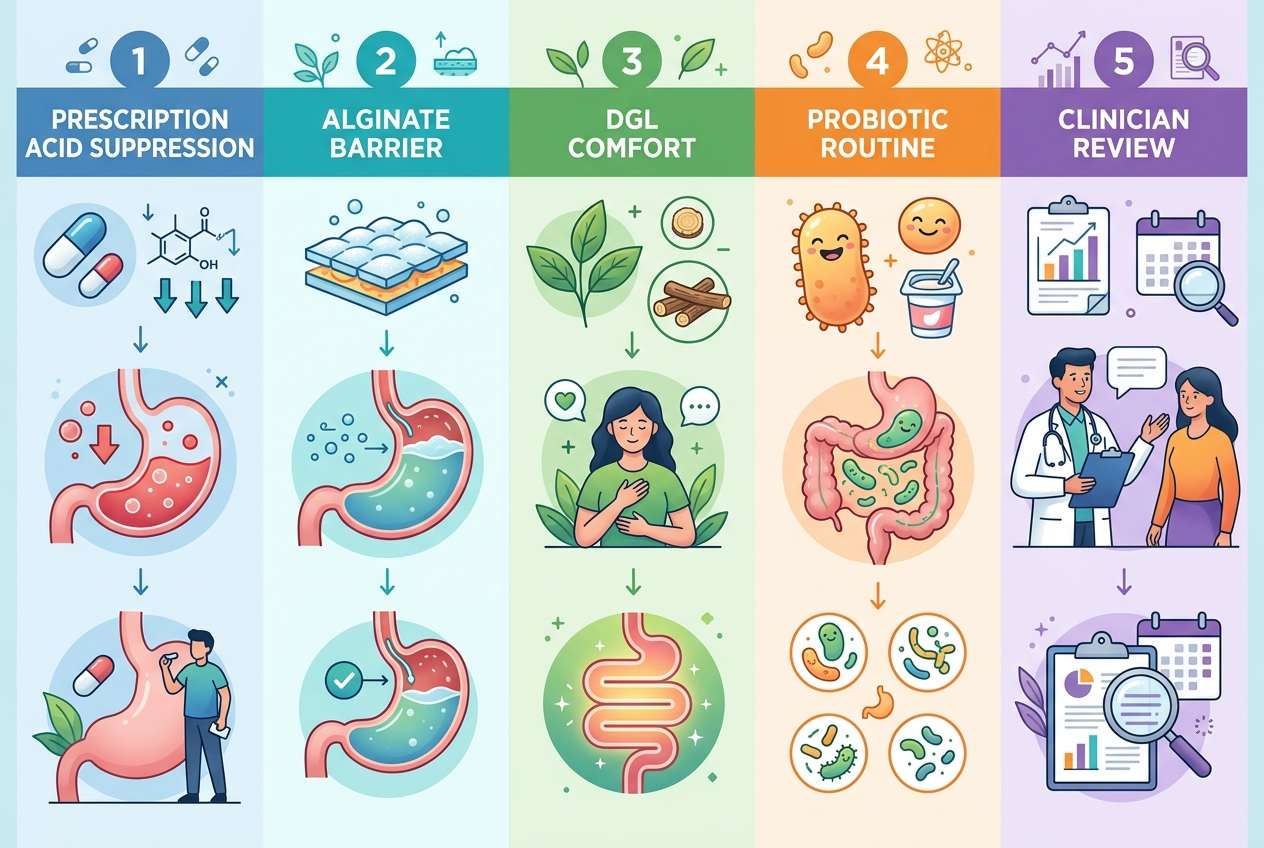
Best for deciding whether rabeprazole or Voquezna still fits: the prescribing clinician, supported by a seven-day symptom, meal, and bowel log. Best for suspected medication-related gas: a pharmacist review of timing, interactions, excipients, constipation, and every simultaneous change. Best for post-meal reflux mechanics while the prescription remains stable: a clinician-approved alginate product whose country-specific label identifies sodium alginate and serving directions. Best for a chewable stomach-comfort routine: a DGL product with glycyrrhizin removed and transparent milligrams, while recognizing that comfort support is not acid control. Best for a probiotic experiment: a strain-identified product introduced only after the baseline stabilizes, because early gas can obscure the original pattern. Best for severe distension, persistent vomiting, black stool, bleeding, progressive swallowing trouble, unintentional weight loss, chest pain, fever, or inability to pass stool or gas: prompt medical assessment. The strongest choice is the one that answers the correct lane without masking warning signs.
Which products meet the comparison criteria?
Some links below are affiliate links. This does not influence our evaluation criteria or recommendations. Rabeprazole and Voquezna meet prescription-label criteria when the current FDA indication, dose, duration, interaction list, and prescriber’s instructions match the patient. Gaviscon Advance meets an alginate comparison criterion only when the package discloses the actual country-specific formula; U.S. and international versions can differ. Culturelle Digestive Daily meets a strain-traceability criterion when the selected package identifies LGG, but it should not be presented as a reflux medication. Yuve DGL Licorice Chewables provide 400 mg of DGL extract and 100 mg of glycine per two-chewable serving. Glycyrrhizin removal supports a different safety profile from whole licorice, but Yuve still belongs in the everyday stomach-comfort lane rather than the GERD-treatment lane. The Yuve digestion collection contains adjacent formats; adding several at once would make the bloating pattern harder to interpret.
What mistakes make medication-related bloating harder to evaluate?
The first mistake is changing rabeprazole, Voquezna, fiber, probiotics, meal timing, and caffeine during the same week. The second mistake is treating “gas,” “bloating,” “fullness,” and “constipation” as identical outcomes. The third mistake is assuming that a side effect listed in prescribing information proves causation in one person. The fourth mistake is using stronger acid suppression as the automatic answer when heartburn persists; reflux hypersensitivity, functional heartburn, dyspepsia, and non-reflux causes can produce overlapping symptoms. The fifth mistake is adding betaine hydrochloride, apple-cider vinegar, or other acidifying products without medical review while taking prescribed acid suppression. The sixth mistake is ignoring the indication: a prescription used to heal erosive esophagitis carries different consequences from a short trial for non-erosive symptoms. Clean evaluation holds the prescription stable unless the prescriber changes it, records one outcome at a time, and tests no more than one approved support category against a defined baseline.
What questions should you ask about rabeprazole, Voquezna, and gas?
These questions turn an uncomfortable but vague pattern into a medication review that a clinician or pharmacist can use. Start with the actual indication, because erosive esophagitis, non-erosive GERD, ulcer care, and H. pylori regimens use different drugs, doses, and durations. Then document whether bloating means upper fullness, visible distension, belching, flatulence, constipation, diarrhea, or pain. Compare the symptom date with each medication, supplement, food, and bowel change. The FDA labels provide population-level adverse-event information; they do not diagnose an individual reaction. A supplement label provides ingredients and serving directions; it does not authorize a prescription change. A concise record also helps the pharmacist screen duplicate acid suppressors, new laxatives, fiber products, and interaction risks. Use the answers below to identify which details belong in the message to the prescriber and which warning signs should accelerate care.
Is Voquezna the same as rabeprazole?
No. Voquezna contains vonoprazan, a potassium-competitive acid blocker, while rabeprazole is a proton-pump inhibitor. Both suppress gastric acid, but their mechanisms, labels, doses, and interaction profiles differ.
Can rabeprazole cause flatulence?
Flatulence appeared in 3% of rabeprazole-treated adults versus 1% with placebo in selected trials summarized by the FDA label. That result makes a medication contribution plausible, not certain in one person.
Can Voquezna cause abdominal distension?
The FDA label lists abdominal distension among common reactions in the erosive-esophagitis healing trial and lists several bowel-related reactions for non-erosive GERD. The relevant rate depends on the indication and trial population.
Should I switch from one drug to the other?
Only the prescriber should direct a switch. The indication, dose, duration, kidney and liver context, interacting medicines, symptom pattern, and prior response all affect that decision.
Can a probiotic fix gas caused by acid suppression?
No product can be assumed to fix medication-related gas. Probiotics are strain-specific and can cause temporary gas themselves, so introducing one during an unclear reaction may add noise.
Can I take DGL with rabeprazole or Voquezna?
Ask the prescriber or pharmacist to review the exact DGL label and medication list. DGL is a comfort supplement, not a substitute for either prescription or a proven solution for their adverse effects.
For a closer look at clean-label options, see Can Not Ejaculating Cause Bloating or Constipation?.
What is the bottom line when both medications feel bloating-related?
Rabeprazole and Voquezna can both appear in a bloating timeline, and their FDA labels support digestive adverse effects as plausible. The next step is not a self-directed switch or a supplement stack. Keep the prescription unchanged unless the prescriber instructs otherwise, define the symptom precisely, record seven days of meals and bowel patterns, and list every concurrent change. Rabeprazole, Voquezna, Gaviscon Advance, Yuve DGL Chewables, and Culturelle solve different problems and should not be ranked as interchangeable treatments. A clinician handles the acid-suppression decision. An alginate addresses post-meal mechanics. DGL supports everyday stomach comfort. A probiotic supports a separate digestive routine and may add gas during introduction. If a clinician approves a Yuve option, review the DGL chewable label and change one variable only. Seek prompt care for bleeding, progressive swallowing difficulty, chest pain, severe distension, persistent vomiting, weight loss, fever, or obstruction symptoms.
Leave a Reply