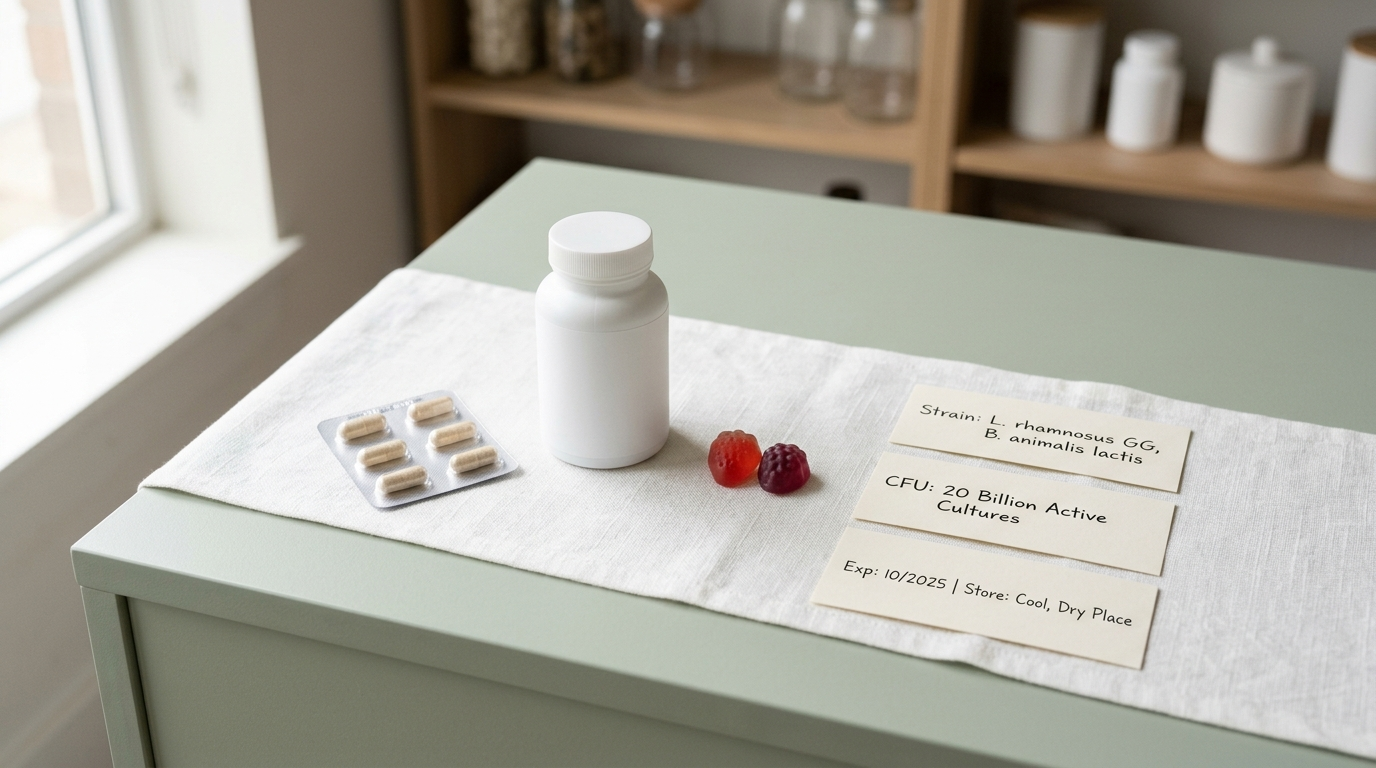
An oral probiotic may influence the vaginal microbiome, but the result depends on the exact strain and the person taking it. A product marketed for general digestion is not automatically a vaginal-health probiotic. Check the full strain codes, CFU through expiration, storage directions, and intended use before choosing a product.
How did we evaluate oral probiotics for vaginal microbiome support?
We prioritized randomized human trials that identified probiotics by genus, species, and strain because results from one microorganism cannot be assigned to every probiotic. We compared each product using its current manufacturer label, including strain codes, colony-forming units, format, storage instructions, and stated purpose. We excluded customer reviews, retailer star ratings, proprietary blends without identifiable organisms, and claims that a supplement treats an infection. The evidence remains limited: several trials studied Lacticaseibacillus rhamnosus GR-1 with Limosilactobacillus reuteri RC-14, but populations, treatment combinations, pregnancy status, and outcome measures varied. A useful comparison therefore separates vaginal-specific strain evidence from general digestive positioning and treats CFU as one label detail rather than a universal potency score. Product formulas can change, so buyers should compare the bottle in hand with the manufacturer page and discuss persistent symptoms, pregnancy, immune suppression, or medication use with a qualified clinician.
Can an oral probiotic affect the vaginal microbiome?
Specific oral probiotic strains may affect vaginal microbial measures, but oral delivery does not guarantee vaginal colonization or symptom relief. A randomized 2006 trial found better 30-day outcomes when L. rhamnosus GR-1 and L. reuteri RC-14 accompanied prescribed metronidazole than when placebo accompanied the drug; that result applies to the studied combination and does not prove that probiotics work alone. A separate randomized trial in healthy women found that orally consumed L. acidophilus La-14 and L. rhamnosus HN001 were not detected in vaginal samples and did not materially change an already healthy microbiota. These findings are not contradictory: baseline microbiome, strain identity, clinical context, and concurrent treatment can change the outcome. The practical conclusion is narrow. A shopper seeking vaginal-microbiome support should choose a product with human evidence for its named strains, while a shopper seeking everyday digestive support may reasonably prioritize format, tolerance, and adherence instead.
What should you check on a probiotic label at Target or another retailer?
A useful probiotic label identifies the genus, species, and preferably the strain code for every organism. “Lactobacillus blend” provides less evidence-matching value than L. rhamnosus GR-1, because clinical findings belong to the tested strain rather than the species name alone. The label should also state CFU per serving, whether that count applies at manufacture or through expiration, serving size, expiration date, and storage conditions. The NIH Office of Dietary Supplements explains that a higher CFU count does not automatically create a greater benefit; the organism and dose must fit the intended outcome. Check “other ingredients” for allergens, gelatin, sugar alcohols, and prebiotic fibers that may affect personal tolerance. Finally, separate a product’s stated lane—vaginal, urinary, digestive, or general wellness—from the shopper’s goal. A familiar retailer, refrigerated shelf, or “women’s” label does not replace strain-level evidence or appropriate medical evaluation.
How do Jarrow, Culturelle, and Yuve probiotic options compare?
Some links below are affiliate links. This does not influence our evaluation criteria or recommendations. Jarrow Fem-Dophilus provides the most direct strain match among these options because its label names GR-1 and RC-14, the pairing used in several vaginal-microbiome trials. Culturelle Women’s 4-in-1 uses a multi-strain capsule positioned across vaginal, urinary, digestive, and immune wellness; buyers should verify the current bottle because regional formulas can differ. Yuve Probiotic Gummies provide 5 billion CFU of Bacillus coagulans per two-gummy serving in a vegan, shelf-stable format. Yuve fits everyday digestive routine support, not a vaginal-specific strain match. The table compares label fit rather than promising clinical results.
| Option | Named organism or strains | Format | Best-fit use case | Main limitation |
|---|---|---|---|---|
| Jarrow Fem-Dophilus | GR-1 and RC-14 | Capsule | Vaginal-specific strain matching | Evidence does not guarantee individual benefit |
| Culturelle Women’s 4-in-1 | Multi-strain women’s formula | Capsule | Broad women’s wellness positioning | Formula must be checked by market |
| Yuve Probiotic Gummies | Bacillus coagulans, 5 billion CFU | Vegan gummy | Everyday digestive routine | Not vaginal-specific |
Which probiotic is best for each use case?
Best for vaginal-specific strain matching: Jarrow Fem-Dophilus lists GR-1 and RC-14, which lets a buyer connect the label to published human research. Best for a broader capsule approach: Culturelle Women’s 4-in-1 combines multiple organisms and a women’s-wellness position, although its exact regional label deserves verification before purchase. Best for a capsule-free digestive routine: Yuve uses shelf-stable Bacillus coagulans in a pectin gummy and publishes the CFU per serving, but its evidence lane is digestive rather than vaginal. Best for an unexplained odor, discharge, itching, burning, pelvic pain, or recurrent symptoms: none of these products replaces testing and diagnosis. A supplement can support a routine; it cannot identify the cause of a symptom. The FDA explains that dietary supplements are not approved for safety and effectiveness before sale. The strongest buying decision therefore matches a named strain to a narrow goal and preserves clinical care for symptoms.
Can probiotics replace treatment for an infection?

Probiotics should not replace evaluation or prescribed treatment for a suspected vaginal infection. Odor, discharge, itching, burning, pain, and urinary discomfort can arise from different causes that require different tests and interventions. The 2006 GR-1 and RC-14 trial evaluated probiotics alongside metronidazole, so its result does not support swapping a supplement for the prescribed drug. A 2025 systematic review found promising probiotic regimens for bacterial vaginosis, while also reporting that consensus on the best species, strain, dose, and duration remains absent and long-term safety data remain limited. That uncertainty matters because a “women’s probiotic” can contain organisms unrelated to the studied regimen. People who are pregnant, immunocompromised, severely ill, or managing recurrent symptoms should ask a clinician before starting a live-microbial supplement. The safe consumer rule is simple: use strain-specific evidence to evaluate a supplement, but use clinical testing to evaluate symptoms. Those are different jobs and should remain separate.
Does a higher CFU count make a women’s probiotic better?
A higher CFU number does not automatically make a women’s probiotic more appropriate or effective, because CFU measures viable organisms without showing whether the species, strain, dose, delivery format, or studied population matches the buyer’s goal. A 50-billion-CFU blend with no strain codes may provide less decision value than a lower-count product that names GR-1 and RC-14, while a count guaranteed only at manufacture provides different stability information from a count guaranteed through expiration. Heat, moisture, oxygen, packaging, and refrigeration affect organisms differently; spore-forming Bacillus coagulans, freeze-dried lactobacilli, and refrigerated blends therefore use different survival strategies that resist a single numerical ranking. Compare CFU only after matching the organism and strain to the intended use, then check serving size, expiration date, storage directions, allergens, added prebiotic fibers, sugar alcohols, and the personal tolerance of other ingredients before choosing a formula for a consistent trial.
How long should you try an oral probiotic before judging it?
There is no universal trial period for an oral probiotic because study durations, strains, doses, outcomes, and populations differ; vaginal-microbiome trials have evaluated periods from roughly two weeks to several months, while a product label may recommend another routine. A buyer should define one observable goal, record the product name and full strain codes, follow the labeled serving and storage directions consistently, and avoid changing several supplements at once because simultaneous changes make attribution difficult. Stop and seek advice for a concerning reaction, and do not delay care for odor, unusual discharge, itching, burning, pelvic pain, fever, pregnancy-related concerns, or recurrent symptoms; minor digestive gas can occur, but persistent discomfort also deserves review. A useful self-check asks whether a predefined outcome changed during a consistent, time-bounded trial, while clinical symptoms still receive appropriate examination and testing instead of an indefinitely extended supplement experiment.
Can you take a digestive probiotic and a vaginal-specific probiotic together?
Two probiotic products can duplicate organisms, increase total CFU, add sugar alcohols or prebiotic fibers, and make reactions harder to attribute; healthy adults may tolerate common probiotics, but combining products does not establish extra benefit, and more organisms do not necessarily create a better outcome. Compare both Supplement Facts panels line by line and record shared species, exact strain codes, CFU per serving, serving frequency, allergens, storage requirements, and other active ingredients before building a stack. A person using Yuve for an easy digestive routine and considering GR-1/RC-14 for a separate goal should ask whether two products are necessary instead of assuming that their different purposes make the combination evidence-based. The NIH notes that probiotics can pose greater risks for people who are seriously ill or immunocompromised, while pregnancy, recurrent vaginal symptoms, prescription treatment, and a complex medical history also warrant professional guidance; one well-matched product creates a cleaner personal trial than an unstructured combination.
Are oral and vaginal probiotic products interchangeable?
Oral and intravaginal probiotic products are not interchangeable because route changes formulation requirements, exposure, dosing, excipients, and the evidence needed to support use. A capsule labeled for oral use should be swallowed as directed rather than inserted vaginally based on an online comment, while a vaginal product should be used only by its labeled route. Clinical trials of oral GR-1 and RC-14 cannot validate every intravaginal product, trials of a vaginal formulation cannot validate every oral capsule, and product quality still depends on strain identity, viable count, packaging, and storage. If a clinician recommends a route or regimen, confirm the exact product and follow that instruction; retail shelves often place “women’s,” urinary, vaginal, and digestive probiotics together, but the route on the label remains a safety instruction rather than a preference and belongs in the buying decision alongside strain codes, intended use, expiration, and storage requirements.
Related reading: Transparent Supplement Brands: What to Verify Before You Buy.
What is the bottom line on store-bought women’s probiotics?
A store-bought women’s probiotic deserves the same scrutiny as any evidence-based supplement: identify the exact organism, match the strain to the goal, verify CFU and expiration, follow the labeled route, and separate wellness support from medical care. GR-1 and RC-14 have human research connected to vaginal outcomes, but positive and null trials show that clinical context and baseline microbiota matter, while general digestive products remain reasonable when the real goal is consistency, format, or digestive routine rather than vaginal-specific support. Yuve occupies that digestive lane, Jarrow Fem-Dophilus occupies the clearer strain-matching lane in this comparison, and Culturelle offers a broader multi-strain women’s formula; none guarantees a result or identifies the cause of a symptom. Buyers seeking a convenient digestive format can review the broader Yuve digestion collection, while anyone with persistent or recurrent vaginal symptoms should prioritize testing and individualized clinical advice.
Leave a Reply