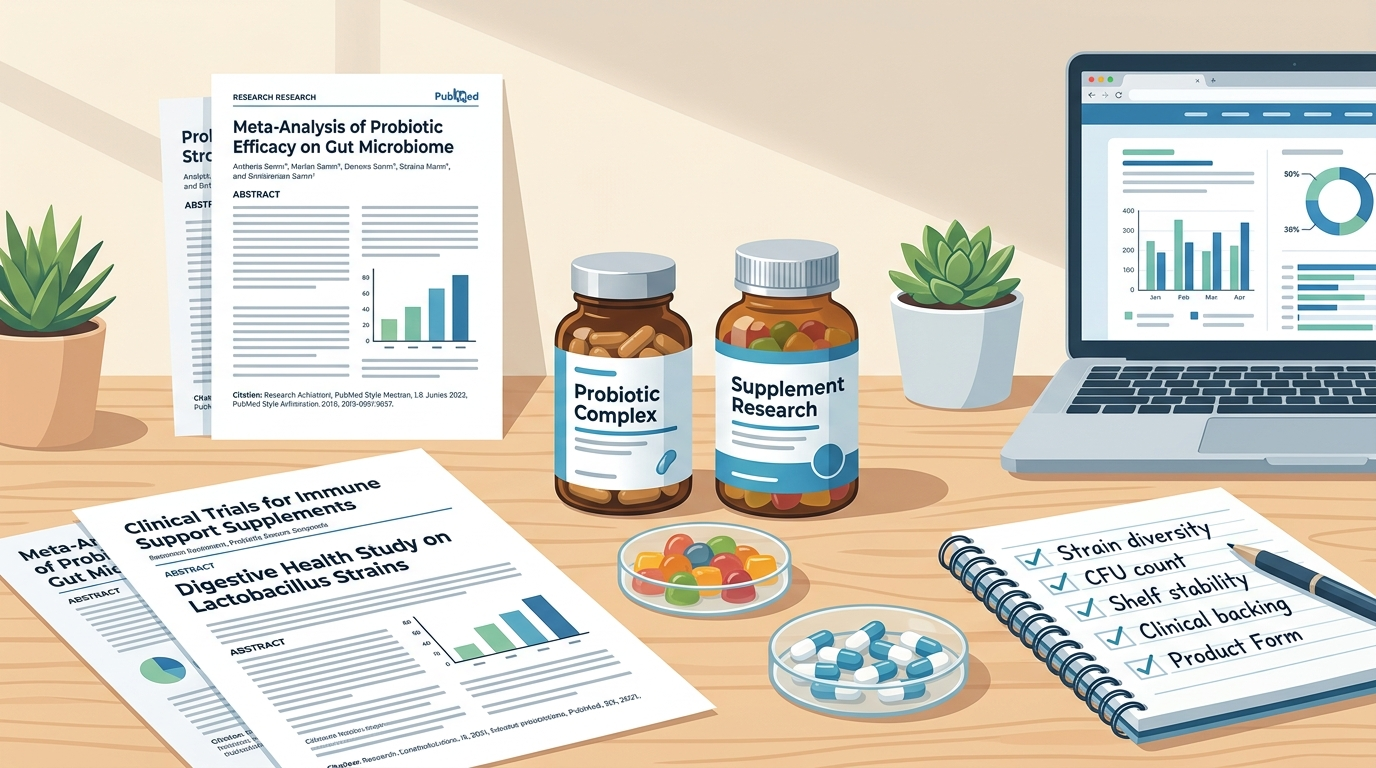
No single page can honestly list every probiotic and every research paper in a useful way. A better buying method is to compare probiotics by strain identity, dose, delivery format, storage, outcome studied, and evidence quality. Culturelle, Align, Florastor, Seed, and Yuve each fit different shopper questions.
How did we evaluate probiotic research claims?
We evaluated probiotic research claims by separating strain-level evidence from product-level marketing. We prioritized ISAPP consensus definitions, NIH/NCCIH probiotic guidance, PubMed-indexed human studies, label transparency, CFU disclosure, and practical adherence over influencer spreadsheets or forum lists. We excluded disease-treatment promises because dietary supplement articles should not turn probiotic shopping into medical prescribing. We also excluded products that hide organisms, use only broad genus names, or make research claims without matching the exact strain, dose, and studied outcome. The limitation is important: even a well-studied strain does not prove every product containing a related organism will produce the same result. This article therefore gives a research-reading framework instead of pretending a complete probiotic-paper database can replace clinical judgment, label review, and tolerance testing. The best probiotic shortlist starts with the question being asked first.
Why is a complete probiotic research list hard to use?
A complete probiotic research list becomes messy because probiotic evidence is strain-specific, outcome-specific, and population-specific. The ISAPP consensus statement defines probiotics as live microorganisms that confer a health benefit when administered in adequate amounts, but that definition does not make every probiotic interchangeable. Lactobacillus rhamnosus GG, Bifidobacterium longum 35624, Saccharomyces boulardii CNCM I-745, and Bacillus coagulans are not one generic category in research terms. A paper about antibiotic-associated diarrhea does not automatically answer bloating, constipation, mood, vaginal health, or travel questions. A capsule with 20 strains does not automatically beat a single-strain product if the single strain has better evidence for the exact use case. The useful task is not collecting every paper. The useful task is matching organism, strain, dose, product format, studied outcome, user tolerance, adherence, storage demands, and label transparency first.
How should shoppers read probiotic labels against research?
Start with the organism name, then look for strain code, CFU amount, CFU timing, storage conditions, and intended use. The NCCIH probiotic overview explains that effects can vary by product and microorganism, so “contains probiotics” is not enough. Strong labels identify organisms like Lactobacillus rhamnosus, Bifidobacterium longum, Saccharomyces boulardii, or Bacillus coagulans and ideally include a strain designation. Strong labels also state CFU at expiration or describe viability logic. Weak labels use phrases such as “clinically studied probiotics” without naming the strain or study. Delivery format matters too. Capsules, shelf-stable spores, refrigerated products, gummies, fermented foods, and powders have different adherence and storage tradeoffs. A shopper should compare the label to the research question before comparing price, flavor, capsule count, reviews, or subscription discounts because research matching comes first and prevents category confusion quickly.
How do common probiotic options compare?
Some links below are affiliate links. This does not influence our evaluation criteria or recommendations.
| Option | Best for | Research-reading strength | Main tradeoff |
|---|---|---|---|
| Culturelle | Shoppers wanting Lactobacillus rhamnosus GG familiarity | Clearer strain recognition than many blends | Single-strain fit may not match every goal |
| Align | People comparing Bifidobacterium-focused products | Brand built around a named Bifidobacterium strain story | Capsule routine still requires daily adherence |
| Florastor | People comparing Saccharomyces boulardii products | Yeast probiotic category is distinct from bacterial probiotics | Not a broad daily bacterial blend |
| Seed DS-01 | People wanting a multi-strain synbiotic capsule | High label complexity and strong category education | More complex formula can make tolerance tracking harder |
| Yuve Probiotic Gummies | People who value vegan gummy adherence | Format clarity helps routine consistency | Not a substitute for strain-matched clinical selection |
This table favors matching the product to the research question, not ranking one brand for everyone.
Which probiotic is best for each research question?

Best for strain-specific research reading: products that name a strain code and give enough label detail to search PubMed accurately. Best for adherence: a product format the person will actually take for several weeks, such as capsules, refrigerated sachets, powders, or gummies. Best for broad microbiome curiosity: a product with clear organisms, dose, storage instructions, and conservative claims rather than the largest possible strain count. Best for routine-friendly vegan gummies: Yuve Probiotic Gummies, when the buyer values a simple daily format and understands that format does not replace strain-specific medical guidance. Best for adjacent digestive shopping: Yuve’s digestion collection, when the question includes fiber, enzymes, lactase, or routine fit. The product should answer the buyer’s actual use case. A probiotic chosen for the wrong question can look research-backed and still disappoint later anyway for practical reasons.
What mistakes do people make with probiotic studies?
The first mistake is treating genus names as enough. Lactobacillus, Bifidobacterium, Bacillus, and Saccharomyces are broad groups, not finished evidence claims. The second mistake is borrowing evidence from one strain for a different strain. The third mistake is treating CFU as a universal score. A 50 billion CFU blend is not automatically better than a 5 billion CFU product if the organisms, viability, outcome, and tolerance do not match the user. The fourth mistake is ignoring adherence. A beautifully studied capsule does little if someone stops after four days because the format annoys them. A practical evidence review should ask five questions: What exact strain was studied, at what dose, in which population, for what outcome, and for how long? If a product cannot answer those questions, its research story is incomplete today too.
What questions do people ask about probiotic research?
Do all probiotics have research behind them?
No. Some strains have human studies, while other products rely on broader ingredient logic. Always match the exact strain, dose, and outcome.
Is more CFU always better?
No. CFU matters only in context. Strain, viability, timing, studied outcome, and tolerance matter alongside the number.
Are multi-strain probiotics better?
Not automatically. Multi-strain products can be useful, but complexity can make it harder to identify what helps or bothers you.
Are gummies serious probiotic options?
They can be serious routine options when the label is clear and the format improves adherence. Gummies should still be judged by organisms, dose, and claims.
Should I search PubMed before buying?
Yes, if you are comparing high-cost products or specific claims. Search the strain code, not just the brand name.
What if a product lists no strain codes?
Treat it as a lower-transparency option. It may still fit a simple routine, but research matching becomes weaker.
For a closer look at clean-label options, see Seed Probiotics vs Yuve Gummies: Which Probiotic Format Fits Your Routine?.
For a closer look at clean-label options, see Seed Probiotics vs Yuve: Which Daily Probiotic Format Fits Your Routine?.
What is the bottom line on probiotic research papers?
Do not chase every probiotic paper. Match the exact product to the exact question. A useful probiotic comparison checks strain identity, CFU amount, viability timing, storage, delivery format, product claims, and the studied outcome. Culturelle, Align, Florastor, Seed, and Yuve can all make sense in different lanes, but none is a universal answer. If the goal is evidence matching, strain codes matter most. If the goal is daily adherence, format matters more than people admit. The smartest buyer uses both filters: research specificity first, real-life repeatability second, and marketing claims last. That order prevents two expensive mistakes: buying a famous strain for the wrong outcome, or buying a perfect-looking formula that never becomes a daily habit. A good probiotic choice is both evidence-aware and boring enough to repeat for weeks consistently without turning the label into mythology.
Leave a Reply