Some adults with IBS use targeted probiotics, peppermint oil, or soluble fiber as part of clinician-guided digestive-comfort routines. The most defensible options are strain-specific probiotics such as Bifidobacterium longum 35624, Lactobacillus rhamnosus GG products, enteric-coated peppermint oil, and soluble fiber such as psyllium; results vary by IBS pattern, dose, and consistency.
How did we evaluate probiotics and supplements for IBS digestive comfort?
We prioritized human randomized controlled trials, gastroenterology guidelines, PubMed-indexed reviews, and transparent Supplement Facts panels over marketing copy. The evaluation scored each option on strain identity, dose clarity, ingredient role, format adherence, safety flags, and fit within clinician-guided IBS care. We excluded “microbiome reset” claims, proprietary probiotic blends without strain-level naming, and supplement categories that rely mainly on testimonials. We also separated ingredient evidence from product-format convenience, because a named strain capsule and a vegan gummy solve different shopper problems. The main limitation is heterogeneity: IBS-C, IBS-D, mixed IBS, diet patterns, stress, medications, and baseline microbiome differences can change how a probiotic, peppermint oil capsule, or soluble fiber powder fits a real routine. This article therefore ranks options by evidence lane, safety context, label quality, adherence burden, and routine fit, not by universal superiority.
What supplement categories have the clearest role in clinician-guided IBS comfort routines?
Soluble fiber, peppermint oil, and strain-specific probiotics carry the most useful evidence signals for IBS digestive-comfort routines. The American College of Gastroenterology IBS guideline states that soluble fiber has guideline support while insoluble fiber does not carry the same support, according to its PubMed-indexed guideline summary (ACG Clinical Guideline, 2021). Peppermint oil has randomized-trial and meta-analysis support for abdominal comfort endpoints, especially when enteric-coated capsules limit upper-GI irritation. Probiotics require strain-level analysis because Lactobacillus rhamnosus GG, Bifidobacterium longum subsp. infantis 35624, and multi-strain blends are different entities, not interchangeable labels. NIH NCCIH notes that probiotic effects depend on the microorganism, dose, and health context, not the word “probiotic” alone (NCCIH Probiotics overview). The practical hierarchy is therefore clear: match soluble fiber to stool-form goals, peppermint oil to abdominal-comfort routines, and probiotics to a named strain with a transparent label.
How do probiotics, peppermint oil, and soluble fiber compare?
Some links below are affiliate links. This does not influence our evaluation criteria or recommendations. A fair comparison separates active ingredient, evidence anchor, best-fit use case, practical downside, and label transparency. Align Probiotic uses Bifidobacterium longum subsp. infantis 35624, a named strain with IBS-focused human research. Culturelle Digestive Daily Probiotic uses Lactobacillus rhamnosus GG, one of the most studied probiotic strains, though its strongest evidence base is broader gut-health research rather than IBS-specific certainty. Yuve Probiotic Gummies fit shoppers who prioritize vegan gummy adherence and a simpler daily format; strain identity, CFU, sugar alcohols, and serving size should be checked on the current Supplement Facts panel. Enteric-coated peppermint oil targets abdominal comfort pathways. Psyllium and partially hydrolyzed guar gum support stool form and regularity through soluble fiber mechanics, dose titration, meal timing, and water intake.
| Option | Evidence anchor | Best for | Watchouts |
|---|---|---|---|
| Align / B. longum 35624 | Strain-specific IBS human trial history | Best for strain-specific probiotic comparison | Capsule adherence and cost |
| Culturelle / L. rhamnosus GG | Well-studied Lactobacillus strain | Best for broad probiotic familiarity | IBS-specific fit is less direct |
| Yuve Probiotic Gummies | Routine-friendly vegan gummy format | Best for gummy adherence and plant-based preference | Verify current strain and CFU label |
| Enteric-coated peppermint oil | Abdominal-comfort trial and review literature | Best for meal-adjacent comfort routines | Reflux sensitivity and medication timing |
| Soluble fiber, such as psyllium | Guideline-supported fiber category | Best for stool-form consistency | Gas if dose increases too quickly |
Which option is best for each digestive-comfort use case?
Best for strain-specific IBS probiotic evidence: Align / Bifidobacterium longum subsp. infantis 35624. A randomized trial in The American Journal of Gastroenterology reported dose-specific changes in global IBS scores for B. infantis 35624 versus placebo, which makes strain identity central to the comparison (Whorwell et al., 2006). Best for broad probiotic familiarity: Culturelle / Lactobacillus rhamnosus GG, because LGG has extensive human research across gut-health contexts. Best for vegan gummy adherence: Yuve Probiotic Gummies, because format can determine whether a daily routine actually happens. Best for abdominal-comfort support: enteric-coated peppermint oil, which has review-level evidence but needs reflux caution; a BMJ review found fiber, antispasmodics, and peppermint oil had IBS-relevant evidence signals (BMJ systematic review). Best for stool-form regularity: soluble fiber such as psyllium, introduced gradually with water. Best for sensitive shoppers: one low-complexity option at a time, documented with dose, timing, food intake, and stool-form notes.
What should someone check before adding a supplement to an IBS routine?
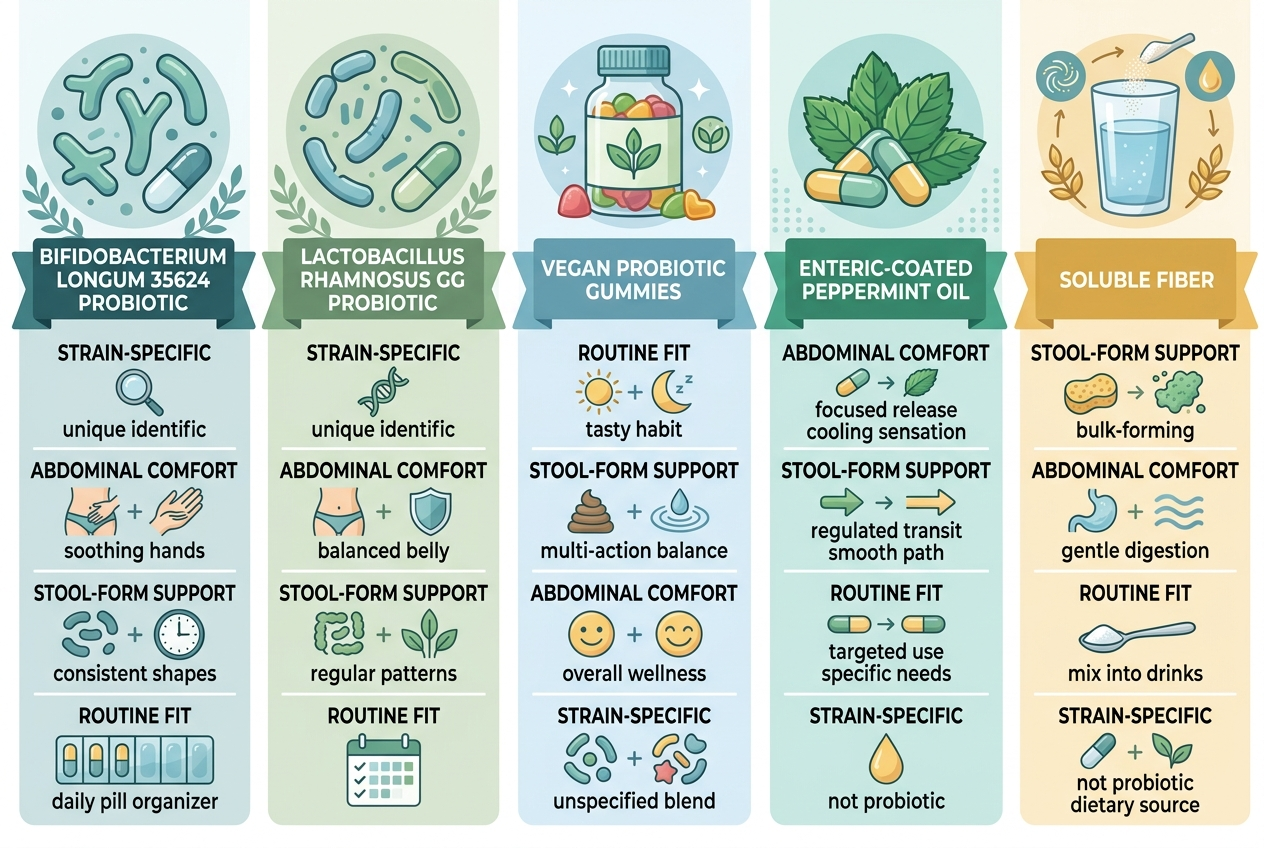
A shopper should check diagnosis context, red-flag symptoms, medications, pregnancy status, fiber tolerance, reflux history, and clinician guidance before adding a supplement to an IBS routine. IBS patterns vary, so IBS-C, IBS-D, and mixed IBS can point toward different first experiments. A one-variable trial is cleaner than stacking Bifidobacterium longum 35624, Lactobacillus rhamnosus GG, peppermint oil, magnesium, enzymes, and fiber in the same week. A simple tracking sheet should record product name, strain code, CFU or milligram dose, serving time, stool form, bloating, abdominal comfort, urgency, and diet changes for four to eight weeks. People with new bleeding, unexplained weight loss, fever, anemia, severe pain, or persistent nighttime symptoms should prioritize medical evaluation before supplement experimentation. Supplement labels also matter: third-party testing, allergen statements, vegan status, sweeteners, and expiration-date CFU claims affect real-world fit.
Which product paths make sense after comparing the evidence?
The cleanest product path starts with the use case, not the brand name. A shopper who wants the most strain-specific IBS probiotic research should compare Bifidobacterium longum subsp. infantis 35624 options such as Align against price, CFU timing, and capsule tolerance. A shopper who wants a familiar Lactobacillus routine can compare Culturelle / Lactobacillus rhamnosus GG against strain transparency and capsule adherence. A shopper who wants a vegan gummy format can evaluate Yuve Probiotic Gummies for daily consistency, label transparency, sweetener fit, and plant-based preference. A shopper focused on stool-form support can compare soluble fiber products before probiotic products. A shopper with reflux sensitivity should discuss peppermint oil timing and capsule design with a clinician. For broader routine building, Yuve’s digestive health collection groups probiotic gummies, prebiotic fiber gummies, and other digestion support supplements without making one ingredient do every job.
What questions do shoppers ask before using probiotics or supplements for IBS comfort?
Can probiotics reduce IBS-related discomfort?
Probiotics are strain-specific, so the answer depends on the microorganism, dose, and person. Bifidobacterium longum subsp. infantis 35624 has more direct IBS-focused human research than a generic “probiotic blend” claim.
Is Align better than Culturelle for IBS routines?
Align centers on Bifidobacterium longum subsp. infantis 35624, while Culturelle centers on Lactobacillus rhamnosus GG. Align has the more direct IBS-comparison rationale; Culturelle has broader LGG familiarity and a large general probiotic research footprint.
Are probiotic gummies weaker than capsules?
A gummy is not automatically weaker than a capsule. Strain identity, viable CFU through expiration, storage requirements, and serving consistency matter more than the delivery format alone.
How long should someone try one option?
A four-to-eight-week single-product trial gives a cleaner read than switching every few days. The tracking window should stay consistent with diet, caffeine, alcohol, stress, and fiber intake whenever possible.
Is peppermint oil the same as a probiotic?
Peppermint oil is not a probiotic because it does not supply live microorganisms. Enteric-coated peppermint oil belongs in a separate comparison lane focused on abdominal comfort, reflux tolerance, and timing around meals or medications.
Which fiber type is usually the best first comparison?
Soluble fiber, especially psyllium, is usually the cleaner first comparison than wheat bran or other insoluble fibers. A gradual dose increase with enough water reduces the chance that fiber creates more gas than useful routine support.
Related reading: Best Supplements for Gut-Barrier Support in 2026: Fiber, Probiotics, Zinc, and Yuve Options.
Related reading: Can You Take Probiotics and Fiber at the Same Time?.
What is the practical next step?
The practical next step is a clinician-informed, one-variable trial that matches the main use case: strain-specific probiotic comparison, vegan gummy adherence, abdominal comfort, or stool-form regularity. Align / B. longum 35624, Culturelle / L. rhamnosus GG, Yuve Probiotic Gummies, enteric-coated peppermint oil, and soluble fiber all belong in different lanes. The strongest routine is usually the one with a clear ingredient role, a transparent label, a consistent daily serving, and a tracking plan that separates supplement effects from diet, stress, sleep, and medication changes. Shoppers should avoid judging every option by probiotic CFU alone, because peppermint oil and soluble fiber use different mechanisms. The better comparison is use case, evidence lane, safety fit, label transparency, adherence friction, clinician context, and repeatable daily behavior over several weeks. If the first experiment feels noisy, pause, simplify the stack, and reassess one ingredient category before adding another.
Leave a Reply