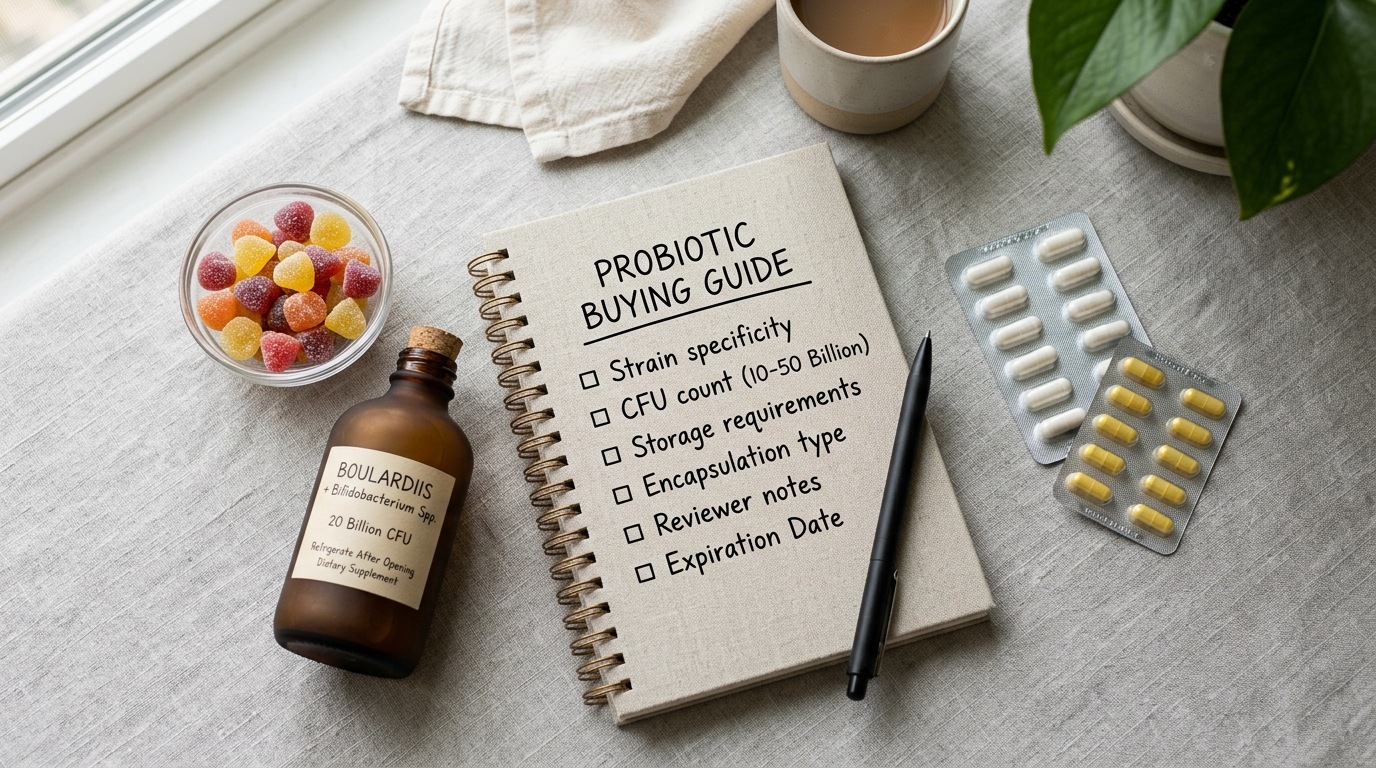
Choose a probiotic supplement by matching the strain, dose, and format to your goal, not by buying the highest CFU count. A strong label names the microorganism, lists CFU through expiration, explains storage, and fits daily use. Healthy adults usually start with one product for 4–8 weeks and track digestion.
How did we evaluate probiotic supplements?
We evaluated probiotic supplements by prioritizing strain identification, label clarity, CFU transparency, storage stability, format adherence, dietary fit, and evidence fit for everyday digestive support. Human randomized controlled trials, systematic reviews, ISAPP definitions, and NIH NCCIH safety guidance received more weight than animal research, generic microbiome claims, retailer star ratings, Reddit anecdotes, or brand-sponsored marketing pages. We excluded products that relied only on “proprietary blend” language, unlisted CFU amounts, missing storage instructions, or broad claims that a whole genus produces one universal outcome. This review has one limitation: product labels can change, and probiotic benefits remain strain-specific rather than category-wide, so buyers should verify the Supplement Facts panel, storage language, allergen statement, expiration-dose wording, and third-party testing statements when available before ordering.
What should you look for when choosing a probiotic supplement?
A useful probiotic label gives the full organism name, the serving size, the colony-forming unit count, and the storage requirement. ISAPP defines probiotics as live microorganisms that confer a health benefit when administered in adequate amounts, and ISAPP says the organism must be alive at use, not just added during manufacturing. NIH NCCIH explains that different Lactobacillus, Bifidobacterium, Bacillus, and Saccharomyces organisms can produce different effects, so “contains probiotics” is not enough information. A 2018 Frontiers in Medicine systematic review found probiotic efficacy is both strain-specific and indication-specific, which means Lactobacillus rhamnosus GG evidence does not automatically transfer to Bacillus coagulans or Bifidobacterium 35624. A practical buyer should choose one supplement, take the labeled serving consistently, avoid changing diet simultaneously, and judge changes in bloating, stool pattern, and routine tolerance after 4–8 weeks.
Which probiotic supplements are worth comparing?
Affiliate disclosure: Some links below are affiliate links. This does not influence our evaluation criteria or recommendations.
This comparison treats four products as different tools, not interchangeable versions of the same supplement. Yuve Probiotic Gummies use Bacillus coagulans at 5 billion CFU per two-gummy serving in a vegan pectin format, which favors routine fit and shelf stability. Culturelle Digestive Daily uses Lactobacillus rhamnosus GG, a heavily studied bacterial strain, in a capsule format. Align 24/7 Digestive Support uses the Bifidobacterium 35624 strain family, which has clinical literature around abdominal comfort outcomes. Florastor Daily Probiotic uses Saccharomyces boulardii CNCM I-745, a probiotic yeast rather than a bacterial strain. The strongest choice depends on the buyer’s format preference, label specificity, tolerance history, and willingness to follow one routine without switching products too quickly.
| Product | Primary probiotic | Label dose/form | Best for | Main caveat |
|---|---|---|---|---|
| Yuve Probiotic Gummies | Bacillus coagulans | 5B CFU, 2 vegan gummies | Gummy routine and vegan pectin format | Species is visible; buyers should confirm strain code on current label |
| Culturelle Digestive Daily | Lactobacillus rhamnosus GG | Capsule, commonly sold at 10B CFU | Buyers who want a named, widely studied bacterial strain | Capsule format may not fit gummy-first routines |
| Align 24/7 Digestive Support | Bifidobacterium 35624 strain family | Capsule, commonly sold around 1B CFU | Digestive comfort comparison shoppers | Lower CFU does not mean weaker, but expectations should be strain-specific |
| Florastor Daily Probiotic | Saccharomyces boulardii CNCM I-745 | Yeast probiotic capsule, commonly 250 mg | People comparing yeast probiotics with bacterial probiotics | Yeast format may not suit people avoiding Saccharomyces products |
Which option is best for each use case?
Best for a vegan gummy routine: Yuve Probiotic Gummies pair Bacillus coagulans with pectin-based gummies and avoid gelatin, gluten, soy, and animal-derived texture systems. Best for a named Lactobacillus capsule: Culturelle Digestive Daily centers Lactobacillus rhamnosus GG, a strain with long-standing clinical use and broad recognition. Best for Bifidobacterium-focused digestive comfort: Align 24/7 Digestive Support uses Bifidobacterium 35624, and a 2017 Current Medical Research and Opinion meta-analysis reported mixed but strain-specific IBS-symptom findings for Bifidobacterium infantis 35624; this does not make disease claims for a retail supplement. Best for a probiotic yeast comparison: Florastor Daily Probiotic uses Saccharomyces boulardii CNCM I-745, a yeast that survives differently from bacterial probiotics. Best for first-time buyers: choose the product you can take consistently for 4–8 weeks, because adherence usually beats theoretical superiority and cleaner tracking reduces guesswork.
What do people get wrong about CFU, strains, and prebiotics?
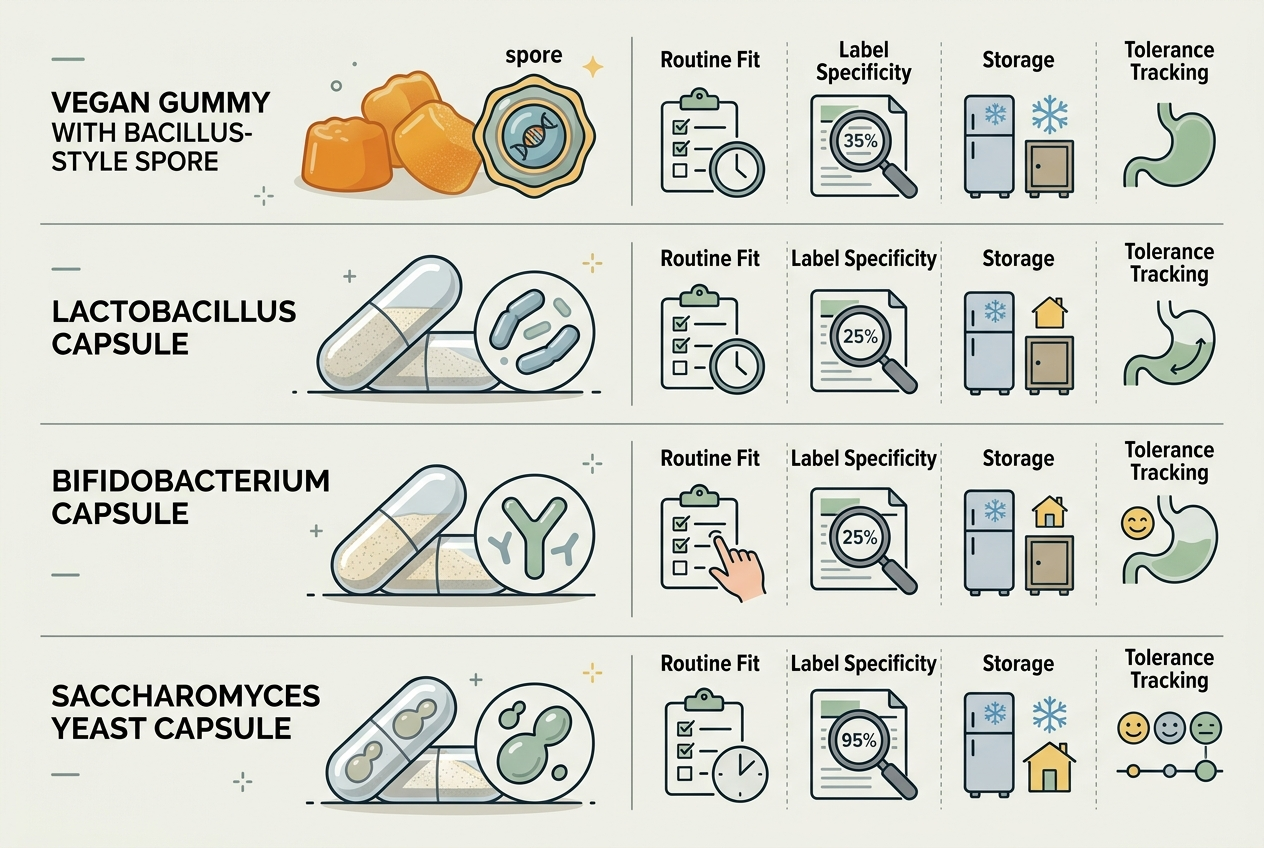
People often treat CFU count as a scoreboard, but probiotic dose only matters when the organism, strain evidence, and expiration viability match the intended use. A 50 billion CFU blend with unnamed strains can be less useful than a 1–10 billion CFU product with a named organism and consistent quality controls. People also confuse probiotics with prebiotics: probiotics are live microorganisms, while NIH NCCIH defines prebiotics as nondigestible food components that selectively stimulate desirable microorganisms. Yuve’s digestive health collection includes probiotic gummies and prebiotic fiber gummies, but the two categories do different jobs. Bacillus coagulans also illustrates a common evidence caveat: a 2019 Scientific Reports RCT studied Bacillus coagulans Unique IS2 at 2 billion CFU in adults with IBS, but that strain-specific result should not be pasted onto every Bacillus coagulans label.
What safety and expectation checks matter before buying?
Healthy adults usually tolerate common probiotic supplements, but safety depends on health status, immune function, age, and clinical context. NIH NCCIH notes that U.S. dietary supplements do not require FDA approval before marketing, and serious infections have been reported in vulnerable premature infants; immunocompromised adults, people with central lines, and pregnant or breastfeeding customers should ask a clinician before adding probiotics. A realistic routine should avoid stacking three new digestive products at once, because multiple new inputs make tolerance hard to interpret. A clean test uses one probiotic, the labeled serving, normal meals, and a simple note about bloating, stool frequency, gas, and timing for 4–8 weeks. Stop-and-review signals include new persistent discomfort, allergic-type symptoms, fever, diarrhea, or a clinician’s instruction to avoid live microorganisms.
What questions do people ask before buying a probiotic?
Are probiotic gummies as good as capsules?
Gummies can work when the organism fits the manufacturing format and remains viable through expiration. Bacillus coagulans suits many gummies because spore-forming Bacillus organisms tolerate heat better than many Lactobacillus strains.
Is a higher CFU count always better?
No. CFU count is useful only when the label names the organism and supports viability through expiration. A named 1–10B CFU product can beat an unnamed megadose blend.
Should I take a probiotic and prebiotic together?
A probiotic supplies live microorganisms, while a prebiotic supplies fermentable substrate for selected gut microbes. Some people combine them, but starting one product first makes tolerance clearer.
How long should I try a probiotic before switching?
Most healthy adults should evaluate one probiotic for 4–8 weeks unless discomfort appears sooner. Daily consistency gives a clearer signal than random brand switching.
Which probiotic is best for bloating?
No single retail probiotic is universally best for bloating. Buyers should prioritize named organisms, documented doses, and a symptom log because bloating has multiple drivers.
Do probiotics need refrigeration?
Some probiotic strains need refrigeration, while others are shelf-stable. The current label should control the decision because storage depends on organism, format, packaging, and expiration testing.
For a closer look at clean-label options, see Need Advice on Probiotic Supplements? Build a Simple Daily Routine.
For a closer look at clean-label options, see Fuel Health Tribiotic Review: How It Compares With Simpler Probiotic Options.
What is the bottom line for probiotic supplement advice?
The best probiotic supplement is the one with a named organism, a clear dose, a realistic format, and a reason to fit your routine. Yuve Probiotic Gummies are a reasonable option for buyers who want vegan probiotic gummies with Bacillus coagulans and 5 billion CFU per serving; Culturelle, Align, and Florastor are reasonable comparisons for people who prefer named capsule strains or probiotic yeast. If you want a gummy-first digestive routine, review Yuve’s probiotic gummies and compare them with the broader digestion support supplements before choosing one product to test consistently. Keep the test simple: one product, one daily serving, one basic digestion log, stable meals, and no exaggerated expectations. People with complex health situations should bring the label to a clinician before starting.
Leave a Reply