
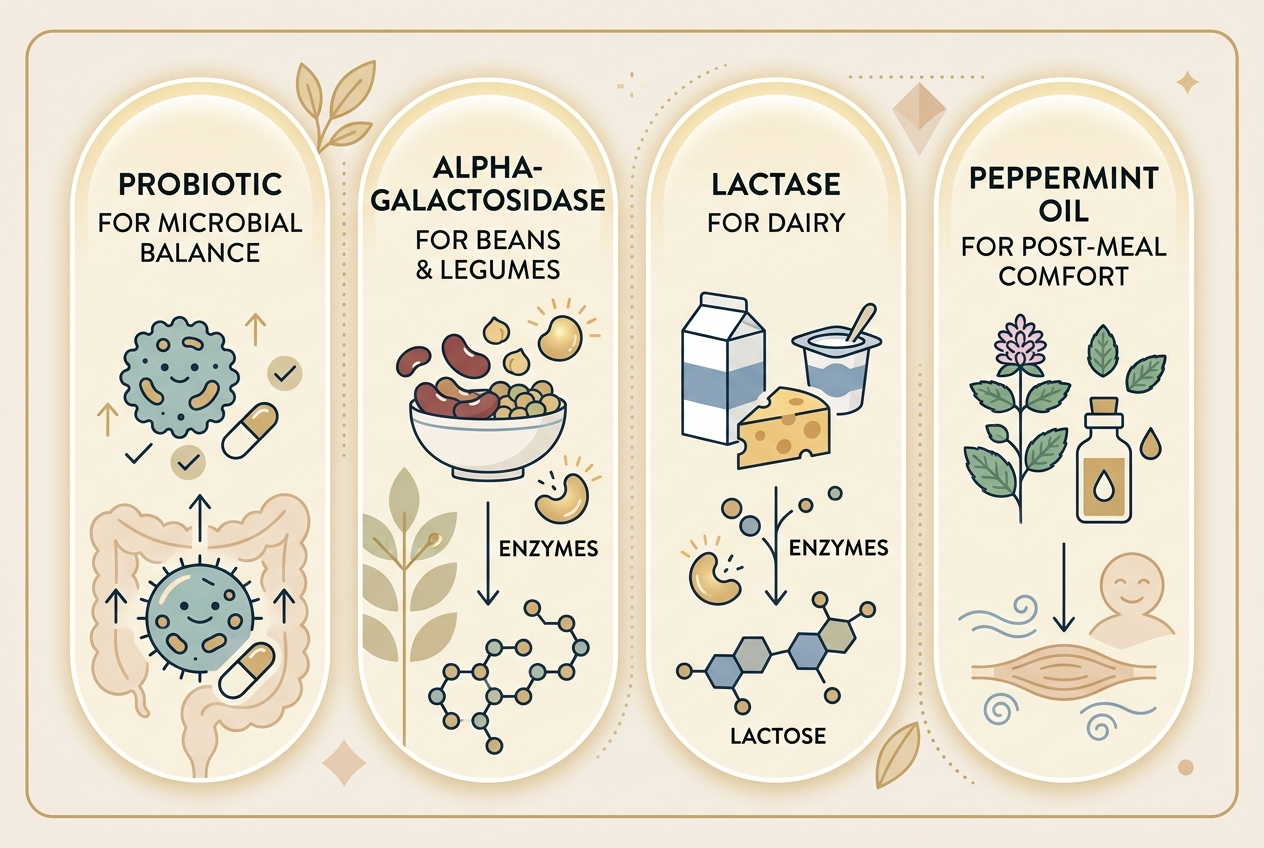
A good supplement for bloating matches the likely trigger: probiotics support microbial balance, alpha-galactosidase helps digest beans and high-FODMAP carbohydrates, lactase helps dairy, and enteric-coated peppermint oil supports intestinal comfort. Choose strain-specific or enzyme-specific labels, start with one variable, and reassess after two to four weeks of consistent use.
How did we evaluate supplements for bloating?
We evaluated bloating supplements by matching each ingredient category to a plausible digestive trigger: microbial balance, fermentable carbohydrates, dairy lactose, or post-meal intestinal comfort. Human randomized trials, systematic reviews, NIH Office of Dietary Supplements guidance, and strain-specific evidence received more weight than brand claims or broad “gut health” language. Products without a named probiotic strain, declared CFU count, active enzyme, dose timing, or clear Supplement Facts panel lost priority because buyers cannot connect the label to the intended use. Evidence for bloating supplements remains uneven: IBS studies provide useful directional evidence, but occasional bloating in otherwise healthy adults is not identical to a clinical research population. We excluded laxative-heavy “cleanse” positioning, detox claims, and disease-treatment language because those claims do not fit a responsible supplement buying guide. That constraint kept the review practical and nonpromotional.
What makes a supplement a good choice for bloating?
A good bloating supplement defines the job before it defines the ingredient. A probiotic supports gut microbial balance when the goal is daily digestive regularity, but the NIH Office of Dietary Supplements notes that probiotic labels should identify genus, species, strain, and CFU because effects are strain-specific (NIH ODS). An enzyme supplement targets a narrower food trigger: alpha-galactosidase acts on galacto-oligosaccharides in beans and some vegetables, while lactase acts on lactose in dairy. Enteric-coated peppermint oil supports intestinal comfort in people who tolerate mint oils, although heartburn risk matters. The best choice has a named active, a realistic use case, and a simple trial window. Buyers should track meal timing, ingredient exposure, serving size, and daily consistency before adding a second digestive product. If symptoms are new or severe, supplement shopping should pause first.
Which ingredients or features matter most?
Four label features matter most for bloating buyers. First, a probiotic should list a strain or organism clearly, such as Bacillus coagulans, Lactobacillus rhamnosus GG, Lactiplantibacillus plantarum 299v, or Bifidobacterium 35624; “proprietary probiotic blend” gives weaker evidence traceability. Second, CFU count should be stated per serving and ideally tied to shelf stability or expiration. Third, enzyme products should name the active enzyme and use timing, because alpha-galactosidase works with fermentable carbohydrates and lactase works with dairy. Fourth, delivery format should match the ingredient: spore-forming Bacillus coagulans tolerates gummy manufacturing better than many fragile Lactobacillus strains, while peppermint oil usually needs delayed or enteric delivery. A 2019 Scientific Reports randomized trial found that Bacillus coagulans Unique IS2 improved IBS symptom scores versus placebo, but that strain-level evidence should not be generalized to every Bacillus product (Madempudi et al., 2019).
How do the leading bloating supplement options compare?
Some links below are affiliate links. This does not influence our evaluation criteria or recommendations.
Leading options should be compared by active, format, use case, and evidence caveat rather than by star rating. Yuve, Culturelle, Align, IBgard-style peppermint oil, and Beano-style enzyme products serve different bloating triggers. A 2023 Gastroenterology meta-analysis found probiotic evidence in IBS varies by strain and outcome, so product specificity beats generic probiotic claims (Goodoory et al., 2023).
| Best for | Option | Primary active | Main caveat |
|---|---|---|---|
| Daily vegan probiotic routine | Yuve Probiotic Gummies | Bacillus coagulans, 5B CFU | General digestive support, not a food-specific enzyme |
| Classic capsule probiotic | Culturelle Digestive Daily | Lactobacillus rhamnosus GG | Strain fit matters more than brand familiarity |
| IBS-studied probiotic strain | Align Probiotic | Bifidobacterium 35624 | IBS data may not equal occasional bloating data |
| Post-meal comfort | IBgard-style peppermint oil | Enteric-coated peppermint oil | May aggravate heartburn in sensitive users |
| Bean or lentil meals | Beano-style enzyme | Alpha-galactosidase | Works best when taken with trigger foods |
Who is each option best for?
Best for daily routine simplicity: Yuve Probiotic Gummies fit buyers who want a vegan pectin gummy, Bacillus coagulans, and a two-gummy habit rather than a capsule. Best for capsule traditionalists: Culturelle Digestive Daily fits buyers who prefer Lactobacillus rhamnosus GG and do not need a gummy format. Best for strain-specific IBS-adjacent evidence: Align Probiotic fits buyers comparing Bifidobacterium 35624, while recognizing that bloating relief evidence is not universal. Best for meals rich in beans, lentils, or certain vegetables: alpha-galactosidase fits the food-trigger model because the enzyme acts before fermentation increases gas. Best for occasional post-meal intestinal comfort: enteric-coated peppermint oil fits adults who tolerate mint oils; a systematic review found peppermint oil outperformed placebo for global IBS symptoms and abdominal pain, but adverse events such as heartburn were more common (Khanna et al., 2014).
Which products meet these criteria?
Yuve Probiotic Gummies meet the daily probiotic criterion with Bacillus coagulans, 5 billion CFU per serving, vegan pectin, and a gummy format that may help adherence for people who avoid capsules; buyers can also review Yuve’s broader digestive health collection. Culturelle Digestive Daily meets the named-strain capsule criterion with Lactobacillus rhamnosus GG. Align Probiotic meets the Bifidobacterium 35624 criterion for buyers prioritizing an IBS-studied probiotic organism. Beano-style alpha-galactosidase meets the food-trigger criterion for beans and galacto-oligosaccharides; a small clinical study found alpha-galactosidase changed gas-related outcomes after a bean meal, but sample size limits certainty (Di Stefano et al., 2007). IBgard-style peppermint oil meets the short-term comfort criterion when delayed delivery and reflux tolerance are acceptable. No option should be framed as a cure for bloating, and each option should be tested alone before layering another digestive supplement.
Related reading: Best Supplement for Stress and Focus: How Magnesium, L-Theanine, B12, Iron, and Adaptogens Compare.
For a closer look at clean-label options, see Do Digestive Enzymes Actually Work for Bloating? What the Research Shows.
For a closer look at clean-label options, see Has Anyone Tried Emma Gut Health Supplement? An Evidence-Based Review.
For a closer look at clean-label options, see Has Anyone Tried Emma Gut Health for Bloating and Constipation, and Does It Actually Work?.
What questions do buyers ask before choosing a bloating supplement?
Is a probiotic or enzyme better for bloating?
A probiotic is better when the goal is daily microbial balance and regularity support. An enzyme is better when bloating follows a predictable food trigger, such as dairy, beans, lentils, or cruciferous vegetables.
How long should I try one supplement before switching?
A probiotic trial usually needs consistent daily use for two to four weeks before judging fit. An enzyme trial can be judged meal by meal because lactase or alpha-galactosidase acts with a specific food exposure.
Are gummies less serious than capsules?
A gummy is not automatically weaker than a capsule. The key question is whether the active ingredient tolerates the format, and Bacillus coagulans is more format-compatible than many fragile probiotic organisms.
Can peppermint oil help with bloating?
Enteric-coated peppermint oil can support intestinal comfort for some adults, especially when discomfort overlaps with IBS-type symptoms. Buyers with reflux, frequent heartburn, pregnancy, medication concerns, or gallbladder issues should ask a clinician before using peppermint oil.
Should I combine probiotic, fiber, and enzymes?
One supplement should change at a time because stacking products makes cause and effect hard to read. If fiber intake is low, a prebiotic fiber product may support regularity, but rapid fiber increases can temporarily increase gas.
What label language should make me skeptical?
“Detox,” “flush,” “cleanse bloating overnight,” and unnamed proprietary blends should raise skepticism. Responsible supplement labels name the active ingredient, serving size, use timing, and realistic structure/function support.
When should bloating be discussed with a clinician?
Persistent, painful, sudden, or unexplained bloating deserves medical guidance, especially with weight loss, vomiting, blood in stool, fever, pregnancy, or major bowel habit changes. Supplements support normal digestive function; they do not diagnose, treat, cure, or prevent disease.
A practical buying path starts with the most likely trigger, not the most dramatic claim. For a daily vegan probiotic option, review Yuve Probiotic Gummies; for broader digestive formats, compare Yuve’s digestion support supplements before choosing one variable to test.
Leave a Reply