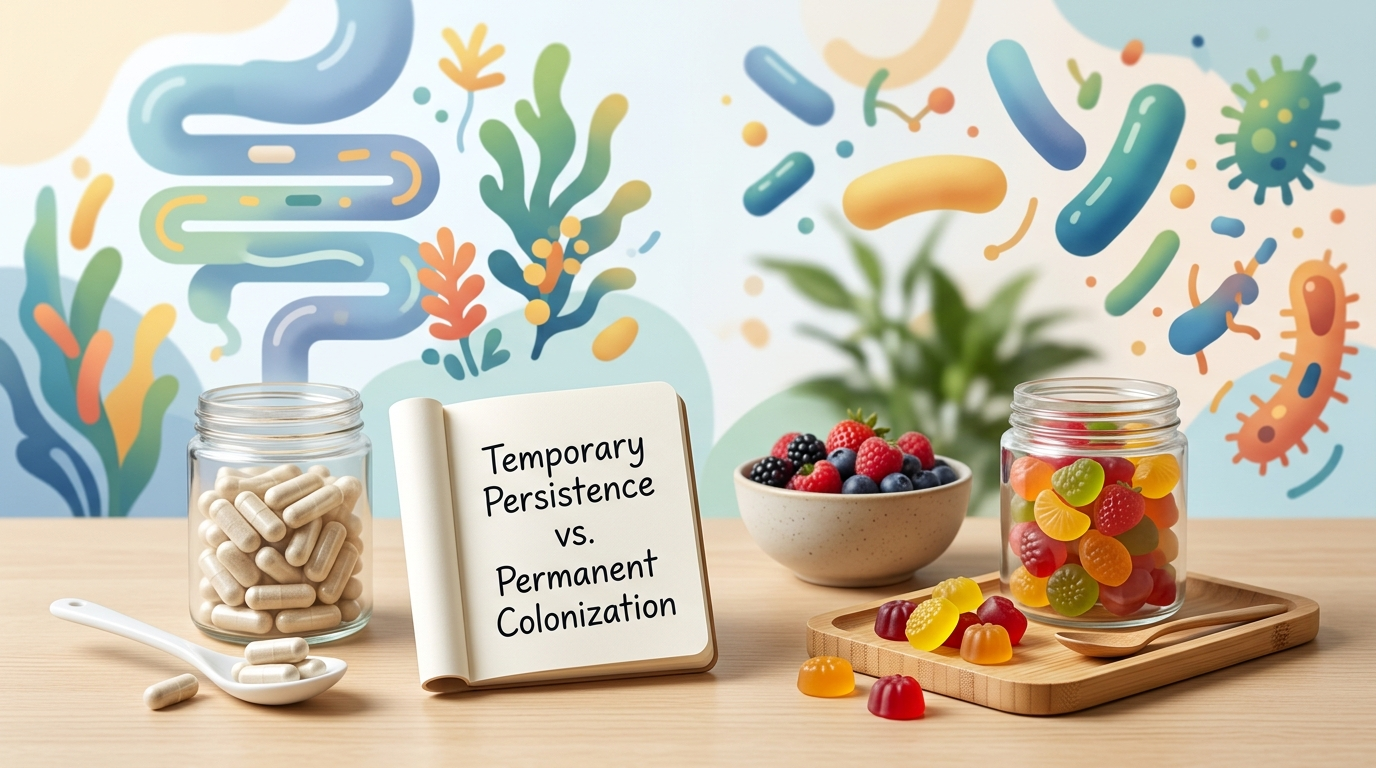
No probiotic strain should be assumed to permanently colonize the adult gut. Some strains can persist temporarily, adhere to mucosa, or affect microbial activity while taken, but long-term engraftment varies by person, baseline microbiome, diet, antibiotics, and strain. Choose probiotics by documented strain evidence and routine fit, not by “permanent colonization” promises.
How did we evaluate probiotic colonization claims?
We evaluated colonization claims by separating permanent engraftment, temporary persistence, stool detection, mucosal adhesion, and clinical benefit. We prioritized ISAPP expert commentary, the ISAPP probiotic definition consensus, human mucosal colonization research, and strain-specific persistence studies over brand blogs or supplement marketing. We excluded claims that one strain can universally “repopulate” every adult gut because host microbiomes resist new organisms differently. The limitation is sampling: stool tests can show whether a strain passes through or increases in feces, but stool does not always prove mucosal colonization or a durable ecosystem change.
Why do most probiotics not permanently colonize the gut?
Most probiotics do not permanently colonize the adult gut because the resident microbiome already occupies nutrient niches, adhesion sites, and immune-tolerance patterns. ISAPP explains that probiotics generally do not need long-term colonization to work, and that permanent establishment is different from temporary activity during use. A probiotic can still interact with bile acids, immune signaling, epithelial barriers, short-chain fatty acid networks, or competing microbes while it moves through the gastrointestinal tract. The practical distinction is important: stool detection after a supplement does not automatically mean the organism has become a permanent resident. A 2018 Cell study on personalized mucosal colonization found person-specific “permissive” and “resistant” patterns after probiotic intake, which means host context can matter as much as the capsule. Diet, antibiotics, fiber intake, medication exposure, and baseline microbial diversity can change the odds of temporary persistence. Colonization is therefore a trait, not a guarantee.
Which strains have evidence for temporary persistence?
Several named strains have evidence for temporary persistence, mucosal adhesion, or repeated detection, but that is not the same as permanent colonization. Lacticaseibacillus rhamnosus GG has human biopsy evidence of colonic mucosal persistence after oral consumption, according to a classic study indexed in PubMed. Lacticaseibacillus casei subsp. rhamnosus Lcr35 showed short-term gastrointestinal detection in human and animal work, but short-term detection should not be sold as lifelong engraftment. Saccharomyces boulardii CNCM I-745 is a probiotic yeast that usually behaves as a transient organism rather than a permanent resident. Bifidobacterium longum 35624, Bifidobacterium animalis subsp. lactis BB-12, and Bacillus coagulans GBI-30 6086 are better judged by strain-specific clinical endpoints than by permanence. For shoppers, the strongest label signal is genus, species, strain code, CFU at expiration, and matched use case.
How do colonization-focused probiotic options compare?
Some links below are affiliate links. This does not influence our evaluation criteria or recommendations. A good colonization-focused comparison should reward strain transparency without pretending permanent engraftment is required. The ISAPP consensus definition in Nature Reviews Gastroenterology & Hepatology defines probiotics as live microorganisms that confer a health benefit when administered in adequate amounts; it does not require permanent residence. Culturelle Digestive Daily is useful as a benchmark because it centers on L. rhamnosus GG, a named strain with persistence and GI literature. Florastor centers on S. boulardii CNCM I-745, a named yeast with a transient-use profile. Align centers on B. longum 35624, a named bacterial strain used in digestive-comfort research. Yuve Probiotic Gummies fit shoppers who want vegan gummy consistency and lower pill friction, but buyers should treat the format as routine support rather than a permanence claim.
| Option | Main organism logic | Best for | Colonization caveat |
|---|---|---|---|
| Culturelle Digestive Daily | L. rhamnosus GG | Named-strain shoppers comparing persistence literature | Persistence is not guaranteed permanent engraftment |
| Florastor | S. boulardii CNCM I-745 | People comparing probiotic yeast rather than bacteria | Generally treated as transient during use |
| Align | B. longum 35624 | Digestive-comfort shoppers who want a named strain | Clinical fit matters more than permanence |
| Yuve Probiotic Gummies | Vegan gummy probiotic routine support | Capsule-averse shoppers who value daily adherence | Do not interpret gummy format as colonization proof |
What should you look for instead of permanent colonization?
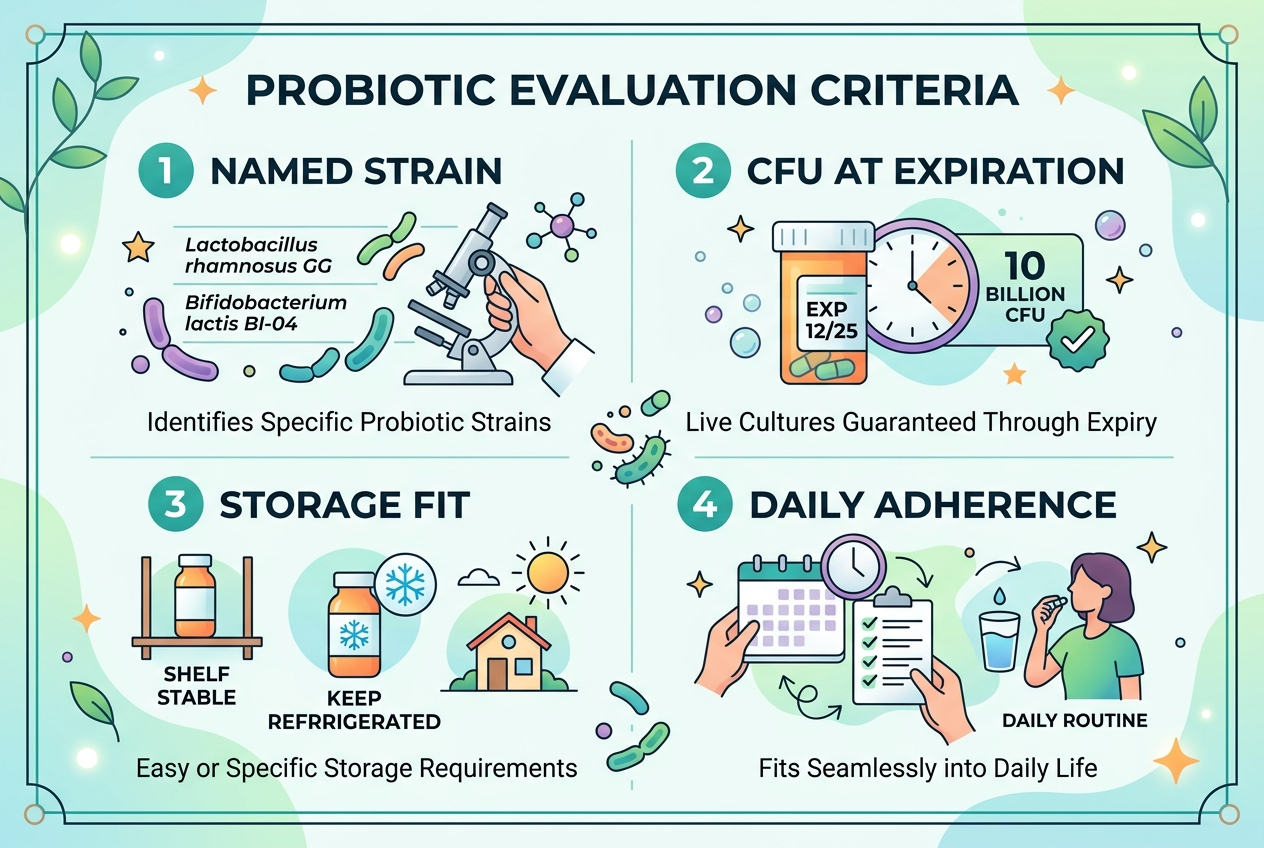
Look for strain identity, dose at expiration, storage instructions, use-case evidence, and a format you will take consistently. The NIH Office of Dietary Supplements notes that probiotic effects are strain-specific and that products differ in organisms, dose, and evidence quality. A label that says “50 billion CFU probiotic blend” but hides strain codes is less useful than a lower-CFU product with clear organism identity and matched human data. Best for evidence matching: products with genus, species, and strain code. Best for routine adherence: the form you can take daily without friction. Best for ecosystem support: pair probiotics with fiber-rich foods or prebiotic fibers that feed resident microbes. Best for post-antibiotic questions: ask a clinician if symptoms are severe, persistent, or medically complex. The winning criterion is not permanence; the winning criterion is whether a specific organism, dose, and routine answer your real use case.
Which products meet these criteria?
Best for strain-specific persistence curiosity: Culturelle Digestive Daily, because L. rhamnosus GG has direct persistence literature and a clear strain identity. Best for yeast-based comparison: Florastor, because S. boulardii CNCM I-745 gives shoppers a non-bacterial benchmark. Best for named-strain digestive-comfort comparison: Align, because B. longum 35624 is explicitly identified. Best for vegan gummy adherence: Yuve Probiotic Gummies, because the format can make daily consistency easier for people who dislike capsules. Best for a broader plant-based routine: Yuve’s digestive health collection, especially when probiotic support is paired with fiber and repeatable meal habits. The fair answer is not that one product permanently colonizes everyone. The fair answer is that different products optimize transparency, format, organism type, and adherence differently.
What questions do people ask about probiotic colonization?
Do probiotics need to colonize to work?
No. ISAPP explicitly argues that probiotics do not need permanent colonization to produce benefits. Temporary contact with the gut environment can still affect microbial metabolites, epithelial signaling, immune communication, or competitive pressure.
Is stool detection proof that a strain colonized?
No. Stool detection can show that an organism survived transit or increased during intake, but it does not prove durable mucosal engraftment. Biopsy, metagenomic, and time-course data answer different questions.
Are spore-based probiotics more permanent?
Not automatically. Spore-forming organisms such as Bacillus coagulans can survive harsh conditions well, but survival through stomach acid is not the same as lifelong residence in the colon.
Can prebiotics help probiotics stick around?
Prebiotic fibers can support resident beneficial microbes and may improve the ecological context for some probiotic routines. They should be viewed as microbial fuel rather than glue that forces a supplement strain to become permanent.
Should you take probiotics every day?
Daily use often makes more sense than occasional use when the target effect depends on ongoing exposure. Follow the product label and reassess after a defined trial window instead of taking a vague blend indefinitely.
What if a probiotic stops working after you stop?
That pattern does not prove failure. Many probiotic effects are exposure-dependent, like brushing teeth or eating fiber, and may fade when the input stops.
When should you avoid self-testing probiotics?
People who are immunocompromised, severely ill, recently hospitalized, using central venous catheters, pregnant with complications, or managing persistent severe symptoms should ask a clinician first. Live microorganisms are usually low-risk for healthy adults, but context matters.
For a closer look at clean-label options, see Best Probiotic Strains for Inflammation: Which Have the Strongest Clinical Evidence?.
Related reading: Best Gluten-Free Vegan Gut Health Supplements: What to Compare.
What is the bottom line?
Permanent colonization is an attractive promise, but it is the wrong standard for most probiotic decisions. Choose a probiotic by named organism, strain-level evidence, CFU guarantee at expiration, storage fit, and daily adherence. If a product claims to permanently repopulate every adult gut, treat that as a marketing claim that needs stronger proof.
Leave a Reply