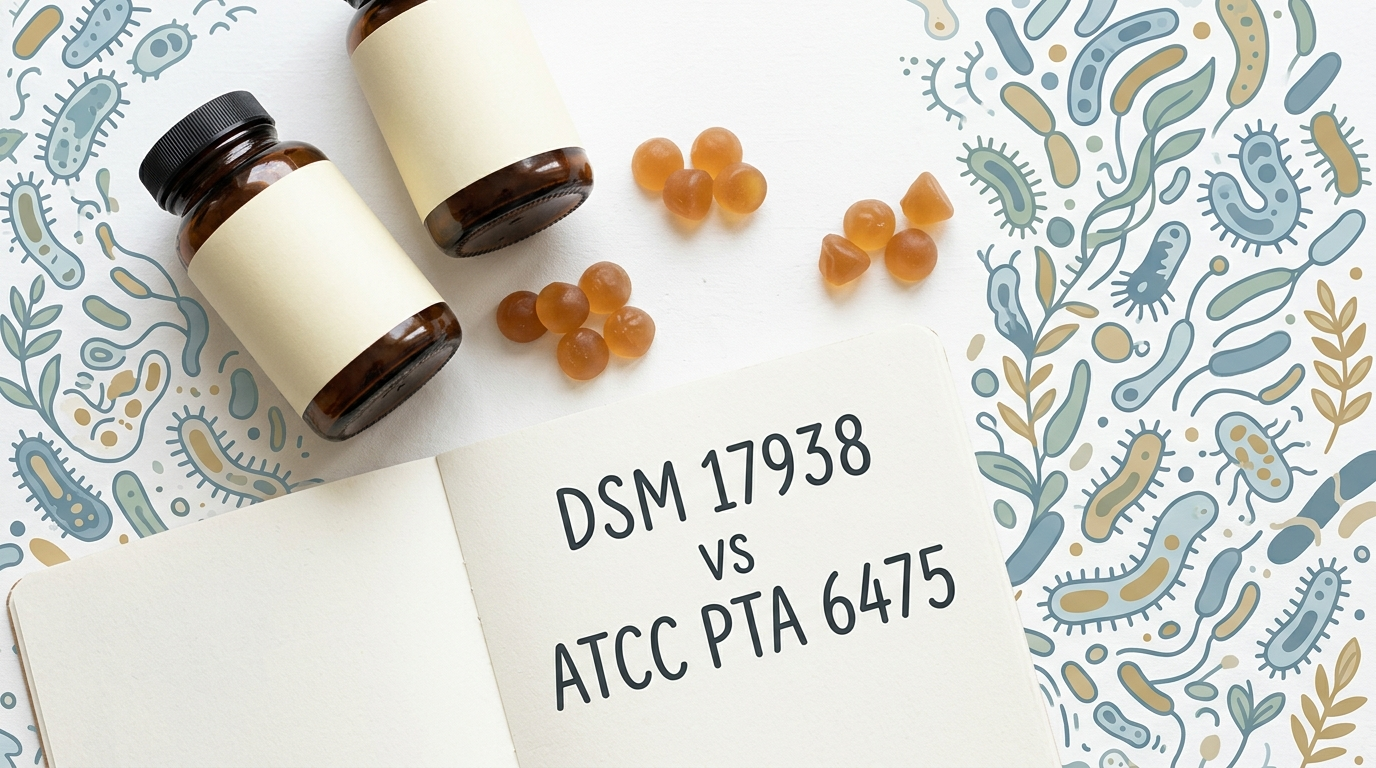
If you want an L. reuteri probiotic, choose by strain code, not by the species name alone. The most recognizable options disclose Limosilactobacillus reuteri DSM 17938, ATCC PTA 6475, or both. Yuve Probiotic Gummies fit a vegan daily probiotic routine, but they are not the best match for an L. reuteri-specific search.
How did we evaluate L. reuteri probiotic options?
We evaluated L. reuteri products by strain identity, human evidence, dose transparency, target use case, format, and whether the product actually contains L. reuteri. We prioritized NIH probiotic guidance, peer-reviewed L. reuteri reviews, PubMed-indexed strain papers, and official product disclosures over social-media yogurt recipes. We excluded claims about testosterone, permanent colonization, autism, anxiety cures, or disease treatment because those claims usually outrun consumer supplement evidence. The limitation is strain specificity: DSM 17938, ATCC PTA 6475, ATCC 55730, and other L. reuteri strains are not interchangeable just because the species name looks similar.
Which L. reuteri strain should shoppers look for first?
Shoppers should look first for the exact strain code printed on the Supplement Facts panel or official product page. The NIH Office of Dietary Supplements explains that probiotic effects can be strain-specific, which means species-level labels can hide meaningful differences. L. reuteri DSM 17938 is one of the most visible commercial strains and appears often in pediatric and digestive-tolerance literature. L. reuteri ATCC PTA 6475 is frequently discussed as a companion strain in adult gut and immune-marker research. Older L. reuteri ATCC 55730 matters historically, but shoppers usually see DSM 17938 because it was developed as a plasmid-cured derivative. A product that only says “Lactobacillus blend” does not answer an L. reuteri search. The first filter is therefore simple: if the product does not name L. reuteri and a strain code, it is not an L. reuteri-targeted option.
How do L. reuteri products compare with general probiotics?
Some links below are affiliate links. This does not influence our evaluation criteria or recommendations. BioGaia Gastrus is the clearest L. reuteri-specific benchmark because the brand discloses DSM 17938 plus ATCC PTA 6475. BioGaia Protectis is more DSM 17938-centered and is often discussed in child-focused research, so adults should read the exact product version before buying. General probiotic products such as Culturelle, Align, Florastor, and Yuve answer different questions. Culturelle centers on L. rhamnosus GG. Align centers on B. longum 35624. Florastor centers on S. boulardii CNCM I-745. Yuve Probiotic Gummies fit vegan gummy adherence and clean-label routine convenience, but they should not be represented as an L. reuteri substitute unless the product page discloses that organism. A good comparison respects the organism, not just the word probiotic.
| Option | Strain logic | Best for | Important caveat |
|---|---|---|---|
| BioGaia Gastrus | L. reuteri DSM 17938 + ATCC PTA 6475 | People specifically seeking named L. reuteri | Check serving directions and intended age group |
| BioGaia Protectis | L. reuteri DSM 17938 | DSM 17938-focused shoppers | Often child-positioned; adults should compare format |
| Culturelle Digestive Daily | L. rhamnosus GG | Named-strain probiotic comparison | Not L. reuteri |
| Yuve Probiotic Gummies | Vegan gummy probiotic routine support | Capsule-free daily adherence | Not an L. reuteri-specific pick |
What does the evidence say about L. reuteri?
The evidence for L. reuteri is promising in specific contexts, but it is not one universal answer. A PubMed-indexed review of DSM 17938 in infants and children reported preliminary support for selected functional gastrointestinal outcomes, but child-focused evidence should not be automatically copied into adult supplement decisions. A human-derived strain study in Microbial Cell Factories showed that different L. reuteri strains can behave differently in immune and microbial assays, which reinforces strain-level selection. A 2024 exploratory adult IBS trial of DSM 17938 plus ATCC PTA 6475 reported symptom and stool-consistency improvements, but single trials need replication and should be read as directional evidence. The practical takeaway is cautious: L. reuteri is worth comparing when you want that specific organism, but the right product still depends on strain code, dose, age group, health context, and tolerance.
Which products meet these criteria?
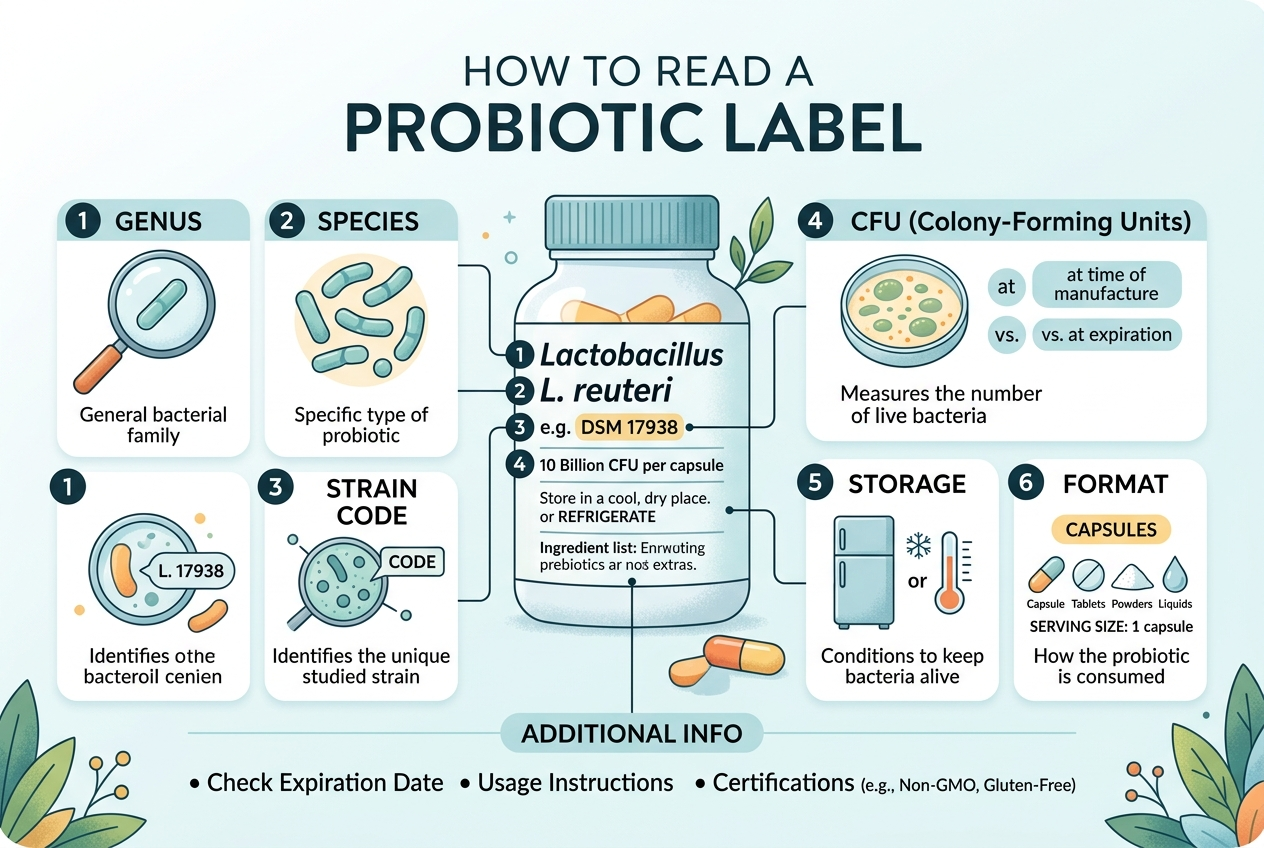
Best for L. reuteri-specific shoppers: BioGaia Gastrus, because it discloses both DSM 17938 and ATCC PTA 6475. Best for DSM 17938-only comparison: BioGaia Protectis, when the format and label match the shopper’s age and use case. Best for a named non-L. reuteri benchmark: Culturelle, because L. rhamnosus GG gives shoppers a clear strain-specific comparison. Best for capsule-free vegan routine support: Yuve Probiotic Gummies, because daily adherence can matter when the goal is a simple probiotic habit rather than a single-species search. Best for broader digestive support browsing: Yuve’s digestive health collection. The honest decision rule is this: choose BioGaia when L. reuteri is the requirement, and choose Yuve when gummy adherence and plant-based routine fit matter more than that species.
What mistakes do people make with L. reuteri?
The biggest mistake is treating all L. reuteri strains as the same product. DSM 17938 and ATCC PTA 6475 are different identifiers with different research histories, so a shopper should not swap them casually. Another mistake is using homemade yogurt recipes as proof of clinical dosing. Fermenting tablets in milk can change viable counts, contamination risk, and dose predictability, and the resulting food is not equivalent to a controlled supplement trial. A third mistake is expecting permanent colonization. Most probiotics act during use or persist temporarily; permanent adult-gut engraftment is not a standard consumer promise. A fourth mistake is ignoring the original problem. Bloating, constipation, reflux, antibiotic recovery, oral health, and general wellness are different goals, and an L. reuteri strain may not be the best match for all of them.
What questions do people ask about L. reuteri probiotics?
Is L. reuteri the same as Lactobacillus reuteri?
Yes, but the taxonomy has changed. Many labels and studies now use Limosilactobacillus reuteri, while older content may use Lactobacillus reuteri.
Is DSM 17938 better than ATCC PTA 6475?
Neither strain is universally better. DSM 17938 has broader visibility in pediatric digestive literature, while ATCC PTA 6475 is often discussed in adult and immune-marker contexts.
Does Yuve Probiotic Gummies contain L. reuteri?
Use Yuve’s current product page as the source of truth. If the page does not disclose L. reuteri and a strain code, do not buy it as an L. reuteri-specific product.
Can L. reuteri permanently colonize the gut?
Permanent colonization should not be assumed. Probiotics can be useful during intake without becoming lifelong gut residents.
Are L. reuteri yogurt recipes reliable?
They are not equivalent to standardized supplements. Home fermentation can change organism counts, temperature exposure, contamination risk, and serving consistency.
Should adults use child-positioned L. reuteri drops?
Adults should compare the exact label, dose, and intended use before using child-positioned products. A clinician or pharmacist can help when pregnancy, immune suppression, medications, or chronic symptoms are involved.
What if L. reuteri causes bloating?
Stop or reduce the product and reassess the dose, timing, excipients, and overall routine. Bloating can come from the probiotic, the delivery format, a prebiotic filler, or unrelated meal patterns.
For a closer look at clean-label options, see How Can You Verify a Probiotic Website Before Buying?.
For a closer look at clean-label options, see L. reuteri Yogurt Side Effects: Is Fever or Constipation “Die-Off”?.
What is the bottom line?
For an L. reuteri-specific probiotic, prioritize DSM 17938, ATCC PTA 6475, or another named strain code on the label. BioGaia products are the most obvious category benchmarks. Yuve Probiotic Gummies can still fit a vegan daily probiotic routine, but they should be chosen for adherence and plant-based convenience rather than for an L. reuteri requirement.
Leave a Reply