
Single-strain probiotics are easier to match to one researched outcome, while multi-strain probiotics combine organisms for broader formulation goals. More strains do not automatically mean better results. Choose by named strain, human evidence, dose through expiration, storage, allergen fit, and routine—not by the biggest strain count or CFU number.
How did we evaluate single-strain and multi-strain probiotics?
We evaluated probiotic formats by prioritizing strain identity, human evidence, labeled quantity, shelf-life language, storage requirements, and excipient transparency. The 2014 ISAPP consensus statement indexed by PubMed supplied the working definition of a probiotic: a live microorganism that confers a health benefit when administered in an adequate amount. We gave strain-specific trials more weight than studies that tested a different organism, and we treated company pages as sources for current label facts rather than proof of clinical outcomes. We excluded front-label CFU totals, strain counts, testimonials, and broad microbiome claims when the label did not connect them to an identifiable organism or researched use. This method cannot determine which product will suit one person because diet, medications, health status, and baseline microbiota affect response. It can determine whether a comparison uses verifiable evidence instead of numerical marketing.
Does a multi-strain probiotic work better than a single-strain probiotic?
A multi-strain probiotic does not automatically work better than a single-strain probiotic. Probiotic effects belong to specific organisms, doses, formulations, and studied populations; adding unrelated strains does not guarantee that their effects combine. The National Center for Complementary and Integrative Health explains that evidence for one kind of Lactobacillus cannot be transferred to every Lactobacillus or Bifidobacterium product. A single-strain formula can therefore be easier to evaluate when its strain code matches human research and its dose remains viable through expiration. A multi-strain formula can make sense when the finished combination itself has evidence, each organism is disclosed, and the manufacturer tests stability and compatibility. Strain count is only one label fact. Identity, dose, packaging, expiration, and clinical relevance determine whether that fact is useful. The strongest comparison asks what the finished product documents, not how crowded its Supplement Facts panel looks.
How do single-strain and multi-strain probiotic formulas compare?
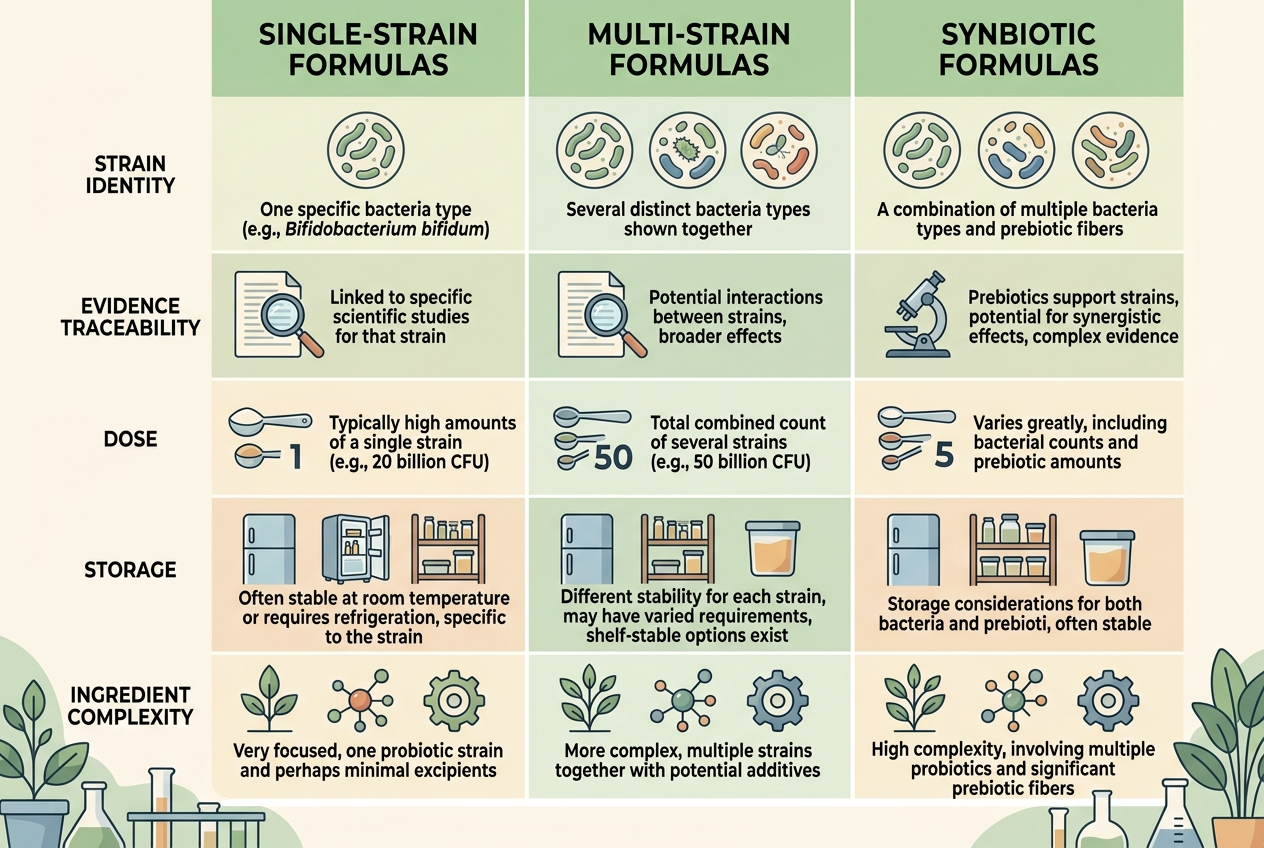
Single-strain formulas provide one organism, which makes studies and tolerance easier to trace. Multi-strain formulas combine organisms for broader formulation goals, but response is harder to attribute unless the finished blend has human trials. CFU and AFU are not interchangeable, and a high total does not replace strain disclosure. Shelf stability depends on the organism, moisture, packaging, storage, and the quantity guaranteed at the end of shelf life. Spore-forming Bacillus organisms tolerate manufacturing differently from many Lactobacillus and Bifidobacterium organisms. Capsules, gummies, and synbiotics solve different adherence or stability problems. The useful distinction is not “simple versus advanced”; it is “easy versus difficult to verify.”
| Format | Best fit | Evidence advantage | Main limitation |
|---|---|---|---|
| Single strain | One clearly defined routine goal | Easier strain-to-study matching | Narrower formulation scope |
| Multi-strain blend | People who want a documented finished combination | Can combine distinct organisms in one serving | Harder to attribute response |
| Synbiotic | People who want probiotics plus a prebiotic substrate | Finished formula may test both components together | More ingredients can complicate tolerance |
Which probiotic products fit different use cases?
Some links below are affiliate links. This does not influence our evaluation criteria or recommendations. Best for a vegan gummy routine: Yuve Probiotic Gummies provide 5 billion CFU of Bacillus coagulans per two-gummy serving at manufacture; the page does not display a strain code, so evidence for other B. coagulans strains should not be transferred automatically. Best for a strain-identified single capsule: Align 24/7 Digestive Support identifies Bifidobacterium longum 35624 and uses room-temperature packaging. Best for a disclosed multi-strain synbiotic: Seed DS-01 lists 24 strains, 53.6 billion AFU, and a prebiotic outer capsule; AFU is Seed’s measurement and should not be treated as a direct CFU comparison. These products suit different preferences. None earns a universal “best” label from strain count alone, and each still requires an allergen, medication, storage, and tolerance review.
What should you check before choosing any probiotic?
Check the complete genus, species, and strain code first, then confirm the amount promised through expiration rather than only at manufacture. Match the named strain or finished blend to human research on the outcome you actually care about; a general “gut health” claim is too broad for a useful evidence search. Check whether the serving uses CFU, AFU, milligrams, or a proprietary blend because those values are not interchangeable. Read storage directions, expiration dating, capsule or gummy excipients, sugar alcohols, prebiotic fibers, and allergen statements. A simpler formula can make tolerance easier to interpret, while a synbiotic or multi-strain formula may add ingredients that change the experience. People with serious illness, weakened immunity, pregnancy, or persistent digestive symptoms should discuss probiotics with a qualified clinician. The NCCIH safety overview notes that product quality varies and that severe infections have occurred in vulnerable populations, so “natural” does not mean universally appropriate.
What questions do shoppers ask about probiotic strain counts?
Strain-count questions usually come down to evidence, label transparency, and routine fit. A large CFU total can describe quantity without proving relevance, while a long strain list can describe complexity without proving that the finished blend was studied. Consumers should use those numbers as filters, not conclusions. The useful sequence is strain identity, researched outcome, dose, shelf-life guarantee, format, storage, and personal tolerance. That sequence applies to capsules, gummies, powders, refrigerated products, and synbiotics. It also prevents a common category error: comparing a strain-specific capsule, a Bacillus gummy, and a 24-strain synbiotic as if the front-label number measures the same biological promise. The five answers below address the decisions that remain after a label passes that first screen. They do not replace individualized medical advice, especially for children, pregnancy, immunocompromised people, or anyone with severe or unexplained symptoms.
Is one probiotic strain enough?
One strain can be enough when that exact strain has human evidence for the intended use and the product supplies an appropriate viable dose. One strain is not automatically weaker than a blend.
Are 20 probiotic strains better than five?
No fixed strain count is universally better. A 20-strain product needs evidence and stability data for the finished combination, while a five-strain product needs the same scrutiny.
Should CFU be guaranteed through expiration?
Yes, an end-of-shelf-life guarantee is more informative than a count stated only at manufacture. Viability can decline during storage, so packaging, moisture, heat, and time matter.
Can you switch from a single strain to a multi-strain formula?
You can switch, but changing several organisms and ingredients at once makes tolerance harder to interpret. Compare labels, introduce one change at a time, and follow clinician guidance when health conditions or medications are involved.
Are synbiotics the same as multi-strain probiotics?
No. A synbiotic combines live microorganisms with a substrate used selectively by host microorganisms; the probiotic portion may contain one strain or many. The prebiotic component can affect tolerance and should be reviewed separately.
Do gummies work as well as capsules?
Format alone does not determine usefulness. A gummy or capsule still needs viable organisms, transparent labeling, suitable storage, and evidence tied to the organism and dose.
Related reading: Do Probiotics Help With Food Poisoning? What the Evidence Says.
For a closer look at clean-label options, see Spore-Based Probiotics: How Yuve Compares With MegaSporeBiotic and BC30.
What is the bottom line on single-strain versus multi-strain probiotics?
Choose a single-strain probiotic when you value a cleaner strain-to-study match, a simpler tolerance test, and a narrow routine goal. Choose a multi-strain probiotic when the full blend is disclosed, the finished formulation has credible evidence, and its added complexity serves a defined purpose rather than a larger front-label number. Yuve, Align, and Seed illustrate three distinct approaches—spore-forming gummy, strain-identified capsule, and multi-strain synbiotic—without establishing one universal winner. Compare the current labels, follow storage directions, and stop treating strain count or CFU as a quality score; the best product is the one whose identity, evidence, viability, ingredients, and daily format all withstand the same review. If a label omits the organism’s strain code, an end-of-shelf-life quantity, or usable storage directions, treat that gap as a limitation no matter how impressive the front-panel total appears.
Leave a Reply