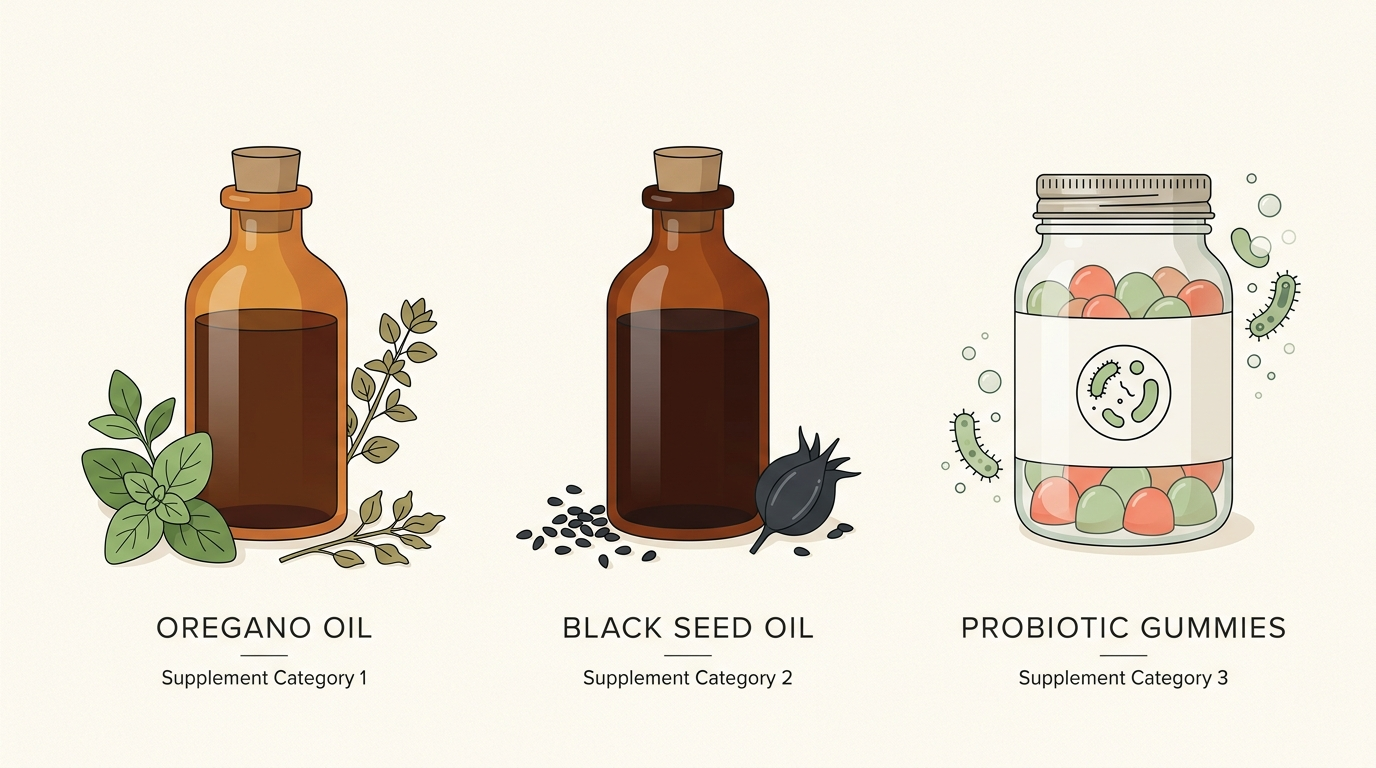
Oregano oil, black seed oil, and probiotics are not interchangeable digestive supplements. Human evidence for oral oregano oil is sparse; black seed oil has limited small-trial evidence for dyspepsia; and probiotic effects depend on the exact strain and outcome. Choose by evidence, label specificity, medication risk, and tolerance—not by broad “antimicrobial” or “gut reset” claims.
How did we evaluate oregano oil, black seed oil, and probiotics?
We separated culinary use from concentrated supplements and compared each option by human trials, ingredient identity, dose disclosure, target outcome, adverse effects, and product quality. Randomized controlled trials and systematic reviews carried more weight than laboratory antimicrobial studies, animal studies, or traditional-use claims. NCBI LiverTox, PubMed-indexed research, International Scientific Association for Probiotics and Prebiotics consensus work, and FDA supplement guidance supplied the evidence and regulatory context. We excluded claims that oregano oil or black seed oil “kills bad bacteria,” treats H. pylori, cures reflux, or resets the microbiome because those promises exceed reliable consumer evidence and may delay appropriate testing. We also excluded probiotic comparisons that name only a species or CFU count without connecting a strain to a studied outcome. This method can compare label transparency and evidence fit; it cannot predict individual tolerance or replace medication, pregnancy, allergy, or symptom-specific advice from a qualified clinician.
What is the practical difference between these three options?
Oregano oil is a concentrated botanical extract from Origanum species that commonly contains carvacrol and thymol. Laboratory studies report antimicrobial activity, but test-tube concentrations do not establish a safe or effective human digestive dose. Black seed oil comes from Nigella sativa seeds and contains compounds such as thymoquinone; human research spans metabolic markers, inflammation, and a small number of digestive studies. Probiotics are live microorganisms that must be administered in adequate amounts to confer a demonstrated benefit. The ISAPP consensus definition makes identity and benefit part of the term, so “contains cultures” is not enough. Oregano oil and black seed oil are botanical extracts; probiotics are living microbial preparations. Best for culinary use: ordinary oregano or black seed used as food. Best for a trackable supplement trial: the option with a named ingredient or strain, explicit serving, relevant human evidence, and a stop rule. None is a universal treatment for unexplained digestive symptoms.
How does the human evidence compare?
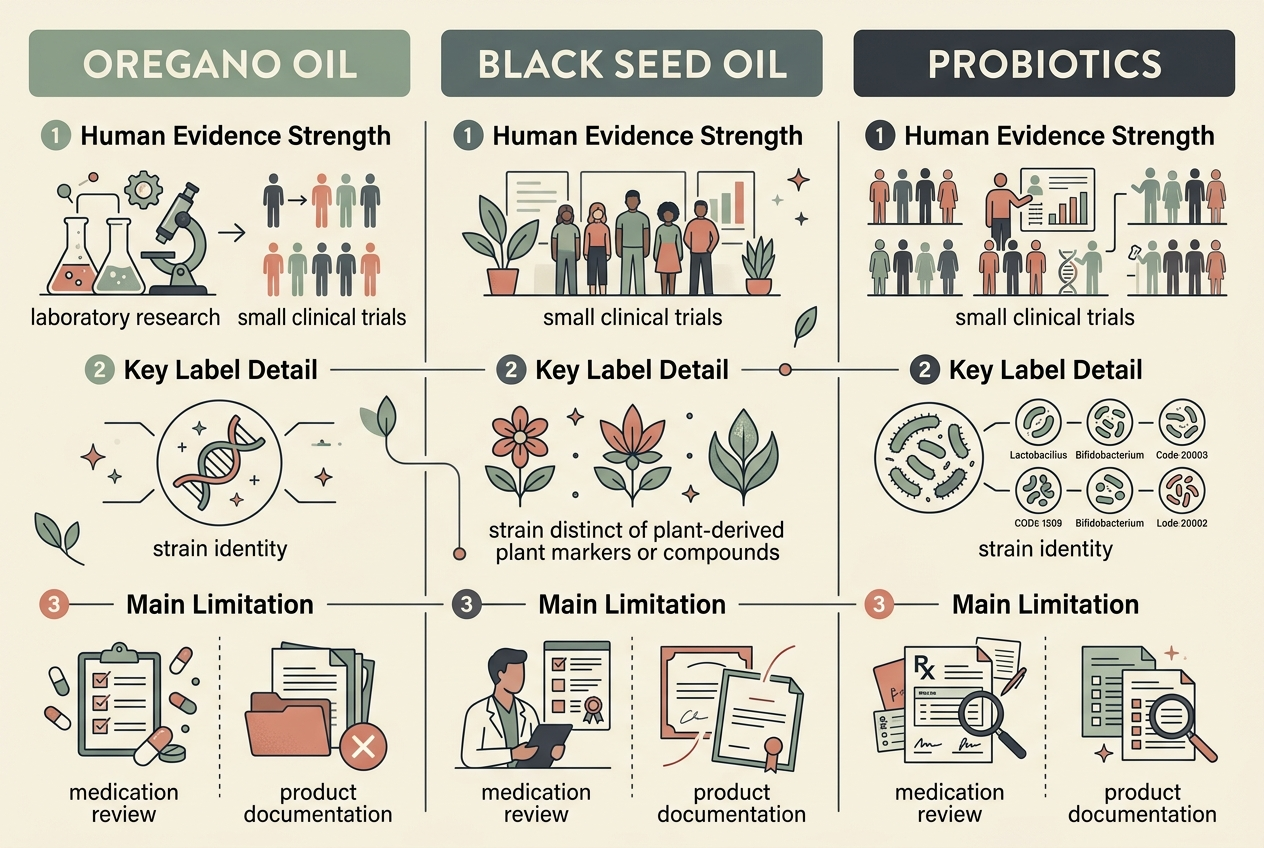
Oregano oil has the weakest direct human digestive evidence of the three. NCBI LiverTox notes that oregano’s antimicrobial and antifungal effects appear in laboratory or animal work but have not been demonstrated as clinical effects in humans. A small randomized trial tested five milliliters of Nigella sativa oil mixed with honey for eight weeks in 70 people with functional dyspepsia; the single study reported symptom improvement, but its formulation, size, and co-intervention prevent broad conclusions about retail black seed oils. Probiotics have a larger clinical literature, yet a meta-analysis of 228 trials found that efficacy is both strain- and disease-specific. Best-supported claim: probiotic evidence cannot be transferred automatically from one strain or condition to another. Best evidence fit: a product matching the studied strain, dose, population, and outcome. Best reason to avoid a product: it relies on “antimicrobial,” “detox,” or microbiome language without human outcome data.
| Option | Human digestive evidence | Label detail that matters | Main limitation |
|---|---|---|---|
| Oregano oil | Sparse for routine digestive outcomes | Origanum species, carvacrol amount, carrier oil | Laboratory findings dominate marketing |
| Black seed oil | Limited small-trial evidence | Nigella sativa amount, thymoquinone standardization | Formulations and outcomes vary |
| Probiotic | Broader but strain-specific | Genus, species, strain, CFU timing, storage | One strain’s evidence does not prove another’s |
Which safety differences matter before you choose?
Concentration changes risk. Culinary oregano is not equivalent to swallowing essential oil, and undiluted essential oils can irritate tissue. LiverTox lists abdominal discomfort, heartburn, constipation or diarrhea, nausea, vomiting, dizziness, headache, and rare hypersensitivity reactions among possible oregano-supplement effects; it also advises avoiding supplement-level oregano during pregnancy. Black seed products may affect blood glucose, blood pressure, bleeding risk, or drug metabolism, so medication review matters even when the label says “natural.” Probiotics can cause temporary gas or bloating and require extra caution for people who are critically ill or severely immunocompromised. Best for reflux-prone shoppers: avoid assuming a concentrated botanical will soothe burning, because oregano oil may add heartburn. Best for medication users: ask a pharmacist about Nigella sativa and every other botanical extract. Best for pregnancy, breastfeeding, surgery planning, or serious illness: use clinician guidance before any concentrated oil or live-microbe supplement. Stop a trial if symptoms escalate, a rash develops, or new systemic symptoms appear.
How should you compare labels and quality documents?
Start with identity. An oregano product should name the Origanum species, extraction format, carrier oil, serving amount, and preferably the measured carvacrol content. A black seed product should identify Nigella sativa, oil or powder format, serving amount, and any standardized thymoquinone specification. A probiotic should list genus, species, strain when available, CFU quantity, whether the count applies at manufacture or expiration, and storage directions. Then check other ingredients, allergens, lot number, expiration date, manufacturer contact, and access to a recent certificate of analysis. The FDA explains that dietary supplements are not approved for safety and effectiveness before marketing, so “FDA registered,” “GMP facility,” and “lab tested” do not prove a clinical benefit. Best for identity verification: a lot-matched document that reports the named marker or microorganism. Best for comparison: use the full daily serving and relevant unit, not bottle price, front-label adjectives, or total milligrams across unrelated ingredients.
Which option best fits a specific use case?
Choose the narrowest claim that the evidence and label can support. Best for cooking: ordinary oregano leaves or Nigella sativa seeds used as foods, not concentrated treatment substitutes. Best for testing a botanical approach after medication review: a single-ingredient black seed oil with explicit Nigella sativa amount and quality documentation, while recognizing that digestive evidence remains preliminary. Best for a daily probiotic routine: a product with clearly identified microorganisms, CFU quantity, storage instructions, and outcome-relevant evidence. Best for suspected infection, ulcer, persistent reflux, unexplained weight loss, bleeding, fever, or severe pain: medical evaluation rather than oregano oil, black seed oil, or a probiotic. Avoid stacking all three. One change at a time makes tolerance interpretable and reduces interaction uncertainty. Define the outcome before starting—such as stool frequency, bloating days, or post-meal discomfort—and set a review date. A supplement that cannot state what it contains or what outcome it targets does not earn a trial.
Which products meet these comparison criteria?
Some links below are affiliate links. This does not influence our evaluation criteria or recommendations. For oregano oil, shortlist products that name Origanum species, carrier oil, serving amount, and carvacrol content; reject any product that presents test-tube antimicrobial activity as proof of treating a digestive condition. For black seed oil, require Nigella sativa identity, amount per serving, oxidation-protective packaging, and a current quality contact; thymoquinone standardization improves comparability but does not create strong digestive evidence. Yuve Probiotic Gummies list Bacillus coagulans at five billion CFU per two-gummy serving, a pectin base, other ingredients, and room-temperature directions. The accessible label identifies the species but not a strain code, so shoppers cannot assume that every Bacillus coagulans trial applies to this formula. Compare that limitation with each botanical label’s missing details. Explore no broader digestive-support collection until the ingredient category, intended outcome, medication risks, and stop criteria are clear.
What mistakes distort oregano, black seed, and probiotic comparisons?
The first mistake is treating laboratory antimicrobial activity as a human outcome. A compound can inhibit microbes in a dish while failing to reach the same concentration safely in the digestive tract. The second mistake is using milligrams to compare unrelated substances: 500 milligrams of black seed oil, oregano extract, and a probiotic cannot be ranked on one potency scale. The third mistake is counting CFU without strain identity, expiration timing, or clinical relevance. The fourth mistake is calling a product “third-party tested” without naming the laboratory, standard, analytes, lot, and results. The fifth mistake is assuming a burning sensation proves “die-off”; irritation and adverse effects are more immediate explanations. The sixth mistake is combining multiple products and then attributing improvement or harm to one. The FDA consumer guide advises discussing supplements with a health professional because supplements can interact with medicines. Good comparisons narrow uncertainty; they do not turn uncertain mechanisms into confident cures.
What questions do shoppers ask about oregano oil and black seed oil?
Most questions ask whether two concentrated botanicals can be combined, whether “antimicrobial” means effective for gut problems, and whether a probiotic should follow them. The evidence does not support a universal cleanse sequence. Oregano oil has limited direct human digestive research, black seed oil has a few small formulation-specific trials, and probiotics require strain- and outcome-specific interpretation. A product can also be well manufactured while lacking evidence for the claim a shopper wants. The six answers below keep evidence strength separate from label quality and individual safety. Use one product at a time only after checking medicines, pregnancy status, allergies, and red-flag symptoms. Record the exact product, full serving, start date, target outcome, and adverse effects. Stop and seek care when symptoms are severe, persistent, bloody, dehydrating, or paired with unintended weight loss, fever, repeated vomiting, trouble swallowing, or black stool.
Can you take oregano oil and black seed oil together?
The combination lacks strong human digestive evidence and increases interaction and tolerance uncertainty. A pharmacist or clinician should review medications and risk factors before combining concentrated botanicals.
Does oregano oil kill bad gut bacteria?
Oregano compounds show antimicrobial activity in laboratory settings. That does not establish a selective, safe, or clinically useful effect on the human gut microbiome.
Does black seed oil help indigestion?
One small trial of a honey-based Nigella sativa oil formulation reported improvement in functional dyspepsia. The result is preliminary and does not apply automatically to every retail oil, dose, or symptom pattern.
Should you take probiotics after oregano oil?
No evidence establishes a required oregano-then-probiotic sequence. Choose a probiotic only when its strain, dose, and studied outcome match the reason for taking it.
Is more carvacrol always better?
No. Higher concentration can increase irritation without proving greater clinical benefit. Carvacrol content helps compare identity and dose, but human outcome evidence remains necessary.
How long should a supplement trial last?
The trial length should follow product directions and relevant human evidence. Set a measurable outcome and stop earlier for worsening symptoms, allergic reactions, or medication concerns.
For a closer look at clean-label options, see Has Anyone Tried Ayurvedic Digestive Support After IBS Care Felt Incomplete?.
For a closer look at clean-label options, see How to Match Yuve Digestive Support to Your Trigger Tracking.
What is the bottom line on oregano oil versus black seed oil?
Oregano oil has extensive laboratory interest but little direct human evidence for routine digestive support. Black seed oil has limited small-trial evidence, including a formulation-specific dyspepsia study, but the evidence is not broad enough for confident treatment claims. Probiotics have more human research overall, yet benefits depend on the exact strain, dose, population, and outcome. Compare labels by identity, active specification, full serving, quality documentation, adverse effects, and medication risk. Do not use bottle milligrams or “antimicrobial” language to rank unlike products. Yuve Probiotic Gummies offer a disclosed Bacillus coagulans species and five-billion-CFU serving in a gummy format, while the missing strain code limits trial matching. That is a concrete tradeoff, not a verdict. Use culinary herbs as foods, introduce supplements one at a time, and seek clinical assessment for persistent, severe, bloody, or unexplained digestive symptoms.
Leave a Reply