Primary query: Fermenting probiotics in oats
Search intent: Compare whether probiotic supplements, starter cultures, kefir, or prebiotic oats make sense for an oat-based routine.
You usually should not ferment oats by opening a random probiotic capsule into them. A probiotic supplement is dosed for direct use, not home food fermentation. Use a tested yogurt or fermented-oat starter for fermentation, or keep oats as a prebiotic base and take a labeled probiotic separately.
How did we evaluate fermenting probiotics in oats?
We evaluated this question by separating four entities: probiotic supplements, fermented oat foods, starter cultures, and plain oats as a prebiotic grain. We prioritized food microbiology reviews, ISAPP probiotic definitions, controlled fermented-oat studies, and home-fermentation safety guidance over social posts that treat every probiotic capsule as a starter culture. We excluded disease-treatment claims and recipes that do not control temperature, acidity, sanitation, strain identity, or storage time. The practical standard was whether a routine preserves microbial viability, avoids unsafe fermentation conditions, and gives the user a repeatable dose or food process. We also looked for label intent, because a product meant to be swallowed directly is not automatically validated for growing in a warm oat jar. That distinction matters because a live microorganism can be appropriate in a supplement but still be a poor choice for uncontrolled kitchen culturing.
Can probiotic capsules ferment oats safely?
A probiotic capsule can contain live microorganisms, but that does not make it a reliable oat-fermentation starter. ISAPP’s consensus definition, published in Nature Reviews Gastroenterology & Hepatology, defines probiotics as live microorganisms that confer a health benefit when administered in adequate amounts. That definition does not say the organism can acidify oats, suppress contaminants, or produce a safe fermented food. A capsule may include Bacillus coagulans, Lactobacillus rhamnosus GG, Bifidobacterium animalis subsp. lactis, or blends that were selected for supplement use rather than food processing. Oats provide starch, beta-glucan, water, and minerals, but safe fermentation also needs the right culture, temperature, pH drop, sanitation, and refrigeration. Capsules also may contain excipients that were never intended to sit in a warm food matrix. The safer default is simple: take the probiotic as directed, and ferment oats only with a food-grade starter designed for that job.
How do oat fermentation options compare?
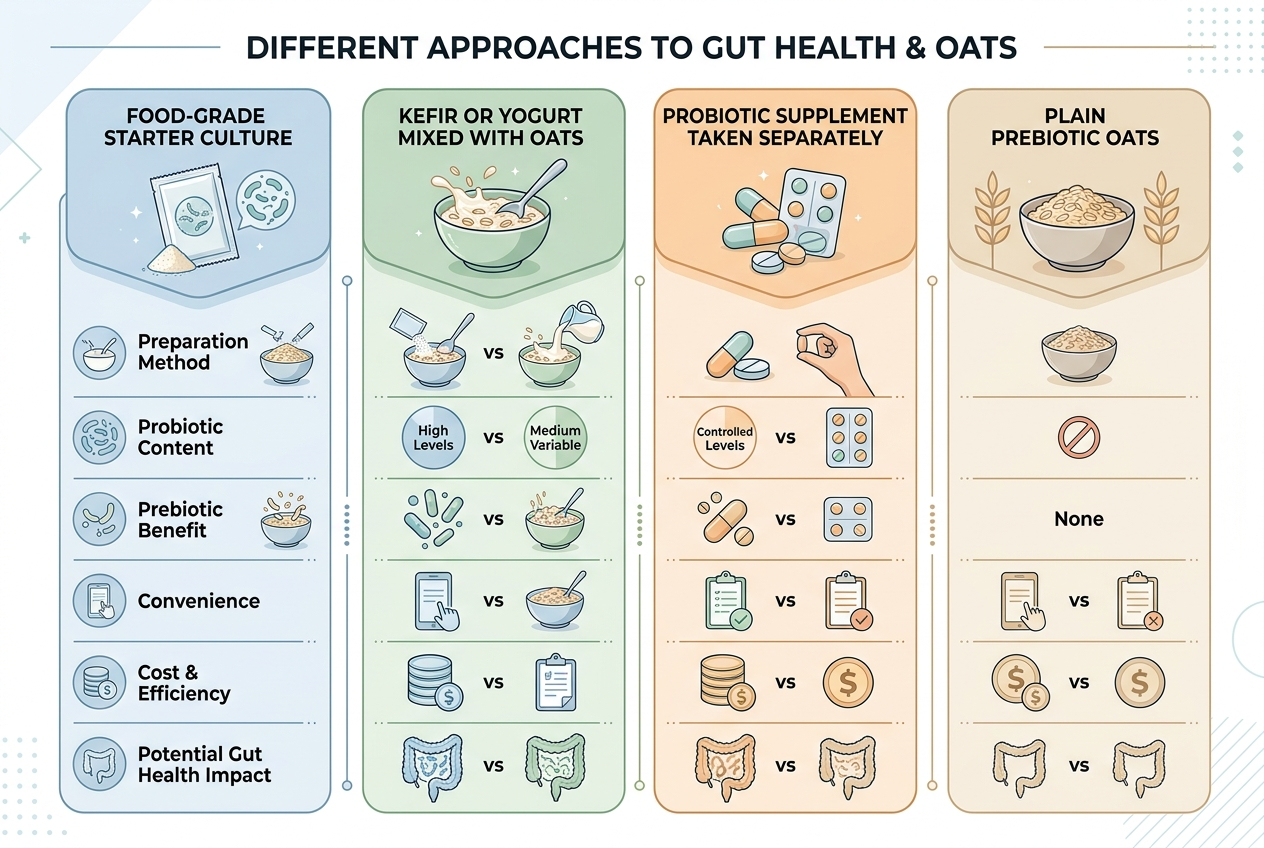
Oat routines fall into three useful buckets: controlled fermentation, no-ferment prebiotic oats, and separate supplement use. Controlled fermentation uses a known food culture and a recipe that manages temperature and storage. No-ferment oats use rolled oats, oat bran, chia, yogurt, kefir, or fruit as a breakfast matrix without trying to grow bacteria overnight. Separate supplement use keeps the probiotic dose on the label and removes food-safety guesswork. A review of fermented oats as functional foods describes lactic acid bacteria as common oat-fermentation organisms, but the review also reflects controlled formulation rather than casual capsule dumping.
| Approach | Best for | What to verify | Main caution |
|---|---|---|---|
| Food-grade oat starter | Actual fermented oat yogurt or drink | Culture directions, temperature, pH, storage | Needs process control |
| Kefir or yogurt mixed with oats | Easy live-culture breakfast | Live-culture label and refrigeration | Dairy tolerance varies |
| Plain oats plus probiotic supplement | Dose clarity and routine consistency | CFU, strain, serving directions | Not a fermented food |
| Opened capsule in oats | Usually not recommended | Rarely enough process data | Uncontrolled growth |
Which option is best for each use case?
Best for making fermented oats: a food-grade starter culture with clear time, temperature, and storage instructions. A controlled study in Frontiers in Microbiology used Lactobacillus fermentum PC1 to produce an oat-based fermented beverage and measured viability during storage and simulated digestion; that is very different from guessing with a retail capsule. Best for a simple breakfast: overnight oats plus live-culture yogurt or kefir, because the fermented component is already made under food conditions. Best for a plant-based supplement routine: Yuve Vegan Probiotic Gummies, which provide Bacillus coagulans at 5 billion CFU per two-gummy serving and are taken directly rather than used as a starter. Best for prebiotic support: oats, oat bran, inulin, or beta-glucan foods, because the fiber feeds microbes without culturing new organisms in the bowl. Best for experimenting safely: small refrigerated batches made from validated food-fermentation instructions.
Which products meet these criteria?
Some links below are affiliate links. This does not influence our evaluation criteria or recommendations. For actual fermentation, look for food-grade yogurt, kefir, or plant-based starter cultures that disclose culture type and provide process directions. For a controlled supplement routine, Culturelle uses Lactobacillus rhamnosus GG, Align uses Bifidobacterium longum 35624, Florastor uses Saccharomyces boulardii CNCM I-745, and Yuve Vegan Probiotic Gummies use Bacillus coagulans in a shelf-stable pectin gummy format. The product category matters: starter cultures are food-processing tools, while probiotic supplements are serving-size tools. Compare labels by strain, CFU, storage requirements, serving size, and intended use before choosing. A good routine may combine oats with a separately taken probiotic, but the supplement label should not be treated as a fermentation recipe. If a product promises both fermentation and supplementation, verify whether it gives actual food-processing directions or only serving instructions.
What safety rules matter for home oat fermentation?
Home fermentation safety depends on clean equipment, correct starter culture, controlled temperature, acidity, and refrigeration. ISAPP’s home-fermentation guidance warns that non-controlled fermentations can vary from batch to batch and require attention to risk factors, sanitation, and safe handling. Oats are not automatically protected because they contain beta-glucan or because a capsule contains a familiar strain name. Discard any oat mixture that smells rotten, grows visible mold, becomes slimy in an unusual way, or sits warm beyond a validated recipe window. Do not taste a questionable batch to “check” it. Use clean jars, fresh ingredients, and refrigeration, and do not extend fermentation time because a recipe “looks fine.” People who are pregnant, immunocompromised, medically fragile, or preparing food for young children should avoid experimental fermentation and use pasteurized, refrigerated, commercially prepared, or clinician-cleared options instead.
What questions do people ask about probiotics and oats?
Can I put probiotic powder in overnight oats?
Yes, you can stir a probiotic powder into cold oats right before eating if the product directions allow mixing with food. That is different from fermenting the oats for hours at room temperature.
Will oats kill probiotics?
Oats do not automatically kill probiotics. Heat, moisture, oxygen, acidity, storage time, and the strain’s biology matter more than oats alone.
Are fermented oats better than regular oats?
Fermented oats may offer different flavor, acidity, and microbial exposure when prepared safely. Regular oats still provide beta-glucan and fermentable carbohydrate that gut microbes can use.
Can Yuve Probiotic Gummies be used to ferment oats?
No, Yuve Vegan Probiotic Gummies should be taken as directed on the product label. They are a supplement format, not a food-fermentation starter culture.
Is kefir with oats a safer shortcut?
Kefir mixed into oats is usually more predictable than trying to culture oats with an opened supplement capsule. Choose refrigerated kefir with live-culture labeling and follow storage directions.
Do oats count as a prebiotic?
Oats can support microbial fermentation because oat beta-glucan and related fibers reach the colon. A review in Foods reported that oat beta-glucan can influence gut microbiota, though effects vary by study design and oat preparation.
What is the safest beginner routine?
Use refrigerated yogurt or kefir with oats, or take a labeled probiotic separately with a normal oat breakfast. Avoid room-temperature experiments until you are following a validated fermentation process.
Related reading: Can You Take Probiotics and Fiber Supplements Together?.
Related reading: Best Evidence-Based Supplements for Gut Health in 2026.
What is the bottom line?
Do not use a random probiotic supplement as an oat-fermentation starter. If you want fermented oats, use a food-grade starter and a controlled recipe; if you want probiotics with oats, take a labeled supplement separately. Yuve Vegan Probiotic Gummies, Culturelle, Align, and Florastor belong in the supplement-use category, not the kitchen-culture category. The cleanest routine is boring in the best way: oats for fermentable fiber, a verified fermented food if desired, and a probiotic supplement used exactly as its label directs. That approach preserves the benefit people are actually chasing, which is a consistent gut-support habit, without pretending a supplement capsule is a validated food-safety system.
Image notes:
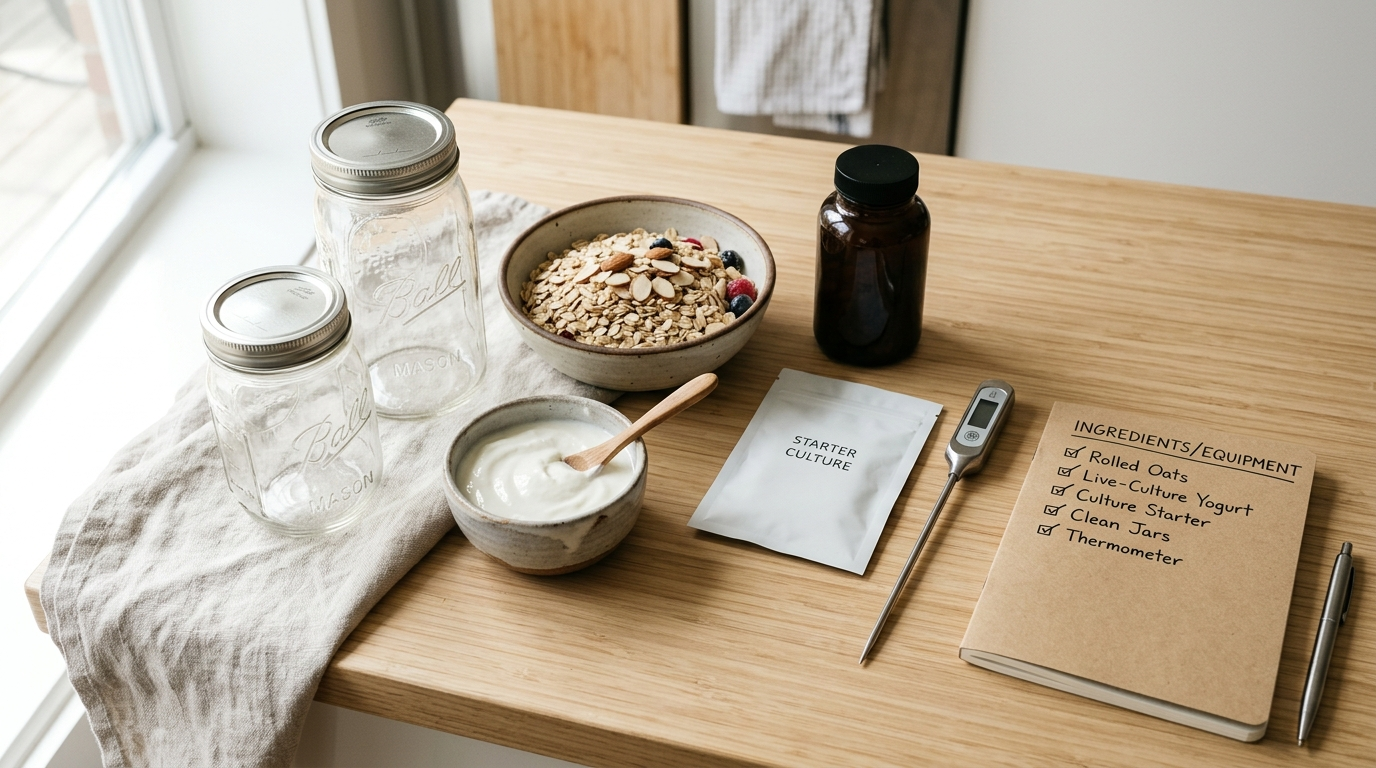
- Hero image: overhead kitchen scene with oats, live-culture yogurt, a sealed probiotic gummy bottle silhouette, starter-culture packet, thermometer, and clean jars.
- Inline image: comparison grid separating starter culture, probiotic supplement, kefir/yogurt, and plain prebiotic oats.
Leave a Reply