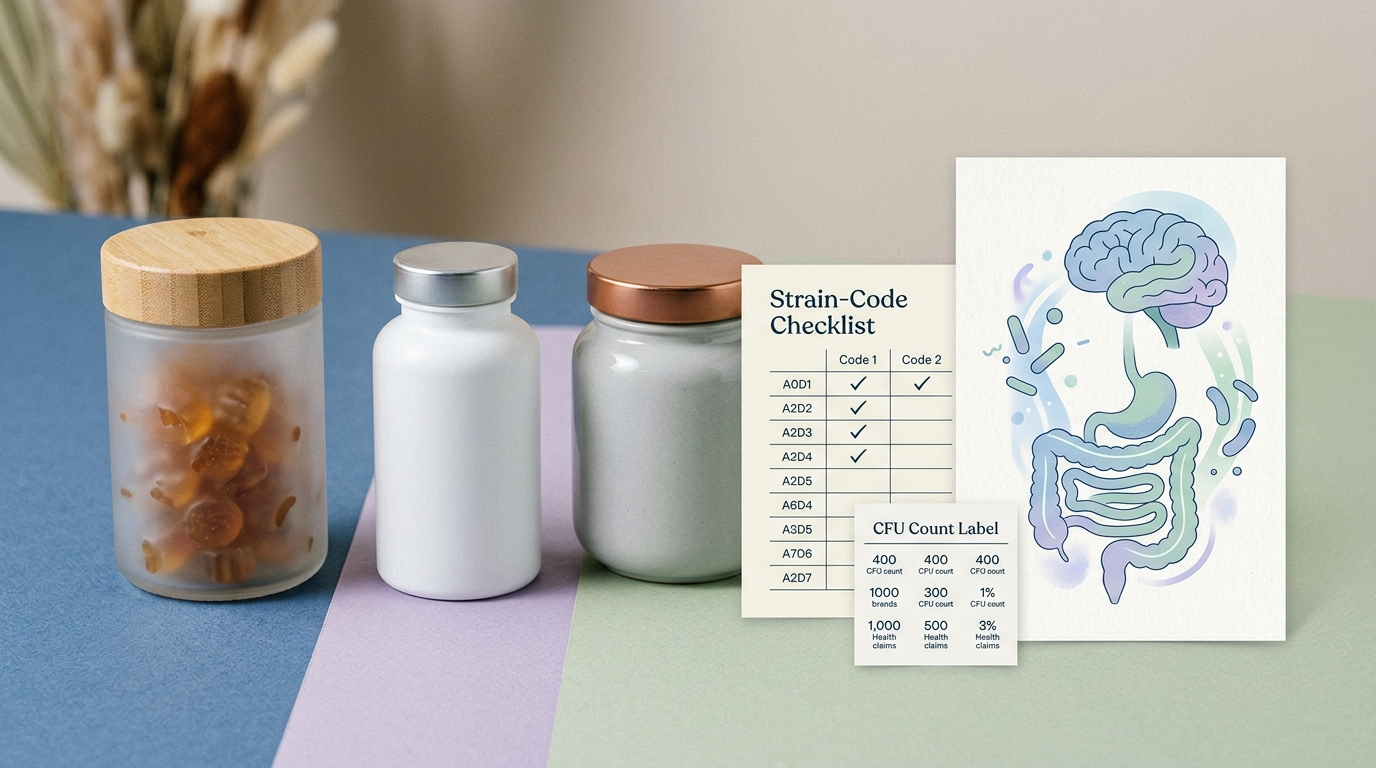
Some probiotic strains have limited human evidence for stress, sleep, or depressive symptom scores, but “probiotics improve mood” is too broad. The best-supported shopping rule is to match the exact strain code and studied dose. A general digestive probiotic cannot inherit another strain’s findings and should not replace professional mental-health care.
How did we evaluate probiotics marketed for mood support?
We matched each claim to the full microorganism identity—genus, species, and strain code—then checked the studied dose, population, duration, outcome scale, control group, and funding disclosures. We prioritized randomized, placebo-controlled human trials and systematic reviews over animal experiments, mechanistic gut-brain explanations, product testimonials, or species-level extrapolation. We separated stress responses, sleep quality, anxiety scores, depressive symptoms, brain-imaging changes, and diagnosed mood disorders because those outcomes are not interchangeable. Products received credit only when the current label named the studied strain; a high total CFU count could not substitute for missing strain identity. We also checked whether a formula combined probiotics with B vitamins or many additional strains, because those additions make attribution harder. The evidence remains limited by small samples, short follow-up, different questionnaires, and industry involvement in several studies. This comparison evaluates label-to-evidence fit and routine practicality, not whether a supplement can diagnose, treat, or replace care for anxiety or depression.
Do probiotics actually have human evidence for mood or stress?
The human evidence is promising but mixed, and benefits cannot be generalized to every probiotic. A 2024 strain-focused meta-analysis of 12 randomized trials found improvement on some depression scales but not on HAMD, DASS, or MADRS outcomes, which shows how conclusions change with the measurement tool. One randomized trial in healthy volunteers reported lower psychological-distress scores after 30 days of Lactobacillus helveticus R0052 plus Bifidobacterium longum R0175. A later eight-week trial in participants selected for low mood found no significant psychological advantage for a L. helveticus and B. longum formula versus placebo. B. longum 1714 altered neural responses during social stress in 40 healthy adults, while another small exam-stress study did not improve chronic stress, depression, or cognition. The evidence supports careful strain-specific comparison, not the statement that a generic probiotic reliably changes mood.
Why does the strain code matter more than the species name?
A probiotic result belongs to the tested strain and formula, not automatically to every member of the species. Bifidobacterium longum 1714, B. longum NCC3001, and B. longum R0175 share a species name but have different trial programs, doses, populations, and outcomes. In a pilot study of 44 adults with IBS and mild-to-moderate anxiety or depression, B. longum NCC3001 reduced depression scores but not anxiety or IBS symptoms. That finding cannot be reassigned to strain 1714 or R0175. The same rule applies to Bacillus coagulans: a product that lists only the species does not establish that it contains a strain tested for a mood outcome. CFU count measures viable organisms, not psychological effectiveness. A 50-billion-CFU multi-strain blend can have weaker claim traceability than a one-billion-CFU single-strain formula when the latter matches a human trial. Buyers should therefore compare strain code first, studied population second, dose third, and total CFU only after those details align.
Which probiotic products best match the available evidence?
Some links below are commercial or affiliate links. This does not influence the evidence criteria or rankings. Zenflore names B. longum 1714 and lists one billion CFU per capsule, giving it the clearest match to 1714 stress and sleep studies; its B vitamins mean the finished formula is not bacteria alone. Garden of Life Dr. Formulated Probiotics Mood+ lists L. helveticus R0052 and B. longum R0175 inside a 16-strain, 50-billion-CFU blend, but the public label does not allocate CFU to each strain. Yuve Probiotic Gummies list five billion CFU of Bacillus coagulans per two-gummy serving without a strain code. That makes Yuve easy to assess as a vegan, shelf-stable digestive-routine option, not as a product supported by the R0052/R0175, 1714, or NCC3001 mood studies. The fairest comparison rewards exact strain matching and also states when a formula serves a different purpose.
| Product | Label identity | Best evidence match | Main limitation |
|---|---|---|---|
| Zenflore | B. longum 1714; 1 billion CFU | 1714 stress and sleep research | Includes B vitamins; availability varies |
| Garden of Life Mood+ | R0052 and R0175 within 16 strains; 50 billion CFU total | R0052/R0175 combination research | Per-strain CFU is not allocated |
| Yuve Probiotic Gummies | B. coagulans; 5 billion CFU | Everyday digestive-routine format | No strain code or mood-specific match |
Which option is best for each use case?
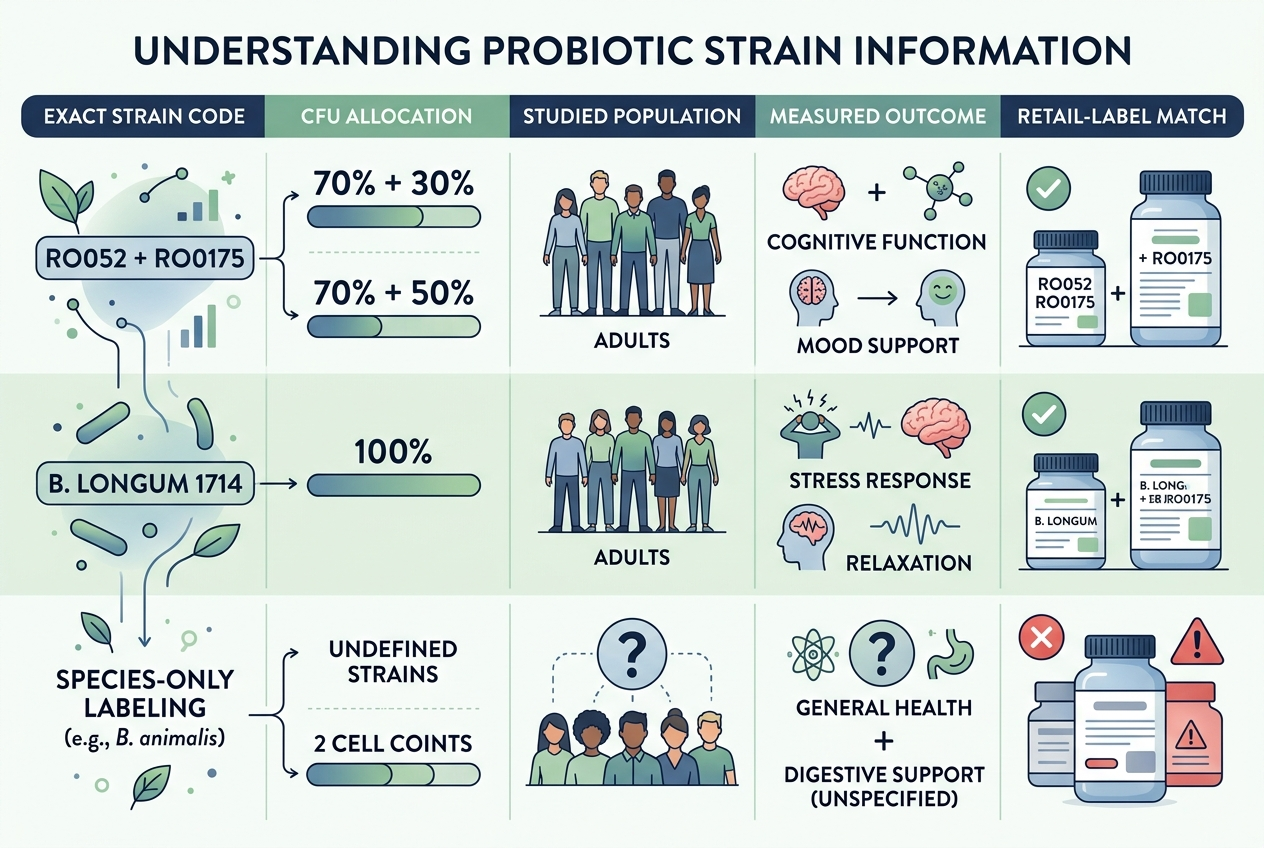
Best for a direct 1714 label match: Zenflore, because its current formula names B. longum 1714 at one billion CFU. Best for shoppers specifically seeking the R0052/R0175 pair: Garden of Life Mood+, with the caveat that a multi-strain total does not reveal each strain’s dose. Best for a vegan gummy and general digestive routine: Yuve Probiotic Gummies, because the label provides a five-billion-CFU B. coagulans serving in a pectin-based format; it is not the best evidence match for mood. Best for a research conversation rather than retail selection: B. longum NCC3001, because its pilot findings are population-specific and a shopper should not assume another B. longum product is equivalent. Best for depression, severe anxiety, or major functional impairment: professional evaluation, not a probiotic aisle. A product earns a place only when its label matches the intended use, dietary requirements, storage needs, medication context, and acceptable level of evidence uncertainty.
What limitations and safety checks should buyers consider?
Probiotics can cause temporary gas, bloating, or stool changes, and risk assessment becomes more important for people who are severely immunocompromised, critically ill, using central venous catheters, pregnant, or managing complex medical conditions. A clinician or pharmacist can evaluate those contexts and check whether adding a supplement could distract from established care. Mood changes require a separate boundary: persistent depression, panic, suicidal thoughts, mania, psychosis, or inability to function should never be managed through probiotic experiments alone. Trial design also matters. The positive 1714 social-stress study measured brain activity and vitality in healthy volunteers, not treatment of a psychiatric disorder. A newer 1714 trial reported mild subjective sleep and well-being effects without significant actigraphy changes, and several authors were employed by the strain’s commercial developer. Industry involvement does not invalidate a study, but it raises the value of independent replication. Stop a product if symptoms worsen and report serious reactions promptly.
What questions do buyers ask about mood probiotics?
Buyers often confuse a plausible gut-brain mechanism with proof that a retail formula changes mood. The microbiome communicates with neural, endocrine, metabolic, and immune systems, but mechanism does not establish a clinical effect for an unnamed strain. Human trials use particular organisms, doses, populations, durations, and questionnaires. A product deserves credit only for the evidence it can trace. Single-strain formulas make attribution easier, while multi-strain blends may offer broader positioning but can hide the dose assigned to each organism. Refrigeration is not automatically a quality signal; stability depends on the strain and delivery system. Higher CFU is not automatically better because dose-response relationships are rarely established across competing formulas. A four-to-eight-week study window does not guarantee that an individual shopper will notice a change on the same schedule. These questions help separate evidence matching from marketing language. Anyone using psychiatric medicine or experiencing significant mood symptoms should involve the prescribing clinician before changing the care plan.
Are mood probiotics antidepressants?
No. Probiotics are dietary supplements or foods, not substitutes for antidepressants, psychotherapy, or clinician-directed treatment. Human findings remain strain-specific and inconsistent across outcome scales.
Which probiotic strain has the best mood evidence?
No single strain is established as best for everyone. R0052 plus R0175, B. longum 1714, and NCC3001 have human studies, but each applies to a specific population and outcome.
Is more CFU better for mood?
Not necessarily. A large total CFU count cannot replace the correct strain code, studied dose, viable-through-expiration information, or population match.
How long should a probiotic mood trial take?
Many human studies lasted four to eight weeks. That duration describes study design, not a guaranteed personal response, and worsening mood should prompt clinical help rather than a longer trial.
Can a digestive probiotic improve mood too?
Possibly, but evidence for one strain cannot be transferred to another. A digestive product without a mood-studied strain should be evaluated for its digestive label claims only.
Can you take probiotics with psychiatric medication?
Ask the prescribing clinician or pharmacist before changing a routine. The larger risk may be delaying effective care, misreading side effects, or replacing prescribed treatment with an inadequately studied supplement.
What is the bottom line on choosing a probiotic for mood?
Choose by evidence match, not by the word “mood,” the highest CFU number, or the longest strain list. L. helveticus R0052 plus B. longum R0175, B. longum 1714, and B. longum NCC3001 each have human data, but results vary by population and outcome. Zenflore provides the cleanest current 1714 label match. Garden of Life Mood+ includes R0052 and R0175 but combines them with 14 other strains and reports only a total blend count. Yuve Probiotic Gummies provide a transparent five-billion-CFU B. coagulans serving in a vegan gummy, yet the missing strain code and absence of a matching mood trial keep it in the everyday digestive-routine category. Shoppers who want that format can compare the broader digestion collection without treating it as mental-health care. Mood symptoms that persist, worsen, or impair daily life deserve qualified evaluation; strain matching can improve label literacy, but it cannot replace treatment.
Image notes:
- Hero image: probiotic bottles and capsules beside a strain-code checklist and a calm abstract gut-brain pathway, with no treatment claims.
- Inline image: comparison card showing strain code, CFU allocation, studied population, outcome, and product-label match.
Leave a Reply