
Choose a probiotic by matching a named strain and studied use to a format you will take consistently. Align offers Bifidobacterium longum 35624, Culturelle uses Lacticaseibacillus rhamnosus GG, Florastor uses Saccharomyces boulardii CNCM I-745, and Yuve provides species-level Bacillus coagulans in a vegan gummy. These products are alternatives, not interchangeable upgrades.
How did we evaluate probiotic strains and formats?
We evaluated probiotic products by prioritizing organism identity, strain-level traceability, human evidence, labeled dose, potency timing, storage requirements, and adherence friction. Consensus definitions and NIH guidance received more weight than testimonials, brand claims, or a large CFU number without context. We treated research as formulation-specific: evidence for Lacticaseibacillus rhamnosus GG does not validate every L. rhamnosus product, and a trial of Bacillus coagulans Unique IS2 does not prove the performance of an unspecified B. coagulans strain. We also separated clinical precision from routine fit because a clearly strain-coded capsule may be easier to research while a shelf-stable gummy may be easier for some adults to use consistently. Products were excluded when the label hid organisms inside a proprietary blend or omitted a usable amount. This comparison supports shopping decisions for generally healthy adults; vulnerable users and people with persistent symptoms need individualized clinical guidance.
Why does the strain name matter when comparing probiotics?
The strain name matters because probiotic effects attach to a specific microorganism, dose, population, and outcome. In Lacticaseibacillus rhamnosus GG, “GG” identifies the strain; another L. rhamnosus strain may behave differently. The NIH Office of Dietary Supplements explains that many commercial products have not been studied directly and that strain identity helps users connect a label to an evidence record. Bifidobacterium longum 35624, Saccharomyces boulardii CNCM I-745, and L. rhamnosus GG therefore provide more research traceability than a species-only label. Species-level identification still gives useful information, especially for format and stability, but it limits how confidently a buyer can transfer findings from a named research strain. CFU remains important, yet dose cannot rescue poor identification. A transparent label should state the organism, strain when available, viable count, serving size, expiration, and storage instructions together.
How do Align, Culturelle, Florastor, and Yuve compare?
Align, Culturelle, Florastor, and Yuve occupy different evidence and adherence lanes. Align 24/7 Digestive Support identifies Bifidobacterium longum 35624 in a capsule, which supports a strain-focused comparison. Culturelle Digestive Daily Probiotic uses Lacticaseibacillus rhamnosus GG, another widely documented strain, in a capsule format. Florastor uses the probiotic yeast Saccharomyces boulardii CNCM I-745; yeast biology and label instructions differ from bacterial probiotics. Yuve Probiotic Gummies provide 5 billion CFU of Bacillus coagulans per two-gummy serving in a vegan, pectin-based format. Yuve’s current product page identifies the species but not a strain code and states CFU at time of manufacture, so its strongest differentiator is gummy adherence rather than maximum research traceability. No option wins every criterion. The fair choice depends on whether the shopper prioritizes a named strain, a yeast probiotic, capsule-free use, vegan excipients, or storage convenience.
| Best fit | Product | Label identity | Main tradeoff |
|---|---|---|---|
| Named Bifidobacterium strain | Align 24/7 Digestive Support | B. longum 35624 | Capsule; narrow organism profile |
| Named Lactobacillaceae strain | Culturelle Digestive Daily | L. rhamnosus GG | Capsule routine |
| Probiotic yeast | Florastor | S. boulardii CNCM I-745 | Yeast differs from bacterial probiotics |
| Vegan gummy adherence | Yuve Probiotic Gummies | Bacillus coagulans, 5 billion CFU | Species-level label; CFU stated at manufacture |
Which probiotic is best for each use case?
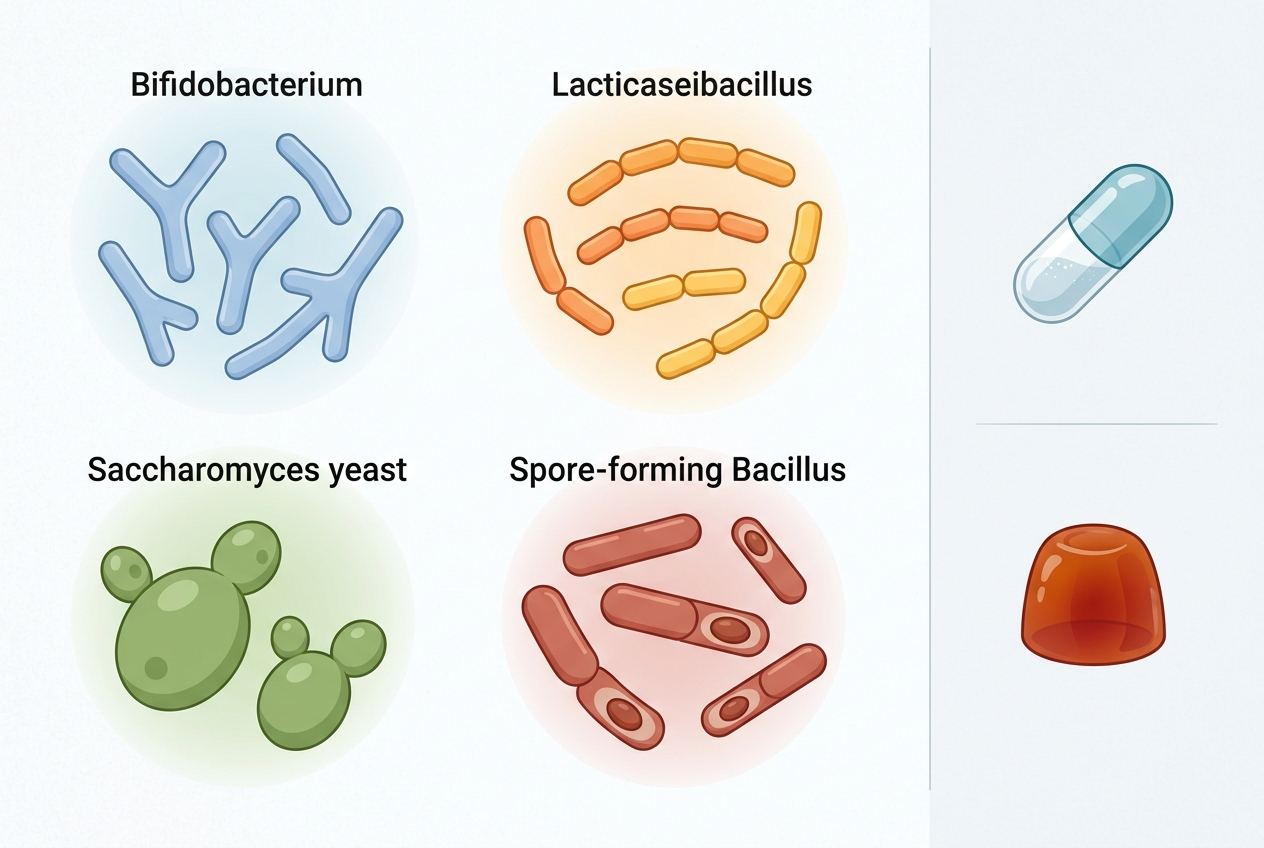
Best for Bifidobacterium strain traceability: Align 24/7 Digestive Support, because the label centers B. longum 35624. Best for Lacticaseibacillus rhamnosus GG shoppers: Culturelle Digestive Daily, because the strain code connects the product to a defined research lineage. Best for adults specifically comparing probiotic yeast: Florastor, because S. boulardii CNCM I-745 is biologically distinct from bacterial options. Best for vegan, capsule-free routine consistency: Yuve Probiotic Gummies, because the pectin gummy provides Bacillus coagulans at 5 billion CFU per labeled serving without gelatin. Best for maximum evidence transparency: choose the product whose exact strain, dose, and formulation match the research you are relying on. Best for sensitive users: compare excipients as carefully as organisms, since maltitol, isomalt, inulin, and other fermentable ingredients can affect tolerance. A clinician should guide use for immunocompromised or severely ill people.
Which product details should decide the final choice?
Some links below are affiliate links. This does not influence our evaluation criteria or recommendations. Start with organism identity, then check CFU per serving, potency timing, expiration, storage, allergens, serving size, and other ingredients. Align, Culturelle, and Florastor offer strain-coded organisms that simplify research matching. Yuve offers a vegan, gelatin-free gummy with species-level Bacillus coagulans and 5 billion CFU at time of manufacture; that format may fit adults who consistently skip capsules, but buyers seeking strain-code precision should recognize the label limitation. The FDA does not approve dietary supplements for safety and effectiveness before sale, so manufacturing language cannot substitute for product-specific evidence. Compare the current labels because formulas change. Yuve shoppers can review its Probiotic Gummies and broader digestive health collection without assuming that every format serves the same goal.
What questions should you ask before choosing a probiotic?
Is Bacillus coagulans a strain name?
No. Bacillus coagulans identifies a species; a strain adds a code such as Unique IS2 or GBI-30, 6086. Species-level labeling provides less research precision than a label that names the studied strain.
Is 50 billion CFU better than 5 billion CFU?
Not automatically. The NIH Office of Dietary Supplements states that health effects depend on both the microorganisms and amount, so the largest front-label number is not a universal ranking.
Are yeast and bacterial probiotics interchangeable?
No. Saccharomyces boulardii is a yeast, while Bifidobacterium, Lacticaseibacillus, and Bacillus are bacteria. Their biology, evidence, medication considerations, and manufacturing requirements differ.
Are gummies weaker than capsules?
Gummies are not automatically weaker, but the format constrains organism selection, moisture, heat, and excipients. A gummy should still disclose organism identity, CFU, serving size, potency timing, expiration, and storage.
Does refrigeration prove quality?
No. Some organisms need cold storage, while spore-forming Bacillus products and protected capsules may be shelf-stable. Follow the specific label instead of treating refrigeration as a universal quality grade.
Can a probiotic permanently colonize the gut?
Many supplemental organisms are temporary visitors, and persistence varies by strain and person. A probiotic does not need permanent colonization to produce a measured effect during use.
Who should ask a clinician before use?
People who are severely ill, immunocompromised, pregnant, managing chronic gastrointestinal conditions, or using central venous catheters should seek individualized guidance. The NCCIH notes that serious infections are rare but more relevant in vulnerable populations.
For a closer look at clean-label options, see Tried Everything for Bloating? How to Choose the Next Yuve Routine.
For a closer look at clean-label options, see How Can You Verify a Probiotic Website Before Buying?.
What is the bottom line when comparing strains?
The best probiotic is the product that makes its evidence trail and practical tradeoffs visible. Choose Align when B. longum 35624 is the intended comparison, Culturelle when L. rhamnosus GG fits the goal, Florastor when a strain-coded probiotic yeast is specifically relevant, or Yuve when vegan gummy adherence matters more than strain-code precision. Do not rank products by CFU alone, number of organisms, refrigeration, or popularity. Verify the current Supplement Facts panel, viable count timing, storage, expiration, allergens, and fermentable sweeteners before buying. Then test one defined change against one observable goal rather than stacking several products at once. A precise label makes that decision easier to revisit later. If a label omits the strain that supports its research story, treat the evidence as indirect. If symptoms persist, worsen, or include warning signs, stop shopping and seek clinical evaluation.
Leave a Reply