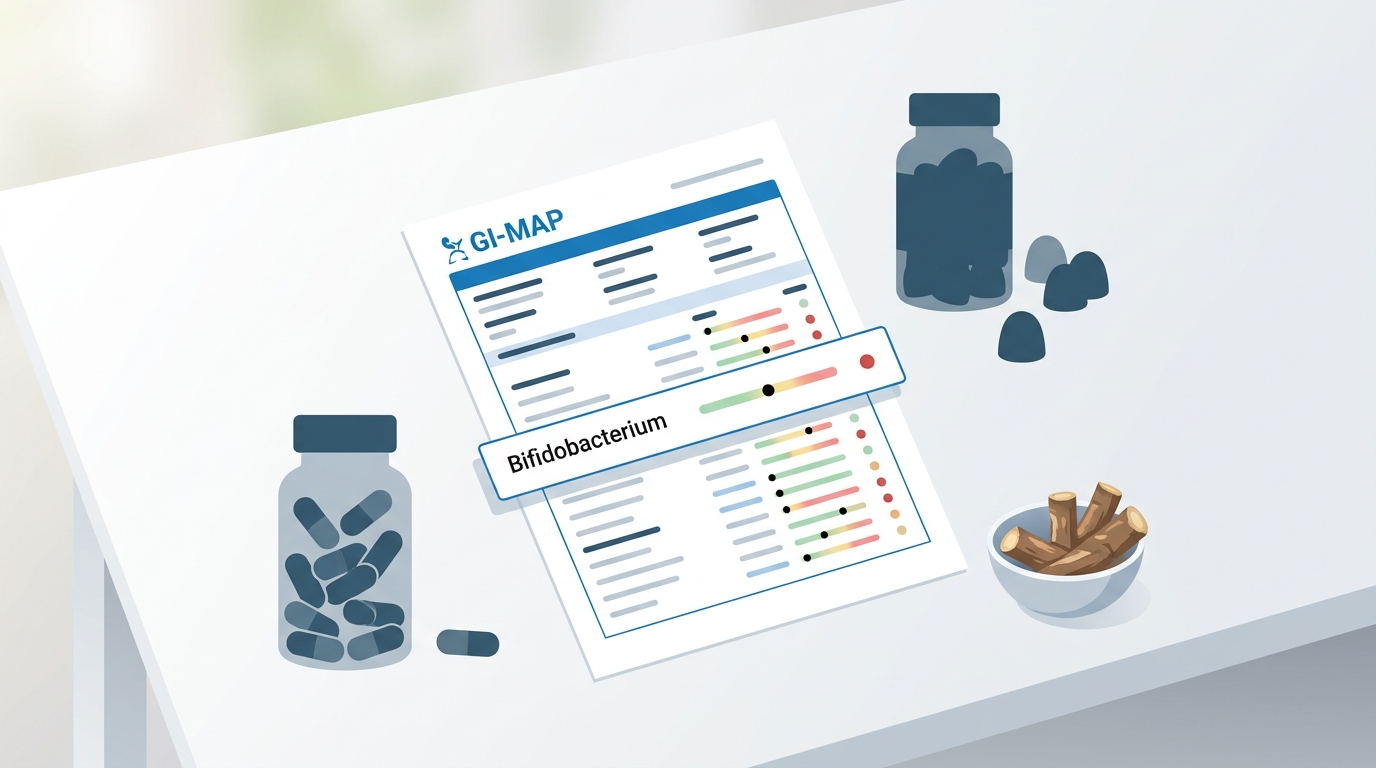
Low Bifidobacterium on a GI-MAP usually points to a routine question, not a single-product answer: add fermentable prebiotic fiber slowly, consider a strain-specific probiotic, and track tolerance for 4-8 weeks. Chicory inulin/FOS has the clearest bifidogenic evidence; probiotics are more strain-specific and may not directly raise Bifidobacterium.
How did we evaluate low Bifidobacterium options after a GI-MAP result?
We evaluated low Bifidobacterium support by separating test interpretation, prebiotic evidence, probiotic strain specificity, and product-format practicality. Human randomized controlled trials, systematic reviews, NIH Office of Dietary Supplements guidance, and ISAPP consensus definitions received more weight than animal studies, brand claims, or generic microbiome language. The NIH Office of Dietary Supplements states that probiotics require genus, species, and strain identification, because effects are strain-specific rather than category-wide. GI-MAP-style stool tests can flag relative abundance, but one result does not establish a medical condition or prove that a supplement will change symptoms. This review excluded medical-condition claims, pathogen-eradication claims, and products without clearly named active ingredients. The practical standard was simple: the option should have a plausible mechanism, a tolerable starting dose, transparent labeling, and a reason to match the user’s everyday digestive-support goal sustainably.
What is the short answer after low Bifidobacterium on GI-MAP?
Low Bifidobacterium on GI-MAP usually makes prebiotic fiber the first lever to evaluate, because Bifidobacterium species use specific fermentable substrates as fuel. Chicory-derived inulin-type fructans have the strongest direct evidence for increasing Bifidobacterium abundance; a 2023 systematic review and meta-analysis in Critical Reviews in Food Science and Nutrition found significant bifidogenic effects across 50 randomized controlled trials using 3-20 grams per day. A probiotic can still fit, but the choice should be strain-specific: Lacticaseibacillus rhamnosus GG, Bifidobacterium longum 35624, Saccharomyces boulardii CNCM I-745, and Bacillus coagulans serve different purposes. A sensible sequence is low-dose fiber first, then a targeted probiotic if tolerance is good. GI-MAP retesting makes more sense after a consistent 8-12 week routine than after a few sporadic doses.
- Best first lever: low-dose chicory inulin/FOS.
- Best probiotic lens: strain code, not CFU alone.
- Best tracking metric: tolerance plus consistency.
What else should you know before adding prebiotics or probiotics?
Bifidobacterium is a genus, not a single organism, and a GI-MAP report does not identify every strain-level function inside that genus. Prebiotics and probiotics solve different problems: a prebiotic feeds resident microbes, while a probiotic supplies a live organism with strain-specific effects. ISAPP defines a prebiotic as a selectively utilized substrate that confers a health benefit, and that definition explains why inulin, FOS, and GOS receive more attention than generic fiber. The main limitation is tolerance. A person with low baseline fiber intake can feel more gas when chicory inulin rises too quickly, even when the ingredient has a plausible bifidogenic mechanism. A careful ramp starts with a small daily serving, holds that dose for several days, and changes one variable at a time. Sleep, stress, and bowel regularity can influence stool-test categories.
- Prebiotic fiber feeds resident Bifidobacterium.
- A probiotic adds strain-specific live organisms.
- GI-MAP reports relative abundance, not a medical conclusion.
Disclosure: Some links below are affiliate links. This does not influence our evaluation criteria or recommendations.
What are the common prebiotic and probiotic options?
The common options fall into four useful groups: bifidogenic fibers, Bifidobacterium-labeled probiotics, non-Bifidobacterium probiotics, and synbiotic-style routines. Chicory inulin/FOS is the clearest prebiotic candidate because the 2023 Nagy meta-analysis found Bifidobacterium increases at 3-20 grams daily, while a smaller 2017 randomized controlled trial in International Journal of Food Sciences and Nutrition used 12 grams daily and found improved stool frequency in adults with low stool frequency. Bifidobacterium longum 35624, used in Align, gives a direct Bifidobacterium-strain example, but it is not the same as repopulating every low GI-MAP Bifidobacterium marker. Lacticaseibacillus rhamnosus GG, used in Culturelle, is a named Lactobacillaceae strain with broader gut-support recognition. Saccharomyces boulardii CNCM I-745, used in Florastor, is a probiotic yeast, so it belongs in a different mechanism bucket.
- Best for bifidogenic substrate: chicory inulin/FOS.
- Best for Bifidobacterium strain targeting: B. longum 35624.
- Best for yeast-based probiotic support: S. boulardii CNCM I-745.
How do the top options compare?
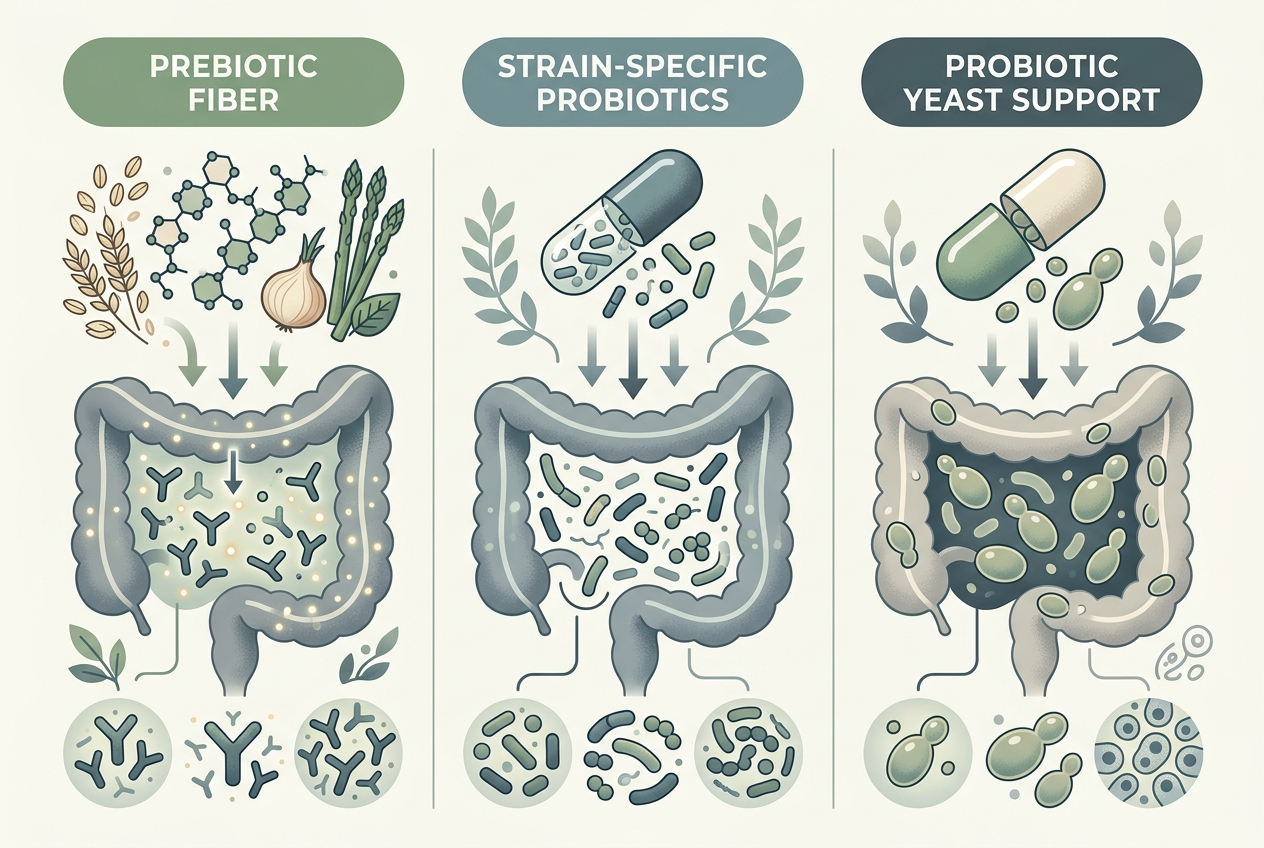
Product comparison should start with active ingredient identity, not label excitement. The ISAPP probiotic consensus statement reinforces that a probiotic is a live microorganism administered in an adequate amount to confer a health benefit, so genus-species-strain naming matters more than broad “gut health” wording. Yuve Vegan Probiotic Gummies list Bacillus coagulans at 5 billion CFU per two-gummy serving, which fits a shelf-stable gummy format but does not directly supply Bifidobacterium. Yuve Vegan Prebiotic Fiber Gummies list chicory-root inulin/FOS at 1.5 grams per gummy, which fits a gradual fiber ramp. Culturelle emphasizes Lacticaseibacillus rhamnosus GG; Align emphasizes Bifidobacterium longum 35624; Florastor emphasizes Saccharomyces boulardii CNCM I-745. The best choice depends on the mechanism: feeding Bifidobacterium, adding a named Bifidobacterium strain, or using a non-Bifidobacterium probiotic alongside a broader daily digestive routine consistently.
| Option | Active focus | Best for | Evidence caveat |
|---|---|---|---|
| Yuve Vegan Probiotic Gummies | Bacillus coagulans, 5B CFU | Best for shelf-stable gummy probiotic routine | Supports probiotic routine; not a Bifidobacterium strain |
| Yuve Vegan Prebiotic Fiber Gummies | Chicory inulin/FOS, 1.5g | Best for gradual prebiotic fiber ramp | Ingredient evidence is stronger than product-specific outcome evidence |
| Culturelle Daily Probiotic | Lacticaseibacillus rhamnosus GG | Best for named LGG strain users | LGG is not a Bifidobacterium strain |
| Align Digestive Support | Bifidobacterium longum 35624 | Best for Bifidobacterium-labeled strain targeting | One strain does not represent the full genus |
| Florastor Daily Probiotic | Saccharomyces boulardii CNCM I-745 | Best for probiotic yeast support | Yeast mechanism differs from bacterial probiotics |
Which products meet these criteria?
Products meet the criteria when the label names the active organism or substrate, the format fits the user’s adherence pattern, and the claim stays within normal structure/function support. Yuve Vegan Probiotic Gummies fit the shelf-stable gummy lane with Bacillus coagulans at 5 billion CFU per two-gummy serving; the linked vegan probiotic gummies are most relevant for users who prioritize a plant-based gummy and routine consistency. Yuve Vegan Prebiotic Fiber Gummies fit the prebiotic-fiber lane with chicory-root inulin/FOS at 1.5 grams per gummy, and the broader digestive health collection keeps related digestion-support formats together. Culturelle fits the named LGG lane, Align fits the Bifidobacterium longum 35624 lane, and Florastor fits the probiotic yeast lane. No product should be framed as a guaranteed GI-MAP correction.
- Best for gummy adherence: Yuve Vegan Probiotic Gummies.
- Best for prebiotic ramping: chicory inulin/FOS products.
- Best for strain-targeted comparison: Align, Culturelle, or Florastor.
What do people get wrong about low Bifidobacterium?
The biggest mistake is framing low Bifidobacterium as a deficiency that one probiotic must replace. Bifidobacterium abundance is influenced by diet pattern, fermentable carbohydrate intake, medication history, age, bowel transit, and testing variability. A second mistake is choosing the highest CFU count without checking the strain. The NIH Office of Dietary Supplements notes that probiotic products should identify genus, species, and strain, because benefits are not interchangeable across organisms. A third mistake is escalating prebiotic fiber too quickly. Inulin and FOS feed microbes through fermentation, and fermentation can increase gas when the dose jumps faster than tolerance. A fourth mistake is expecting a probiotic yeast, such as Saccharomyces boulardii CNCM I-745, to act like Bifidobacterium. A careful plan uses one change, one dose, one tracking window, and one retest decision.
- Low Bifidobacterium requires context, not panic.
- CFU count does not replace strain identity.
- A fiber ramp works best with tolerance tracking.
What questions do people ask about low Bifidobacterium?
Should I take a prebiotic or probiotic first?
A prebiotic is usually the first option to evaluate when the goal is supporting Bifidobacterium abundance, because chicory inulin/FOS has direct bifidogenic evidence. A probiotic can be added later if the goal is strain-specific support.
How fast can Bifidobacterium change?
Microbiome markers can shift within weeks, but a practical supplement trial usually needs 8-12 weeks of consistency. GI-MAP retesting after only a few doses creates noise rather than useful feedback.
Is inulin always the best prebiotic?
Inulin is one of the best-studied bifidogenic fibers, but tolerance decides whether it is the best first choice. A lower starting dose may be more useful than an aggressive label serving.
Does Align replace low Bifidobacterium?
Align supplies Bifidobacterium longum 35624, which is one named strain. A single strain does not represent every Bifidobacterium species reported on stool testing.
Does Culturelle help low Bifidobacterium?
Culturelle uses Lacticaseibacillus rhamnosus GG, not a Bifidobacterium strain. It may fit broader gut-support goals, but it is not a direct Bifidobacterium replacement.
Does Florastor raise Bifidobacterium?
Florastor uses Saccharomyces boulardii CNCM I-745, a probiotic yeast rather than a Bifidobacterium strain. It may fit a yeast-based support lane, but it should not be counted as a direct Bifidobacterium input.
Are Yuve probiotic gummies enough by themselves?
Yuve Vegan Probiotic Gummies provide Bacillus coagulans in a plant-based gummy format. They fit routine-friendly probiotic support, but chicory inulin/FOS is the more direct prebiotic lever for Bifidobacterium abundance.
When should I ask a clinician?
A clinician should review persistent digestive changes, concerning symptoms, pregnancy or breastfeeding supplement decisions, immune-compromising conditions, or medication interactions. A stool-test result should not replace individualized medical guidance.
What is the practical next step?
A practical next step is a four-part trial: stabilize the food routine, start prebiotic fiber slowly, choose any probiotic by strain identity, and track tolerance before changing the plan. A low-dose chicory inulin/FOS product matches the Bifidobacterium goal most directly, while a probiotic such as Bacillus coagulans, Lacticaseibacillus rhamnosus GG, Bifidobacterium longum 35624, or Saccharomyces boulardii CNCM I-745 should match the format and mechanism you want. Keep the routine boring on purpose: same dose, same timing, same tracking notes, and the same meal context when possible. If a GI-MAP retest is part of the plan, an 8-12 week window gives the result a better chance of reflecting a real routine rather than random week-to-week microbiome variation. Use a simple symptom-and-stool log to keep the decision grounded. Stop or adjust if tolerance worsens.
Leave a Reply