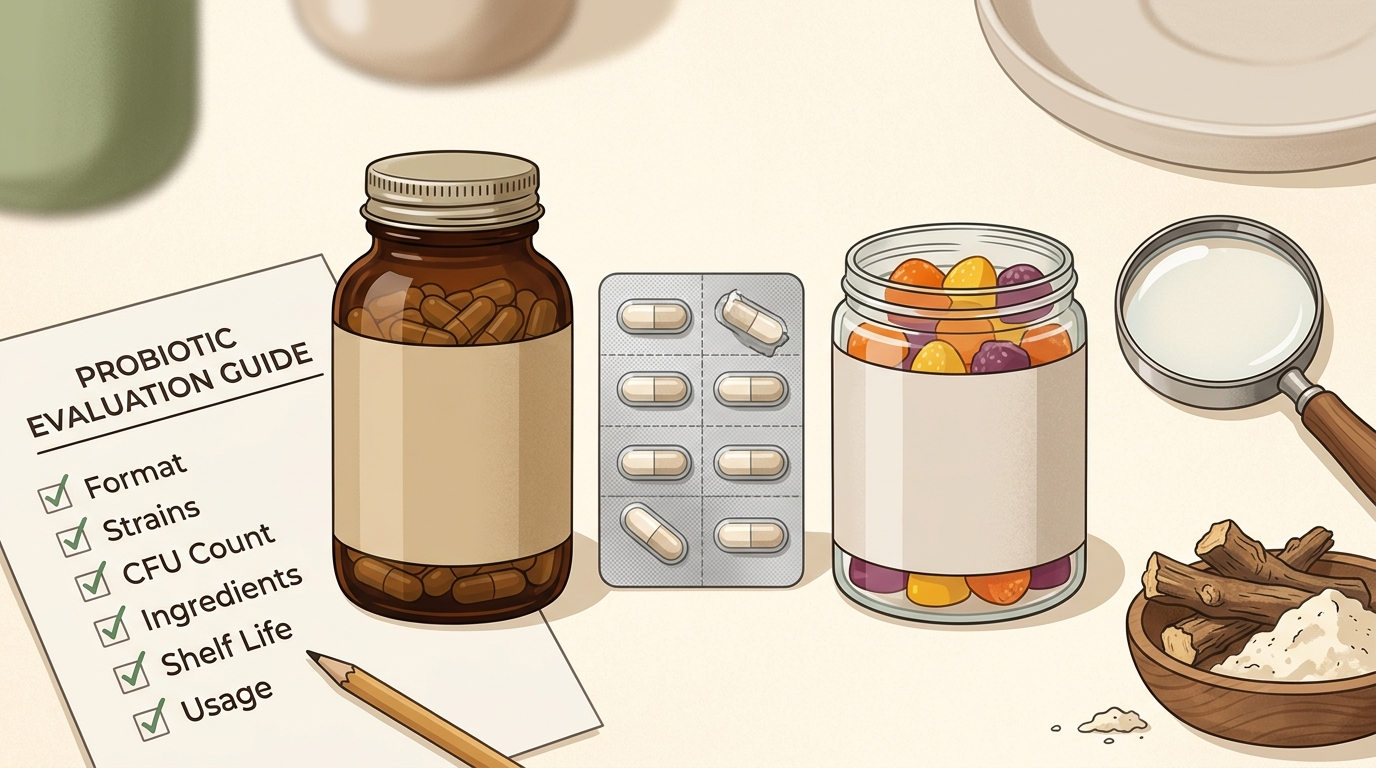
SlimLeaf is marketed online as a synbiotic capsule combining a 500-million-CFU probiotic blend with chicory inulin and potato resistant starch. The name appears across multiple near-identical websites with inconsistent organism lists, so verify the seller and purchased label before buying. Ingredient research does not establish that the finished formula delivers its advertised results.
How did we evaluate SlimLeaf and its alternatives?
We evaluated SlimLeaf by comparing the ingredient identities, strain disclosure, live-microbe count, prebiotic amounts, serving directions, seller identity, manufacturing language, and evidence attached to the finished product. We prioritized the NIH Office of Dietary Supplements probiotic fact sheet, FDA explanations of supplement oversight, FTC substantiation guidance, human randomized trials, and current manufacturer pages over testimonials, countdown timers, star ratings, or “clinically studied ingredients” language. We excluded claims that ingredient research automatically proves a finished blend, that an FDA-registered facility means FDA approval, or that one microbiome marker predicts an individual result. Public SlimLeaf pages differ in their listed probiotic organisms, and none of the pages reviewed provided a clearly linked finished-product randomized trial. This comparison therefore evaluates what a shopper can verify as of August 15, 2026; it does not authenticate a seller, test a bottle, or predict digestive or metabolic outcomes for an individual user.
What does the SlimLeaf formula disclose?
The page at sliemleaf.com describes a proprietary probiotic blend totaling 500 million CFU and names Clostridium butyricum and Akkermansia muciniphila, plus 211 mg of chicory inulin and 100 mg of potato resistant starch. Another SlimLeaf-branded page at slimsleaf.com adds Bifidobacterium infantis to what appears to be the same 500-million-CFU blend. Neither public description reviewed assigns a strain code or individual CFU amount to each organism. The NIH probiotic fact sheet explains that probiotic effects depend on the specific microorganism and amount, while higher total CFU counts alone do not guarantee greater benefit. SlimLeaf’s disclosed prebiotic amounts are measurable, but the pages do not connect those exact quantities and that exact blend to a finished-product human trial. A shopper should photograph the purchased Supplement Facts panel and compare the organism list, total CFU statement, expiration guarantee, serving size, and seller with the page used at checkout.
Why does the seller and label identity matter?
Search results currently surface several SlimLeaf-branded domains with similar layouts, repeated marketing language, and differing organism lists. That does not prove that a page or bottle is illegitimate, but it prevents a careful reviewer from treating every “official” result as the same verified product. The comparison should begin with the legal business name, contact address, return terms, subscription authorization, lot number, Supplement Facts image, and payment descriptor. A claim that a product comes from an “FDA Approved Facility” also requires correction: the FDA explains that it does not approve dietary supplements, and facility registration or inspection does not independently mean FDA approval of the facility or formula. GMP language describes a manufacturing-control framework, not clinical effectiveness. Preserve the checkout confirmation and label because a web page can change after purchase. If the bottle’s organism list, serving, or business identity differs from the sales page, pause use and request clarification before relying on any advertised benefit.
How do SlimLeaf, Pendulum Akkermansia, and Yuve compare?
Some links below are affiliate links. This does not influence our evaluation criteria or recommendations. SlimLeaf presents a synbiotic concept but uses a proprietary 500-million-CFU blend, omits strain codes on the reviewed pages, and appears under differing online organism lists. Pendulum Akkermansia identifies live Akkermansia muciniphila as its central organism and distinguishes preclinical evidence from consumer-survey claims on its current page, although shoppers still need the purchased label for dose, strain, excipients, and expiration details. Yuve Probiotic Gummies list 5 billion CFU of Bacillus coagulans per two-gummy serving and disclose other ingredients, but the public page does not show a strain code and the formula does not include SlimLeaf’s inulin-plus-resistant-starch combination. These are not clinically interchangeable products. The comparison ranks disclosure and use case, not universal effectiveness. Prices, subscriptions, and formulas can change, so verify checkout terms and the exact package rather than treating a search snippet, review page, or ingredient study as current product evidence.
| Option | Current public disclosure | Best for | Main limitation |
|---|---|---|---|
| SlimLeaf | 500 million CFU proprietary blend; chicory inulin 211 mg; potato resistant starch 100 mg | Shoppers specifically seeking a combined probiotic-prebiotic concept | Reviewed pages differ on organism list and omit strain-level amounts |
| Pendulum Akkermansia | Live A. muciniphila positioned as the central organism | Shoppers specifically seeking a directly identified Akkermansia product | Current product page leans on preclinical and survey evidence for several claims |
| Yuve Probiotic Gummies | 5 billion CFU B. coagulans per two gummies; full other-ingredient list | Vegan gummy format and routine convenience | No public strain code; no included prebiotic blend |
What does the Akkermansia evidence actually establish?
Akkermansia muciniphila is a biologically interesting species, but evidence for one preparation cannot validate every capsule that names the organism. A 2026 randomized trial studied pasteurized A. muciniphila MucT after an eight-week low-energy diet in adults who had already achieved at least 8% weight loss; that specific controlled design differs from an unspecified live organism inside a multi-ingredient synbiotic. Product effects can depend on strain, live versus pasteurized state, dose, manufacturing, storage, accompanying ingredients, population, and measured outcome. SlimLeaf’s reviewed pages invoke studies of ingredients but do not link a randomized human trial of the complete commercial formula. Pendulum’s current page labels several gut-lining statements as preclinical and separately labels percentages as consumer-survey results, which are not randomized clinical outcomes. The responsible conclusion is narrow: A. muciniphila has emerging human research, while any finished-product claim still requires evidence for a sufficiently comparable preparation and use. Species name alone is not clinical equivalence.
Which product is best for each use case?
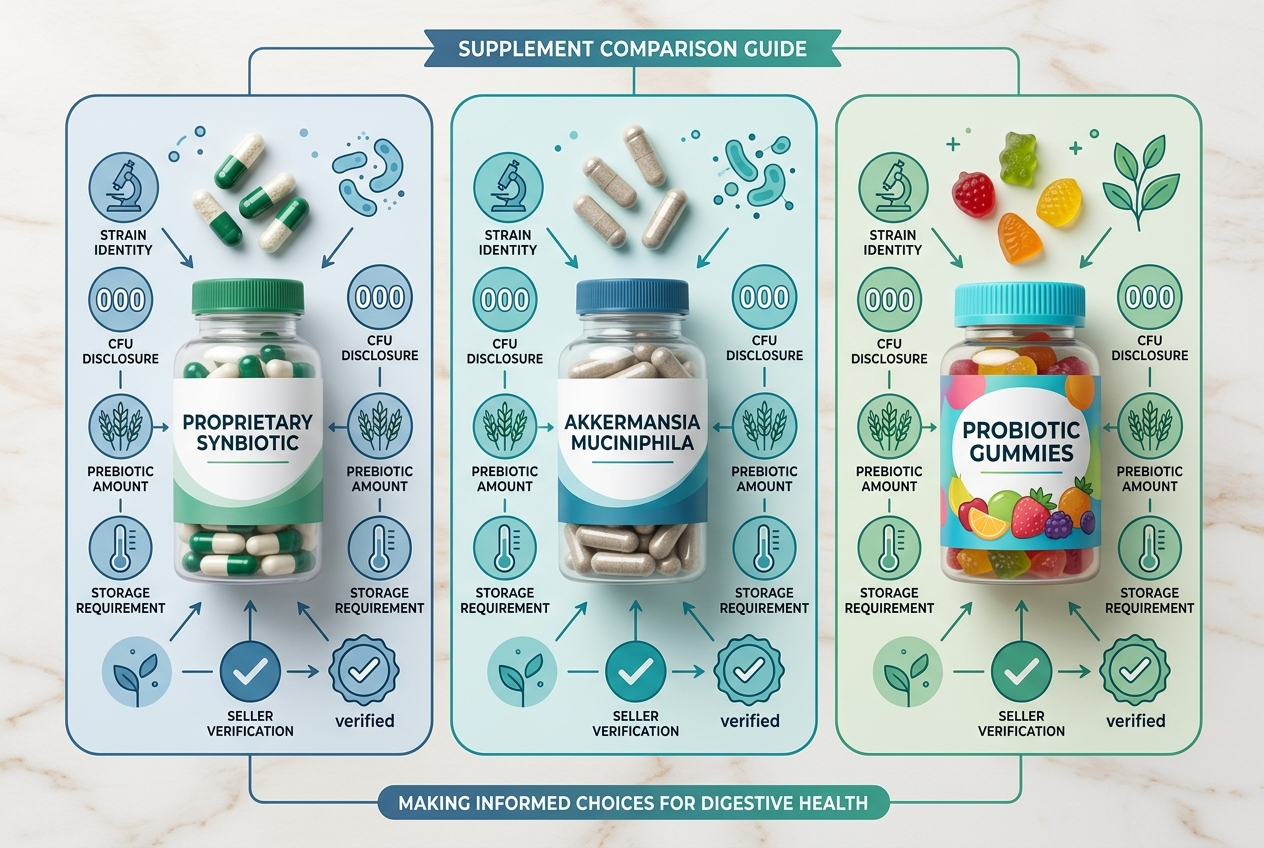
Best for a label-first synbiotic comparison: SlimLeaf only after the purchased bottle matches the seller page, the business identity is clear, and the proprietary-blend limitation is acceptable. Best for directly identified Akkermansia: Pendulum Akkermansia, with the caveat that preclinical findings and consumer surveys should not be read as finished-product randomized evidence. Best for a vegan gummy routine: Yuve Probiotic Gummies, which disclose 5 billion CFU of B. coagulans per two gummies but do not publish a strain code on the current page. Best for increasing fermentable fiber: food sources or a dedicated prebiotic with a declared gram amount may be easier to evaluate than 311 mg of combined prebiotic ingredients inside a broad blend. Shoppers comparing digestive formats can review Yuve’s digestion collection. The best choice is the option whose identity, amount, storage, evidence, and format match one defined goal without relying on unsupported superiority language.
For a closer look at clean-label options, see Is Toniiq Probiotic 200 Worth It? CFU, Strains, and Alternatives.
FAQ: Is SlimLeaf legitimate or a scam?
The available public information does not support a responsible one-word verdict, and multiple SlimLeaf-branded domains use similar copy while presenting inconsistent probiotic organism lists, so a shopper should verify the legal seller, contact information, label, lot, payment descriptor, subscription terms, and refund process before purchase. Website ambiguity is a reason for stronger verification, not proof of fraud; likewise, a polished page, star rating, countdown timer, money-back promise, or “official” label does not authenticate a supplement. If the purchased bottle matches the chosen seller’s Supplement Facts and the business answers documentation questions, evaluate the formula on its disclosed merits; if the seller cannot identify the responsible company, provide a stable label, explain recurring billing, or reconcile ingredient differences, do not proceed until those gaps are resolved. Consumers can also preserve screenshots and report deceptive marketing or billing concerns through the appropriate payment provider, state consumer office, or FTC complaint channel.
FAQ: Does SlimLeaf contain live Akkermansia muciniphila?
SlimLeaf-branded pages claim that the proprietary blend includes Akkermansia muciniphila, but the reviewed pages do not show a strain code, per-organism amount, viability method, or finished-product certificate confirming what remains live through expiration. The product’s public claim is therefore evidence about what the seller says, not independent verification of the purchased bottle. A buyer should ask whether the CFU guarantee applies at manufacture or expiration, how Akkermansia muciniphila viability is measured, what storage conditions protect the anaerobic organism, and whether a lot-specific certificate identifies the species; Pendulum’s manufacturing discussion illustrates why this matters because the organism is oxygen-sensitive and requires specialized production before stabilization, although one company’s process does not establish what another uses. Do not infer live-organism delivery from an ingredient list alone, and do not infer a health outcome from live-organism delivery alone; identity, viability, strain, dose, storage, and comparable human evidence are separate requirements.
FAQ: Is 500 million CFU enough in a probiotic?
No universal minimum CFU count determines whether a probiotic is enough because the relevant amount depends on the exact strain, intended use, formulation, viability through expiration, and human evidence. NIH guidance explicitly notes that a higher CFU number does not necessarily produce a greater benefit, which prevents a simple ranking of SlimLeaf’s 500 million CFU against Yuve’s 5 billion CFU or another product’s larger number. SlimLeaf also pools its organisms inside a proprietary total, so the public pages do not reveal how much belongs to Akkermansia muciniphila, Clostridium butyricum, or the Bifidobacterium infantis named on one version; ask whether a finished-product trial used the same organisms and amounts, then confirm whether the label guarantees viable organisms through the use-by date. A small evidence-matched dose can be more defensible than a large unrelated count, but a total with no strain allocation or comparable trial leaves the shopper unable to make that match.
FAQ: Do SlimLeaf’s inulin and resistant starch amounts matter?
Yes, because a prebiotic effect depends on substrate identity and dose rather than the mere presence of a fiber name. SlimLeaf pages disclose 211 mg of chicory inulin and 100 mg of potato resistant starch, totaling 311 mg before considering whether the exact source and processing match published studies. Many dietary fiber interventions use gram-scale amounts, so ingredient research at larger doses cannot be transferred automatically to a few hundred milligrams; the formula might still contribute substrate, but the magnitude and outcome require direct evidence, comparison with the label’s total dietary fiber and serving instructions, and a match to doses in any cited human trial. Also consider tolerance because inulin can increase gas or bloating in some people when several fermentable fibers are added together, while a dedicated fiber food or product with a declared gram amount may provide a clearer test when increasing fermentable fiber is the primary goal.
FAQ: What marketing claims deserve extra scrutiny?
Claims about fast bloating relief, appetite control, fat burning, “root cause” repair, nutrient absorption, metabolism, energy, or guaranteed microbiome restoration deserve product-specific human evidence rather than citations about isolated ingredients. The FTC health-products guidance says objective health claims require competent and reliable scientific substantiation, and research on an ingredient may not support a multi-ingredient finished product with a different dose or formulation. “Clinically studied ingredients” answers whether some related material was researched; it does not say that SlimLeaf itself was randomized against placebo, that all outcomes were favorable, or that the purchased serving matches the study, while “FDA approved facility,” “doctor recommended,” “number one,” “natural,” “GMP certified,” testimonials, and review totals are separate claims requiring their own verification and scope. The cleanest buying decision starts with the current label, responsible seller, lot documentation, comparable human trial, realistic outcome, total cost, and an explicit cancellation path.
Leave a Reply