
A commercial stool report showing “low beneficial bacteria” is not a diagnosis and does not prove that important microbes are absent throughout your gut. First verify the method, reference population, and whether results are relative abundance. Then prioritize a varied diet and symptom-based care; consider a strain-identified probiotic only for a defined goal, not to chase every low bar.
How did we evaluate low-beneficial-bacteria microbiome results?
We evaluated consumer microbiome reports by analytical method, clinical validation, reference ranges, sampling variability, and whether a proposed next step has human evidence. An international clinical consensus statement received more weight than a testing company’s wellness score, supplement bundle, or color-coded dashboard. Human dietary-intervention research informed the food section, while the NIH Office of Dietary Supplements guided the probiotic-label comparison. We excluded claims that one stool sample maps the entire intestinal ecosystem, that a low relative abundance equals a deficiency, or that a supplement can permanently “repopulate” the gut. The evidence has important limits: sequencing platforms identify different organisms, databases change, stool represents mainly the distal colon, and relative-abundance percentages can shift when another organism rises or falls. Symptoms, medications, recent antibiotics, diet, transit time, and collection technique also affect interpretation. The practical goal is not to normalize every proprietary score. It is to identify validated clinical questions, support a varied dietary pattern, and choose any supplement by a specific purpose and transparent label.
What does “low beneficial bacteria” actually mean?
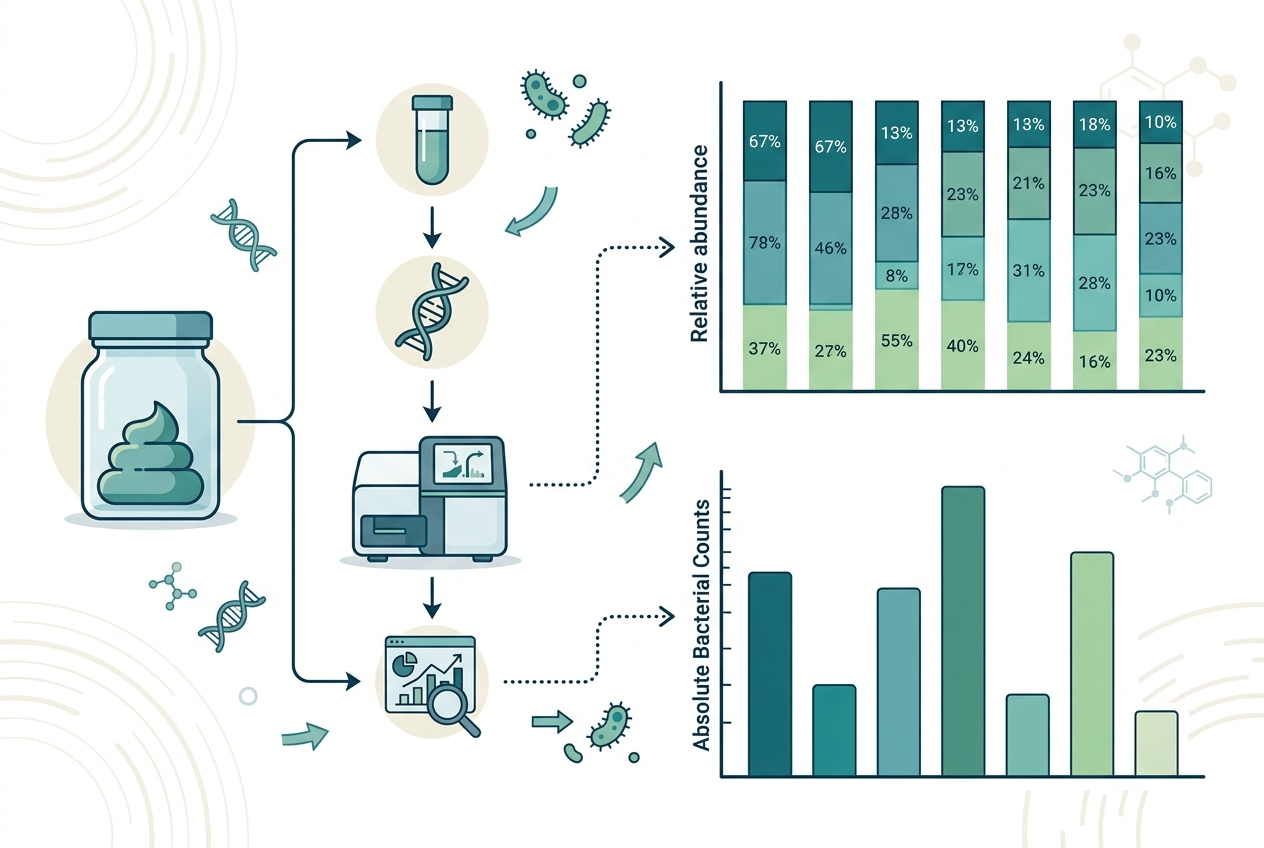
The phrase usually means that the laboratory detected a lower relative abundance of selected taxa compared with its own reference group. It does not necessarily mean zero living cells, whole-gut depletion, or impaired function. Relative abundance works like a percentage chart: one group’s share can fall because another group expanded even when the first group’s absolute count did not change. Different companies may use 16S rRNA sequencing, shotgun metagenomics, different collection preservatives, different taxonomic databases, and different “healthy” comparison cohorts. Those choices can produce different names and scores from the same biological sample. The 2025 international consensus statement concluded that evidence for routine clinical usefulness remains scarce and warned that direct-to-consumer reports can lead to waste or inappropriate management. Ask whether the result is absolute or relative, whether the marker has a validated clinical threshold, and whether repeating the sample would likely change the interpretation. A commercial wellness category should not be treated like a blood-test deficiency.
Can diet change the gut microbiome after a low result?
Diet can change microbial activity and composition, but no single menu reliably restores a proprietary “beneficial bacteria” score. A practical foundation includes varied plant foods, legumes, whole grains, nuts, seeds, fruits, vegetables, and fermented foods that fit personal tolerance. Increase fermentable fiber gradually because abrupt changes can increase gas or bloating. In a 17-week randomized Cell trial, a high-fermented-food diet increased microbiota diversity and reduced several inflammatory markers, while a high-fiber diet increased microbiome carbohydrate-processing capacity without increasing community diversity. The study included only 18 participants per arm, so it provides directional evidence rather than a universal prescription. Fermented foods also vary: pasteurization, storage, and product type affect live microorganisms. A diverse diet remains more defensible than buying foods solely to raise one genus on a report. People with significant gastrointestinal symptoms, food restrictions, immune compromise, or recent treatment should personalize changes with a qualified clinician or registered dietitian rather than force high-fiber or fermented-food targets.
How do the main next-step options compare?
Some links below are affiliate links. This does not influence our evaluation criteria. Food-first changes offer substrate variety but require gradual steps. Yuve Probiotic Gummies provide 5 billion CFU of Bacillus coagulans per two-gummy serving, with species-level labeling. Culturelle Digestive Daily names Lacticaseibacillus rhamnosus GG; Align 24/7 Digestive Support names Bifidobacterium longum 35624. A dietitian fits restrictive eating or fiber intolerance. Clinical evaluation fits persistent symptoms or alarm signs because a consumer score cannot exclude medical causes. Retesting can show change, but a prettier dashboard does not prove better health.
| Option | Best for | Evidence anchor | Main limitation |
|---|---|---|---|
| Food-first variety | Broad daily foundation | Human diet studies | Response and tolerance vary |
| Yuve Probiotic Gummies | Vegan gummy adherence | 5 billion CFU B. coagulans | Species-level label |
| Culturelle Digestive Daily | LGG strain traceability | L. rhamnosus GG | Goal-specific evidence still matters |
| Align 24/7 Digestive Support | 35624 strain traceability | B. longum 35624 | Not a universal microbiome reset |
| Dietitian or clinician | Symptoms or restrictions | Clinical history and validated tests | Requires an appointment |
Which option is best for each use case?
Best for a low score without significant symptoms: food variety, regular meals, sleep, movement, and a cautious review of the test’s methodology before buying anything. Best for a vegan, capsule-free probiotic habit: Yuve Probiotic Gummies, provided the user accepts species-level rather than strain-level identification and tolerates the sweetener system. Best for maximum label traceability: Culturelle or Align, because each names an alphanumeric strain that can be matched more directly to published research. Best for increasing fermentable substrate: whole foods first, followed by a measured soluble or prebiotic fiber only when tolerance and dose are clear. Best for restrictive eating after a report: a registered dietitian who can protect nutritional adequacy. Best for ongoing symptoms or alarm signs: a clinician using medical history and validated testing rather than the commercial diversity score. The digestion collection can help compare formats, but no product should be selected merely because a dashboard marked one bacterial group red.
How should you choose a probiotic after a microbiome test?
Start with a defined goal rather than the name of a “missing” genus. The NIH Office of Dietary Supplements explains that probiotic effects depend on the specific microorganisms and dose; higher CFU counts alone do not guarantee greater benefit. Read the genus, species, alphanumeric strain, CFU amount, serving size, expiration-based viability statement, storage directions, allergens, and other ingredients. A product that lists only a proprietary blend offers weak evidence traceability. Match published evidence to the exact strain and intended outcome instead of assuming that any Bifidobacterium, Lactobacillus, or Bacillus product replaces a low stool-report category. Introduce one product at a time and predefine what improvement would look like, such as a consistent change in bowel frequency or comfort. Track tolerance because probiotics and prebiotic ingredients can increase gas. Reassess at the label-directed interval. Stop and seek professional guidance if symptoms worsen, and avoid self-directed probiotic use when seriously ill or immunocompromised.
What questions should you ask about a low microbiome score?
Is low diversity always unhealthy?
No. Diversity varies with age, geography, diet, medication, transit, and laboratory method; no universal healthy cutoff exists for consumer testing.
Can a probiotic permanently colonize the gut?
Usually not. Many probiotic strains are detectable mainly during use, so benefits—when present—do not require permanent colonization.
Should I repeat the same stool test?
Retesting can show analytical or biological change, but it may not change care. Ask what decision a second result would alter before paying again.
Do I need to eat every food the report recommends?
No. Use tolerance, nutritional adequacy, allergies, and medical guidance rather than a proprietary food list built from uncertain associations.
Can antibiotics lower beneficial bacteria?
Antibiotics can disrupt microbiome composition, but recovery patterns vary. Do not take or stop an antibiotic based on a consumer stool score.
When does the result need clinical review?
Seek review for persistent symptoms, bleeding, fever, dehydration, swallowing problems, repeated vomiting, or unexplained weight loss. The report cannot exclude medical causes.
For a closer look at clean-label options, see Should a Microbiome Test Change Your Gut-Health Routine?.
What is the bottom line after a low beneficial-bacteria result?
Treat the report as a hypothesis generator, not a diagnosis or personalized prescription. Verify whether the company reports relative abundance, which sequencing method it uses, how its reference cohort was built, and whether any flagged marker has a validated clinical threshold. A varied diet that gradually expands tolerated plant fibers and fermented foods has broader human evidence than chasing one bacterial genus. If a probiotic fits a defined goal, choose by strain identity, viable dose, storage, other ingredients, and a measurable trial—not by the largest CFU number or a promise to reset the microbiome. Yuve offers a vegan gummy adherence option with species-level Bacillus coagulans labeling; Culturelle and Align offer more precise strain identification in capsule formats. None can be ranked as a universal repair tool. Persistent symptoms deserve symptom-based clinical evaluation, and alarm signs deserve prompt care. A better outcome is improved function, tolerance, and nutritional adequacy, not simply moving a commercial dashboard from red to green.
Leave a Reply