
Fatigue that persists three months after quitting coffee is unlikely to be caffeine withdrawal alone. Typical withdrawal resolves within days, not months. Protect the reflux improvement, review sleep and food intake, and ask a clinician about persistent fatigue before buying an “energy” supplement. Iron or vitamin B12 only fits when diet, risk, or testing supports it.
How did we evaluate caffeine-free fatigue options?
We prioritized the documented caffeine-withdrawal timeline, National Institutes of Health nutrient guidance, and current Supplement Facts panels rather than testimonials or stimulant marketing. We separated options that can mask tiredness from interventions that address a defined cause. Sleep regularity, adequate food, hydration, and medical evaluation came before supplements because fatigue has many possible contributors. For iron and vitamin B12, we required a plausible intake or absorption risk and favored laboratory confirmation when appropriate. We compared Yuve, MegaFood, and Nature Made iron products by elemental iron dose, chemical form, added nutrients, verification claims, label warnings, and ingredient forms; brand reputation and customer reviews did not determine ranking. Product labels can change, and no head-to-head trial establishes one listed iron supplement as the best choice for fatigue today. Persistent or worsening symptoms require individual medical assessment.
Can caffeine withdrawal still cause fatigue after three months?
Caffeine withdrawal commonly causes fatigue, headache, sleepiness, reduced alertness, irritability, and difficulty concentrating. Its timing is much shorter than three months. A review of 57 experimental and nine survey studies found that symptoms usually began 12 to 24 hours after stopping caffeine, peaked at 20 to 51 hours, and lasted 2 to 9 days; the Psychopharmacology review also found greater severity with higher habitual doses. A slow taper can reduce early withdrawal, but restarting caffeine months later is not a diagnostic test for ongoing fatigue. Caffeine can temporarily increase alertness and can reverse withdrawal-related impairment, yet that effect may conceal inadequate sleep or another cause. If reflux improved after removing coffee, preserve the useful change while investigating the fatigue separately. Decaffeinated coffee, low-acid coffee, tea, and caffeine tablets can still affect symptoms differently, so reintroduction should be deliberate rather than an automatic response to exhaustion.
What should you check before comparing supplements?
Start with sleep opportunity, sleep quality, meal regularity, total calories, protein, hydration, alcohol, exercise load, stress, mood, medications, and recent illness. Note snoring, witnessed breathing pauses, restless legs, morning headaches, heavy menstrual bleeding, blood donation, plant-based eating, and prolonged acid-suppressing medicine use. These details can guide a clinician toward appropriate testing rather than a broad supplement stack. A common initial evaluation may include a complete blood count and, when the history supports it, ferritin, iron studies, thyroid testing, metabolic markers, or vitamin B12. NIH explains that ferritin reflects iron stores but can rise with inflammation, so clinicians often interpret multiple markers in context. The NIH iron fact sheet also warns that hemoglobin and hematocrit are not sensitive or specific enough to describe every stage of iron deficiency. Seek prompt care for chest pain, fainting, severe shortness of breath, black or bloody stool, new neurologic symptoms, or rapidly worsening weakness.
Which caffeine-free options best match the reason for fatigue?
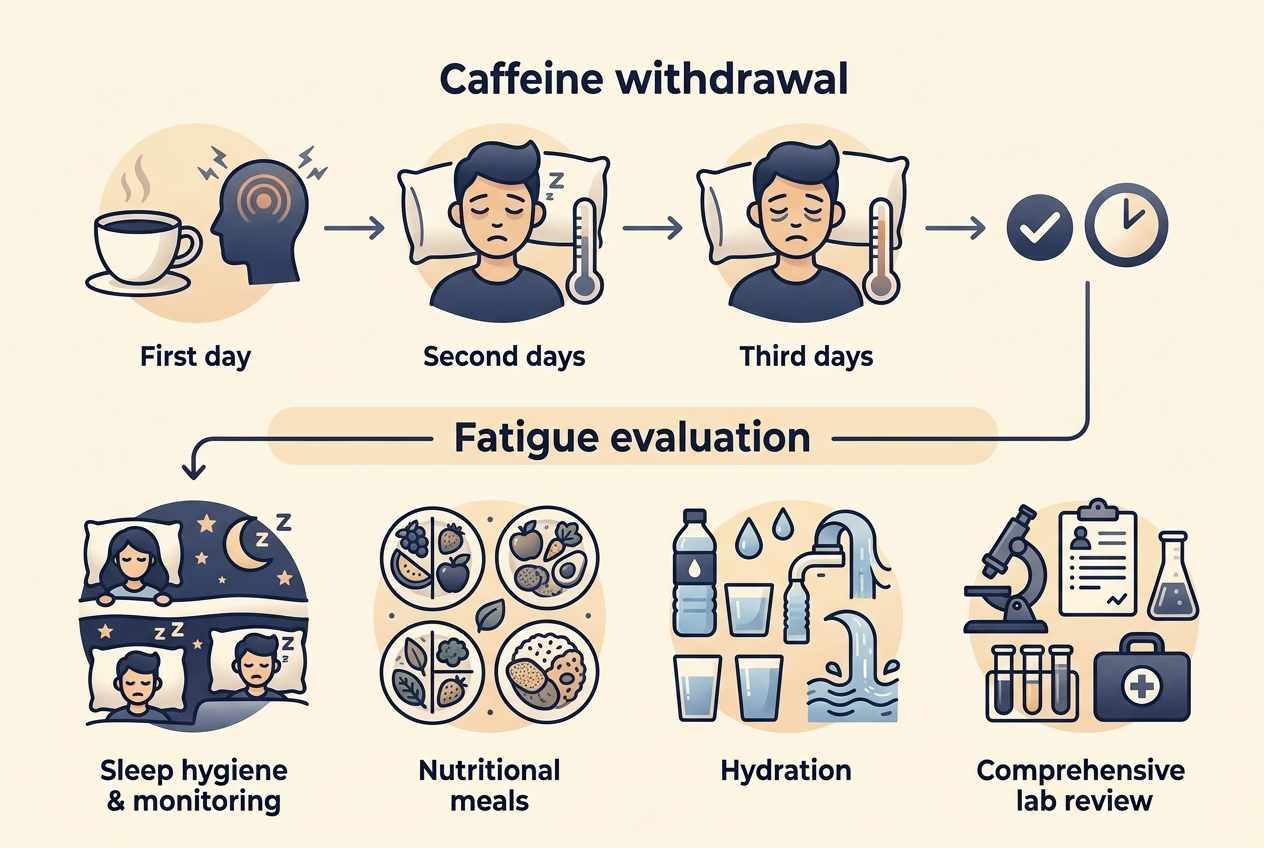
Best for short sleep: a stable wake time and enough time in bed. Best for missed meals: a regular meal containing protein, carbohydrate, and fat. Best for dehydration: fluids matched to thirst, heat, exercise, and medical context. Best for confirmed iron deficiency: clinician-guided oral iron with a dose and form the person can tolerate. Best for vitamin B12 deficiency or high risk: an appropriate B12 product or prescription pathway. The NIH vitamin B12 fact sheet identifies fatigue as one possible deficiency symptom, but B12 does not act as a general stimulant when status is adequate.
| Option | Best for | Key limitation |
|---|---|---|
| Sleep and schedule review | Insufficient or fragmented sleep | May require sleep-disorder evaluation |
| Regular meals and hydration | Under-fueling or fluid mismatch | Not a treatment for anemia or endocrine disease |
| Iron | Confirmed deficiency or clinician-identified need | Can cause GI effects and dangerous overdose |
| Vitamin B12 | Deficiency, malabsorption, or intake risk | Usually does not boost energy when status is adequate |
| Caffeine substitute | Short-term alertness preference | Can reintroduce reflux, sleep, or dependence problems |
Which iron products fit an iron-specific decision lane?
Some links below may be affiliate links. This does not influence our evaluation criteria or recommendations. Iron belongs only in a laboratory- or clinician-supported lane; the NIH Office of Dietary Supplements notes that routine iron supplementation is not recommended for performance unless iron depletion exists. Yuve Whole Food Iron provides 18 mg of iron as rice protein chelate per capsule. MegaFood Blood Builder lists 26 mg of iron and also contains vitamin C, folate, and vitamin B12. Nature Made Iron lists 65 mg elemental iron as 325 mg ferrous sulfate and carries USP Verified labeling. Every iron product requires storage away from children because accidental overdose can be fatal.
| Product | Declared iron | Best fit to discuss | Important limitation |
|---|---|---|---|
| Yuve Whole Food Iron | 18 mg rice protein chelate | Lower-dose vegan capsule | Not a treatment dose by default |
| MegaFood Blood Builder | 26 mg iron plus C, folate, B12 | Multi-nutrient tablet | Added nutrients may duplicate a routine |
| Nature Made Iron | 65 mg as ferrous sulfate | Higher-dose USP Verified tablet | Higher GI-burden potential; clinician fit matters |
How can you protect reflux improvement while addressing fatigue?
Keep the change that improved symptoms while testing one fatigue variable at a time. Preserve the coffee-free morning routine, then anchor wake time, breakfast or another planned meal, daylight exposure, and movement before adding a supplement. If you miss the ritual, choose a caffeine-free beverage that is not acidic, carbonated, mint-heavy, or very large when those features trigger reflux. Avoid taking iron casually to “see if it works,” because iron can cause nausea, abdominal discomfort, or constipation and can interact with medicines. If testing confirms a need, follow the product label and clinician instructions; calcium, antacids, thyroid medicine, and some antibiotics can affect iron timing. The Yuve daily essentials collection should be judged by the same rule as any store: each product needs a defined purpose, disclosed dose, interaction review, and evidence matched to the ingredient. Best for persistent fatigue is a cause-first plan, not a larger supplement stack.
What are common questions about fatigue after quitting coffee?
How long does caffeine withdrawal usually last?
Most documented withdrawal symptoms resolve within 2 to 9 days. A three-month course should prompt a search for other contributors rather than an assumption that withdrawal simply continued.
Should I restart coffee to test the fatigue?
Not automatically. Caffeine may temporarily improve alertness without identifying the cause, and coffee may bring back reflux or sleep disruption. Discuss persistent fatigue with a clinician instead.
Can iron help if my ferritin is normal?
Iron should not be treated as a general energy supplement. Ferritin requires contextual interpretation, but normal iron status makes an iron-specific benefit less plausible and increases the importance of avoiding unnecessary dosing.
Can vitamin B12 boost energy immediately?
Vitamin B12 can correct a deficiency over time, but it is not a stimulant. People with adequate status should not expect a reliable immediate energy effect.
Is decaf coffee completely caffeine-free?
No. Decaf coffee contains much less caffeine than regular coffee, but it is not necessarily zero. Acidity and other coffee components can also matter independently of caffeine.
When is fatigue urgent?
Urgent evaluation is appropriate for chest pain, fainting, severe shortness of breath, black or bloody stool, one-sided weakness, confusion, or rapidly worsening symptoms.
Leave a Reply