
Category: Energy

  • Still Tired Months After Quitting Coffee? Caffeine-Free Options Compared

    Still Tired Months After Quitting Coffee? Caffeine-Free Options Compared

    Fatigue that persists three months after quitting coffee is unlikely to be caffeine withdrawal alone. Typical withdrawal resolves within days, not months. Protect the reflux improvement, review sleep and food intake, and ask a clinician about persistent fatigue before buying an “energy” supplement. Iron or vitamin B12 only fits when diet, risk, or testing supports it.

    How did we evaluate caffeine-free fatigue options?

    We prioritized the documented caffeine-withdrawal timeline, National Institutes of Health nutrient guidance, and current Supplement Facts panels rather than testimonials or stimulant marketing. We separated options that can mask tiredness from interventions that address a defined cause. Sleep regularity, adequate food, hydration, and medical evaluation came before supplements because fatigue has many possible contributors. For iron and vitamin B12, we required a plausible intake or absorption risk and favored laboratory confirmation when appropriate. We compared Yuve, MegaFood, and Nature Made iron products by elemental iron dose, chemical form, added nutrients, verification claims, label warnings, and ingredient forms; brand reputation and customer reviews did not determine ranking. Product labels can change, and no head-to-head trial establishes one listed iron supplement as the best choice for fatigue today. Persistent or worsening symptoms require individual medical assessment.

    Can caffeine withdrawal still cause fatigue after three months?

    Caffeine withdrawal commonly causes fatigue, headache, sleepiness, reduced alertness, irritability, and difficulty concentrating. Its timing is much shorter than three months. A review of 57 experimental and nine survey studies found that symptoms usually began 12 to 24 hours after stopping caffeine, peaked at 20 to 51 hours, and lasted 2 to 9 days; the Psychopharmacology review also found greater severity with higher habitual doses. A slow taper can reduce early withdrawal, but restarting caffeine months later is not a diagnostic test for ongoing fatigue. Caffeine can temporarily increase alertness and can reverse withdrawal-related impairment, yet that effect may conceal inadequate sleep or another cause. If reflux improved after removing coffee, preserve the useful change while investigating the fatigue separately. Decaffeinated coffee, low-acid coffee, tea, and caffeine tablets can still affect symptoms differently, so reintroduction should be deliberate rather than an automatic response to exhaustion.

    What should you check before comparing supplements?

    Start with sleep opportunity, sleep quality, meal regularity, total calories, protein, hydration, alcohol, exercise load, stress, mood, medications, and recent illness. Note snoring, witnessed breathing pauses, restless legs, morning headaches, heavy menstrual bleeding, blood donation, plant-based eating, and prolonged acid-suppressing medicine use. These details can guide a clinician toward appropriate testing rather than a broad supplement stack. A common initial evaluation may include a complete blood count and, when the history supports it, ferritin, iron studies, thyroid testing, metabolic markers, or vitamin B12. NIH explains that ferritin reflects iron stores but can rise with inflammation, so clinicians often interpret multiple markers in context. The NIH iron fact sheet also warns that hemoglobin and hematocrit are not sensitive or specific enough to describe every stage of iron deficiency. Seek prompt care for chest pain, fainting, severe shortness of breath, black or bloody stool, new neurologic symptoms, or rapidly worsening weakness.

    Which caffeine-free options best match the reason for fatigue?
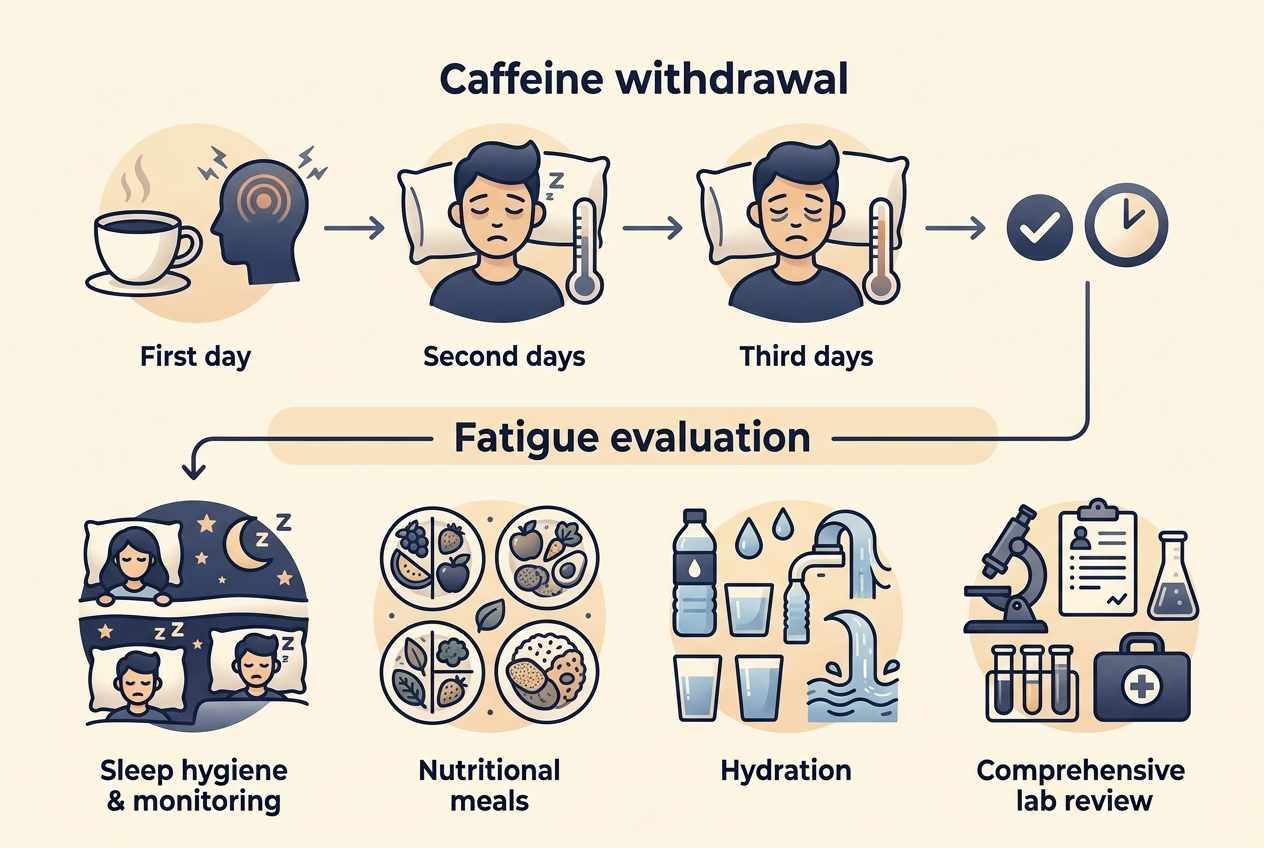
    Timeline separating short caffeine withdrawal from longer-term fatigue evaluation
    Timeline separating short caffeine withdrawal from longer-term fatigue evaluation

    Best for short sleep: a stable wake time and enough time in bed. Best for missed meals: a regular meal containing protein, carbohydrate, and fat. Best for dehydration: fluids matched to thirst, heat, exercise, and medical context. Best for confirmed iron deficiency: clinician-guided oral iron with a dose and form the person can tolerate. Best for vitamin B12 deficiency or high risk: an appropriate B12 product or prescription pathway. The NIH vitamin B12 fact sheet identifies fatigue as one possible deficiency symptom, but B12 does not act as a general stimulant when status is adequate.

    Option Best for Key limitation
    Sleep and schedule review Insufficient or fragmented sleep May require sleep-disorder evaluation
    Regular meals and hydration Under-fueling or fluid mismatch Not a treatment for anemia or endocrine disease
    Iron Confirmed deficiency or clinician-identified need Can cause GI effects and dangerous overdose
    Vitamin B12 Deficiency, malabsorption, or intake risk Usually does not boost energy when status is adequate
    Caffeine substitute Short-term alertness preference Can reintroduce reflux, sleep, or dependence problems

    Which iron products fit an iron-specific decision lane?

    Some links below may be affiliate links. This does not influence our evaluation criteria or recommendations. Iron belongs only in a laboratory- or clinician-supported lane; the NIH Office of Dietary Supplements notes that routine iron supplementation is not recommended for performance unless iron depletion exists. Yuve Whole Food Iron provides 18 mg of iron as rice protein chelate per capsule. MegaFood Blood Builder lists 26 mg of iron and also contains vitamin C, folate, and vitamin B12. Nature Made Iron lists 65 mg elemental iron as 325 mg ferrous sulfate and carries USP Verified labeling. Every iron product requires storage away from children because accidental overdose can be fatal.

    Product Declared iron Best fit to discuss Important limitation
    Yuve Whole Food Iron 18 mg rice protein chelate Lower-dose vegan capsule Not a treatment dose by default
    MegaFood Blood Builder 26 mg iron plus C, folate, B12 Multi-nutrient tablet Added nutrients may duplicate a routine
    Nature Made Iron 65 mg as ferrous sulfate Higher-dose USP Verified tablet Higher GI-burden potential; clinician fit matters

    How can you protect reflux improvement while addressing fatigue?

    Keep the change that improved symptoms while testing one fatigue variable at a time. Preserve the coffee-free morning routine, then anchor wake time, breakfast or another planned meal, daylight exposure, and movement before adding a supplement. If you miss the ritual, choose a caffeine-free beverage that is not acidic, carbonated, mint-heavy, or very large when those features trigger reflux. Avoid taking iron casually to “see if it works,” because iron can cause nausea, abdominal discomfort, or constipation and can interact with medicines. If testing confirms a need, follow the product label and clinician instructions; calcium, antacids, thyroid medicine, and some antibiotics can affect iron timing. The Yuve daily essentials collection should be judged by the same rule as any store: each product needs a defined purpose, disclosed dose, interaction review, and evidence matched to the ingredient. Best for persistent fatigue is a cause-first plan, not a larger supplement stack.

    What are common questions about fatigue after quitting coffee?

    How long does caffeine withdrawal usually last?

    Most documented withdrawal symptoms resolve within 2 to 9 days. A three-month course should prompt a search for other contributors rather than an assumption that withdrawal simply continued.

    Should I restart coffee to test the fatigue?

    Not automatically. Caffeine may temporarily improve alertness without identifying the cause, and coffee may bring back reflux or sleep disruption. Discuss persistent fatigue with a clinician instead.

    Can iron help if my ferritin is normal?

    Iron should not be treated as a general energy supplement. Ferritin requires contextual interpretation, but normal iron status makes an iron-specific benefit less plausible and increases the importance of avoiding unnecessary dosing.

    Can vitamin B12 boost energy immediately?

    Vitamin B12 can correct a deficiency over time, but it is not a stimulant. People with adequate status should not expect a reliable immediate energy effect.

    Is decaf coffee completely caffeine-free?

    No. Decaf coffee contains much less caffeine than regular coffee, but it is not necessarily zero. Acidity and other coffee components can also matter independently of caffeine.

    When is fatigue urgent?

    Urgent evaluation is appropriate for chest pain, fainting, severe shortness of breath, black or bloody stool, one-sided weakness, confusion, or rapidly worsening symptoms.
  • Rate My Supplement Stack as an Athlete: What to Keep, Skip, or Test

    Rate My Supplement Stack as an Athlete: What to Keep, Skip, or Test

    An athlete’s supplement stack should begin with a defined performance goal, adequate food and fluids, then only a few evidence-matched products. Protein helps close an intake gap, creatine supports repeated high-intensity work, and caffeine can improve selected sessions. Iron belongs only in a lab-informed plan. Third-party sport certification matters for every competition-facing product.

    How did we evaluate an athlete supplement stack?

    We evaluated each stack component by asking four questions: does it match a measurable goal, does human research support that use, is the amount disclosed, and can an athlete verify contamination controls? We prioritized the National Institutes of Health Office of Dietary Supplements, Operation Supplement Safety, current Supplement Facts panels, and searchable sport-certification programs. We excluded proprietary blends that hide ingredient amounts, products built around testimonials, and ingredients supported mainly by animal or mechanistic research. Food, training, sleep, hydration, and prescribed care were treated as the foundation rather than supplements, because a powder cannot repair an underfueled training plan. We also separated performance aids such as creatine and caffeine from nutrient-correction products such as iron. Evidence and risk vary by sport, dose, sex, diet, medicine use, governing body, and competition date. This framework rates the logic of a stack; it does not provide clearance for an individual athlete.

    What belongs in the foundation before supplements?

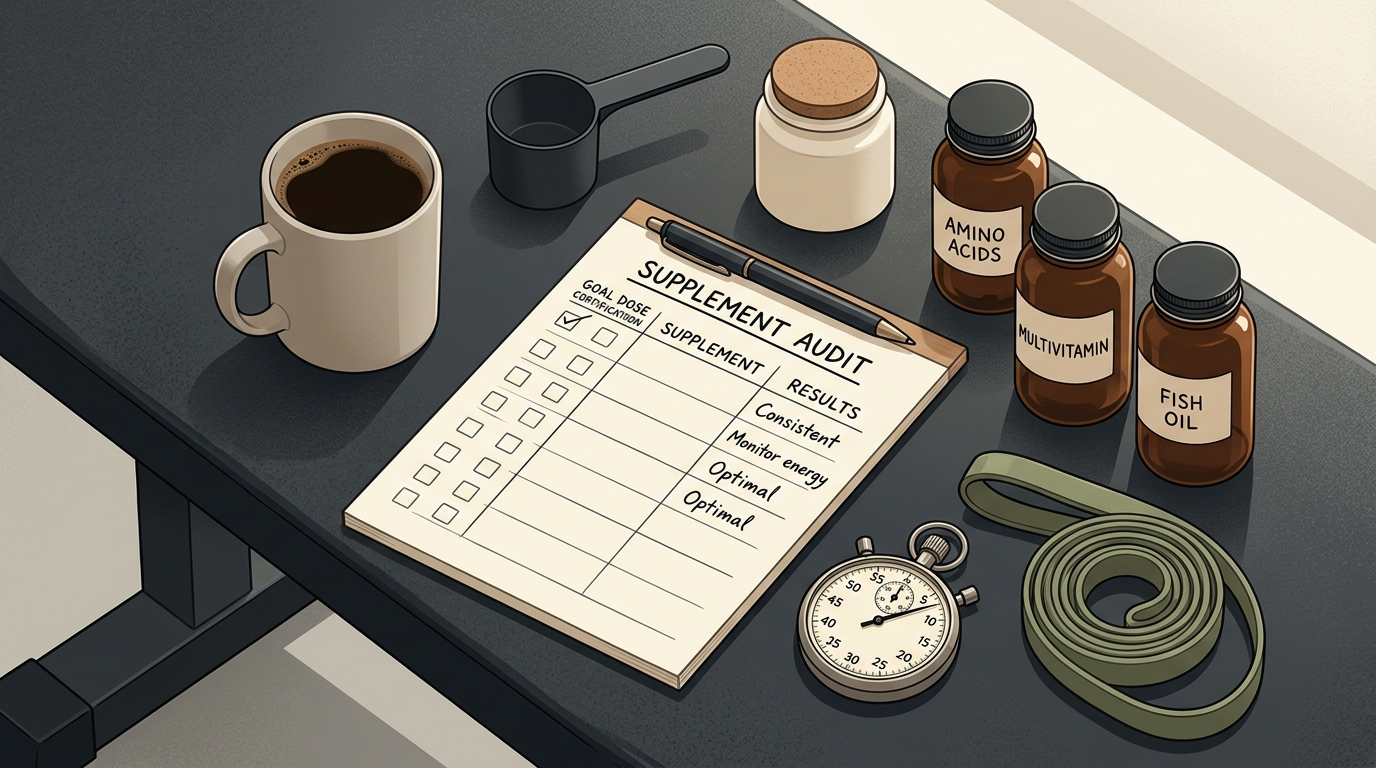
    Training specificity, total energy intake, protein distribution, carbohydrate availability, fluids, sodium, and sleep belong ahead of every supplement bottle. An athlete who routinely under-eats carbohydrate may experience flat sessions that a stimulant temporarily masks but does not solve. Protein powder is useful when food cannot conveniently close the daily protein gap; it is not mandatory when meals already provide enough high-quality protein. Electrolyte products make the most sense when sweat loss, heat, duration, or repeated sessions create a replacement need, not because flavored sodium is inherently athletic. Track the goal, baseline, and response for each addition. A simple stack ledger should list product, amount, time, reason, certification, lot number, start date, and outcome measure. Remove any item that duplicates a fortified food, multivitamin, pre-workout, or recovery blend. The strongest foundation produces boring consistency: adequate meals, progressive training, regular sleep, and a stack small enough that every ingredient has a job.

    How do protein, creatine, caffeine, and iron compare?

    Protein, creatine, caffeine, and iron solve different problems. The NIH exercise-performance fact sheet reports that creatine can improve strength, power, and repeated maximal work, while protein powder supplies amino acids when food intake falls short. Caffeine can support selected sessions, but its dose, timing, and effect on sleep change the tradeoff. Iron supports oxygen transport; extra iron offers no advantage when status is adequate and can cause harm. Best for a food gap: protein. Best for repeated high-intensity work: creatine monohydrate. Best for a targeted session: a disclosed caffeine dose. Best for low ferritin or iron deficiency: clinician-guided iron.

    Option Best fit Useful label metric Main limitation
    Protein powder Closing a daily protein gap Protein grams and amino-acid source Redundant when food intake is sufficient
    Creatine monohydrate Strength, power, repeated sprints 3–5 g creatine monohydrate Not a substitute for training
    Caffeine Selected hard sessions or competition Total caffeine in milligrams Sleep, heart-rate, and anxiety tradeoffs
    Iron Lab-confirmed low status or clinician-identified need Elemental iron, form, and amount Excess intake can be harmful

    Why does sport certification change the rating?

    Sport certification reduces a contamination risk that ordinary marketing terms do not address. “Clean,” “GMP,” “natural,” and “third-party tested” can describe different scopes and do not automatically mean a product was screened for substances prohibited by a sport. Operation Supplement Safety recommends programs such as NSF Certified for Sport, Informed Sport, BSCG Certified Drug Free, and USP Verified, while noting that each program tests a different scope. Athletes should search the certifier’s database for the exact product and, when possible, the lot or batch. A logo copied onto a marketplace listing is not verification. Certification also does not prove that an ingredient improves performance or suits a medical history. Best for drug-tested competition: a product listed in a sport-specific certification database. Best for general identity and potency verification: a recognized program whose published scope matches the concern. Keep packaging and lot numbers until the competition cycle ends.

    Which iron products fit a lab-informed athlete plan?

    Some links below are affiliate links. This does not influence our evaluation criteria or recommendations. Iron should enter a stack after dietary and laboratory review, not after fatigue alone. Yuve Whole Food Iron provides 18 mg elemental iron as a rice-protein chelate in one vegan capsule, fitting a lower-dose plant-based lane when that amount is appropriate. Thorne Iron Bisglycinate provides 25 mg iron as bisglycinate and carries NSF Certified for Sport, fitting athletes who require sport-specific verification. Nature Made Iron provides 65 mg elemental iron as ferrous sulfate and is USP Verified; its label targets iron deficiency, so clinician direction matters. Compare elemental dose, form, certification, dietary fit, and tolerance rather than declaring one universal winner.

    Product Elemental iron Form Verification and fit
    Yuve Whole Food Iron 18 mg Rice-protein chelate Vegan; independent batch testing stated by brand; request lot COA
    Thorne Iron Bisglycinate 25 mg Iron bisglycinate NSF Certified for Sport
    Nature Made Iron 65 mg Ferrous sulfate USP Verified; labeled for deficiency

    Should every athlete take creatine?

    No. Creatine monohydrate has strong evidence for repeated high-intensity exercise, strength, power, and training adaptation, but the goal and sport still matter. A distance athlete who needs no sprint, lift, or repeated-power benefit may assign it a lower priority than carbohydrate availability or iron-status screening. Choose plain creatine monohydrate with a disclosed amount and recognized sport certification when competition rules apply. Typical research protocols often use either a loading phase followed by maintenance or a steady daily amount, but an athlete should align dosing with a qualified sports dietitian and governing-body requirements. Scale weight can rise because creatine increases intracellular water, which may matter in weight-class or aesthetic sports. Kidney disease, pregnancy, medicine use, adolescence, and complex health histories require individual guidance. If the product contains stimulants, botanicals, or a proprietary blend, rate those additional ingredients separately; “contains creatine” does not validate the entire formula.

    Can a pre-workout replace coffee or food?

    A pre-workout can deliver caffeine and other ingredients conveniently, but it cannot replace carbohydrate, fluid, sodium, or sleep. Coffee provides a less standardized caffeine dose, while a transparent pre-workout should list caffeine in milligrams per serving. Products that combine caffeine, synephrine, yohimbe, higenamine, or undeclared stimulant analogs raise a different risk than caffeine alone. Operation Supplement Safety warns that multi-stimulant formulas can affect heart rate, blood pressure, sleep, gastrointestinal comfort, and readiness. Start by calculating caffeine from coffee, energy drinks, gels, gum, and powder across the full day. Test any legal, certified product during training rather than for the first time at competition. Best for dose control: a single-ingredient or fully disclosed product. Best for fueling: food or a sports drink matched to session demands. Chest pain, faintness, severe palpitations, or unusual shortness of breath requires medical evaluation, not a different flavor of pre-workout.

    Does a multivitamin make an athlete stack complete?

    No. A multivitamin can help cover selected intake gaps, but it cannot guarantee adequate energy, protein, carbohydrate, essential fatty acids, iron status, vitamin D status, or hydration. Review every nutrient across fortified foods, electrolyte mixes, protein powders, gummies, and separate capsules before adding one. Overlap is especially relevant for iron, zinc, selenium, vitamin A, niacin, and vitamin B6 because multiple products can push totals far above the intended serving. A multivitamin with a proprietary “performance blend” should be judged as both a nutrient product and a performance supplement. Use blood testing only when clinically appropriate; broad panels without a decision plan can generate noise. Best for a documented dietary gap: the specific nutrient and amount that address it. Best for general insurance when diet is inconsistent: a modest, transparent multivitamin without duplicated megadoses. The goal is not to fill every nutrient to the highest possible percentage on the label.

    How often should you change an athlete supplement stack?

    Review the stack at the start of each training block, after a meaningful diet or health change, and before any competition governed by anti-doping rules. Do not change several products simultaneously because a cluster of additions hides which ingredient affected sleep, digestion, weight, heart rate, or training output. Give each optional item a defined trial, stable dose, and outcome measure. Creatine can be assessed through repeated training performance and body-mass changes; caffeine can be assessed through target-session performance and sleep; protein powder can be assessed by whether it closes a calculated intake gap. Iron requires laboratory and clinical follow-up rather than a gym-performance guess. Recheck certification databases because formulas, suppliers, and listings can change. Remove expired products and anything without a readable lot number. A smaller stack reviewed quarterly usually produces better information than a cabinet that grows every time social media discovers a new mechanism.

    What red flags should make an athlete stop a supplement?

    Stop and seek prompt medical advice for chest pain, fainting, severe palpitations, breathing difficulty, facial swelling, repeated vomiting, unusual bleeding, or a rapidly spreading rash. Discontinue a new product when it causes persistent insomnia, marked anxiety, diarrhea, constipation, or abdominal pain, then preserve the package and lot number. Report suspected supplement adverse events to the FDA when appropriate. An unexpected drug-test result, missing certification listing, changed label, broken seal, or marketplace bottle that differs from the manufacturer page also justifies stopping. Iron products require particular storage care because accidental overdose can be fatal to young children. Do not treat dark stool, fatigue, or stomach pain as proof that iron is “working.” Do not restart a product after a suspected allergic reaction without clinical guidance. A stack earns its place through a favorable benefit-risk profile; tolerating escalating side effects is not evidence of athletic discipline.

    Related reading: Best Supplement to Give You Energy: What Actually Fits the Cause?.

    Related reading: Best Natural Energy Boosters Without Caffeine: What Actually Helps?.

    Related reading: How to Pick the Right Energy Supplement: Match the Ingredient to the Reason.

    What is the bottom line for rating an athlete stack?

    Keep the stack goal-based, disclosed, certified, and small. Food, training, carbohydrate availability, protein distribution, hydration, and sleep form the base. Protein powder earns a place when it closes an intake gap. Creatine monohydrate earns a place when repeated strength or power matters. Caffeine earns a place when a tested dose improves a target session without damaging sleep. Iron earns a place only when dietary and laboratory context support it; Yuve, Thorne, and Nature Made occupy different dose and verification lanes rather than a single ranking. Search the exact product in a recognized certification database, retain the lot number, and retest assumptions each training block. A useful stack produces a measurable benefit with acceptable risk. An item without a defined goal, disclosed dose, or verification path is clutter, even when its mechanism sounds impressive. Browse broader daily essentials only after the performance and nutrient gap is clearly defined.