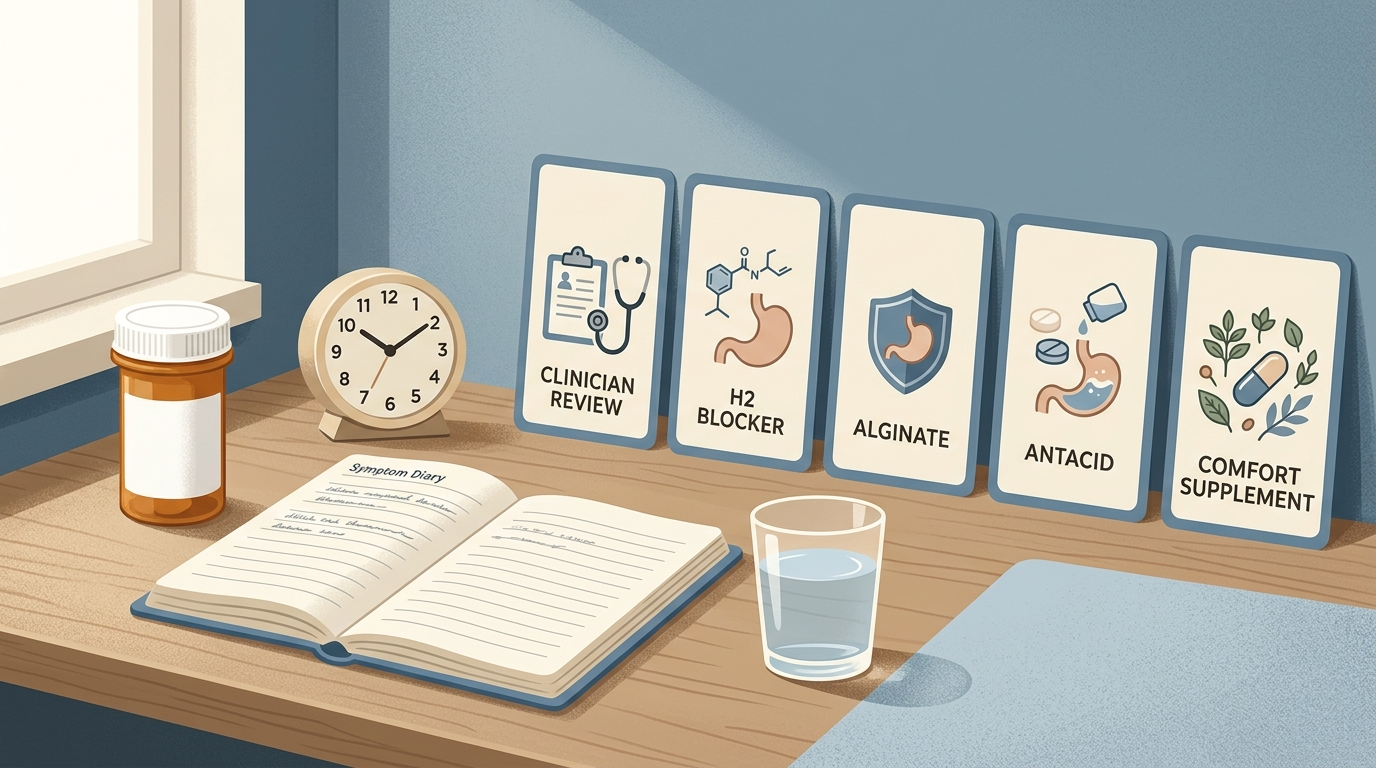
“Acid revenge” after stopping Prilosec may be rebound acid hypersecretion, but Barrett’s esophagus changes the decision. Do not remain off omeprazole or rely on Tums, supplements, or an online taper without the gastroenterologist’s approval. Ask promptly whether long-term acid suppression is still indicated and which supervised bridge, if any, fits.
How did we evaluate options for acid rebound after Prilosec?
We evaluated prescription proton-pump inhibitor management, famotidine, alginate-antacid products, calcium carbonate, and DGL licorice by clinical indication, mechanism, evidence quality, onset, interaction risk, and ability to protect rather than obscure a high-risk reflux history. American Gastroenterological Association and American College of Gastroenterology guidance received more weight than supplement claims, social posts, observational associations, or isolated laboratory findings. The AGA de-prescribing update specifically says that known Barrett’s esophagus generally should not enter a routine PPI de-prescribing trial and that decisions should rest on whether a valid indication remains, not fear of an association alone. We excluded self-directed taper schedules, liver-fibrosis causation claims, acidifying remedies, and any suggestion that an over-the-counter product replaces Barrett’s care. The main limitation is individual context: endoscopy findings, pathology, fibrosis assessment, medicines, prior reflux testing, and treatment goals determine the safe plan.
What does “acid revenge” usually mean after stopping Prilosec?
“Acid revenge” is an informal name for rebound acid hypersecretion or a return of the condition that omeprazole was controlling. Long-term PPI exposure can increase gastrin signaling; stopping can temporarily increase acid-related symptoms, although symptom timing alone cannot separate rebound from persistent GERD. The AGA advises clinicians to warn patients about transient upper-gastrointestinal symptoms after discontinuation, but it also distinguishes de-prescribing candidates from people with established indications. Barrett’s esophagus is that crucial dividing line. The 2022 AGA Barrett’s update advises at least daily PPI therapy for patients with Barrett’s esophagus, based on expert review rather than a promise that one drug prevents every adverse outcome. A hiatal hernia can also support ongoing reflux mechanics even when its size does not justify surgery. Two difficult weeks off Prilosec therefore do not prove addiction, treatment failure, supplement deficiency, or liver injury; they trigger a gastroenterology review.
Why does Barrett’s esophagus change the usual stop-or-taper question?
Barrett’s esophagus represents intestinal metaplasia in the esophagus and requires an indication review that is different from uncomplicated, occasional heartburn. The updated ACG Barrett’s guideline addresses surveillance, acid suppression, dysplasia, and endoscopic therapy as connected parts of long-term care. A patient should not trade that plan for repeated calcium-carbonate doses or an unverified “acid inhibitor” because symptom relief and mucosal management are not equivalent outcomes. The gastroenterologist should confirm the pathology, segment length, dysplasia status, surveillance date, omeprazole indication, lowest effective regimen, and whether an alternative PPI or another prescribed acid blocker is reasonable. A hepatologist or primary clinician should separately evaluate fibrosis causes using the complete metabolic, alcohol, viral, medication, and imaging history. Observational links between PPIs and adverse outcomes can be confounded by age, illness, and indication. A temporal association does not establish that Prilosec caused fibrosis or that stopping is safer.
How do the main prescription and nonprescription options compare?
Each option belongs to a different lane. A clinician-managed PPI plan addresses an established acid-suppression indication. Famotidine blocks histamine-2 receptors and may be used in selected plans, but tolerance can reduce its effect with repeated use. Gaviscon Advance uses an alginate formulation to create a post-meal raft; formulas differ by country. Tums uses calcium carbonate for brief neutralization and adds a meaningful calcium load when repeated. Yuve DGL Licorice Chewables provide deglycyrrhizinated licorice for everyday stomach comfort, not acid suppression or Barrett’s management. A systematic review of 11 randomized trials found that alginate evidence versus placebo, antacids, or PPIs was mixed and did not establish a universal substitute for prescribed therapy (PubMed). No row below authorizes a person with Barrett’s esophagus to stop omeprazole. The prescriber must choose the medical lane before optional comfort products enter the discussion.
| Option | Category | Best for | What to verify | Main limitation |
|---|---|---|---|---|
| Clinician-managed Prilosec or another PPI | Prescription acid suppression | Established Barrett’s or GERD indication | Diagnosis, dose, timing, duration, interactions | Changes require clinician review |
| Pepcid (famotidine) | H2-receptor blocker | Selected clinician-directed bridge or adjunct | Kidney function, medicines, frequency | Not automatically equivalent to a PPI |
| Gaviscon Advance | Alginate-antacid | Post-meal mechanical barrier comparison | Country-specific alginate and sodium content | Does not replace Barrett’s management |
| Tums | Calcium-carbonate antacid | Occasional, brief symptom neutralization | Total calcium, kidney history, interactions | Repeated use can add risk and mask poor control |
| Yuve DGL Chewables | DGL comfort supplement | Optional chewable comfort routine | DGL amount, glycyrrhizin removal, full label | Not an acid blocker or Barrett’s therapy |
Which option is best for each use case?
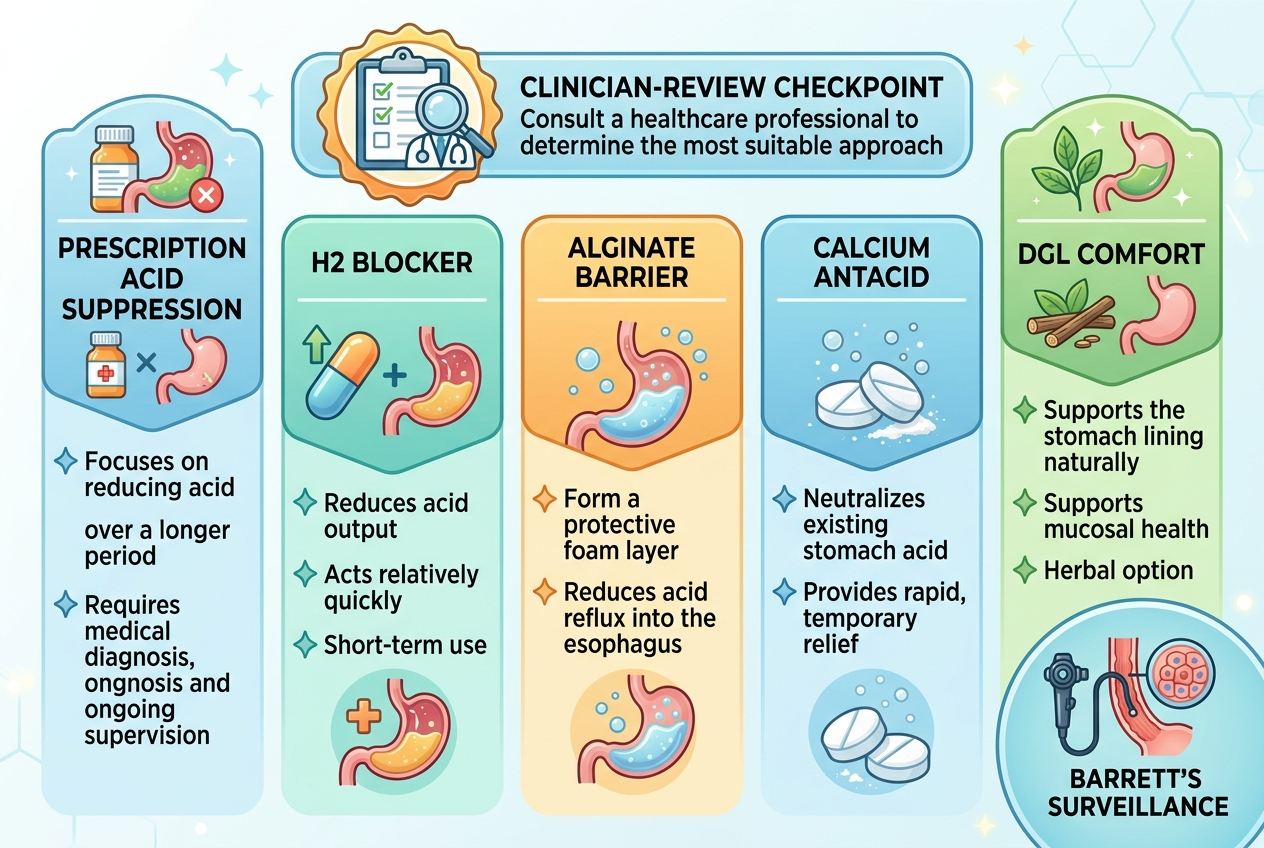
Best for Barrett’s esophagus with severe reflux after stopping Prilosec: prompt review by the gastroenterologist who knows the endoscopy and pathology. Best for deciding whether omeprazole still has a valid indication: a medication review based on Barrett’s status, erosive disease, bleeding risk, response, dose, and adverse-event evidence. Best for a temporary bridge: only the clinician-approved choice among an H2 blocker, alginate, antacid, or another plan. Best for post-meal reflux mechanics: an alginate product whose exact regional formula is verified. Best for occasional neutralization: calcium carbonate used within its label and checked against kidney history, calcium intake, and interacting medicines. Best for optional stomach comfort: a transparent DGL product after the pharmacist reviews the label, with no expectation that it controls acid exposure. Best for chest pressure, trouble swallowing, bleeding, black stool, persistent vomiting, severe pain, weight loss, or fainting: urgent medical assessment rather than another retail product.
Which products meet the comparison criteria?
Some links below are affiliate links. This does not influence our evaluation criteria or recommendations. Prilosec and generic omeprazole meet the prescription criterion only when the clinician confirms a current indication and regimen. Pepcid meets an H2-blocker comparison criterion when the exact dose, kidney function, interactions, and intended duration are reviewed. Gaviscon Advance meets an alginate criterion when the package discloses the regional formula; U.S. and U.K. products are not interchangeable by name alone. Tums meets an occasional-antacid criterion when total calcium exposure and label limits fit the person. Yuve DGL Licorice Chewables list 400 mg of DGL extract plus 100 mg of glycine per two-chewable serving. DGL belongs in a comfort category and does not replace PPI therapy, surveillance, or reflux testing. The broader Yuve digestion collection contains adjacent formats, but stacking products would make the rebound pattern harder to interpret.
What mistakes make acid rebound harder to evaluate?
The first mistake is assuming that a new symptom after stopping Prilosec proves rebound and excludes uncontrolled GERD. The second mistake is stopping a PPI because of an observational risk claim without rechecking why the drug was prescribed. The third mistake is treating symptom relief as proof that Barrett’s exposure is adequately managed. The fourth mistake is adding famotidine, alginate, calcium carbonate, DGL, probiotics, meal changes, and a commercial taper kit during the same week. The fifth mistake is ignoring formulation details: alginate content varies, whole licorice differs from DGL, and repeated antacid doses alter mineral and interaction exposure. The sixth mistake is using apple-cider vinegar, betaine hydrochloride, or other acidifying products in a person with proven reflux without medical direction. The cleanest evaluation keeps a dated medication and symptom log, records swallowing and regurgitation separately, changes only what the clinician approves, and preserves the scheduled Barrett’s surveillance plan.
What questions should you ask about Prilosec rebound and alternatives?
These questions organize a gastroenterology visit around the actual indication rather than around fear or frustration. Bring the endoscopy and pathology date, Barrett’s segment description, dysplasia result, omeprazole dose, taper timeline, symptom onset, liver-fibrosis records, and every prescription, antacid, and supplement label. Ask which findings require long-term PPI therapy, whether the current dose is the lowest effective dose, and whether the clinician considers the present symptoms rebound, recurrent GERD, or another mechanism. Ask what monitoring supports any proposed change and whether famotidine, alginate, calcium carbonate, or DGL has a defined role. Ask who will coordinate the gastroenterology and liver evaluations so one concern does not erase the other indication. The ACG GERD guideline treats PPIs as the main medical therapy for GERD while also supporting individualized diagnostic and management decisions. The answers below should refine the appointment, not replace it.
Can stopping Prilosec cause rebound acid symptoms?
Yes. Transient upper-digestive symptoms can occur after long-term PPI discontinuation, although symptom return may also represent the underlying GERD. Timing alone cannot distinguish the two.
Should someone with Barrett’s esophagus stop a PPI?
Not without the gastroenterologist’s direction. AGA guidance generally excludes known Barrett’s esophagus from routine PPI de-prescribing trials because a valid long-term indication may remain.
Is Pepcid a substitute for omeprazole?
Not automatically. Famotidine uses a different mechanism, and the clinician must decide whether it can serve as an adjunct or bridge in the specific case.
Can Gaviscon help during a supervised plan?
An alginate product may help selected post-meal symptoms, but formulas and evidence vary. It does not replace Barrett’s surveillance or clinician-directed acid suppression.
Is taking Tums every day harmless?
No. Repeated calcium-carbonate use can increase calcium exposure, cause constipation, interact with medicines, and conceal inadequate control, so a pharmacist or clinician should review the pattern.
Can DGL or probiotics prevent acid rebound?
No good evidence establishes DGL or probiotics as prevention for rebound acid hypersecretion. DGL belongs to a comfort-support category, while probiotics belong to a separate digestive-routine category.
For a closer look at clean-label options, see Acid Rebound After Taking Pantoprazole? Which Daily Support Routine Makes the Most Sense.
Related reading: Best Supplements for “Leaky Gut”? Safer Gut-Barrier Support Options.
What is the bottom line for “acid revenge” after Prilosec?
Severe reflux after a Prilosec taper may reflect rebound acid hypersecretion, recurrent GERD, or both. Barrett’s esophagus makes self-directed discontinuation a poor experiment because professional guidance generally supports ongoing PPI therapy when that diagnosis creates a valid indication. Contact the gastroenterologist promptly and provide the endoscopy, pathology, dose, taper, symptom, and fibrosis records. Ask the clinician to separate three decisions: whether acid suppression remains necessary, which drug and dose fit, and whether a short bridge has a role. Famotidine, Gaviscon Advance, Tums, and Yuve DGL Chewables have different mechanisms and limitations; none is an interchangeable substitute for Barrett’s care. Keep every change clinician-directed, documented, and limited to one variable at a time. Seek urgent care for chest pain, progressive swallowing trouble, vomiting blood, black stool, fainting, severe persistent pain, or inability to keep fluids down.
Leave a Reply