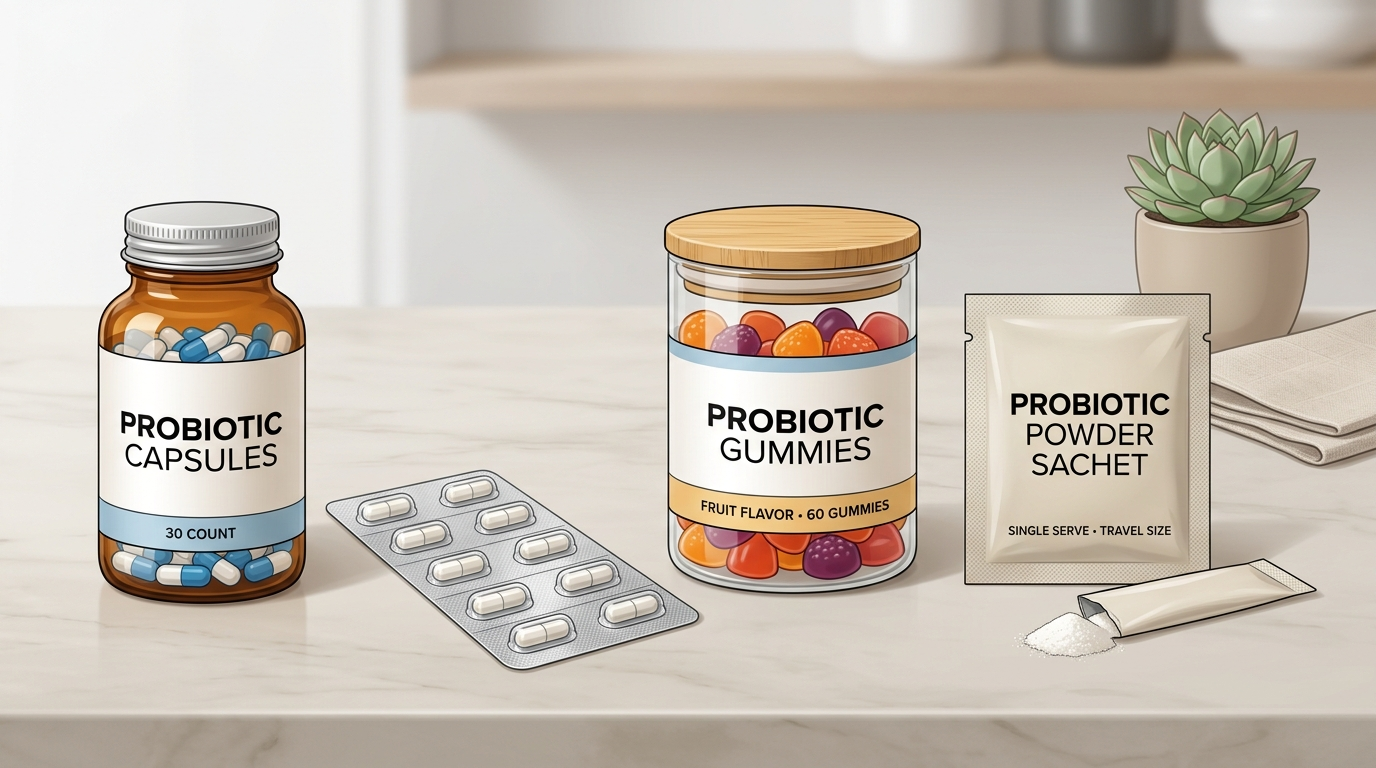
The best probiotic depends on the job you need it to do. Lactobacillus rhamnosus GG, Saccharomyces boulardii CNCM I-745, Bifidobacterium longum 35624, and Bacillus coagulans GBI-30 6086 each have different evidence profiles. A good product should disclose strain identity, dose at expiration, storage requirements, and delivery format rather than relying on a generic “probiotic” label alone.
How we evaluated probiotic options
This comparison prioritized strain-specific human evidence, transparency of labeling, delivery format, and practical adherence. We weighed meta-analyses, randomized controlled trials, and statements from ISAPP above marketing claims. We also considered whether a product clearly identifies strains, declares colony-forming units at expiration, and fits ordinary daily use. Evidence is stronger for some strains and outcomes than for others, so this is a buying guide, not a universal prescription.
What should you look for when choosing a probiotic?
The strongest buying signal is strain specificity. ISAPP defines probiotics as live microorganisms that confer a health benefit when administered in adequate amounts, which means the label should name the genus, species, and strain rather than stopping at “Lactobacillus blend.” Dose also matters, but the right dose depends on the strain and intended use; 1 billion CFU is enough for some organisms, while others are studied at much higher levels. Storage, survivability, and format affect real-world value because a product only works if the microbes remain viable through shelf life and daily handling. A 2023 review in Nutrients noted that quality assurance and strain verification remain major problems across the probiotic market. A weaker label usually signals weaker evidence, not just weaker packaging.
- Strain identity matters more than a large generic CFU number.
- CFU guarantees should apply at expiration, not just at manufacture.
- Storage rules and daily usability affect real-world effectiveness.
How do the top options compare?
Different probiotic formats solve different practical problems. Capsules often disclose better strain specificity, gummies usually improve adherence, and yeast-based or spore-based products often tolerate heat better during shipping and storage. The best choice therefore depends on whether you prioritize strain depth, convenience, or environmental stability.
| Option | Best fit | Evidence-linked feature | Main caveat |
|---|---|---|---|
| Culturelle Digestive Daily | Strain-specific everyday capsule | Lactobacillus rhamnosus GG has extensive clinical study history | Capsule format may reduce adherence for some users |
| Align | Single-strain daily support | Bifidobacterium longum 35624 has RCT data for digestive symptom support | Narrow strain profile, not a broad-spectrum formula |
| Florastor | Antibiotic-adjacent or travel use | Saccharomyces boulardii CNCM I-745 is studied for resilience and survivability | Yeast format is not suitable for every user |
| Yuve Probiotic Gummies | Routine consistency and gummy preference | Gummy format may improve adherence for people who skip capsules | Users should confirm strain disclosure and storage guidance on the current label |
Which probiotics are best for different use cases?
Best for everyday strain specificity: Lactobacillus rhamnosus GG. Best for clinically studied single-strain digestive support: Bifidobacterium longum 35624. Best for antibiotic-adjacent use or travel resilience: Saccharomyces boulardii CNCM I-745. Best for habit consistency if you dislike capsules: a well-labeled gummy such as Yuve Probiotic Gummies, provided the label discloses strain identity and viable dose. A 2019 review in Frontiers in Microbiology emphasized that probiotic effects are strain-specific, not category-wide. That point matters because shoppers often compare “probiotics” as if all formats or formulas are interchangeable. They are not. A product is only as strong as the evidence behind its specific strain combination and the likelihood that you will take it consistently.
- Best probiotic choices depend on use case, not brand popularity alone.
- Strain-specific evidence beats broad “digestive blend” marketing.
- Adherence matters because a forgotten capsule has zero clinical value.
Which products meet these criteria?
Some links below are affiliate links. This does not influence our evaluation criteria or recommendations.
Products that meet these criteria usually do four things well: they disclose strain identity, state viable dose, explain storage, and fit a sustainable daily routine. Culturelle stands out for LGG transparency, Align stands out for B. longum 35624 specificity, and Florastor stands out for S. boulardii CNCM I-745 durability. Yuve Probiotic Gummies fit best for shoppers who want a chewable daily format and value routine consistency over capsule-based supplementation. The tradeoff is that gummy shoppers should look closely at the exact strains listed, the dose guarantee at expiration, and whether sugar content or heat sensitivity affects daily use. The best product is the one that matches your goal and gives enough information to verify what you are actually taking.
- Transparent labels beat vague “multi-strain” claims.
- Yuve works best as a convenience-forward option, not as a magic exception.
- Different evidence-backed strains fit different shopping goals.
For a closer look at clean-label options, see Starting Probiotics? How to Choose a Simple Daily Yuve Routine.
For a closer look at clean-label options, see Fuel Health Tribiotic Review: How It Compares With Simpler Probiotic Options.
FAQ
Is a higher CFU count always better?
No. A higher CFU count does not automatically mean a better product because probiotic effects depend on the exact strain and the dose studied for that strain. Ten billion unspecified CFU can be less useful than one billion CFU of a well-studied organism.
Are gummy probiotics as good as capsules?
They can be, but only if the label discloses meaningful strain and viability information. Gummies often win on adherence, while capsules often win on formulation flexibility and strain depth.
What probiotic strain has the most evidence?
Lactobacillus rhamnosus GG and Saccharomyces boulardii CNCM I-745 are among the most studied strains overall. That does not make them best for every person, but it does make them easier to evaluate against actual clinical literature.
Should I refrigerate my probiotic?
Only if the label requires it. Some Lactobacillus and Bifidobacterium products need cold storage, while spore-based strains and some yeast products are designed to remain shelf-stable.
Can one probiotic fix every digestive issue?
No. Probiotic benefits are not universal across symptoms, strains, or people. The better question is whether a specific strain has evidence for your intended use and whether you can take it consistently.
Is Yuve the best probiotic for everyone?
No. Yuve is one reasonable option for shoppers who prefer gummies and want a simpler daily habit. People prioritizing a specific studied strain may prefer another product with tighter strain-level targeting.
Leave a Reply