
A lactose-intolerant person may tolerate the probiotic in question because lactose intolerance is dose-dependent and not the same as milk allergy. The practical test is the current label: avoid it if milk-derived ingredients, lactose, or personal sensitivity have triggered symptoms before; consider a dairy-free probiotic if tolerance is uncertain.
How did we evaluate lactose intolerance and probiotic choices?
We evaluated this question by separating lactose intolerance, milk allergy, and general supplement tolerance because each issue changes the decision. We prioritized current Supplement Facts panels, named probiotic organisms, colony-forming unit amounts, delivery format, and evidence tied to specific strains rather than generic probiotic claims. We used human randomized trials, meta-analyses, NIH resources, and ISAPP education materials where available; we treated brand pages as label references, not clinical proof. We excluded products that could not be compared by active organism, format, or allergen-relevant excipients, and we treated every option as label-dependent because manufacturers can change inactive ingredients, serving sizes, and allergen statements without changing the front-of-package name. This article does not diagnose lactose intolerance, milk allergy, irritable bowel syndrome, or any digestive condition; it gives a label-reading framework for discussing probiotic choices with a clinician when symptoms are severe, new, or persistent.
Some links below are affiliate links. This does not influence our evaluation criteria or recommendations.
Can someone with lactose intolerance usually take Align?
Align may be tolerated by some lactose-intolerant adults, but the answer depends on the exact Align formula and the person’s threshold. The NIDDK explains that lactose intolerance causes gas, bloating, diarrhea, nausea, or abdominal pain after lactose exposure, and it also notes that many people can tolerate some lactose. Align’s core clinical identity is Bifidobacterium 35624, a strain studied in a 362-person randomized controlled trial published in The American Journal of Gastroenterology; that trial found strain-specific digestive symptom effects at one tested dose, not proof that Align is lactose-free. Lactose intolerance is not milk allergy. Milk allergy concerns milk proteins, while lactose intolerance concerns digestion of milk sugar. A cautious user checks the current bottle for lactose, milk, casein, whey, or “contains milk,” then starts only if the label and personal history make sense.
What label details matter more than the word probiotic?
The probiotic label matters more than the category name because probiotic benefits and tolerability are strain-, dose-, and excipient-specific. The International Scientific Association for Probiotics and Prebiotics defines probiotics as live microorganisms that must be documented to provide a health benefit at adequate amounts; that definition makes “contains probiotics” an incomplete buying criterion. A lactose-intolerant buyer should check four items before comparing brands: active organism, CFU or milligram dose, inactive ingredients, and allergen statement. Active organism identifies the evidence target, such as Bifidobacterium 35624, Lactobacillus rhamnosus GG, Saccharomyces boulardii CNCM I-745, or Bacillus coagulans. Dose identifies whether the serving resembles studied amounts. Inactive ingredients identify lactose, milk derivatives, gelatin, pectin, sugar alcohols, or prebiotic fibers. Allergen statements identify milk-risk issues that lactose claims may miss. The NCCIH notes that different probiotic types can have different effects, so one Lactobacillus product should not be treated as interchangeable with another Bifidobacterium, yeast, or spore-forming product.
How do Align, Culturelle, Florastor, and Yuve Probiotic Gummies compare?
Align, Culturelle, Florastor, and Yuve Probiotic Gummies serve different lactose-intolerant use cases because they use different organisms and formats. Align centers on Bifidobacterium 35624 in a capsule format, which makes label scrutiny important for milk-derived inactive ingredients. Culturelle Digestive Daily centers on Lactobacillus rhamnosus GG, a widely studied bacterial strain usually positioned for daily digestive support. Florastor centers on Saccharomyces boulardii CNCM I-745, a probiotic yeast; a World Journal of Gastroenterology systematic review and meta-analysis found evidence for Saccharomyces boulardii in adult antibiotic-associated diarrhea prevention, but that evidence does not answer lactose tolerance directly. Yuve Probiotic Gummies use Bacillus coagulans at 5 billion CFU per 2-gummy serving in a vegan pectin gummy. The cleanest comparison is not “strongest probiotic.” The cleanest comparison is “which organism, format, and excipient profile fits this person’s tolerance pattern?”
| Option | Active organism | Format | Lactose-intolerant label check | Best fit |
|---|---|---|---|---|
| Align | Bifidobacterium 35624 | Capsule | Check current formula for milk-derived ingredients or allergen language | Best for users specifically seeking Bifidobacterium 35624 |
| Culturelle | Lactobacillus rhamnosus GG | Capsule | Check dairy-free status and added prebiotic fiber tolerance | Best for users seeking a classic Lactobacillus strain |
| Florastor | Saccharomyces boulardii CNCM I-745 | Capsule or packet | Check for lactose in inactive ingredients and yeast sensitivity | Best for users seeking a probiotic yeast format |
| Yuve Probiotic Gummies | Bacillus coagulans, 5 billion CFU | Vegan pectin gummy | Check sugar alcohol tolerance; formula is positioned as vegan and dairy-free | Best for users who prefer a non-capsule daily routine |
Which probiotic is best for each lactose-intolerant use case?
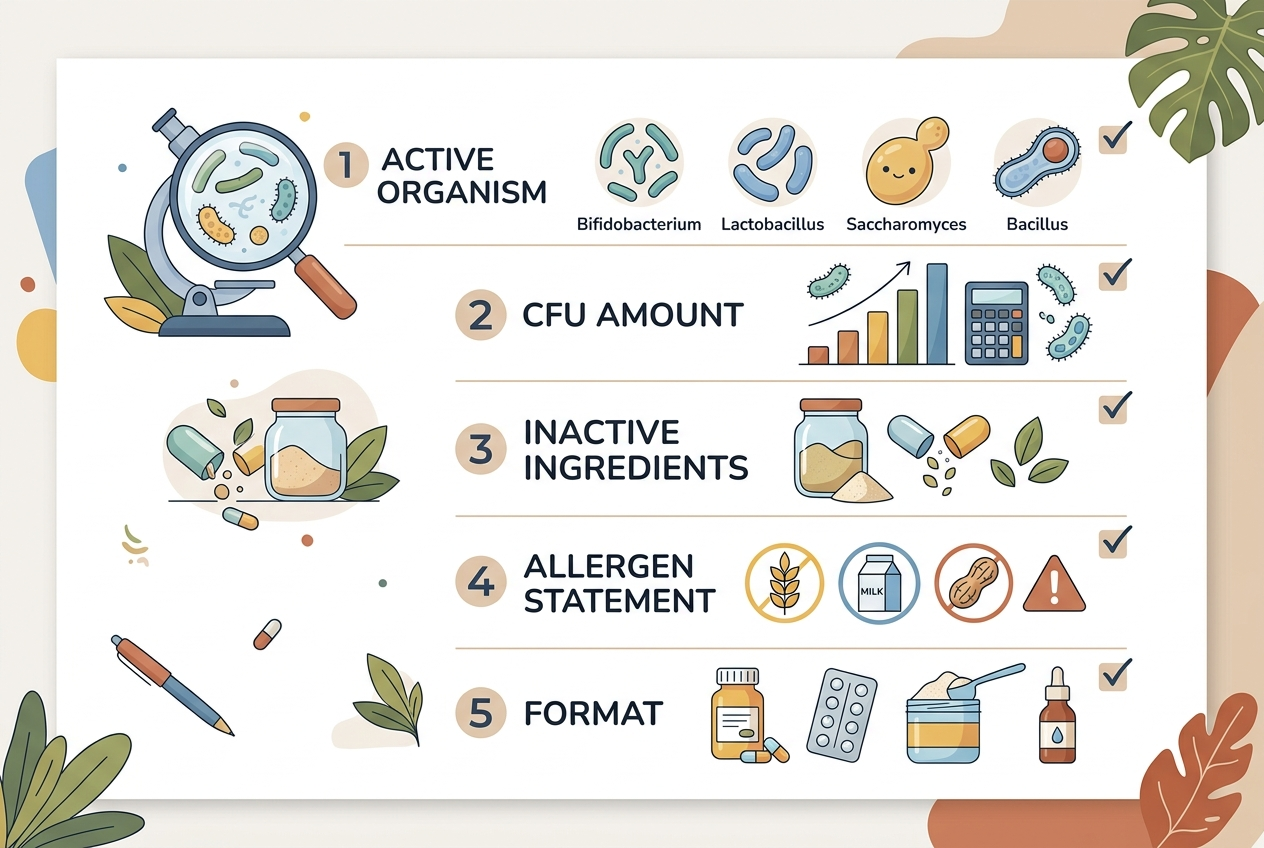
Best for Bifidobacterium-specific interest: Align, because Bifidobacterium 35624 gives the product a defined strain identity and published human research context. Best for Lactobacillus familiarity: Culturelle, because Lactobacillus rhamnosus GG has unusually broad consumer recognition and a clear single-strain positioning. Best for yeast-based probiotic comparison: Florastor, because Saccharomyces boulardii CNCM I-745 is not a bacterial probiotic and may fit people comparing yeast versus bacterial formats; lactose-sensitive users still need to inspect its inactive ingredients. Best for vegan gummy routine fit: Yuve Probiotic Gummies, because Bacillus coagulans, a pectin gummy base, and 5 billion CFU per serving create a capsule-free option for people who prioritize format adherence. Best for the most cautious lactose-intolerant buyer: the product with the clearest dairy-free label, the simplest inactive ingredient list, and the least history of triggering that individual’s symptoms. The best option is personal tolerance plus label clarity, not brand popularity.
What do people get wrong about lactose intolerance and probiotics?
People often treat lactose intolerance as an automatic ban on every product connected to bacteria, fermentation, or dairy-adjacent manufacturing. That shortcut is too broad. Lactose intolerance means the small intestine has limited lactase activity; it does not mean a person reacts to every trace exposure, every capsule, or every probiotic organism. People also confuse lactose intolerance with milk allergy. Milk allergy involves immune reactions to milk proteins, so a “tiny amount” approach is not the right safety frame for someone with a true allergy. Another common mistake is assuming all probiotic strains work the same way. Bifidobacterium 35624, Lactobacillus rhamnosus GG, Saccharomyces boulardii CNCM I-745, and Bacillus coagulans are different organisms with different evidence trails. The final mistake is ignoring inactive ingredients. Lactose, casein, whey, gelatin, inulin, maltitol, and isomalt can matter as much as the active probiotic for a sensitive digestive system.
What are the most common questions about Align and lactose intolerance?
Is Align lactose-free?
Align’s lactose status depends on the exact product and current label. Check the bottle or retailer label for lactose, milk, casein, whey, and “contains milk” language before assuming any Align formula fits a lactose-intolerant routine.
Is lactose intolerance the same as milk allergy?
No. Lactose intolerance is difficulty digesting lactose, while milk allergy is an immune reaction to milk proteins. A person with milk allergy should use stricter allergen guidance than a person with lactose intolerance.
Can a tiny amount of lactose still cause symptoms?
Yes, a tiny amount can bother some people, while others tolerate small exposures. The NIDDK notes that many people with lactose intolerance can consume some lactose, but individual thresholds vary.
Is Culturelle easier than Align for lactose-intolerant users?
Culturelle may be easier for users who want Lactobacillus rhamnosus GG and a label that fits their dairy-avoidance needs. It is not automatically better than Align because strain goal, inactive ingredients, and personal tolerance still control the choice.
Is Florastor a good option if lactose is a concern?
Florastor is worth comparing because Saccharomyces boulardii CNCM I-745 is a probiotic yeast rather than a bacterial strain. Lactose-sensitive users should still check the inactive ingredients because some Florastor formats may include lactose.
Are Yuve Probiotic Gummies relevant if someone is comparing Align?
Yuve Probiotic Gummies are relevant as a format comparison, not as an identical substitute for Align. Yuve uses Bacillus coagulans at 5 billion CFU per serving in a vegan pectin gummy, while Align uses Bifidobacterium 35624 in capsule form.
Should symptoms after a probiotic be blamed on lactose?
Not automatically. Symptoms can relate to lactose, prebiotic fibers, sugar alcohols, dose changes, baseline digestive sensitivity, or the probiotic organism itself. New, severe, or persistent symptoms deserve clinician guidance rather than repeated trial-and-error.
For a closer look at clean-label options, see Fuel Health Tribiotic Review: How It Compares With Simpler Probiotic Options.
For a closer look at clean-label options, see Does Probiotic Strain Matter? How to Compare Yuve, Culturelle, Align, Florastor, and Seed.
What is the bottom line for choosing a probiotic when lactose intolerant?
A lactose-intolerant person can choose a probiotic more safely by ranking label clarity above popularity. Align may fit some people who want Bifidobacterium 35624, but the current ingredient list decides whether it fits a lactose-sensitive routine. Culturelle, Florastor, and Yuve Probiotic Gummies give different comparison anchors: Lactobacillus rhamnosus GG, Saccharomyces boulardii CNCM I-745, and Bacillus coagulans in a vegan gummy format. If the goal is a dairy-free, plant-based daily routine, Yuve’s digestive health collection is a relevant place to compare probiotic gummies with other digestion support supplements. If the goal is strain continuity, stay with the product whose organism matches the evidence you want. If the goal is symptom avoidance, choose the product with the clearest allergen language and the simplest excipient profile. A calm two-week trial after label review is more useful than switching formats every few days.
Leave a Reply