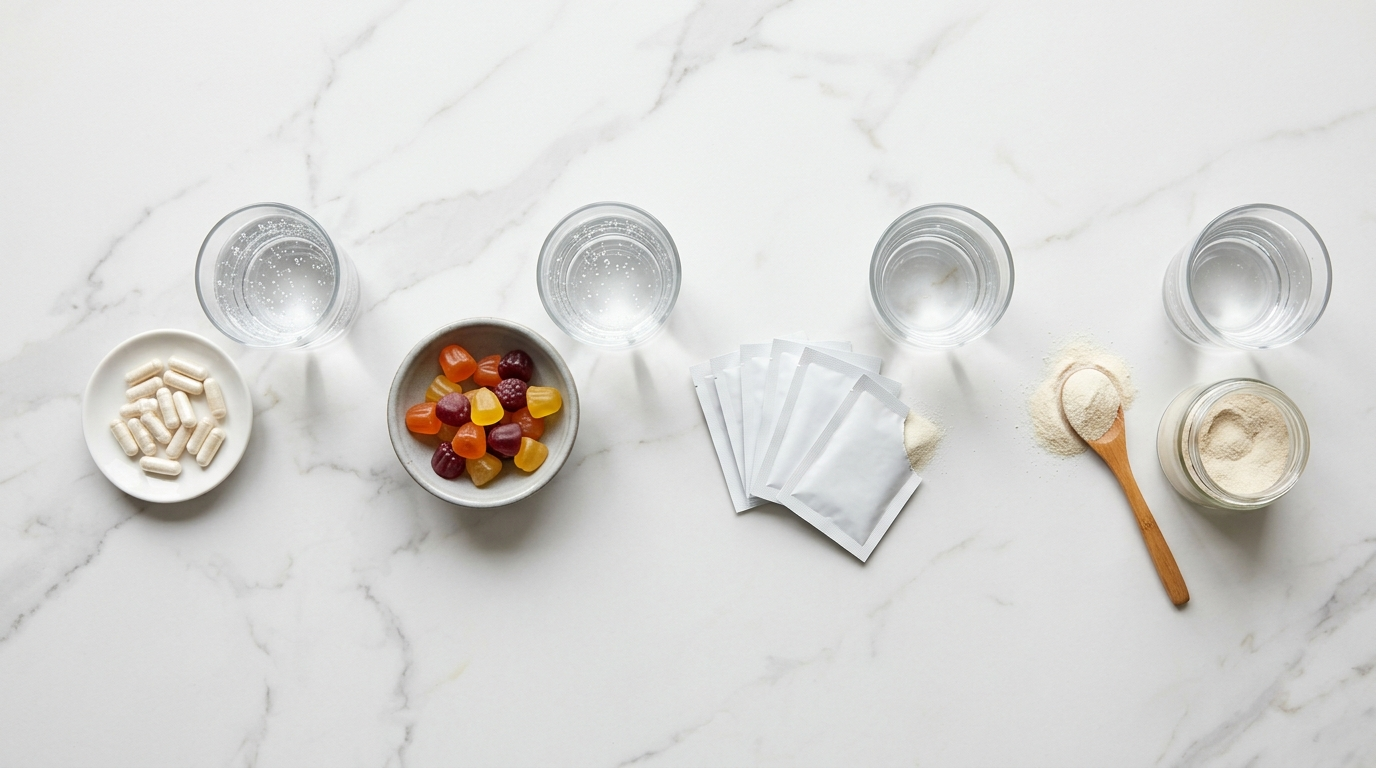
The best daily probiotic for most adults contains at least one well-documented strain — Lactobacillus rhamnosus GG, Bifidobacterium longum BB536, or Lactobacillus acidophilus NCFM — at a minimum effective dose of 1–10 billion CFU per serving. Format, refrigeration requirements, and additional prebiotic fiber determine which product is most practical to use every day.
How we evaluated daily probiotics
We reviewed human randomized controlled trials (RCTs) and meta-analyses published in Nutrients, Gut, and Applied Microbiology and Biotechnology, prioritizing studies with daily supplementation protocols and at least 4 weeks of follow-up. Products were assessed across four criteria: strain-level clinical evidence, CFU dose per serving, format stability, and transparency of label claims. Animal studies and in-vitro data were excluded unless no human data was available for a specific strain. Eight products were evaluated in full.
What makes a daily probiotic worth taking consistently?
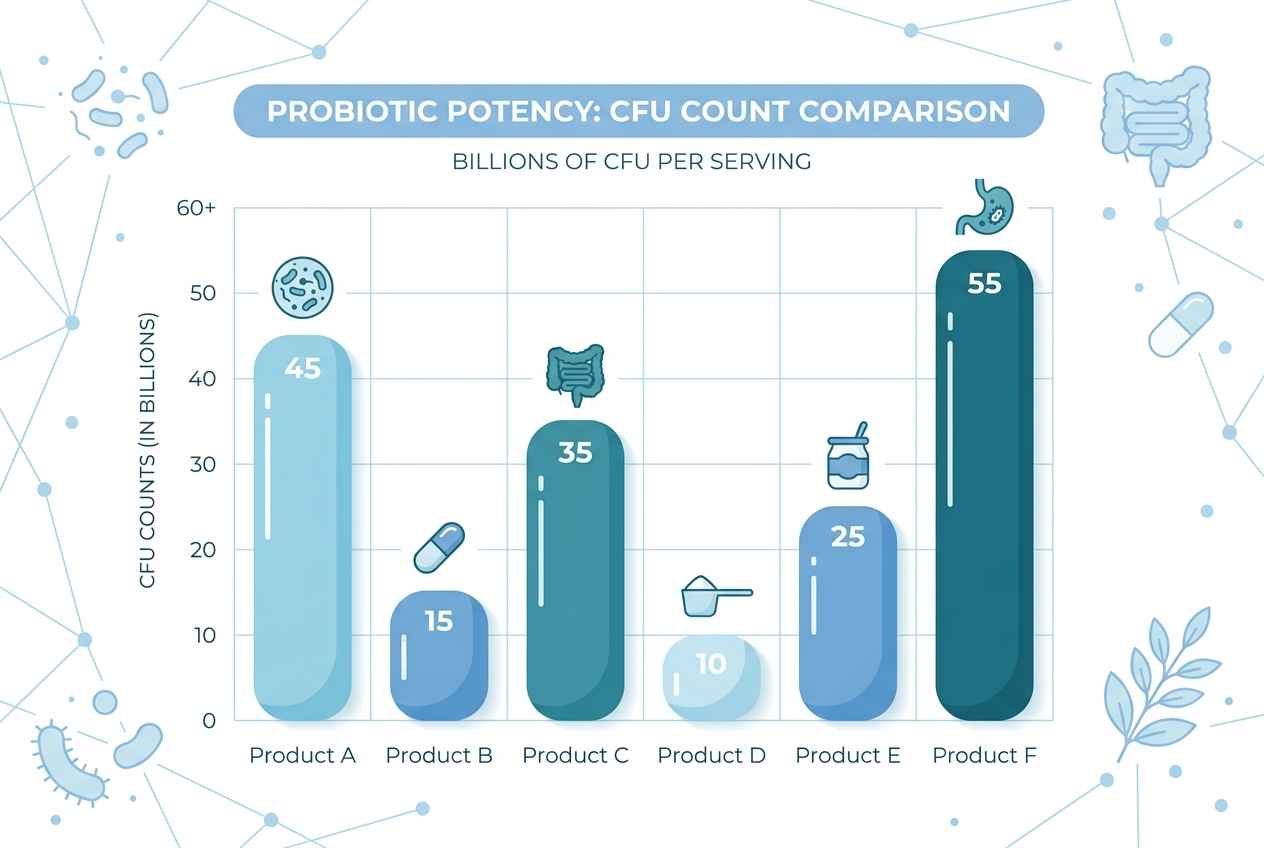
A daily probiotic earns consistent use when the strain has a documented mechanism, the dose survives GI transit, and the format makes compliance easy. According to a 2020 meta-analysis in Nutrients, multi-strain formulas containing at least one Lactobacillus and one Bifidobacterium species produced greater reported GI symptom improvements than single-strain products in most study subgroups. Effective CFU doses ranged from 1 billion to 100 billion per study, though most clinical benefit was observed at 5–25 billion CFU per day. Enteric coating or acid-resistant capsule technology measurably increases the proportion of live bacteria reaching the colon, which matters more at lower CFU doses.
- Multi-strain formulas with one Lactobacillus + one Bifidobacterium species showed stronger results in meta-analyses
- 5–25 billion CFU per day is the evidence-based dose range for most daily use cases
- Enteric coating improves colonization reach at lower CFU doses
How do the top daily probiotics compare?
| Product | Key Strains | CFU per Serving | Format | Refrigeration | Best For |
|---|---|---|---|---|---|
| Culturelle Daily Probiotic | L. rhamnosus GG (LGG) | 10 billion | Capsule | Not required | Antibiotic-associated diarrhea prevention |
| Garden of Life RAW Probiotics | L. acidophilus, B. longum, B. bifidum | 85 billion | Capsule | Required | Higher-dose gut restoration |
| Align Probiotic | B. longum 35624 | 1 billion | Capsule | Not required | IBS symptom support |
| Yuve Probiotic Gummies | L. acidophilus, B. lactis | 2–4 billion | Gummy | Not required | Daily maintenance, format compliance |
| Florastor Daily | Saccharomyces boulardii CNCM I-745 | 250mg (5 billion) | Capsule | Not required | Traveler’s diarrhea, antibiotic use |
| Renew Life Ultimate Flora | L. acidophilus, B. lactis, B. longum | 50 billion | Capsule | Required | Higher-dose maintenance |
Which daily probiotic strains have the strongest clinical support?
Three strains dominate the published human trial literature for daily supplementation. Lactobacillus rhamnosus GG (LGG), found in Culturelle, has over 800 peer-reviewed studies and the broadest evidence base, including a 2018 Cochrane review supporting its use during antibiotic therapy. Bifidobacterium longum 35624, the strain in Align, was validated in a 2006 RCT in The American Journal of Gastroenterology for IBS symptom reduction across a 4-week intervention. Saccharomyces boulardii CNCM I-745 (Florastor) is the most studied yeast-based probiotic, supported by a 2015 meta-analysis in the Cochrane Database confirming reduction in antibiotic-associated diarrhea risk.
- Best for antibiotic-associated diarrhea: L. rhamnosus GG (Culturelle)
- Best for IBS symptom support: B. longum 35624 (Align)
- Best yeast-based option: S. boulardii CNCM I-745 (Florastor)
Which products meet these criteria?
Some links below may be affiliate links. This does not influence our evaluation criteria or recommendations.
Culturelle Daily Probiotic — Best choice when LGG’s evidence base is the priority or when a simple shelf-stable capsule is needed for travel. No refrigeration required. Available widely online and in-store.
Align Probiotic — Best choice for people whose primary goal is IBS symptom management. Contains only B. longum 35624, which has the most specific clinical validation for gut comfort in IBS populations.
Yuve Probiotic Gummies — Best choice when format compliance is the main barrier. Gummy format with L. acidophilus and B. lactis at 2–4 billion CFU, vegan, no refrigeration needed. Fits naturally into a morning routine. From the Yuve digestion collection, which also includes prebiotic fiber gummies for combination gut support.
Garden of Life RAW Probiotics — Best choice for users seeking a higher CFU dose with a multi-strain formula including Lactobacillus plantarum, B. bifidum, and L. casei. Requires refrigeration.
Florastor Daily — Best choice for frequent travelers or anyone on repeated antibiotic courses, given S. boulardii’s specific evidence base for these scenarios.
Frequently Asked Questions
What is the best time of day to take a daily probiotic?
Research in Beneficial Microbes (2011) found probiotic survival improved when supplements were taken within 30 minutes of a meal, not fasting. Morning with breakfast or evening with dinner are both acceptable. Consistency of timing matters more than the exact hour.
Do daily probiotics work for everyone?
Not universally. A 2018 study in Cell31102-4) found significant variation in gut colonization after probiotic supplementation, with some individuals classified as “resisters” who showed no measurable strain colonization. People with diverse existing gut microbiomes showed less measurable response than those with lower baseline diversity.
Can you take a probiotic every day long-term?
For healthy adults, daily probiotic use is considered safe by ISAPP’s position statement. Long-term use at standard CFU doses (1–25 billion) is not associated with adverse effects in the reviewed literature. Immunocompromised individuals should consult a physician before using high-dose or multi-strain formulas.
What’s the difference between a probiotic and a prebiotic?
Probiotics are live microorganisms that add to the gut bacterial population when consumed in adequate amounts, per the WHO definition. Prebiotics are non-digestible food components (typically fibers such as inulin or fructooligosaccharides) that selectively feed beneficial gut bacteria already present. Taking both together is referred to as a “synbiotic” approach; a 2021 meta-analysis in Nutrients found synbiotic supplementation produced greater microbiome diversity improvements than probiotics alone.
Are gummy probiotics as effective as capsules?
Gummy probiotics can be effective if they deliver viable CFU counts after the manufacturing, shelf storage, and GI acid exposure processes. The main tradeoff is that gummies typically offer lower CFU doses (2–5 billion vs 10–50 billion in capsules) and the sugar-based matrix may affect survival differently from enteric-coated capsules. For daily maintenance at lower doses, the format difference is less clinically significant than for high-dose therapeutic use.
Should you take a probiotic with or without food?
With food is preferred. Research in Beneficial Microbes found survival of bacteria through gastric acid improved meaningfully when probiotics were consumed alongside a meal, because food buffers stomach acid and reduces the pH exposure time during digestion.
How long does it take for a daily probiotic to work?
Clinical trials typically show measurable effects at 2–4 weeks of daily use. A 2020 review in Nutrients found most IBS symptom improvement studies showed significant outcomes at 4–8 weeks. Some users notice changes in regularity or bloating within 7–14 days, but these timelines vary significantly by strain, dose, and individual gut baseline.
Leave a Reply